Calathea
Goeppertia roseopicta (rose-painted calathea)
Formerly Calathea roseopicta
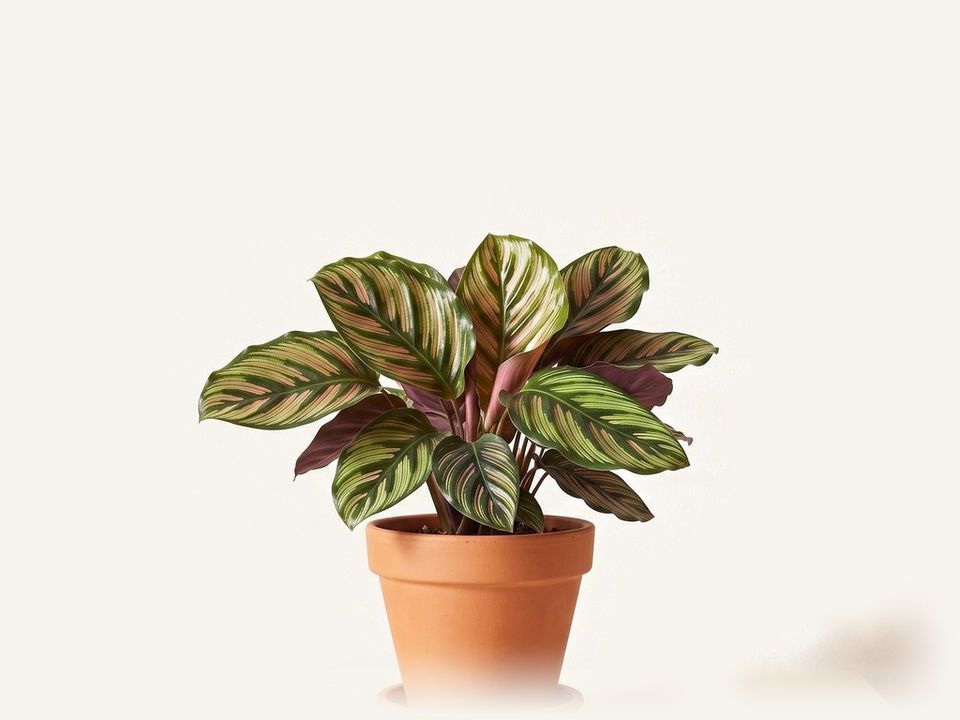
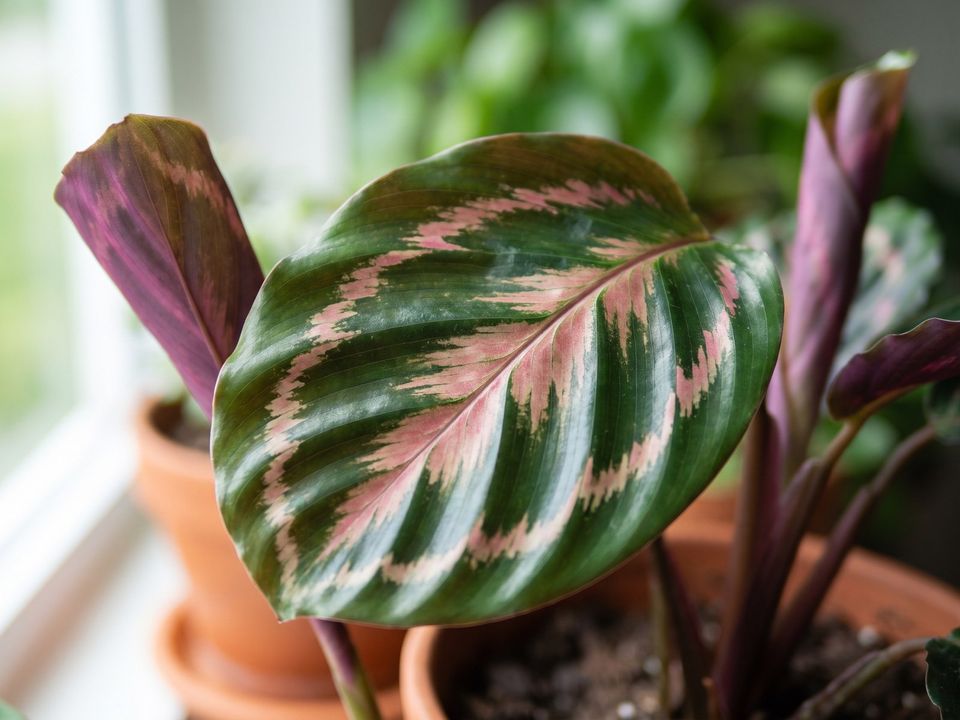
Broad, glossy oval leaves brushed pink and cream on deep green, purple underneath. Known for folding up at night, and for fussiness about water and air.
1.8/5
how easy it is to care for
2.8/5
how much it stands out visually
: Bright shade
Right by a north window or back from a brighter one
Right by a north window, or a few feet back from an east, south or west one, out of the sun’s beam. Farther back it copes, though the pink and cream markings fade; sun on the leaves burns the tips.
Too little light and the pink and cream markings fade (NC State Extension); too much, and the leaf tips burn, which UF/IFAS growers see in strong light too.
An east or north window is the spot, or a few feet back from a south or west one.
: Weekly+
Evenly damp soil: every 4-7 days, 6-10 in winter
Evenly damp is the goal: every 4-7 days in summer and 6-10 in winter, with just the surface drying between. Rain or distilled water spares the edges the browning that fluoride in tap water can cause.
Water until it runs out the bottom, then empty the saucer; soggy soil rots the roots. Don’t let it dry out completely: by the next soak just the surface should feel dry, which takes 5-7 days in most rooms. Water at the soil, not over the leaves, which invites leaf spot. A pitcher filter doesn’t take fluoride out; rain, distilled, or reverse-osmosis water is fluoride-free.
Gone for a while? A week is the most it takes: soak it the day you leave and move it a little farther from the window.
: Small
A bushy clump 1-1.5 feet tall and about as wide
A compact, bushy clump that reaches 1-1.5 feet tall and about as wide, its broad leaves held up on slender stalks. New leaves unroll from the center in spring and summer; growth all but stops in winter.
Growth is moderate: new leaves unroll from the center through spring and summer. Cut a brown or tired leaf off at the base; there’s nothing else to prune.
: Pet & kid safe
Nothing harmful for dogs, cats, or kids
- DogsSafe
- CatsSafe
- KidsSafe
The ASPCA lists calatheas as non-toxic to dogs and cats, and they’re on the University of California’s safe-plant list for kids. A big chew can upset a stomach, as any plant can, but there’s nothing harmful in it.
Kids too: it’s on the University of California’s safe-plant list. The ASPCA notes that eating any plant can upset a pet’s stomach, so a big chew may still mean some vomiting, but the plant isn’t poisonous.
- ASPCA: safe for dogs (rates the whole genus).
- ASPCA: safe for cats (rates the whole genus).
- UC ANR: safe for kids.
Cats and dogs: The ASPCA lists it as non-toxic.
Kids: No poison-centre listing; rated from university extension sources. Care note: sap can irritate skin (NC State).
: Average
Warm and humid; dry winter heat crisps its edges
Warm, humid rooms suit it: 65-75°F and no colder than 60°F, with humidity over 60%, though it gets by at 45%. Dry winter heat crisps the edges; a humidifier nearby or a bright bathroom helps.
- Temperature
- 65-75°F
- Humidity
- 45%+
: Spider mites, mealybugs
Spider mites in dry air; mealybugs at the stalks
Dry winter air brings spider mites, which leave the leaves dull and speckled with fine webbing below. Mealybugs look like white cotton where stalks meet, scale like brown bumps on them; thrips visit too.
- Spider mites
- Mealybugs
- Thrips
- Scale
More than most. Spider mites love it, especially in dry winter air, and NC State also lists mealybugs, aphids, and scale.
Spider mites leave the leaves dull and speckled, with fine webbing underneath. Rinse the whole plant in the shower, undersides of the leaves included, and raise the humidity; insecticidal soap is the next step.
Mealybugs look like white cotton where the leaf stalks meet; scale, like small brown bumps on the stalks; aphids, like small soft bugs on new leaves. Wipe them off with a cotton swab dipped in rubbing alcohol, then check again next week.
Root rot comes from soggy soil, and leaf spot from wetting the leaves when you water (NC State). Empty the saucer and water at the soil.
: Most
Monthly feeds, leaf trims, and a jug of distilled water
Feeds come monthly from spring through summer, and the leaves want a wipe and a trim of crisped edges every couple of months. Keep a jug of rain or distilled water filled; repotting comes about every 2 years.
- Feed monthly in season6× a year
- Wipe leaves6× a year
- Trim crisped leaves6× a year
- Special water: rain or distilled (refill jug)12× a year
- Repotevery 2 years
A pot with a drainage hole and a peaty potting mix that holds moisture but still drains fast (NC State).
Repot when it fills the pot, in spring, one pot size up; that’s also the time to divide it (see Propagation).
Food is optional: a houseplant fertilizer once a month from spring through summer (NC State), and none in winter.
: Showy
Pink and cream brushwork on deep green, purple below
Pink and cream brush strokes cross deep green on oval leaves about 8 inches long, purple underneath, with a soft satin sheen. They fold up each evening, and the clump hides only part of the soil.
Where to find me
Not at PILF places
Fun fact
Its leaves fold up every evening and open again in the morning, cued by changes in light and temperature.
Designer tips
Painterly and a little dramatic, it suits a calm room where it can be seen up close.
Troubleshooting
The leaf edges are turning brown and crispy
Dry air or tap water, most often: NC State points to low humidity and the fluoride in tap water. If it bothers you, rain or distilled water and a humidifier nearby help, and the brown edges trim off along the leaf’s shape; the plant carries on either way.
Why are the leaves curling in the daytime?
Thirst or dry air; NC State names both. If its last drink was a while ago, a good soak is the likely fix; if it was watered recently, the air is probably too dry, and a humidifier nearby helps.
Why are the lower leaves turning yellow?
Usually soggy soil. Empty the saucer and give it a little longer between drinks, so just the surface dries; an old leaf yellowing now and then is normal and can be cut off at the base.
See all 9
The leaves fold up every evening
That’s normal. Like others in the prayer plant family, it folds its leaves up at dusk and opens them again in the morning, cued by changes in light and temperature.
Why are the pink markings fading?
Too little light, most likely (NC State); nearer a north window, or a few feet back from a brighter one, new leaves tend to keep their color. Burnt tips point the other way, to too much sun.
The leaves look dull and speckled
Likely spider mites, which love it in dry winter air; look for fine webbing under the leaves. A rinse in the shower, undersides included, and more humidity usually knock them back, with insecticidal soap as the next step.
Why does it struggle every winter?
Dry heated air. NC State wants its humidity above 60%, and a heated apartment in January usually runs well below that; a humidifier nearby and a spot away from vents help it through.
I’m going away for a week
A week is about its limit. Soak it the day you leave and move it a little farther from the window, and it usually holds until you’re back.
Is it safe for my cat or dog?
Yes. The ASPCA lists calatheas as non-toxic to cats and dogs, and the University of California has them on its safe list for kids; a big chew can still upset a stomach, as any plant can.
Propagation
By division, in spring when you repot.
- Ease it out of the pot and pull or cut the clump apart at the roots, keeping several leaves and a good piece of root on each division.
- Pot them up, keep them evenly moist, and give them a humid spot out of bright light while they settle in; UF/IFAS growers use mist and lower light at this stage.
The PILF Matrix
1.8/5
how easy it is to care for
2.8/5
how much it stands out visually
“The one that rolls its leaves at your tap water.”

EASE
1.7/5
how easy it is to care for
PRESENCE
2.7/5
how much it stands out visually
BrightSoak weekly+Small sizePet & kid safe

EASE
2.2/5
how easy it is to care for
PRESENCE
2.7/5
how much it stands out visually
BrightSoak weekly+Small sizePet & kid safe

EASE
1.6/5
how easy it is to care for
PRESENCE
2.8/5
how much it stands out visually
BrightSoak weekly+Medium sizePet & kid safe
Where it sits and what sun touches it.
- Dim shadeA dark corner or a windowless room; natural light casts no shadow
- Bright shadeBack from the window in a south-, east- or west-facing room, or right by a north-facing one, where only low early or late summer sun reaches it
- Filtered sunBehind a sheer curtain or tinted glass; the sun’s shadows are blurred
- Partial sunIn an east- or west-facing window: up to a few hours of direct sun
- Full sunThe sunniest spot you have, usually a south-facing window, with direct sun 6+ hours a day
How often, and what the soil does between.
- MonthlyEvery 2-3 weeks in summer and 3-5 in winter; the soil dries all the way between
- 2-3× a monthEvery 7-14 days in summer, longer in winter; the top of the soil dries between
- Weekly+About every 4-8 days in summer; the soil stays lightly damp
How much room it usually takes indoors.
Size
- TinyUnder 6 inches tall or wide; for a desk or a sill
- Small6 inches to 1.5 feet tall or wide; for a shelf or a sill
- Medium1.5 to 3 feet tall or wide; for a table or a stand
- Large3 to 6 feet tall or wide; for the floor
- GiantOver 6 feet tall or wide; a statement in the corner
Shape
- TreeA trunk that branches into a canopy
- CaneBare stalks topped with leaves
- UprightStiff stems or leaves rising straight from the soil
- FountainLeaves or fronds arching out from the center
- BushyA full, rounded mound of leaves
- RosetteLeaves radiating from one low point
- ViningTrails, climbs, or both
Growth
How fast it gets there.
- SlowUnder 6 inches of new growth a year
- Moderate6-12 inches a year, mostly in spring and summer
- FastOver 12 inches a year; it may want trimming or training
What risks exist for pets and kids.
- Pet & kid safeNothing to worry about
- Mildly irritatingMay irritate the mouth or stomach if chewed, or for some plants, the skin if handled
- Moderately toxicCan cause illness if eaten, though typically not serious or fatal
- DangerousCan cause serious illness if eaten, including some reports of death
- Not yet ratedNot clearly rated by our sources; please check with your vet or doctor
For its safety ratings, PILF relies on research and guidance from leading sources, including the ASPCA, Pet Poison Helpline, Merck Veterinary Manual, Poison Control, and Children’s Hospital of Philadelphia, and others.
The small jobs beyond watering, over a year.
- Little upkeepA few small jobs a year beyond watering, like a feed now and then
- Some upkeepA small job about once a month beyond watering, like feeding or turning it
- More upkeepA small job every couple of weeks beyond watering, like a wipe, a turn, or a feed
- Most upkeepA small job most weeks beyond watering, like raising the humidity or misting
- TreeA trunk that branches into a canopy
- CaneBare stalks topped with leaves
- UprightStiff stems or leaves rising straight from the soil
- FountainLeaves or fronds arching out from the center
- BushyA full, rounded mound of leaves
- RosetteLeaves radiating from one low point
- ViningTrails, climbs, or both
How fast it gets there.
- SlowUnder 6 inches of new growth a year
- Moderate6-12 inches a year, mostly in spring and summer
- FastOver 12 inches a year; it may want trimming or training
The temperature and humidity it’s comfortable in.
How dry a room it takes.
- Needs 50%+ humidity
- Fine at 35% humidity
- Fine at 15-20% humidity
The bugs that usually find it, by name.
How often pests find it.
- 5+ regular pests
- 3 regular pests
- Pests are rare
The year’s chores: feeding, pruning, repotting, and cleaning.
Chores beyond water.
- Most upkeep
- Some upkeep
- Little upkeep
Its finish, fullness, and texture.
Color, pattern, and flowers.
- SimpleOne green, one texture, nothing to read
- SuaveA sheen, a stripe, or a clean shape that catches the eye up close
- ShowyColor, pattern, or blooms you see from across the room
How striking the leaf’s surface is up close.
- PlainFlat and matte
- SatinA sheen or a light texture
- StrikingGloss, wax, or velvet
How much of its own outline is leaves.
- AiryYou see through it
- MediumSome gaps
- DenseYou can’t see through it