Aloe Vera
Aloe vera
Also called medicinal aloe
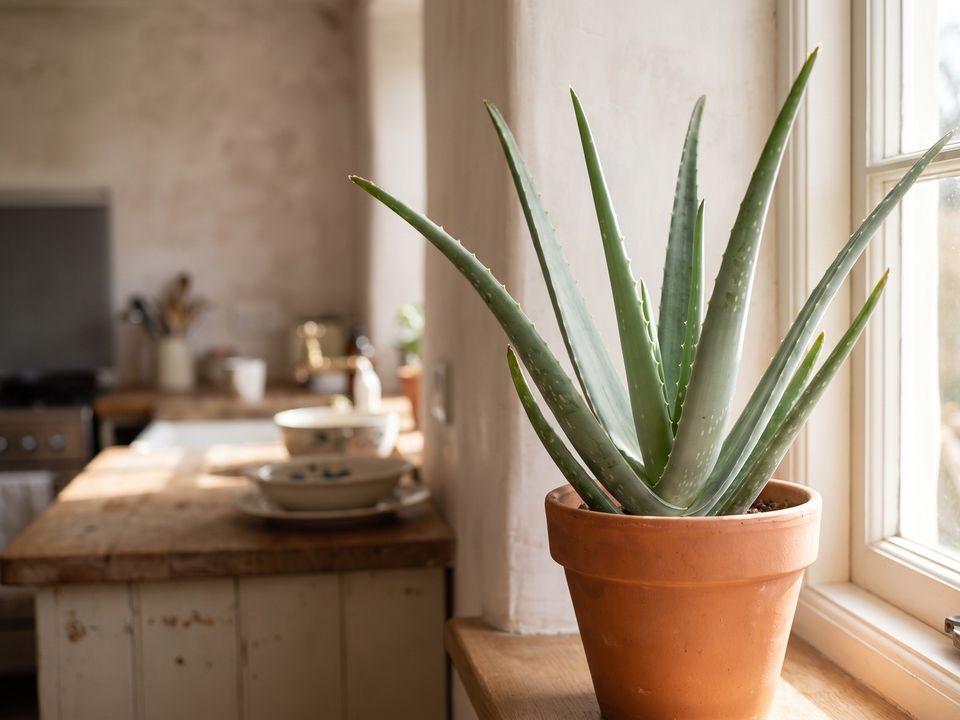
Fleshy, gray-green spears rimmed in small teeth fan out from the soil. A sunny window and a rare drink are all it asks.
3.9/5
how easy it is to care for
2.9/5
how much it stands out visually
: Shade to full sun
Sun to part shade: a sunny window or a bright room
Hours of sun on its leaves in a south or west window keep its gray-green color strong and give a mature plant its best shot at blooming. Set back from the glass, bright but sunless, it gets by.
An east window, with its morning sun, still sits within what it handles: NC State counts 2-6 hours as workable partial sun.
Penn State ties its color to sun, so a dull, faded rosette likely wants a sunnier seat. In a dim winter, a grow light can make up the missing hours (Penn State Extension).
It can’t take frost (Penn State Extension), so a summer outdoors ends before the first cold night; NC State suggests starting it out there in partial sun. Its wild home is the sun-baked Hajar Mountains of northern Oman (POWO), so a sunny window is the closest thing to home you can offer it.
: Monthly
Shrugs off drought; soggy soil is what does it in
A soak every 2-3 weeks in summer and every 3-5 weeks in winter, with the soil drying to the bottom of the pot between. A forgotten drink costs it little; too many can rot the roots.
Its leaves already carry the water it lives on, so what the roots want is soil that dries fast. NC State calls a clay pot with several drainage holes the best home for it, and Penn State Extension suggests either a cactus and succulent blend or equal parts potting soil, sand and perlite.
That pairing does the patient work for you: clay breathes moisture off the sides, and grit keeps water from pooling around those thick roots between your long-spaced soaks.
Gone for a while? A month is fine if it’s watered the day you leave; its leaves hold water for the dry spell.
: Small
A toothed rosette, about 1-2 feet tall and wide
Thick, toothed leaves fan up and out from a low center, 1-2 feet tall and wide. Set it on a sunlit sill or stand in a wide clay pot, and lift out the pups crowding its base to give them pots of their own.
Each leaf can run up to 18 inches (NC State), rising from a stem so short and stout it stays hidden under the rosette. Seen from above, that starburst shows best: a deep sill, a side table by a sunny window, a low shelf at hip height.
When it moves up a pot, about every two years, Penn State Extension suggests leaving 1-1.5 inches between root ball and rim, and setting the plant so its lowest leaves sit just above the soil rather than buried in it.
: Mildly irritating
Chewing can upset the stomachs of dogs, cats, or kids
- DogsMildly irritating
- CatsMildly irritating
- KidsMildly irritating
The ASPCA notes a chewed leaf may bring vomiting, lethargy, or diarrhea in dogs and cats. For kids, NC State lists cramps and diarrhea; the laxative sits in the yellow latex, not the clear gel.
The clear gel is considered edible; it’s the yellow latex just under the leaf’s skin that acts as a strong laxative.
Aloin, one of the plant’s anthraquinone glycosides (Pet Poison Helpline), is what gives a nibbler’s gut a rough day, one that usually passes on its own. Saponins are in the mix too (ASPCA). NC State lists abdominal cramps, diarrhea, and red urine, and rates the overall severity low.
If you use the gel on skin, cut away the outer leaf, keep only the gel, and test a small patch first, since the latex can irritate skin (NC State).
Most nibbles settle at home. If symptoms don’t settle or anything worries you, call your vet or the ASPCA Animal Poison Control Center (a fee may apply); for a child, Poison Control.
With a nibbler at home, give it the sunny window in a room they rarely visit, and pick up any broken leaf rather than leaving it on the floor.
- ASPCA: mild for dogs.
- Merck Veterinary Manual: toxic for dogs (rates the whole genus).
- Pet Poison Helpline: mild for dogs.
- ASPCA: mild for cats.
- Merck Veterinary Manual: toxic for cats (rates the whole genus).
- Pet Poison Helpline: mild for cats.
- NC State Extension: mild for kids.
Cats and dogs: Most of the leading sources agree.
Kids: No poison-centre listing; rated from university extension sources.
: Dry OK
66-81°F; dry air is fine
Happiest at 66-81°F, and it shouldn’t sit below 50°F. Humidity can drop to 10% without trouble.
- Temperature
- 66-81°F
: Mealybugs
Mealybugs, scale, aphids; check bases and the center
Mealybugs are the common guest, tucked into the leaf bases and the middle of the rosette. Scale can settle on leaf surfaces and bases, and aphids favor new center leaves and flower stalks.
- Mealybugs
- Scale
- Aphids
Not many. Mealybugs and scale turn up now and then, and root rot if the soil stays wet.
Mealybugs look like tufts of white cotton tucked where the leaves meet; scale looks like small brown bumps stuck to the leaves. Wipe them off with a cotton swab dipped in rubbing alcohol (a fingernail lifts scale), then check again next week.
Root rot shows as leaves going soft and mushy from the base up. SDSU Extension says there’s no cure once it’s advanced, so catch it early: let the pot dry out completely and water less often. If the base is gone, pot up a healthy pup and start again.
Brown or rusty spots on the leaves are aloe rust or another leaf fungus, which cool, damp air brings on. Cut off the worst leaves at the base and keep water off the leaves.
: Some
Feed monthly April-September; repot when roots fill pot
Feed once a month from April through September, and not in winter. Lift out offsets with roots attached when they appear, and repot slightly larger when roots fill the pot. Remove dried lower leaves any time.
- Feed6× a year
- Repot1× a year
- Divide1× a year
- Clean leaves1× a year
A gritty cactus mix that drains fast, in a pot with a drainage hole. Clay pots are best (per NC State Extension).
Repot every two years, into a pot only slightly bigger; UF/IFAS warns that too big a pot holds water that rots the roots. Spring or summer is the time, and the pups can come off then (see Propagation).
Food is optional: SDSU Extension says it usually needs none. If you like, a cactus fertilizer once a month in summer is plenty; don’t feed it in winter.
: Suave
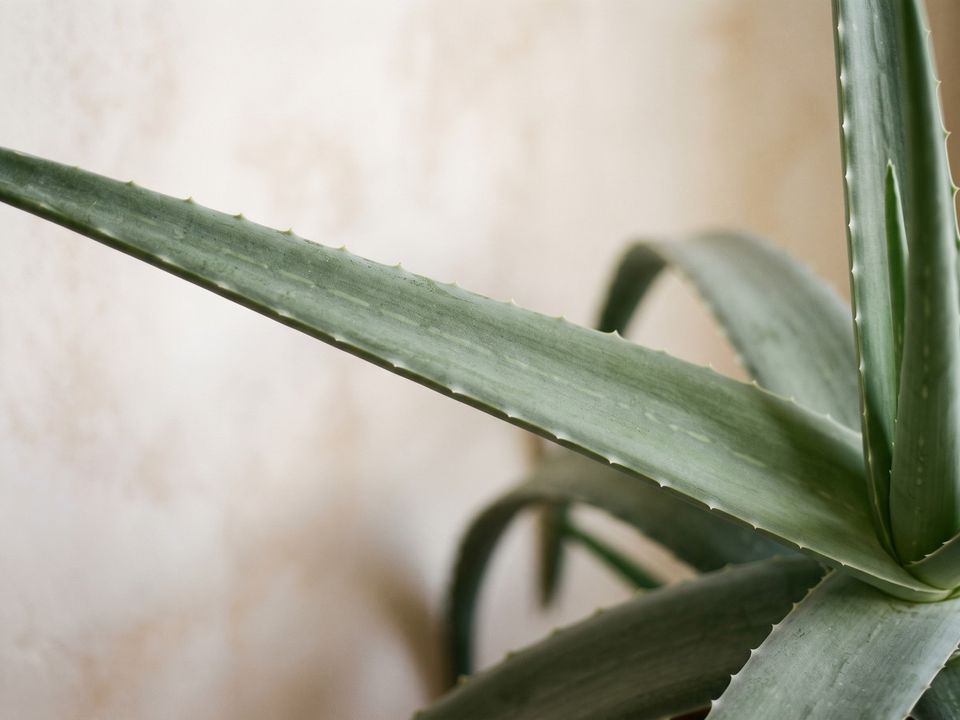
Gray-green toothed spears with a faint sheen
Fleshy gray-green spears fan out from the center, each edge lined with small teeth. The skin is smooth and slightly glossy, and the leaves leave part of the soil showing.
Where to find me
Not yet pilferableFun fact
Its name stacks two old words: aloe likely comes from an Arabic word for a bitter, shiny substance, and vera is Latin for true. Hence its other name, true aloe.
Designer tips
Sculptural and desert-modern, it looks best on a sunny sill in a plain clay or concrete pot.
Troubleshooting
Leaves are going soft and mushy at the base
Most likely too much water, with the roots starting to rot. Let the pot dry out completely and cut off any leaf that’s gone to mush; if the whole base is soft, a healthy pup in a pot of its own is the fresh start.
The leaves are thin and puckered
It’s thirsty: the leaves store water and shrink and pucker as they use it up (SDSU Extension). A good soak usually plumps them again.
The leaves are flopping over
Likely too little light: in a dim spot aloe grows leggy and its leaves droop. Your sunniest window helps new leaves come in sturdier, though the floppy ones stay as they are.
See all 9
My dog chewed a leaf
It’s mildly irritating: the ASPCA lists vomiting, lethargy, and diarrhea in dogs and cats, from the yellow latex under the skin, and it usually passes on its own. If your pet ate a lot or seems unwell, call your vet or the ASPCA Animal Poison Control Center.
Why did the leaves turn brown or reddish after a move?
Usually sunburn from a sudden jump into strong sun, which UF/IFAS warns about. Bring it back a step and add sun gradually; the marked leaves stay marked, and new ones come in clean.
What are the little plants around the base?
Pups: baby aloes growing from the mother’s roots. Leave them for a fuller clump, or once one has several leaves, ease it away with some roots attached and give it a small pot of cactus mix.
Can I use the gel on a burn?
For a minor burn or sunburn, yes: NC State Extension says the gel is safe on the skin for most people. Wipe away the yellow latex at the cut first, since it can irritate skin, and take a lower leaf; it doesn’t grow back.
Will it flower?
Rarely indoors: NC State says it blooms only once it’s 3 or more years old, with about 6 hours of sun a day. If it does, a tall stalk of tubular yellow to orange flowers rises from the center.
Can it go outside for the summer?
Yes, and it likes it. Start it in partial shade and move it into more sun gradually so it doesn’t burn, then bring it in before the first cold fall night; it can’t take frost.
Propagation
Yes, from its pups: the small plants that come up around the base.
- When a pup has several leaves of its own, ease the plant out of its pot and pull or cut the pup away with some roots attached.
- Pot it in its own small pot of cactus mix; it settles in and starts growing in a few weeks.
The PILF Matrix
3.9/5
how easy it is to care for
2.9/5
how much it stands out visually
“The one you only remember after a sunburn.”

EASE
3.9/5
how easy it is to care for
PRESENCE
2.7/5
how much it stands out visually
Dim to brightSoak monthlySmall sizePet & kid safe

EASE
3.8/5
how easy it is to care for
PRESENCE
1.5/5
how much it stands out visually
Shade to full sunSoak monthlySmall sizeMildly irritating

EASE
3.9/5
how easy it is to care for
PRESENCE
1.4/5
how much it stands out visually
Shade to part sunSoak 2-3× a monthMedium sizePet & kid safe
Where it sits and what sun touches it.
- Dim shadeA dark corner or a windowless room; natural light casts no shadow
- Bright shadeBack from the window in a south-, east- or west-facing room, or right by a north-facing one, where only low early or late summer sun reaches it
- Filtered sunBehind a sheer curtain or tinted glass; the sun’s shadows are blurred
- Partial sunIn an east- or west-facing window: up to a few hours of direct sun
- Full sunThe sunniest spot you have, usually a south-facing window, with direct sun 6+ hours a day
How often, and what the soil does between.
- MonthlyEvery 2-3 weeks in summer and 3-5 in winter; the soil dries all the way between
- 2-3× a monthEvery 7-14 days in summer, longer in winter; the top of the soil dries between
- Weekly+About every 4-8 days in summer; the soil stays lightly damp
How much room it usually takes indoors.
Size
- TinyUnder 6 inches tall or wide; for a desk or a sill
- Small6 inches to 1.5 feet tall or wide; for a shelf or a sill
- Medium1.5 to 3 feet tall or wide; for a table or a stand
- Large3 to 6 feet tall or wide; for the floor
- GiantOver 6 feet tall or wide; a statement in the corner
Shape
- TreeA trunk that branches into a canopy
- CaneBare stalks topped with leaves
- UprightStiff stems or leaves rising straight from the soil
- FountainLeaves or fronds arching out from the center
- BushyA full, rounded mound of leaves
- RosetteLeaves radiating from one low point
- ViningTrails, climbs, or both
Growth
How fast it gets there.
- SlowUnder 6 inches of new growth a year
- Moderate6-12 inches a year, mostly in spring and summer
- FastOver 12 inches a year; it may want trimming or training
What risks exist for pets and kids.
- Pet & kid safeNothing to worry about
- Mildly irritatingMay irritate the mouth or stomach if chewed, or for some plants, the skin if handled
- Moderately toxicCan cause illness if eaten, though typically not serious or fatal
- DangerousCan cause serious illness if eaten, including some reports of death
- Not yet ratedNot clearly rated by our sources; please check with your vet or doctor
For its safety ratings, PILF relies on research and guidance from leading sources, including the ASPCA, Pet Poison Helpline, Merck Veterinary Manual, Poison Control, and Children’s Hospital of Philadelphia, and others.
The small jobs beyond watering, over a year.
- Little upkeepA few small jobs a year beyond watering, like a feed now and then
- Some upkeepA small job about once a month beyond watering, like feeding or turning it
- More upkeepA small job every couple of weeks beyond watering, like a wipe, a turn, or a feed
- Most upkeepA small job most weeks beyond watering, like raising the humidity or misting
- TreeA trunk that branches into a canopy
- CaneBare stalks topped with leaves
- UprightStiff stems or leaves rising straight from the soil
- FountainLeaves or fronds arching out from the center
- BushyA full, rounded mound of leaves
- RosetteLeaves radiating from one low point
- ViningTrails, climbs, or both
How fast it gets there.
- SlowUnder 6 inches of new growth a year
- Moderate6-12 inches a year, mostly in spring and summer
- FastOver 12 inches a year; it may want trimming or training
The temperature and humidity it’s comfortable in.
How dry a room it takes.
- Needs 50%+ humidity
- Fine at 35% humidity
- Fine at 15-20% humidity
The bugs that usually find it, by name.
How often pests find it.
- 5+ regular pests
- 3 regular pests
- Pests are rare
The year’s chores: feeding, pruning, repotting, and cleaning.
Chores beyond water.
- Most upkeep
- Some upkeep
- Little upkeep
Its finish, fullness, and texture.
Color, pattern, and flowers.
- SimpleOne green, one texture, nothing to read
- SuaveA sheen, a stripe, or a clean shape that catches the eye up close
- ShowyColor, pattern, or blooms you see from across the room
How the leaves catch light.
- Matte
- Satin
- Glossy or waxy
How much it fills its pot.
- Soil shows
- Soil partly hidden
- Leaves hide the soil