Arrowhead Plant
Syngonium podophyllum
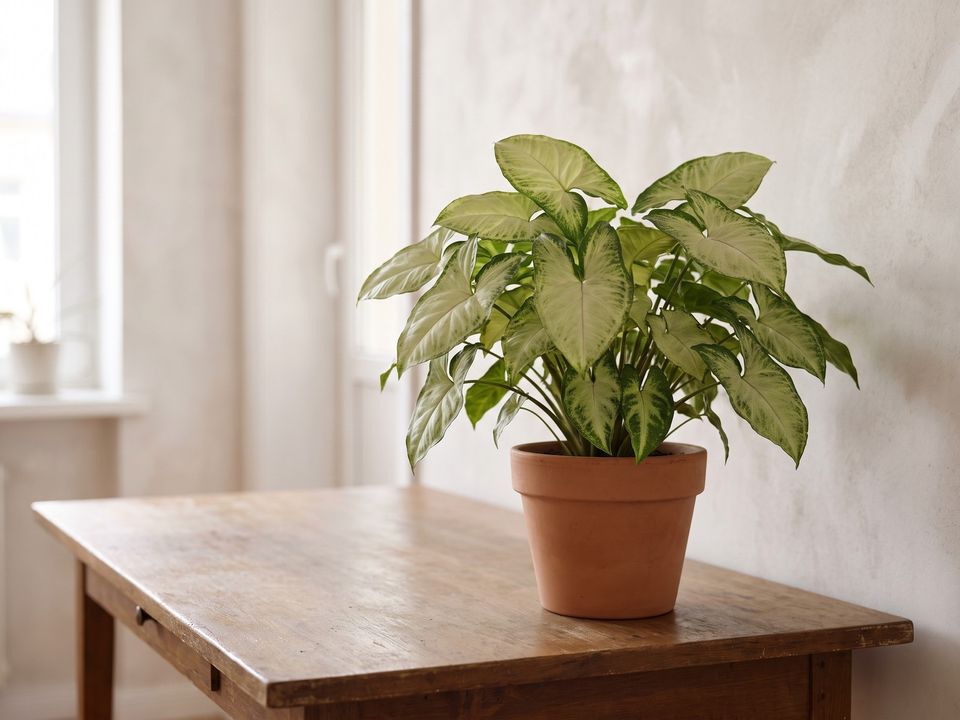
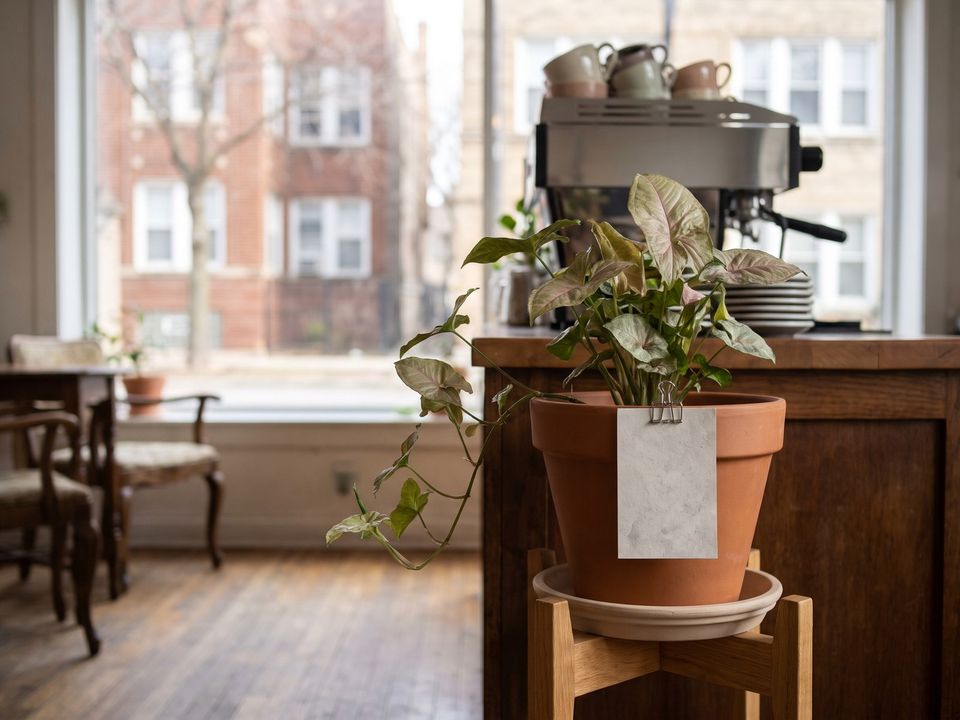
Arrow-shaped leaves washed in pink or silver, on stems that bush up, then wander. Grows fast and changes as it does.
2.5/5
how easy it is to care for
3.6/5
how much it stands out visually
: Dim to bright
A few feet back from a window suits it; sun bleaches it
Its best spot is near a bright window, in steady light kept off the leaves themselves. It gets by in a dark corner too, but direct sun can burn or bleach the foliage.
Every Syngonium is a hemiepiphyte from the moist, elevated forests between Mexico and Brazil (UF/IFAS): it sprouts under the canopy, then climbs toward the light. Indoors it’s rated for low light (Texas A&M), so a dimmer spot won’t break it. It does best between 250 and 1,000 foot-candles, a range that covers medium light (UF/IFAS).
A north-facing window works, or a spot back from an east one; in a south- or west-facing room, the far wall or a sheer curtain keeps the sun off. Pale, washed-out patches on the leaves may mean it’s catching more sun than it likes.
Given a pole or a trellis, it heads upward on its own, the forest climber still in it. Offer it medium light, and let it go looking for more.
: Weekly+
About every 5-8 days in summer, the surface drying between
About every 5-8 days in summer and 7-12 in winter, with the surface drying slightly between. It likes the mix never to dry out completely, even through the cooler months.
Its tolerance for wet runs surprisingly deep: in Florida it grows in forested wetlands and rides out seasonal flooding (UF/IFAS). Still, NC State lists soft rot among its problems, so give it a pot with a drainage hole.
That swampy streak shows in what it likes overhead, too: NC State calls a warm, humid setting ideal. If leaf edges crisp during furnace season and that bothers you, a bathroom with a window may suit it. It survives either way.
Gone for a while? Ten days is fine if you soak it the day you leave. Any longer, ask a friend to give it a drink.
: Medium
A fast 1-3 foot mound; its vines run up to 6 feet
Starts as a leafy clump 1-3 feet tall, then quickly sends out vines that can trail or climb to 6 feet. Pinch back the long stems to keep it a compact mound, or give it a moss pole and let it climb.
Its stems come with their own grip: NC State describes them as succulent, with roots that sprout along the way, which is how a wild stem holds itself to a tree trunk.
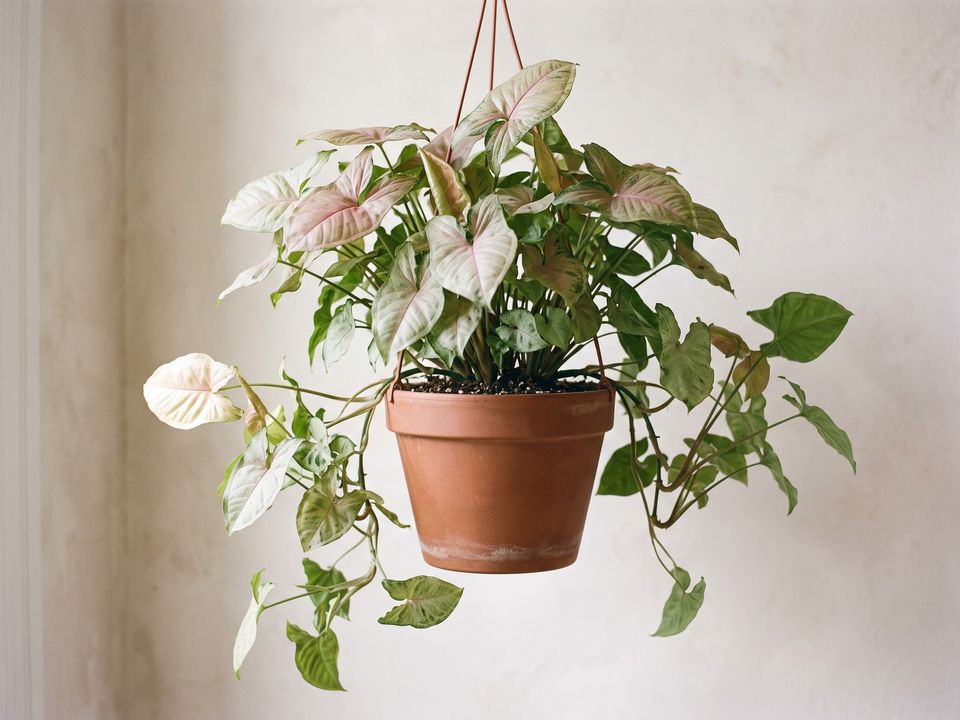
NC State lists it for hanging baskets, climbers, and small shrubs alike, and indoors you choose which one it becomes. Trained upward, it can fill a narrow floor corner that needs something green and tall; left loose, its stems spill from a hook by the window.
: Mildly irritating
Chewing can sting the mouths of dogs, cats, or kids
- DogsMildly irritating
- CatsMildly irritating
- KidsMildly irritating
A chewed leaf may bring mouth pain, drooling, and vomiting in dogs and cats; the ASPCA names its oxalate crystals as the irritant. Kids may get a sore, swollen mouth, and the milky sap can redden skin.
Its sap is the part most owners actually meet. It can leave a red, itchy rash where it touches skin (NC State) and can harm eyes (UF/IFAS), so gloves are a good habit when you trim it. If sap gets in an eye, rinse it with room-temperature water for 15-20 minutes, then call Poison Control.
With a chewed leaf, swollen lips and tongue or a little trouble swallowing can come along with the sore mouth, and these usually pass on their own (ASPCA). If symptoms don’t settle or anything worries you, Poison Control is there for a child, and for a pet your vet or the ASPCA Animal Poison Control Center (a fee may apply).
A fast grower means frequent trims, so sweep up the snipped pieces before a toddler or a cat finds them. If anyone in the house likes to chew, give it a hanging hook or a shelf they can’t reach.
- ASPCA: mild for dogs.
- Pet Poison Helpline: mild for dogs.
- ASPCA: mild for cats.
- Pet Poison Helpline: mild for cats.
- NC State Extension: mild for kids.
Cats and dogs: Most of the leading sources agree.
Kids: No poison-centre listing; rated from university extension sources.
: Average
65-80°F; average humidity is fine
Happiest at 65-80°F, and it shouldn’t sit below 59°F, so keep it away from cold glass in winter. Average humidity of 40-60% suits it.
- Temperature
- 65-80°F
- Humidity
- 40-60%
: Pest-resistant
Rarely bothered; peek at new shoots and leaf undersides
Rarely bothered. Aphids go for new shoots and young leaves, mealybugs for leaf axils and petiole bases, and spider mites for leaf undersides. Scale clings to stems and petioles, thrips to the leaves.
- Aphids
- Mealybugs
- Spider mites
- Scale
- Banded greenhouse thrips
A few. Aphids, mealybugs, and spider mites are the usual pests, and wet soil or wet leaves can bring rot and leaf spot.
Aphids are small, soft green, pink, or black bugs bunched on new growth, and they leave the leaves sticky. Rinse them off in the shower or wipe them away with a cotton swab dipped in rubbing alcohol.
Mealybugs look like tufts of white cotton where the leaves meet the stems. Wipe them off with an alcohol swab, then check again next week.
Spider mites leave a faded, speckled look and, in a bad case, fine webbing, mostly in warm, dry air. Rinse the whole plant in the shower, undersides of the leaves included; if they come back, spray it with insecticidal soap.
Bacterial leaf spot shows as small, dark, soggy-looking spots, and stem rot as a stem going soft at the soil. Cut off spotted leaves and soft stems, keep water off the leaves, and let the top of the soil dry a little before the next soak.
: More
Feed monthly in summer; pinch, prune, wipe 4× a year
Feed monthly in spring and summer. Pinch young stem tips, prune runners, and wipe the leaves about 4 times a year. Stake it once it vines if you want it upright, and repot every few years.
- Feed6× a year
- Prune4× a year
- Pinch4× a year
- Clean leaves4× a year
- Stake1× a year
A light mix that drains fast, in a pot with a drainage hole: ordinary potting mix with a few handfuls of perlite works.
Repot every few years, one size up, in spring. If you’d rather keep it small, trim the roots and put it back in the same pot with fresh mix.
Food is optional: a balanced houseplant fertilizer at half strength once a month in spring and summer is plenty. It isn’t a heavy feeder, so skip it in fall and winter.
: Suave
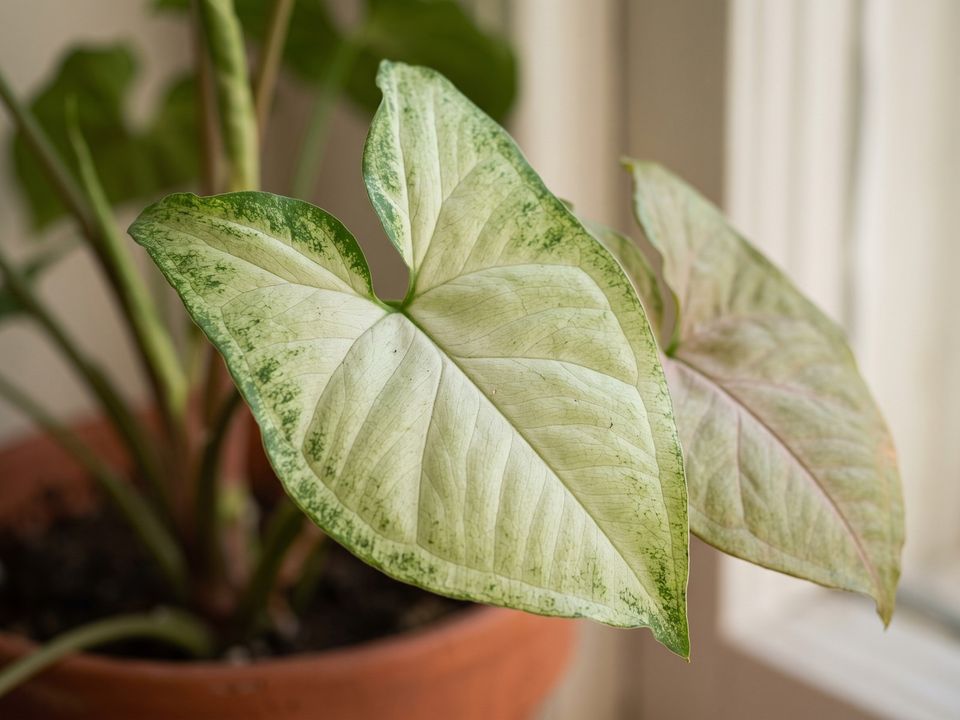
Green arrowheads washed pink or silver, lightly glossy
Each arrow-shaped leaf is green with a wash of pink or silver, as if brushed on by hand. The surface has a gentle sheen, and the bushy stems fill out so the leaves cover the soil.
Where to find me
Not yet pilferableFun fact
Its genus name, Syngonium, joins the Greek for 'together' and 'reproductive organs,' for its fused ovaries. It’s also sold as African evergreen, though it’s from the Americas.
Designer tips
Soft, colorful leaves that look fresh and a little retro, in a hanging pot or climbing a pole.
Troubleshooting
It’s getting long and leggy
Not enough light, or it’s growing up. In a dim spot the stems stretch with long gaps between the leaves, so move it closer to a window, and cut the long stems back if you like: it fills out from below the cuts, and the pieces root easily.
Some leaves are turning yellow
Too much water, most likely, if the soil stays soggy: let the surface dry slightly between drinks and empty the saucer. If the soil’s fine and older leaves are going pale, UF/IFAS lists a lack of nitrogen, and a spring feed usually sorts it out.
Why are the leaf edges brown and crispy?
Dry soil or dry air, usually. Water about every 5-8 days in summer, before the mix dries out completely, and in winter, when the heat dries the air, a humidifier nearby helps; sun landing on the leaves can scorch the edges too.
See all 9
Why is it losing its pink or silver wash?
It wants more light. Clemson Extension notes the colorful kinds hold their color better in brighter light and dull in a dim room, so move it nearer a window, though not where sun lands on the leaves, which bleaches them.
Why do the new leaves look different from the old ones?
It’s growing up. Young leaves are simple arrows; as it matures and climbs, new leaves come in bigger and split into several leaflets, like a goose’s foot. Cut the long stems back if you’d rather keep the arrows.
My cat chewed a leaf
Expect a sore mouth: drooling, pawing at its face, maybe some vomiting. It’s mildly irritating, and the ASPCA names the oxalate crystals in the sap as the cause; if swallowing looks hard or the vomiting keeps up, call your vet or the ASPCA Animal Poison Control Center.
Soggy-looking spots showed up on the leaves
Cold water is a likely cause, so use room-temperature water from now on. If the spots are small and dark and keep spreading, it may be bacterial leaf spot: cut off spotted leaves and keep water off the leaves.
Can it go outside for the summer?
Yes, in shade: a porch or under a tree, where sun doesn’t land on the leaves. Bring it in before nights dip below about 60°F, and check it for bugs on the way in.
Can it go ten days without water?
Usually, if you soak it the day you leave. Any longer, ask a friend to give it a drink.
Propagation
Easily, from a cutting.
- Cut a stem tip with two or three leaves just below a node, the bump where a leaf meets the stem, and stand it in a glass of water or a small pot of damp mix.
- In a warm room it roots in about three weeks; pot it up once the roots are a few inches long.
A crowded pot can also be divided when you repot.
The PILF Matrix
2.5/5
how easy it is to care for
3.6/5
how much it stands out visually
“The one that changes shape the minute it gets comfortable.”


- nephthytis
- goosefoot plant
Rated 1-5, with 5 being easiest
Built from light, water, air, pests, and upkeep.
Rated 1-5, with 5 being easiest
Rated 1-5, with 5 being highest presence
Built from its scale (size, shape, growth) and its look (color and flowers, shine, fullness).
Rated 1-5, with 5 being highest presence
Where it sits and what sun touches it.
- Dim shadeA dark corner or a windowless room; natural light casts no shadow
- Bright shadeBack from the window in a south-, east- or west-facing room, or right by a north-facing one, where only low early or late summer sun reaches it
- Filtered sunBehind a sheer curtain or tinted glass; the sun’s shadows are blurred
- Partial sunIn an east- or west-facing window: up to a few hours of direct sun
- Full sunThe sunniest spot you have, usually a south-facing window, with direct sun 6+ hours a day
How often, and what the soil does between.
- MonthlyEvery 2-3 weeks in summer and 3-5 in winter; the soil dries all the way between
- 2-3× a monthEvery 7-14 days in summer, longer in winter; the top of the soil dries between
- Weekly+About every 4-8 days in summer; the soil stays lightly damp
How much room it usually takes indoors.
Size
- TinyUnder 6 inches tall or wide; for a desk or a sill
- Small6 inches to 1.5 feet tall or wide; for a shelf or a sill
- Medium1.5 to 3 feet tall or wide; for a table or a stand
- Large3 to 6 feet tall or wide; for the floor
- GiantOver 6 feet tall or wide; a statement in the corner
Shape
- TreeA trunk that branches into a canopy
- CaneBare stalks topped with leaves
- UprightStiff stems or leaves rising straight from the soil
- FountainLeaves or fronds arching out from the center
- BushyA full, rounded mound of leaves
- RosetteLeaves radiating from one low point
- ViningTrails, climbs, or both
Growth
How fast it gets there.
- SlowUnder 6 inches of new growth a year
- Moderate6-12 inches a year, mostly in spring and summer
- FastOver 12 inches a year; it may want trimming or training
What risks exist for pets and kids.
- Pet & kid safeNothing to worry about
- Mildly irritatingMay irritate the mouth or stomach if chewed, or for some plants, the skin if handled
- Moderately toxicCan cause illness if eaten, though typically not serious or fatal
- DangerousCan cause serious illness if eaten, including some reports of death
- Not yet ratedNot clearly rated by our sources; please check with your vet or doctor
For its safety ratings, PILF relies on research and guidance from leading sources, including the ASPCA, Pet Poison Helpline, Merck Veterinary Manual, Poison Control, and Children’s Hospital of Philadelphia, and others.
The small jobs beyond watering, over a year.
- Little upkeepA few small jobs a year beyond watering, like a feed now and then
- Some upkeepA small job about once a month beyond watering, like feeding or turning it
- More upkeepA small job every couple of weeks beyond watering, like a wipe, a turn, or a feed
- Most upkeepA small job most weeks beyond watering, like raising the humidity or misting
- TreeA trunk that branches into a canopy
- CaneBare stalks topped with leaves
- UprightStiff stems or leaves rising straight from the soil
- FountainLeaves or fronds arching out from the center
- BushyA full, rounded mound of leaves
- RosetteLeaves radiating from one low point
- ViningTrails, climbs, or both
How fast it gets there.
- SlowUnder 6 inches of new growth a year
- Moderate6-12 inches a year, mostly in spring and summer
- FastOver 12 inches a year; it may want trimming or training
The temperature and humidity it’s comfortable in.
How dry a room it takes.
- Needs 50%+ humidity
- Fine at 35% humidity
- Fine at 15-20% humidity
The bugs that usually find it, by name.
How often pests find it.
- 5+ regular pests
- 3 regular pests
- Pests are rare
The year’s chores: feeding, pruning, repotting, and cleaning.
Chores beyond water (what needs work means).
- Most upkeep
- Some upkeep
- Little upkeep
Its finish, fullness, and texture.
Color, pattern, and flowers.
- SimpleOne green, one texture, nothing to read
- SuaveA sheen, a stripe, or a clean shape that catches the eye up close
- ShowyColor, pattern, or blooms you see from across the room
How the leaves catch light.
- Matte
- Satin
- Glossy or waxy
How much it fills its pot.
- Soil shows
- Soil partly hidden
- Leaves hide the soil