Desert Rose
Adenium obesum
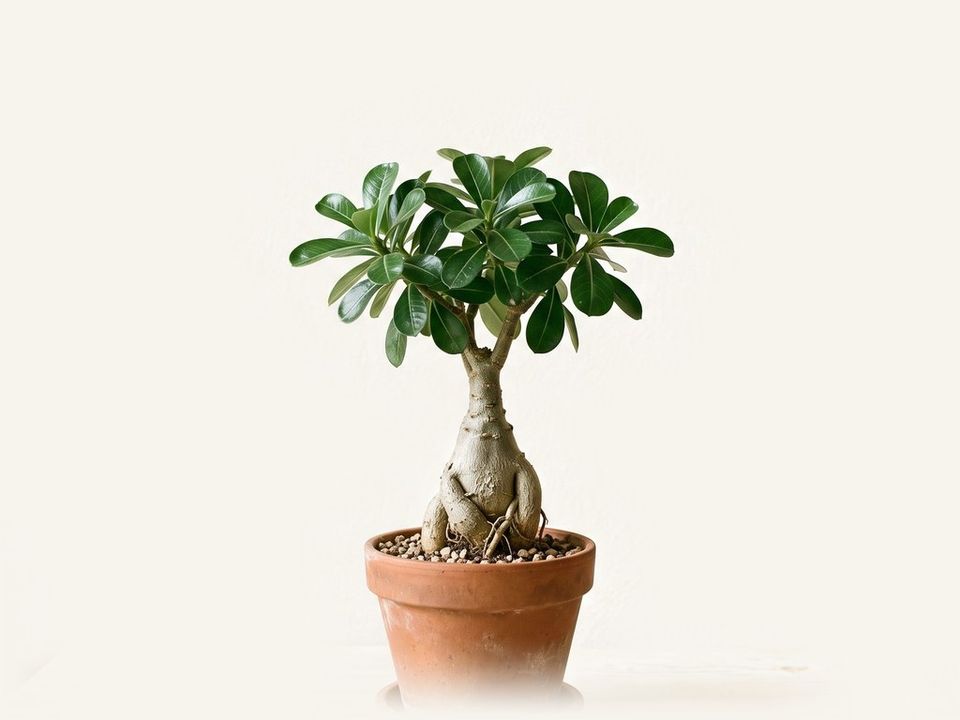
A swollen trunk under a crown of leaves and pink, red, or white trumpets. Known for looking like a living bonsai and wanting all the sun you have.
1.8/5
how easy it is to care for
2.2/5
how much it stands out visually
: Full sun
Your sunniest south or west window, 6+ hours of sun
Give it the sunniest south or west window you have, where 6 or more hours of direct sun reach the leaves. With less it won’t flower and may drop leaves, and a Chicago winter can’t give it enough, so it rests.
With less, it flowers little or not at all. A Chicago winter can’t give it enough, so expect it to rest then.
A summer outdoors in full sun is the best thing you can do for it (see Troubleshooting).
: Monthly
Every 1-2 weeks in summer, 3-6 in winter; dries out fully
Through summer it takes a soak every 1-2 weeks, and every 3-6 weeks during its winter rest, with the mix drying out all the way between. Soggy soil rots the roots and the swollen trunk, so when in doubt, wait.
Water until it runs out the bottom, empty the saucer, and let the soil dry out between soaks, which takes 7-10 days in a sunny summer window. Soggy soil rots the roots and the swollen trunk, so when in doubt, wait.
Gone for a while? Two weeks is fine if it’s watered the day you leave, and in winter, while it rests, it can go longer.
: Large
A fat-trunked tree, slowly reaching 3-5 feet
A swollen trunk branches into a small, leafy crown, slowly reaching 3-5 feet in a pot over many years. Growers often lift it higher in its pot to show off more of that water-storing base.
Growth is slow, and the caudex widens and swells as it ages. It needs no pruning; if you trim a branch to shape it, wear gloves.
: Dangerous
Dangerous for dogs and cats; moderately toxic for kids
- DogsDangerous
- CatsDangerous
- KidsModerately toxic
Dangerous for a dog or cat that chews it, with an irregular heartbeat among the signs (ASPCA), so it suits a home without a chewer. For kids it’s moderately toxic; CHOP advises calling Poison Control if any is eaten.
It contains heart toxins; ASPCA lists irregular heartbeat and death among the signs
The whole plant carries cardiac glycosides. The ASPCA lists vomiting, diarrhea, loss of appetite, depression, an irregular heartbeat, and death. If a pet has chewed any part of it, call your vet or the ASPCA Animal Poison Control Center right away.
Kids too: NC State Extension says all parts are poisonous if eaten, and the milky sap irritates skin. Wear gloves to prune or repot it, and keep it well out of reach of small children.
- ASPCA: toxic for dogs.
- Merck Veterinary Manual: toxic for dogs (rates the whole genus).
- ASPCA: toxic for cats.
- Merck Veterinary Manual: toxic for cats (rates the whole genus).
- : toxic for kids.
Cats and dogs: A leading source reports deaths, and none calls them rare.
Kids: Heart toxins (cardiac glycosides, Merck); CHOP says any amount of a cardiac-glycoside plant needs a call to poison control.
: Dry OK
Built for heat and dry air; cold is what it minds
Built for heat and dry air, it’s comfortable at 55-95°F with humidity as low as 10%, so there’s no misting to do. Cold is what’s hard on it: bring it in from a summer outdoors before nights reach 55°F.
- Temperature
- 55-95°F
- Humidity
- 10%+
: Mealybugs, scale
Mealybugs and scale; check stems and leaves
Mealybugs look like tufts of white cotton, and scale like small brown bumps stuck to the stems and leaves. Aphids, small soft bugs on new growth, and spider mites turn up now and then.
- Mealybugs
- Scale
- Aphids
- Spider mites
A few. Scale is the one to watch for, then mealybugs and aphids, and rot if the soil stays wet.
Scale looks like small brown bumps stuck to the stems and leaves. Lift them off with a fingernail or a cotton swab dipped in rubbing alcohol (gloves on), then check again next week. The same swab takes care of mealybugs, which look like tufts of white cotton, and aphids, small soft bugs on new growth.
Leaf spot, a fungus, leaves brown spots on the leaves now and then. Pick off the spotted ones and keep water off the leaves.
Rot shows as a trunk going soft or wrinkled at the base while the soil is wet. Let it dry right out and water less often from then on.
: Little
A few feeds in spring; less water in its winter rest
A few feeds in spring and summer are plenty, and in winter you cut back the water and let the leaves fall while it rests. Trim to shape with gloves on if you like, and repot every 2 years or so.
- Feed in spring3× a year
- Winter dormancy: cut water, accept leaf drop1× a year
- Prune with gloves (toxic latex)1× a year
- Repotevery 2 years
A cactus and succulent mix, in a pot with a drainage hole. Terracotta helps the soil dry out between soaks.
Repot only when the roots fill the pot, in spring or summer while it’s growing, and wear gloves.
Food is optional: a balanced houseplant fertilizer a few times in spring and summer is plenty, and none while it rests in winter.
: Simple
Satiny oval leaves over a fat, swollen trunk
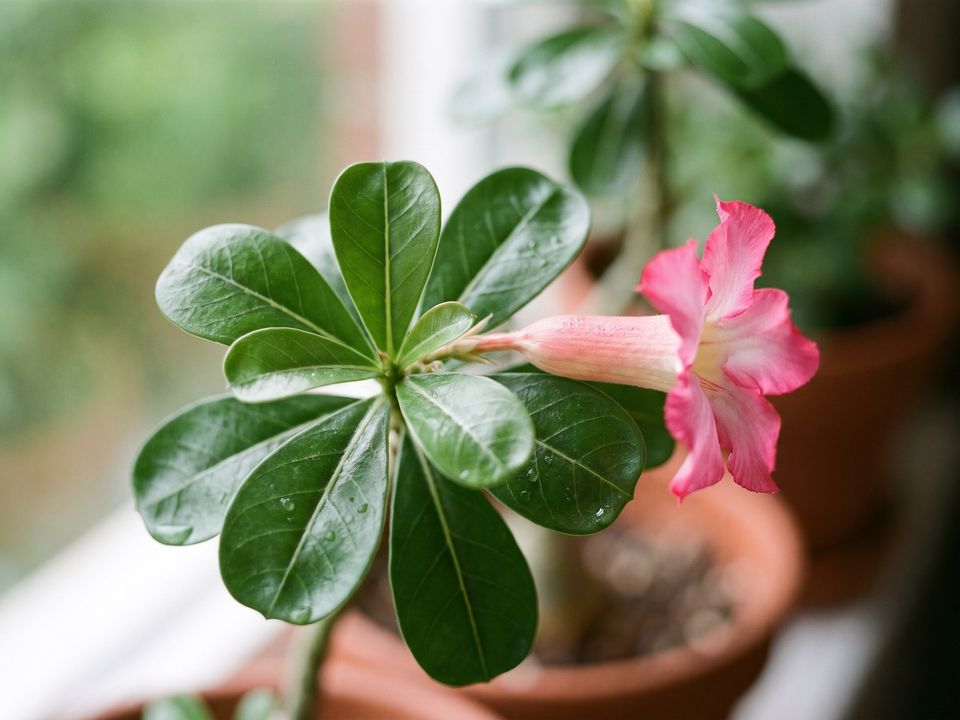
Oval leaves about 3 inches long, with a satin sheen, crown a fat, swollen trunk, and the soil shows around its base. For a few summer weeks, pink, red or white trumpets may open.
Where to find me
Not at PILF places
Fun fact
Growers often 'lift' (root-wash) it to show off more of its swollen, water-storing base.
Designer tips
Sculptural and a little desert-modern: a fat trunk, a small crown, and bright summer flowers.
Troubleshooting
It’s dropping its leaves in winter
That’s its winter rest, and it’s normal. Water it much less while it rests; UF/IFAS says it leafs out again once the cold season has passed.
Why isn’t it flowering?
Usually not enough sun: UF/IFAS says it needs six or more hours of bright light a day to keep flowering. Your sunniest window helps, and a summer outside in full sun helps most; even then, indoor blooms may last only a few weeks.
The swollen trunk is going soft
Most likely rot from too much water; a healthy trunk is firm. Let the soil dry right out and water less often from now on, though a trunk that’s soft all the way through rarely recovers.
See all 9
Can I keep one with a cat or dog?
It’s dangerous if chewed, so it suits a home where pets leave plants alone, out of their reach. The ASPCA lists it as toxic to cats and dogs, with an irregular heartbeat among the signs. If yours has chewed any, call your vet or the ASPCA Animal Poison Control Center right away.
How often should I water it in winter?
Much less often than in summer, about every 3-6 weeks while it rests. NC State Extension says to cut back on water then; pick up again when new leaves appear in spring.
Can it go outside for the summer?
Yes, and it’s the best thing for it: a sunny balcony or patio in full sun. NC State Extension says to bring it back in when nights drop toward 55°F.
Small brown bumps on the stems
That’s likely scale, the pest to watch for on this plant. Lift the bumps off with a fingernail or a cotton swab dipped in rubbing alcohol, gloves on, and check again next week.
I got the milky sap on my skin
It’s mildly irritating: NC State Extension says the latex can cause a rash. Wash your hands after handling a cut stem, and gloves make the next pruning or repotting more comfortable.
Is it safe around small children?
It’s moderately toxic for kids: it carries heart toxins (Merck), and CHOP advises calling Poison Control after any amount is eaten. Keep it well out of reach of small children.
Propagation
Possible, but slow: growers raise it from stem cuttings, seed, or grafts.
- Wear gloves to take a cutting, since the sap is toxic.
- Most people find it simpler to buy another.
The PILF Matrix
1.8/5
how easy it is to care for
2.2/5
how much it stands out visually
“The one that wants a desert, and you have a Chicago window.”


- mock azalea
- adenium
Rated 1-5, with 5 being easiest
Built from light, water, air, pests, and upkeep.
Rated 1-5, with 5 being easiest
Rated 1-5, with 5 being highest presence
Built from its scale (size, shape, growth) and its look (color and flowers, shine, fullness).
Rated 1-5, with 5 being highest presence
Where it sits and what sun touches it.
- Dim shadeA dark corner or a windowless room; natural light casts no shadow
- Bright shadeBack from the window in a south-, east- or west-facing room, or right by a north-facing one, where only low early or late summer sun reaches it
- Filtered sunBehind a sheer curtain or tinted glass; the sun’s shadows are blurred
- Partial sunIn an east- or west-facing window: up to a few hours of direct sun
- Full sunThe sunniest spot you have, usually a south-facing window, with direct sun 6+ hours a day
How often, and what the soil does between.
- MonthlyEvery 2-3 weeks in summer and 3-5 in winter; the soil dries all the way between
- 2-3× a monthEvery 7-14 days in summer, longer in winter; the top of the soil dries between
- Weekly+About every 4-8 days in summer; the soil stays lightly damp
How much room it usually takes indoors.
Size
- TinyUnder 6 inches tall or wide; for a desk or a sill
- Small6 inches to 1.5 feet tall or wide; for a shelf or a sill
- Medium1.5 to 3 feet tall or wide; for a table or a stand
- Large3 to 6 feet tall or wide; for the floor
- GiantOver 6 feet tall or wide; a statement in the corner
Shape
- TreeA trunk that branches into a canopy
- CaneBare stalks topped with leaves
- UprightStiff stems or leaves rising straight from the soil
- FountainLeaves or fronds arching out from the center
- BushyA full, rounded mound of leaves
- RosetteLeaves radiating from one low point
- ViningTrails, climbs, or both
Growth
How fast it gets there.
- SlowUnder 6 inches of new growth a year
- Moderate6-12 inches a year, mostly in spring and summer
- FastOver 12 inches a year; it may want trimming or training
What risks exist for pets and kids.
- Pet & kid safeNothing to worry about
- Mildly irritatingMay irritate the mouth or stomach if chewed, or for some plants, the skin if handled
- Moderately toxicCan cause illness if eaten, though typically not serious or fatal
- DangerousCan cause serious illness if eaten, including some reports of death
- Not yet ratedNot clearly rated by our sources; please check with your vet or doctor
For its safety ratings, PILF relies on research and guidance from leading sources, including the ASPCA, Pet Poison Helpline, Merck Veterinary Manual, Poison Control, and Children’s Hospital of Philadelphia, and others.
The small jobs beyond watering, over a year.
- Little upkeepA few small jobs a year beyond watering, like a feed now and then
- Some upkeepA small job about once a month beyond watering, like feeding or turning it
- More upkeepA small job every couple of weeks beyond watering, like a wipe, a turn, or a feed
- Most upkeepA small job most weeks beyond watering, like raising the humidity or misting
- TreeA trunk that branches into a canopy
- CaneBare stalks topped with leaves
- UprightStiff stems or leaves rising straight from the soil
- FountainLeaves or fronds arching out from the center
- BushyA full, rounded mound of leaves
- RosetteLeaves radiating from one low point
- ViningTrails, climbs, or both
How fast it gets there.
- SlowUnder 6 inches of new growth a year
- Moderate6-12 inches a year, mostly in spring and summer
- FastOver 12 inches a year; it may want trimming or training
The temperature and humidity it’s comfortable in.
How dry a room it takes.
- Needs 50%+ humidity
- Fine at 35% humidity
- Fine at 15-20% humidity
The bugs that usually find it, by name.
How often pests find it.
- 5+ regular pests
- 3 regular pests
- Pests are rare
The year’s chores: feeding, pruning, repotting, and cleaning.
Chores beyond water (what needs work means).
- Most upkeep
- Some upkeep
- Little upkeep
Its finish, fullness, and texture.
Color, pattern, and flowers.
- SimpleOne green, one texture, nothing to read
- SuaveA sheen, a stripe, or a clean shape that catches the eye up close
- ShowyColor, pattern, or blooms you see from across the room
How the leaves catch light.
- Matte
- Satin
- Glossy or waxy
How much it fills its pot.
- Soil shows
- Soil partly hidden
- Leaves hide the soil