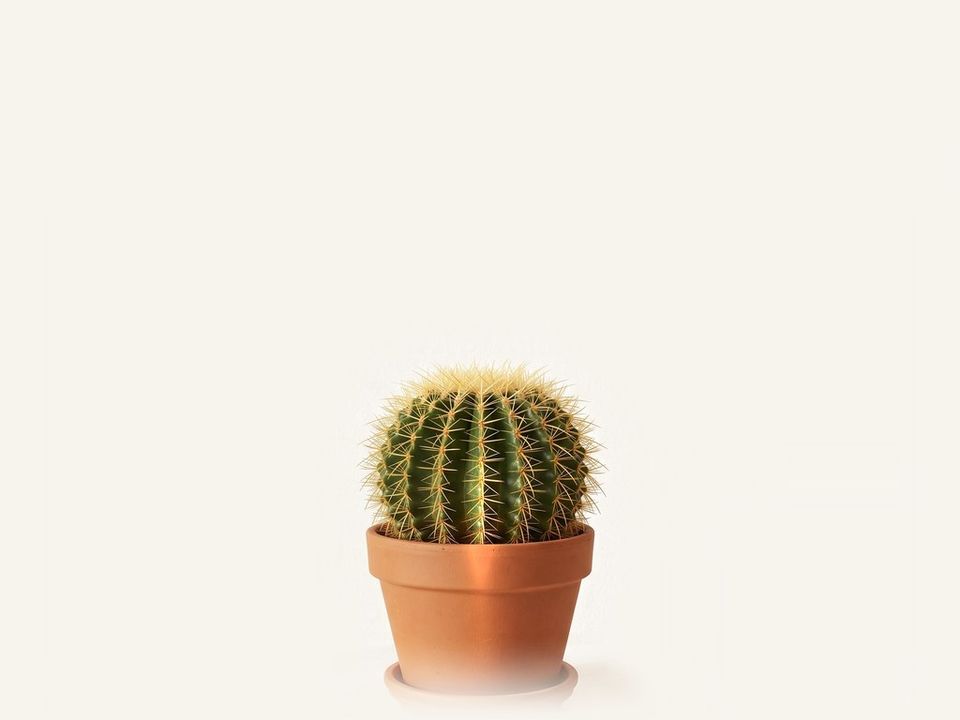
Golden Barrel Cactus
Kroenleinia grusonii
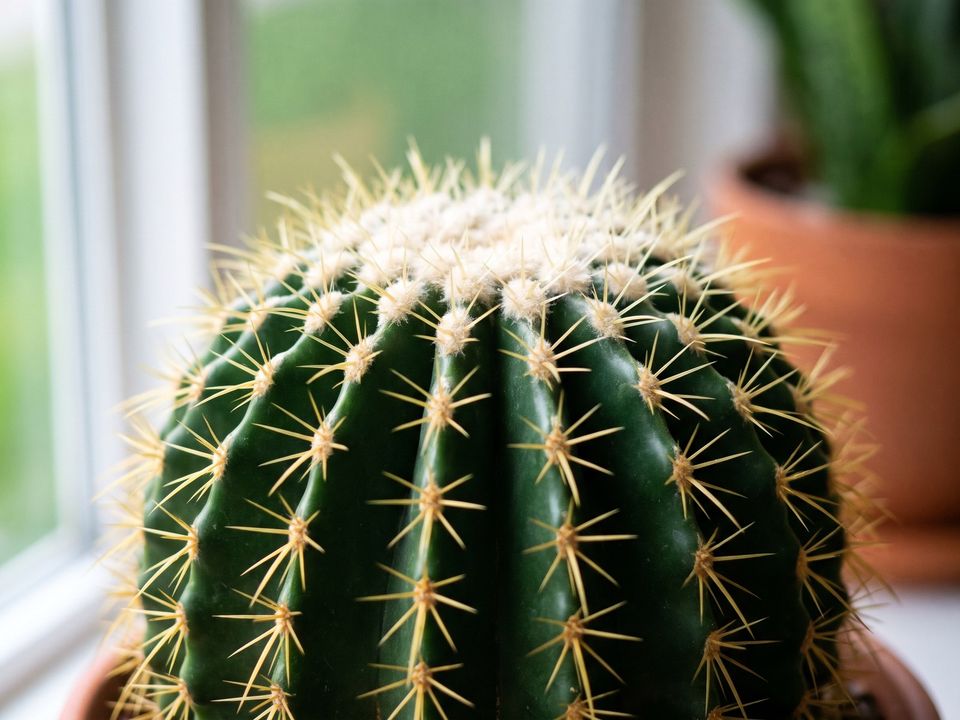
A fat green globe with deep ribs lined in golden spines, like a pincushion. Known for thriving on full sun and being left alone.
2.6/5
how easy it is to care for
1.4/5
how much it stands out visually
: Full sun
In a south or west window, with several hours of sun
Set it right in your sunniest window, south or west, where sun lands on it for several hours a day. It gets by on 2-6 hours, but with too little the globe stretches and leans toward the glass.
Short of that, it grows weak and misshapen, stretching and leaning toward the light (the RHS calls this etiolation).
Moving it into much stronger light, or outside for the summer? Ease it in: Clemson Extension says to give cacti partial shade for the first few weeks so they can adjust, or the skin can scorch.
: Monthly
Every 10-21 days in summer; barely any in winter
Spring through summer, it takes a soak every 10-21 days, and the mix dries all the way through between. Winter is its rest: every 3-6 weeks, just enough to keep it from shriveling.
Water until it runs out the bottom and empty the saucer; it must never sit in water. Let the soil dry right out between soaks, which takes 14-21 days in a sunny window. From November to early March, water just enough to keep it from shriveling: the RHS and Clemson Extension both say so.
Gone for a while? A month is fine, and in winter it can go even longer.
: Medium
A ribbed globe that inches up to about 1.5 feet
Often wider than tall, the ribbed globe takes many years to reach about 1.5 feet indoors, gaining about 1-2 inches a year. Very old ones slowly stretch into a squat barrel.
Growth is slow, and there’s nothing to prune. Turn the pot a little every few waterings so it grows round instead of leaning toward the window.
: Mildly irritating
Mildly irritating for pets and kids, from its spines
- DogsMildly irritating
- CatsMildly irritating
- KidsMildly irritating
Long, stiff spines can prick a paw, a nose, or a hand, which makes it mildly irritating for dogs, cats, and kids. It isn’t on the ASPCA’s list, and UC ANR lists cacti only for spines and sap that can irritate skin.
Rated Mild for its spines, which can prick a paw, a mouth or a hand; no poison source lists it as toxic
We found no vet source that names it as poisonous. For kids, the University of California lists cacti only for their spines and sap, which can irritate skin, not as a poison if eaten. A low table is the worst spot in a home with toddlers or a nosy dog; a windowsill they can’t reach is better.
- UC ANR: mild for kids.
Cats and dogs: None of the leading sources names it. Spines or thorns: long, stiff spines.
Kids: No child poison-centre listing names it. Its sap can irritate skin or eyes. Spines or thorns: long, stiff spines.
: Dry OK
50-85°F and dry air; a cool winter rest suits it
Anywhere from 50-85°F works, and in winter it rests best in a cool, sunny spot close to the glass. Dry heated air, down to 10% humidity, suits it; air that stays humid can mark its skin.
- Temperature
- 50-85°F
- Humidity
- 10%+
: Mealybugs
Mealybugs, like cotton tucked between the ribs
Look between the ribs and around the base for mealybugs, which look like tufts of white cotton. Scale, small brown bumps between the spines, and spider mites, with their fine webbing, turn up less often.
- Mealybugs
Not many, as long as the soil stays dry. Mealybugs are the pest to watch, and rot, from wet soil, is what kills most cacti.
Mealybugs look like tufts of white cotton tucked between the ribs and at the base. Dab them with a cotton swab dipped in rubbing alcohol, then check again next week; if they keep coming, use an insecticidal soap labeled for cacti.
Scale looks like small brown bumps stuck to the skin between the spines. Pick off a light case with a toothpick; Clemson Extension warns a heavy case is hard to clear. Spider mites (fine webbing, pale speckles) rinse off with a spray of water.
Rot shows as a soft, brown, or black patch at the base where the globe meets the soil. Stop watering and let the pot dry out completely; a base that has gone mushy rarely recovers.
: More
A quarter-turn each month; a few feeds in summer
Give the pot a quarter-turn each month so the globe grows round, and feed it a low-nitrogen cactus fertilizer a few times from June to September. Repot about every 3 years, with thick gloves on.
- Feeding in season3× a year
- Quarter-turn toward window12× a year
- Dry winter rest (stop watering)1× a year
- Repot with spine protectionevery 3 years
A cactus mix, or ordinary potting mix cut half and half with coarse sand or grit (Clemson’s recipe), in a pot with a drainage hole.
It likes a snug pot. Repot only when it outgrows its pot, in spring, into a pot only slightly larger; extra soil stays wet and rots the roots. Handle it with a folded strip of newspaper as tongs or thick leather gloves, and wait several days before watering it.
Food is optional: a low-nitrogen cactus fertilizer a few times between June and September is plenty, and none in winter.
: Suave
A matte green globe, ribs lined in golden spines
Deep ribs lined in golden spines run down a matte green globe, like a pincushion. It sits on its own in the pot, with plenty of soil showing around the base.
Where to find me
Not at PILF places
Fun fact
Grown by the millions in nurseries, yet listed as Endangered in the wild.
Designer tips
A living sculpture: a bold golden globe that suits a modern or desert-toned room, on its own or with a group of cacti.
Troubleshooting
It’s soft and dark at the base
Likely rot, from soil that stayed wet. Stop watering and let the pot dry out completely, then repot into fresh cactus mix if the soil stays soggy. A small, firm-edged spot may stop there, though a base that’s mushy through rarely recovers.
It’s leaning toward the window
It’s reaching for more light. Move it to your sunniest window, south or west, and give the pot a quarter-turn every few waterings so it evens out over time.
Tan or brown crusty patches on its skin
Tan, corky patches are what the RHS calls corky scab, linked to too much humidity or light. A pale, bleached patch after a move into stronger sun is sunburn. The marks stay, though the cactus carries on; easing the cause keeps new ones from forming.
See all 10
White fluff between the ribs
Likely mealybugs, the pest that finds it most. If they bother you, dab them with a cotton swab dipped in rubbing alcohol and look again the next week; an insecticidal soap labeled for cacti is the next step if they keep coming.
Should I water it in winter?
Barely. From November to early March, give it just enough to keep it from shriveling (RHS). Winter is its rest, and cold, wet soil is how most cacti rot.
My dog poked its nose on the spines
That’s the spines, not a poison: it rates mildly irritating, and it isn’t on the ASPCA’s list either way. If spines are stuck in a nose or paw, call your vet to get them out; a windowsill your pets can’t reach keeps it from happening again.
How do I move or repot it without getting stuck?
Wrap a folded strip of newspaper around it as a handle, or wear thick leather gloves; Clemson Extension and the RHS both suggest it. After repotting, wait several days before watering.
Will it flower?
Probably not for a long time. The Oxford Botanic Garden says its pale yellow flowers only start after twenty or more years.
Can it go outside for the summer?
Yes, and it likes the sun out there. Start it in partial shade for the first few weeks so its skin doesn’t scorch (Clemson Extension), then move it into full sun, and bring it in before nights drop below 50°F.
Isn’t it endangered?
In the wild, yes: it’s listed as endangered in its small native range in Mexico, where habitat loss and cactus theft are the big threats (Oxford Botanic Garden). The ones sold as houseplants are grown by the millions in nurseries.
Propagation
Not practical at home. Golden barrels are raised from seed, and a seedling is years away from looking like this one: the RHS gives it 10 to 20 years to reach full size.
The PILF Matrix
2.6/5
how easy it is to care for
1.4/5
how much it stands out visually
“The one that needs a sunnier zip code.”


- Formerly Echinocactus grusonii
Rated 1-5, with 5 being easiest
Built from light, water, air, pests, and upkeep.
Rated 1-5, with 5 being easiest
Rated 1-5, with 5 being highest presence
Built from its scale (size, shape, growth) and its look (color and flowers, shine, fullness).
Rated 1-5, with 5 being highest presence
Where it sits and what sun touches it.
- Dim shadeA dark corner or a windowless room; natural light casts no shadow
- Bright shadeBack from the window in a south-, east- or west-facing room, or right by a north-facing one, where only low early or late summer sun reaches it
- Filtered sunBehind a sheer curtain or tinted glass; the sun’s shadows are blurred
- Partial sunIn an east- or west-facing window: up to a few hours of direct sun
- Full sunThe sunniest spot you have, usually a south-facing window, with direct sun 6+ hours a day
How often, and what the soil does between.
- MonthlyEvery 2-3 weeks in summer and 3-5 in winter; the soil dries all the way between
- 2-3× a monthEvery 7-14 days in summer, longer in winter; the top of the soil dries between
- Weekly+About every 4-8 days in summer; the soil stays lightly damp
How much room it usually takes indoors.
Size
- TinyUnder 6 inches tall or wide; for a desk or a sill
- Small6 inches to 1.5 feet tall or wide; for a shelf or a sill
- Medium1.5 to 3 feet tall or wide; for a table or a stand
- Large3 to 6 feet tall or wide; for the floor
- GiantOver 6 feet tall or wide; a statement in the corner
Shape
- TreeA trunk that branches into a canopy
- CaneBare stalks topped with leaves
- UprightStiff stems or leaves rising straight from the soil
- FountainLeaves or fronds arching out from the center
- BushyA full, rounded mound of leaves
- RosetteLeaves radiating from one low point
- ViningTrails, climbs, or both
Growth
How fast it gets there.
- SlowUnder 6 inches of new growth a year
- Moderate6-12 inches a year, mostly in spring and summer
- FastOver 12 inches a year; it may want trimming or training
What risks exist for pets and kids.
- Pet & kid safeNothing to worry about
- Mildly irritatingMay irritate the mouth or stomach if chewed, or for some plants, the skin if handled
- Moderately toxicCan cause illness if eaten, though typically not serious or fatal
- DangerousCan cause serious illness if eaten, including some reports of death
- Not yet ratedNot clearly rated by our sources; please check with your vet or doctor
For its safety ratings, PILF relies on research and guidance from leading sources, including the ASPCA, Pet Poison Helpline, Merck Veterinary Manual, Poison Control, and Children’s Hospital of Philadelphia, and others.
The small jobs beyond watering, over a year.
- Little upkeepA few small jobs a year beyond watering, like a feed now and then
- Some upkeepA small job about once a month beyond watering, like feeding or turning it
- More upkeepA small job every couple of weeks beyond watering, like a wipe, a turn, or a feed
- Most upkeepA small job most weeks beyond watering, like raising the humidity or misting
- TreeA trunk that branches into a canopy
- CaneBare stalks topped with leaves
- UprightStiff stems or leaves rising straight from the soil
- FountainLeaves or fronds arching out from the center
- BushyA full, rounded mound of leaves
- RosetteLeaves radiating from one low point
- ViningTrails, climbs, or both
How fast it gets there.
- SlowUnder 6 inches of new growth a year
- Moderate6-12 inches a year, mostly in spring and summer
- FastOver 12 inches a year; it may want trimming or training
The temperature and humidity it’s comfortable in.
How dry a room it takes.
- Needs 50%+ humidity
- Fine at 35% humidity
- Fine at 15-20% humidity
The bugs that usually find it, by name.
How often pests find it.
- 5+ regular pests
- 3 regular pests
- Pests are rare
The year’s chores: feeding, pruning, repotting, and cleaning.
Chores beyond water (what needs work means).
- Most upkeep
- Some upkeep
- Little upkeep
Its finish, fullness, and texture.
Color, pattern, and flowers.
- SimpleOne green, one texture, nothing to read
- SuaveA sheen, a stripe, or a clean shape that catches the eye up close
- ShowyColor, pattern, or blooms you see from across the room
How the leaves catch light.
- Matte
- Satin
- Glossy or waxy
How much it fills its pot.
- Soil shows
- Soil partly hidden
- Leaves hide the soil