Philodendron Birkin
Philodendron 'Birkin'
Also called Birkin
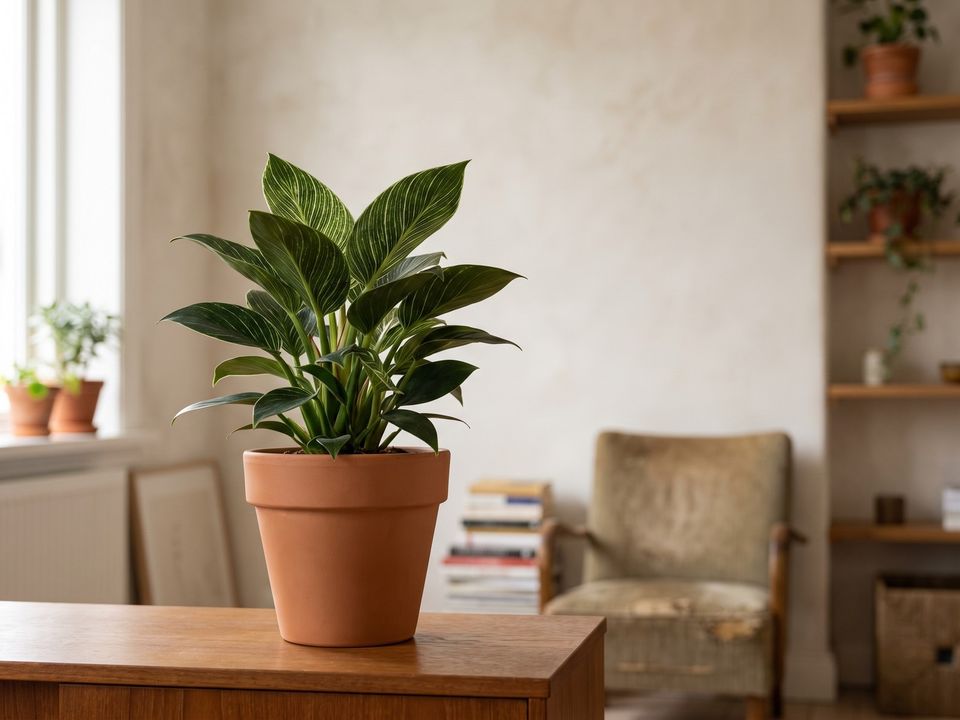
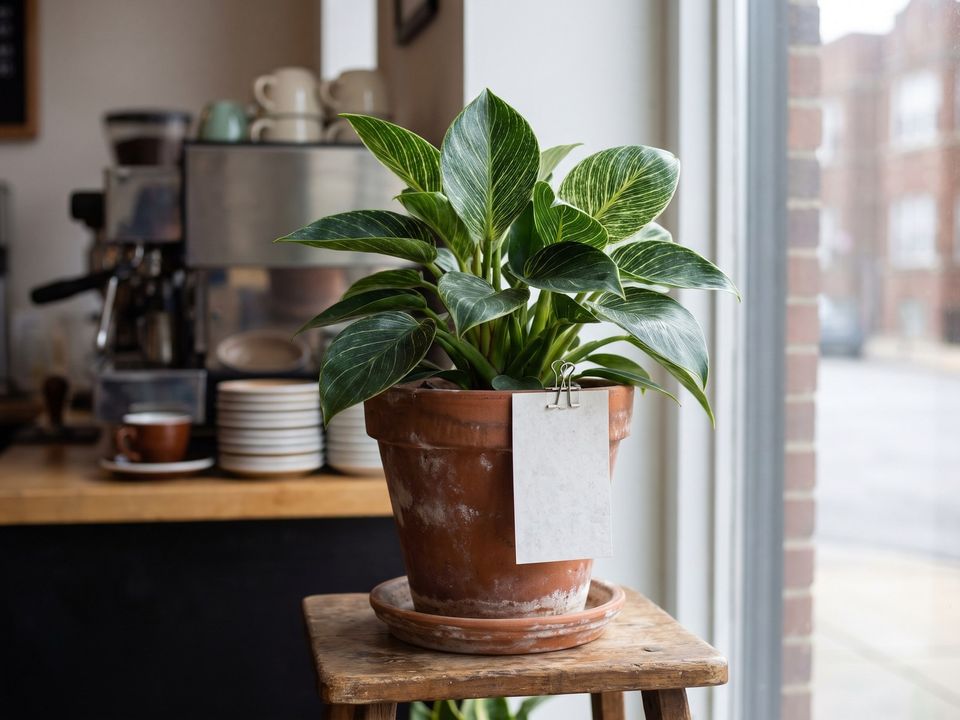
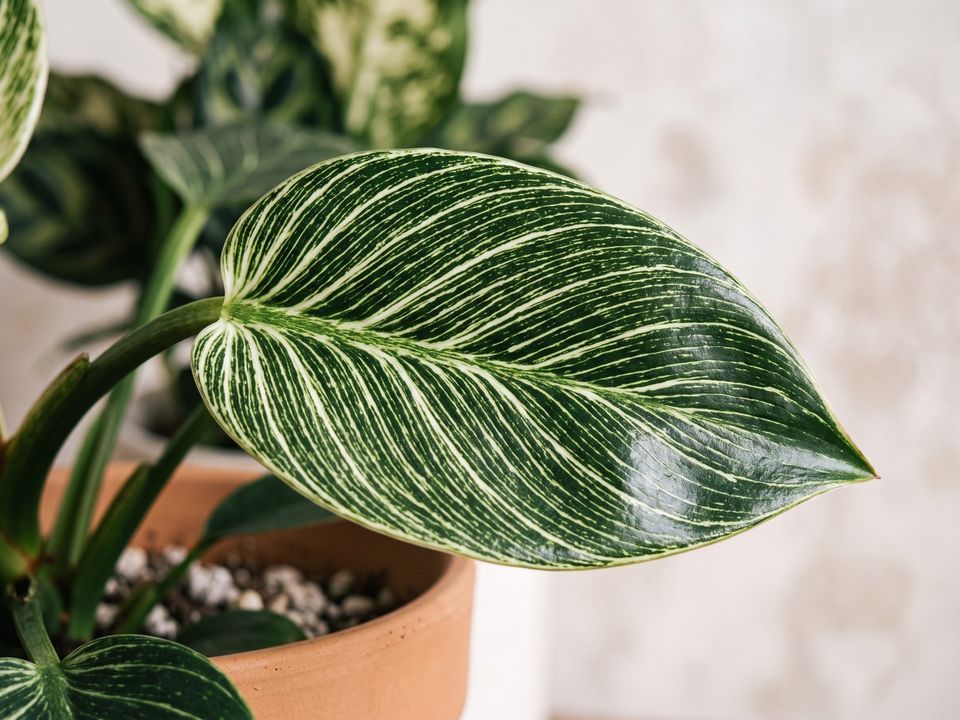
Deep green leaves pinstriped in cream, like a tailored suit. Each new leaf may come in streakier or plainer than the last.
2.9/5
how easy it is to care for
3.2/5
how much it stands out visually
: Shade to filtered
Near a sheer-curtained window; low light fades its stripes
Filtered light, like a window behind a sheer, keeps its cream pinstripes crisp against the deep green. In medium light it carries on, though leaves may come in smaller with fainter stripes.
Its pinstripes are the gauge. NC State ties lost variegation, leggy stems, and small leaves to too little light, so a clump of plain, stretched leaves is asking for more. Scorched patches mean direct sun is reaching it.
An east-facing window may come closest to what it wants, or a few feet back from a south or west one, where a curtain softens the afternoon.
In a Chicago winter it may move nearer the glass for the weaker sun, as long as no cold draft reaches it (NC State warns against drafts and cold).
Light is what it spends on its looks: in a middling room it carries on, just in plainer clothes.
: 2-3× a month
Every 7-10 days, nearer two weeks in winter; never soggy
About every 7-10 days in summer, stretching to 10-14 in winter. Overwatering is what it won’t forgive: yellowing leaves first, then root rot under those thick, upright stems.
Air matters as much as the watering can. It likes humidity at 50-60% and a room between 65 and 85°F (NC State), so a bathroom with a window may suit it well.
If the tips of its broad, glossy leaves begin to brown and that bothers you, a humidifier or a pebble tray beside the pot can help; NC State links brown tips to dry air. It’ll grow on regardless.
With its leaves gathered in a tight crown, aim the water at the soil around the stems rather than over the top. NC State notes leaf spots can follow when leaves get wet during watering.
Gone for a while? Two weeks is fine if you soak it the day you leave.
: Medium
Pinstriped leaves on short stems, slowly up to 3 feet
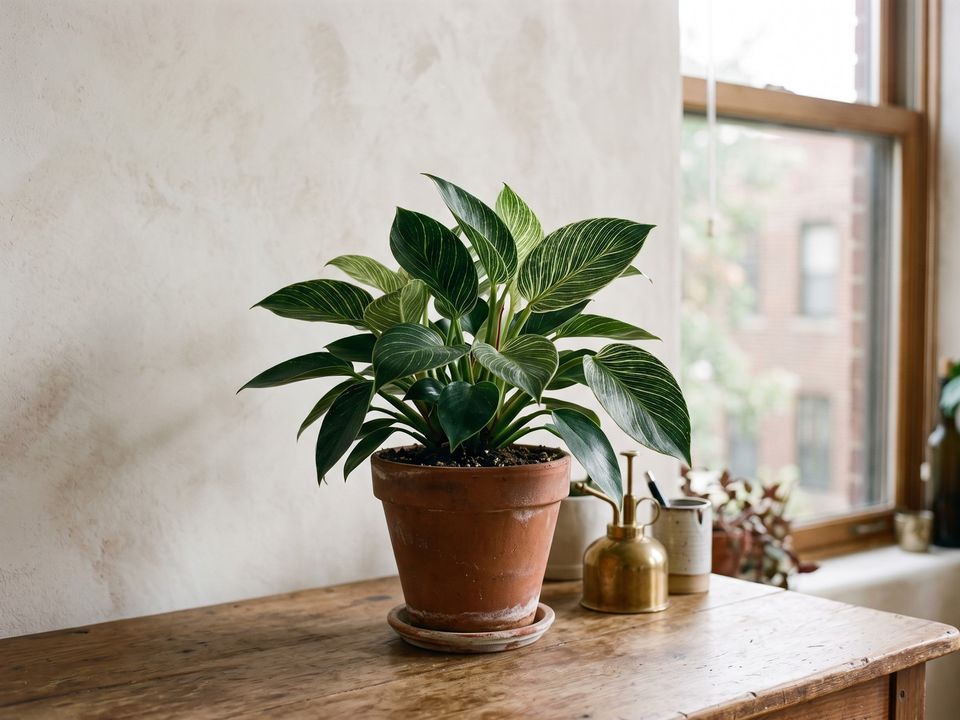
A dense clump of thick, upright stems, 1-3 feet tall and about as wide, and slow to get there. Sized for a desk, a side table, or a shelf with headroom for those stems to stand tall.
It’s what growers call self-heading: instead of vining, it grows from very short stems with its leaves gathered in a tight crown (NC State), so the clump stays put with nothing to climb.
NC State lists its growth as slow, which in practice means one new striped leaf unfurling from the center at a time. Nursery plants often come small, so a 3-foot spread may take years.
That striped crown reads best from above and from every side: the middle of a shared desk, a kitchen island, an end table by the sofa.
: Mildly irritating
Chewing can sting the mouths of dogs, cats, or kids
- DogsMildly irritating
- CatsMildly irritating
- KidsMildly irritating
A chewed leaf may sting and swell the mouth of a dog, cat, or child and bring on drooling; a pet may also vomit. It usually passes, and NC State rates the risk low.
Some sources say kidney or nerve effects are possible, mostly in cats, though that isn’t the usual course.
The sting comes from calcium-oxalate crystals packed into its leaves and stems. Chewed, they can leave the lips, tongue, and throat sore and swollen, and a pet may drool, vomit, or find swallowing hard for a while. It usually settles on its own (NC State rates the overall risk low). The sap can irritate skin, so gloves may help when you trim or repot.
If symptoms don’t settle, or anything worries you, Poison Control can help with a child. For a pet, your vet or the ASPCA Animal Poison Control Center can help (a fee may apply).
Because it stays compact and upright rather than trailing, it’s easy to lift out of reach: a high shelf, the top of a bookcase, a desk the cat doesn’t patrol. With a determined chewer at home, a room behind a closed door may help.
- ASPCA: mild for dogs.
- Merck Veterinary Manual: toxic for dogs (rates the whole genus).
- Pet Poison Helpline: mild for dogs (rates the whole genus).
- ASPCA: mild for cats.
- Merck Veterinary Manual: toxic for cats (rates the whole genus).
- Pet Poison Helpline: mild for cats (rates the whole genus).
- Poison Control: mild for kids.
Cats and dogs: Most of the leading sources agree.
Kids: Poison Control lists it; the effect is mouth pain from oxalate crystals.
: Average
65-85°F; average humidity is fine
Happiest at 65-85°F, and it shouldn’t sit below 59°F. Keep it away from cold glass in winter. It likes 50-60% humidity and gets by at 35%.
- Temperature
- 65-85°F
- Humidity
- 50-60%
: Spider mites
Spider mites, mealybugs, thrips: check leaf undersides
Spider mites and thrips favor the leaf undersides, while mealybugs tuck into leaf axils and the base of each leaf stalk. Scale and aphids come by less often, on stems, veins, and the growing tip. Look at new leaves as they unfurl.
- Spider mites
- Mealybugs
- Banded greenhouse thrips
- Scale insects
- Aphids
Not many. Mealybugs, scale, aphids, and spider mites turn up now and then, and root rot if the soil stays soggy.
Mealybugs look like tufts of white cotton where the leaves meet the stems; scale looks like small brown bumps stuck to the stems and the undersides of the leaves. Wipe both off with a cotton swab dipped in rubbing alcohol (a fingernail lifts scale), then check again next week.
Aphids bunch on a new leaf as it unfurls and leave it sticky. Rinse them off in the shower.
Spider mites leave a faded, speckled look and fine webbing, mostly in warm, dry air. Rinse the whole plant, undersides of the leaves included; if they come back, spray it with insecticidal soap.
Root rot and leaf spot are its diseases. If it wilts while the soil is wet, let it dry out, empty the saucer and water less often. Cut off spotted leaves and keep water off the rest.
: Most
Rotate every 2 weeks; feed monthly April-September
Turn the pot every couple of weeks for even growth, and feed monthly from April to September. Wipe or rinse the leaves 4 times a year, and snip any all-green or red shoots as you spot them. Repot in spring every 2-3 years.
- Feed6× a year
- Rotate26× a year
- Clean leaves4× a year
- Prune1× a year
An ordinary potting mix that drains fast, in a pot with a drainage hole.
Repot when it gets crowded, or when the soil starts drying out much faster than it used to: one pot size up, in spring or summer.
Feed it lightly: a balanced houseplant fertilizer at half strength once or twice a month in spring and summer, and none in winter.
: Suave
Dark green leaves pinstriped in cream, glossy
Deep green leaves carry fine cream pinstripes, and each new one may come in streakier or plainer than the last. The surface is glossy and waxy, and the stems stand close enough to partly hide the soil.
Where to find me
Not yet pilferableFun fact
It was introduced in 2010, and its family tree is still a mystery: it’s believed to be either a rare mutation of the burgundy 'Rojo Congo' or a cross of 'Congo' and 'Imperial Green'.
Designer tips
Crisp and graphic: the pinstriped leaves look drawn by hand, and they suit a modern room.
Troubleshooting
The bottom leaves are turning yellow
Usually too much water, the one thing it won’t forgive. Giving it longer between soaks and emptying the saucer helps; an old leaf yellowing now and then is normal, and it snips off at its base.
Why do the new leaves have so few stripes?
Give it time and light: NC State notes the stripes grow bolder as the plant matures, so a young plant’s leaves are often plainer. A spot a few feet from a window helps; in a dim corner the stripes fade.
It’s putting out solid green or reddish leaves
It may be reverting: 'Birkin' likely began as a sport of the red-leaved 'Rojo Congo' (per NC State), and a stem can slip back. Keep it if you like the mix, or cut a stem that keeps coming in plain off at its base.
See all 8
Why are the leaf edges turning brown?
Dry air, most often in a heated winter room; NC State links brown tips to it, and dry soil or sun on the leaves can do it too. A humidifier or pebble tray nearby helps if the edges bother you, and it grows on regardless.
Why hasn’t it grown in months?
It’s slow by nature, one new leaf from the center at a time, and slower still in winter or a dim spot. More light and a little food from April to September help; extra water doesn’t.
Fine webbing under the leaves
Spider mites, its most common pest, mostly in warm, dry air. A rinse in the shower, undersides included, usually clears them; insecticidal soap is the next step if they come back.
My cat chewed a leaf
It’s mildly irritating: calcium-oxalate crystals in the sap can leave a sore, drooly mouth and maybe some vomiting, and NC State rates the risk low. If your cat struggles to swallow or keeps vomiting, call your vet or the ASPCA Animal Poison Control Center.
Can it go outside for the summer?
Yes, in shade: a porch or under a tree, where sun can’t reach the leaves. Bring it in before nights cool below about 60°F, and check it for bugs on the way in.
Propagation
Yes, slowly: from a piece of stem or an offset.
- Cut a section of stem with at least two nodes (the rings where leaves grew) and stand it in water or damp perlite.
- Roots start in 10-21 days, and a dip in rooting hormone speeds things up.
Or, when you repot, pull off a young offset growing beside the main stem, with roots of its own, and pot it up.
The PILF Matrix
2.9/5
how easy it is to care for
3.2/5
how much it stands out visually
“The one that’s Birkin on the streets but budget on the (spread)sheets.”


Rated 1-5, with 5 being easiest
Built from light, water, air, pests, and upkeep.
Rated 1-5, with 5 being easiest
Rated 1-5, with 5 being highest presence
Built from its scale (size, shape, growth) and its look (color and flowers, shine, fullness).
Rated 1-5, with 5 being highest presence
Where it sits and what sun touches it.
- Dim shadeA dark corner or a windowless room; natural light casts no shadow
- Bright shadeBack from the window in a south-, east- or west-facing room, or right by a north-facing one, where only low early or late summer sun reaches it
- Filtered sunBehind a sheer curtain or tinted glass; the sun’s shadows are blurred
- Partial sunIn an east- or west-facing window: up to a few hours of direct sun
- Full sunThe sunniest spot you have, usually a south-facing window, with direct sun 6+ hours a day
How often, and what the soil does between.
- MonthlyEvery 2-3 weeks in summer and 3-5 in winter; the soil dries all the way between
- 2-3× a monthEvery 7-14 days in summer, longer in winter; the top of the soil dries between
- Weekly+About every 4-8 days in summer; the soil stays lightly damp
How much room it usually takes indoors.
Size
- TinyUnder 6 inches tall or wide; for a desk or a sill
- Small6 inches to 1.5 feet tall or wide; for a shelf or a sill
- Medium1.5 to 3 feet tall or wide; for a table or a stand
- Large3 to 6 feet tall or wide; for the floor
- GiantOver 6 feet tall or wide; a statement in the corner
Shape
- TreeA trunk that branches into a canopy
- CaneBare stalks topped with leaves
- UprightStiff stems or leaves rising straight from the soil
- FountainLeaves or fronds arching out from the center
- BushyA full, rounded mound of leaves
- RosetteLeaves radiating from one low point
- ViningTrails, climbs, or both
Growth
How fast it gets there.
- SlowUnder 6 inches of new growth a year
- Moderate6-12 inches a year, mostly in spring and summer
- FastOver 12 inches a year; it may want trimming or training
What risks exist for pets and kids.
- Pet & kid safeNothing to worry about
- Mildly irritatingMay irritate the mouth or stomach if chewed, or for some plants, the skin if handled
- Moderately toxicCan cause illness if eaten, though typically not serious or fatal
- DangerousCan cause serious illness if eaten, including some reports of death
- Not yet ratedNot clearly rated by our sources; please check with your vet or doctor
For its safety ratings, PILF relies on research and guidance from leading sources, including the ASPCA, Pet Poison Helpline, Merck Veterinary Manual, Poison Control, and Children’s Hospital of Philadelphia, and others.
The small jobs beyond watering, over a year.
- Little upkeepA few small jobs a year beyond watering, like a feed now and then
- Some upkeepA small job about once a month beyond watering, like feeding or turning it
- More upkeepA small job every couple of weeks beyond watering, like a wipe, a turn, or a feed
- Most upkeepA small job most weeks beyond watering, like raising the humidity or misting
- TreeA trunk that branches into a canopy
- CaneBare stalks topped with leaves
- UprightStiff stems or leaves rising straight from the soil
- FountainLeaves or fronds arching out from the center
- BushyA full, rounded mound of leaves
- RosetteLeaves radiating from one low point
- ViningTrails, climbs, or both
How fast it gets there.
- SlowUnder 6 inches of new growth a year
- Moderate6-12 inches a year, mostly in spring and summer
- FastOver 12 inches a year; it may want trimming or training
The temperature and humidity it’s comfortable in.
How dry a room it takes.
- Needs 50%+ humidity
- Fine at 35% humidity
- Fine at 15-20% humidity
The bugs that usually find it, by name.
How often pests find it.
- 5+ regular pests
- 3 regular pests
- Pests are rare
The year’s chores: feeding, pruning, repotting, and cleaning.
Chores beyond water (what needs work means).
- Most upkeep
- Some upkeep
- Little upkeep
Its finish, fullness, and texture.
Color, pattern, and flowers.
- SimpleOne green, one texture, nothing to read
- SuaveA sheen, a stripe, or a clean shape that catches the eye up close
- ShowyColor, pattern, or blooms you see from across the room
How the leaves catch light.
- Matte
- Satin
- Glossy or waxy
How much it fills its pot.
- Soil shows
- Soil partly hidden
- Leaves hide the soil