Pink Princess Philodendron
Philodendron 'Pink Princess'
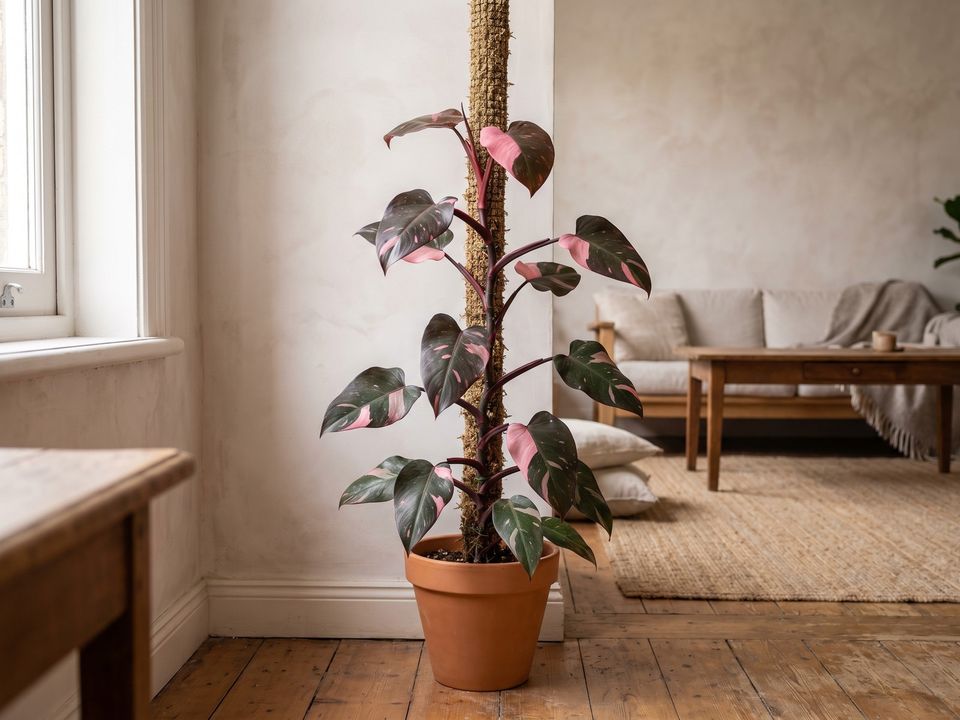
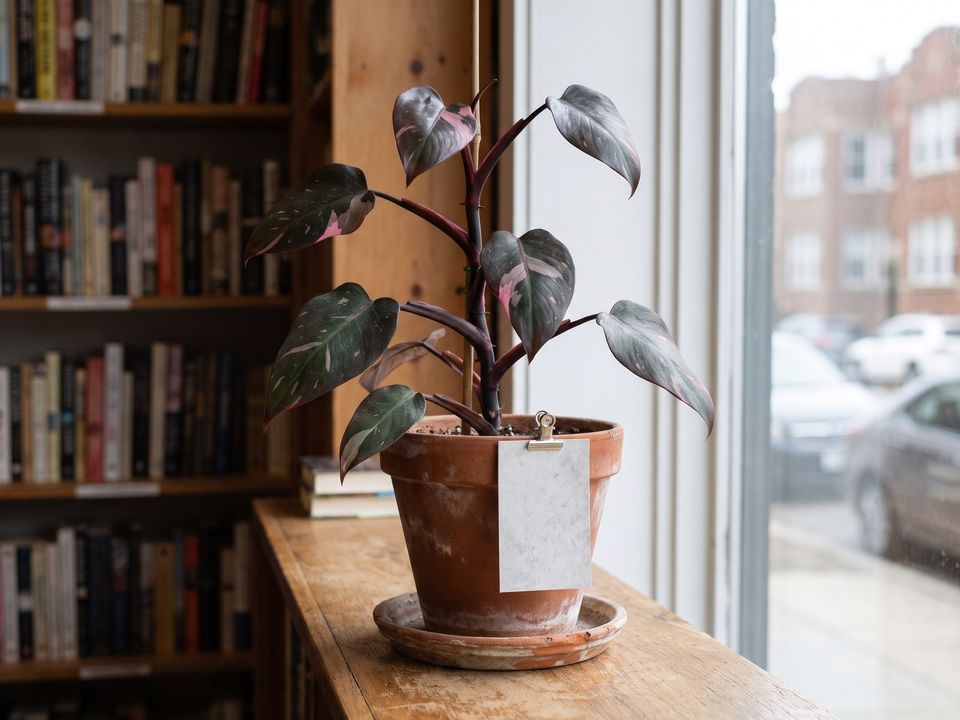
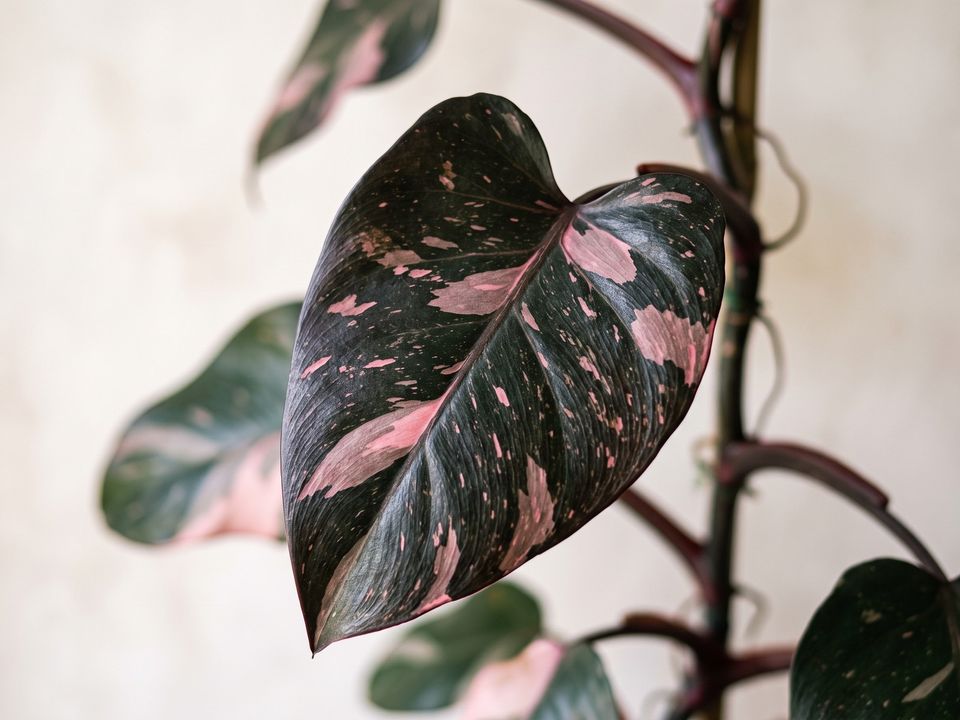
Dark leaves splashed bubblegum pink, no two alike. More light keeps the pink coming; too little and it shows less.
2.7/5
how easy it is to care for
3.6/5
how much it stands out visually
: Shade to filtered
Near a window, out of the sun; less light, less pink
Its pink runs on light: close to a bright window but out of direct sun, the splashes stay bold. Given less, it gets by, with greener leaves and longer, leggier stems.
Light decides how much pink you get. In too much shade, Missouri Botanical Garden notes, its variegation fades, and the bold splashes may shrink to the odd fleck of blush on a dark leaf.
An east window, set back from the glass, keeps it bright without the direct sun NC State advises it avoid. Facing south or west, a sheer curtain softens the light enough. A north window works if it sits right at the sill.
Its pink patches make no chlorophyll (University of Florida Extension), so every splash is fed by the green around it. Give it the brightest sunless spot you have; the princess is worth the window.
: 2-3× a month
Keep it evenly moist, never soggy or standing in water
Every 7-10 days in summer, 10-14 in winter, letting it dry a little between. A pot that stays wet can cause root rot, and waterlogging can dull its pink.
Now and then a philodendron beads sticky droplets on its leaves. The RHS reads these as a sign its conditions could be better, so check its spot and ease off the water a little if the pot has been staying wet.
If dry winter air seems to wear on its leaves and that bothers you, NC State suggests a humidifier, though philodendrons usually adapt to an average home. It’ll survive either way.
Gone for a while? Two weeks is fine if it’s watered the day you leave.
: Large
Slowly climbs to 3-4 feet on a pole, or trails instead
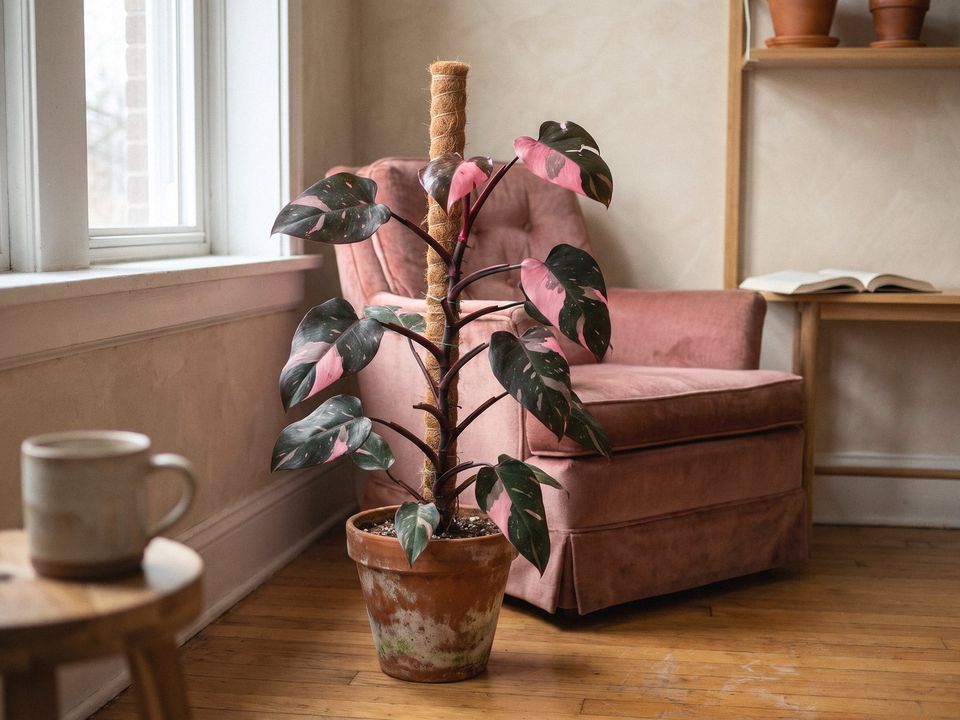
A slow climber with leaves up to 8 inches long that reaches 3-4 feet on a moss pole, or trails instead. Give it the pole early and tie in each pink-splashed leaf as it climbs, keeping the newest color facing the room.
Every so often a stem comes in solid green, and that’s the one to watch: plain green growth outpaces the pink (University of Illinois). Cutting it back to the last leaf that still shows pink keeps the color in charge (Missouri Botanical Garden). A trimmed stem with a leaf or two can root in its own pot (NC State recommends stem cuttings).
Growth is slow (MBG), so a new leaf now and then is its normal pace, not a sign something’s wrong. It spreads about 1-2 feet wide (MBG), so a spot beside a bright window gives it room, close enough that each new splash gets noticed.
: Mildly irritating
Chewing can sting the mouths of dogs, cats, or kids
- DogsMildly irritating
- CatsMildly irritating
- KidsMildly irritating
A bite may bring mouth pain, swelling, drooling, or vomiting, from needle-like calcium oxalate crystals; it usually passes. The ASPCA lists it as toxic to dogs and cats, though cases are usually mild.
Some sources note kidney or nerve effects are possible, mostly in cats, but that isn’t the usual course.
Its sap carries the same irritation to skin (NC State), so gloves help when you prune or take cuttings.
For a pet with a sore mouth, remove any plant bits, flush the mouth with water, and offer broth or tuna juice to rinse the crystals away (Texas A&M AgriLife). A child’s sore mouth usually settles too. If drooling or trouble swallowing doesn’t ease, or anything worries you, call your vet, the ASPCA Animal Poison Control Center (a fee may apply), or Poison Control.
Its climbing habit can work in your favor. Trained up a moss pole on a tall stand, its leaves sit higher than most dogs reach. With a cat who leaps or a toddler who grabs, a room they rarely visit keeps the leaves out of reach.
- ASPCA: mild for dogs.
- Merck Veterinary Manual: toxic for dogs (rates the whole genus).
- Pet Poison Helpline: mild for dogs (rates the whole genus).
- ASPCA: mild for cats.
- Merck Veterinary Manual: toxic for cats (rates the whole genus).
- Pet Poison Helpline: mild for cats (rates the whole genus).
- Poison Control: mild for kids.
Cats and dogs: Most of the leading sources agree.
Kids: Poison Control lists it; the effect is mouth pain from oxalate crystals.
: Average
65-85°F; average humidity is fine
Happiest at 65-85°F, and it shouldn’t sit below 59°F. Keep it away from cold glass in winter. It likes 60-100% humidity and gets by at 35%.
- Temperature
- 65-85°F
- Humidity
- 60-100%
: Spider mites
Spider mites and scale; check leaf undersides and stems
Spider mites hide on leaf undersides, and scale clings to stems, leaf stalks, and midribs. Mealybugs lurk in leaf axils, sheaths, and new growth, aphids on new shoots, and thrips under leaves. Look closely at each.
- Spider mites
- Scale insects
- Mealybugs
- Aphids
- Banded greenhouse thrips
Not many. NC State names spider mites, mealybugs, aphids, and scale, plus root rot and leaf spot from too much water.
Spider mites leave fine webbing and pale speckles, mostly in warm, dry air; mealybugs look like tufts of white cotton where the leaves meet the stem; scale looks like small brown bumps; aphids cluster on new growth. Rinse the plant in the shower, undersides of the leaves included, and wipe off what’s left with a cotton swab dipped in rubbing alcohol. If they come back, an insecticidal soap spray is the next step.
Root rot shows as yellowing, drooping leaves while the soil is still wet: let it dry more between soaks, empty the saucer, and water less often. Leaf spot leaves brown spots where water sat on the leaves; cut the worst ones off and water the soil, not the plant.
: Some
Wipe quarterly, feed monthly in summer, tie up stems
Wipe the leaves 4 times a year and check the undersides for mites. Feed monthly in spring and summer, tie new growth to a pole as stems lengthen, and cut out all-green stems. Repot every 2-3 years.
- Feed6× a year
- Prune2× a year
- Stake4× a year
- Clean leaves4× a year
A pot with a drainage hole and a rich potting mix that drains fast. Set a moss pole or stake in at potting time, so you don’t disturb the roots later.
Repot when the roots crowd the pot, or when the soil dries out within days of a soak, one pot size up, in spring or summer (Iowa State).
A balanced houseplant fertilizer at half strength, once or twice a month in spring and summer, keeps it growing (Iowa State, UConn). Too much browns and curls the leaf tips (Clemson).
: Suave
Dark glossy leaves splashed bubblegum pink
Each deep green leaf carries its own splashes of pink, so no two match. The surface is glossy and waxy, and the plant grows full enough to cover some of the soil but not all of it.
Where to find me
Not yet pilferableFun fact
In Colombia, its species clings its way up trees as high as 60 feet. In your living room, the tallest tree it will ever meet is a moss pole, with each new pink leaf a rung higher.
Designer tips
Dark leaves splashed with bubblegum pink: a showpiece for a bright, modern room.
Troubleshooting
The new leaves are coming in all green
Usually too little light: in a dim spot, variegated plants tend to put out solid green leaves (UMN Extension). A brighter spot helps, and a stem that keeps making plain leaves can be cut back to the last leaf with pink, since it would otherwise outgrow the rest (Illinois Extension).
Why are the leaves turning yellow?
Usually too much water or too little light (Clemson). If the soil is still wet days after a soak, give it longer between waterings and empty the saucer; otherwise, try a spot closer to the window.
Does it need a moss pole?
Not strictly, but it’s a climber: with a pole, stake or small trellis it grows up instead of sprawling (NC State), and its aerial roots grab on. Tie the stem loosely as it goes.
See all 9
Brown spots on the leaves
Most often water left sitting on them, which NC State links to leaf spot; pour at the soil instead and trim the worst leaves if you like. Pale, crisp patches on the window side are sunburn, and a step back from the glass sorts that out.
What are the brown roots growing from the stem?
Aerial roots, and they’re normal: they’re how it climbs. Guide them onto the pole or tuck them into the pot.
The leaf tips are curling and brown
Too much fertilizer, most often (Clemson). Plenty of plain water run through the pot and lighter feeding help, and the brown bits trim off if they bother you.
Why is it growing so slowly?
That’s its pace: growth is slow (Missouri Botanical Garden), so a new leaf now and then is normal, not a sign something’s wrong. Good light keeps those new leaves pink.
My cat chewed a leaf
Expect drooling and a sore mouth from calcium oxalate crystals, maybe some vomiting: it’s mildly irritating, and the ASPCA notes cases are usually mild. If it keeps vomiting, can’t swallow or seems unwell, call your vet or the ASPCA Animal Poison Control Center.
My toddler bit a leaf
A sore, maybe swollen mouth and some drooling are likely, from the same oxalate crystals: it’s mildly irritating (Poison Control), and it usually settles. If drooling or trouble swallowing doesn’t ease, call Poison Control.
Propagation
Yes, from stem cuttings.
- Cut a piece of stem with at least two nodes (the bumps where leaves and aerial roots grow) and a leaf or two, from a stem whose leaves show good pink.
- Root it in a glass of water or damp potting mix (Iowa State); it roots in three to six weeks, and it’s ready to pot once the roots are an inch or two long.
The PILF Matrix
2.7/5
how easy it is to care for
3.6/5
how much it stands out visually
“The one in pink and smarter than it looks: Elle Woods in plant form.”


- blushing philodendron
Rated 1-5, with 5 being easiest
Built from light, water, air, pests, and upkeep.
Rated 1-5, with 5 being easiest
Rated 1-5, with 5 being highest presence
Built from its scale (size, shape, growth) and its look (color and flowers, shine, fullness).
Rated 1-5, with 5 being highest presence
Where it sits and what sun touches it.
- Dim shadeA dark corner or a windowless room; natural light casts no shadow
- Bright shadeBack from the window in a south-, east- or west-facing room, or right by a north-facing one, where only low early or late summer sun reaches it
- Filtered sunBehind a sheer curtain or tinted glass; the sun’s shadows are blurred
- Partial sunIn an east- or west-facing window: up to a few hours of direct sun
- Full sunThe sunniest spot you have, usually a south-facing window, with direct sun 6+ hours a day
How often, and what the soil does between.
- MonthlyEvery 2-3 weeks in summer and 3-5 in winter; the soil dries all the way between
- 2-3× a monthEvery 7-14 days in summer, longer in winter; the top of the soil dries between
- Weekly+About every 4-8 days in summer; the soil stays lightly damp
How much room it usually takes indoors.
Size
- TinyUnder 6 inches tall or wide; for a desk or a sill
- Small6 inches to 1.5 feet tall or wide; for a shelf or a sill
- Medium1.5 to 3 feet tall or wide; for a table or a stand
- Large3 to 6 feet tall or wide; for the floor
- GiantOver 6 feet tall or wide; a statement in the corner
Shape
- TreeA trunk that branches into a canopy
- CaneBare stalks topped with leaves
- UprightStiff stems or leaves rising straight from the soil
- FountainLeaves or fronds arching out from the center
- BushyA full, rounded mound of leaves
- RosetteLeaves radiating from one low point
- ViningTrails, climbs, or both
Growth
How fast it gets there.
- SlowUnder 6 inches of new growth a year
- Moderate6-12 inches a year, mostly in spring and summer
- FastOver 12 inches a year; it may want trimming or training
What risks exist for pets and kids.
- Pet & kid safeNothing to worry about
- Mildly irritatingMay irritate the mouth or stomach if chewed, or for some plants, the skin if handled
- Moderately toxicCan cause illness if eaten, though typically not serious or fatal
- DangerousCan cause serious illness if eaten, including some reports of death
- Not yet ratedNot clearly rated by our sources; please check with your vet or doctor
For its safety ratings, PILF relies on research and guidance from leading sources, including the ASPCA, Pet Poison Helpline, Merck Veterinary Manual, Poison Control, and Children’s Hospital of Philadelphia, and others.
The small jobs beyond watering, over a year.
- Little upkeepA few small jobs a year beyond watering, like a feed now and then
- Some upkeepA small job about once a month beyond watering, like feeding or turning it
- More upkeepA small job every couple of weeks beyond watering, like a wipe, a turn, or a feed
- Most upkeepA small job most weeks beyond watering, like raising the humidity or misting
- TreeA trunk that branches into a canopy
- CaneBare stalks topped with leaves
- UprightStiff stems or leaves rising straight from the soil
- FountainLeaves or fronds arching out from the center
- BushyA full, rounded mound of leaves
- RosetteLeaves radiating from one low point
- ViningTrails, climbs, or both
How fast it gets there.
- SlowUnder 6 inches of new growth a year
- Moderate6-12 inches a year, mostly in spring and summer
- FastOver 12 inches a year; it may want trimming or training
The temperature and humidity it’s comfortable in.
How dry a room it takes.
- Needs 50%+ humidity
- Fine at 35% humidity
- Fine at 15-20% humidity
The bugs that usually find it, by name.
How often pests find it.
- 5+ regular pests
- 3 regular pests
- Pests are rare
The year’s chores: feeding, pruning, repotting, and cleaning.
Chores beyond water (what needs work means).
- Most upkeep
- Some upkeep
- Little upkeep
Its finish, fullness, and texture.
Color, pattern, and flowers.
- SimpleOne green, one texture, nothing to read
- SuaveA sheen, a stripe, or a clean shape that catches the eye up close
- ShowyColor, pattern, or blooms you see from across the room
How the leaves catch light.
- Matte
- Satin
- Glossy or waxy
How much it fills its pot.
- Soil shows
- Soil partly hidden
- Leaves hide the soil