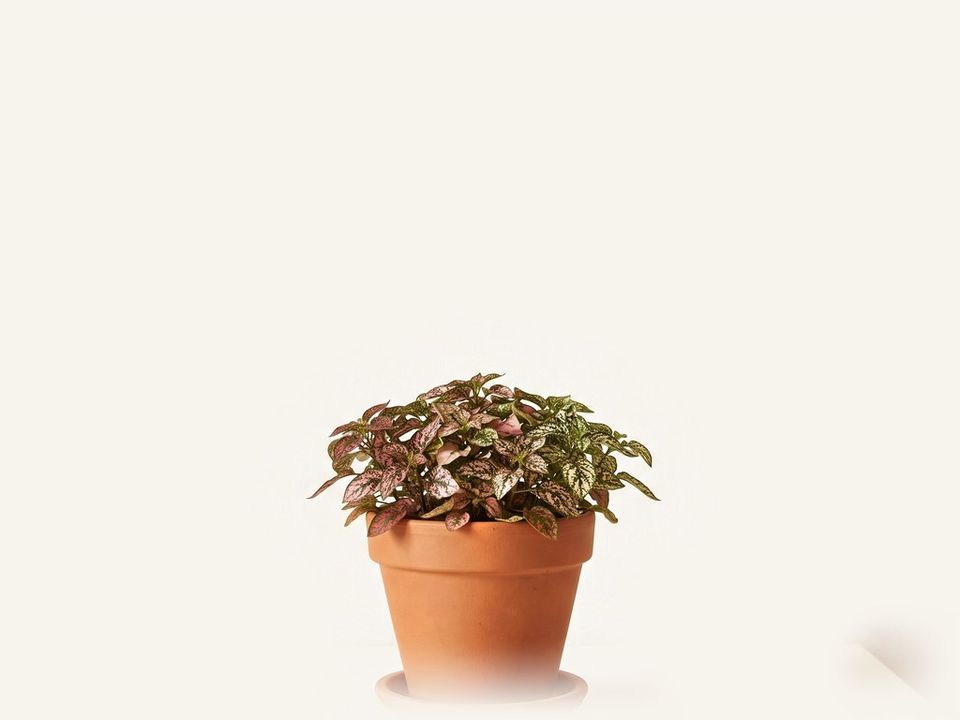
Polka Dot Plant
Hypoestes phyllostachya
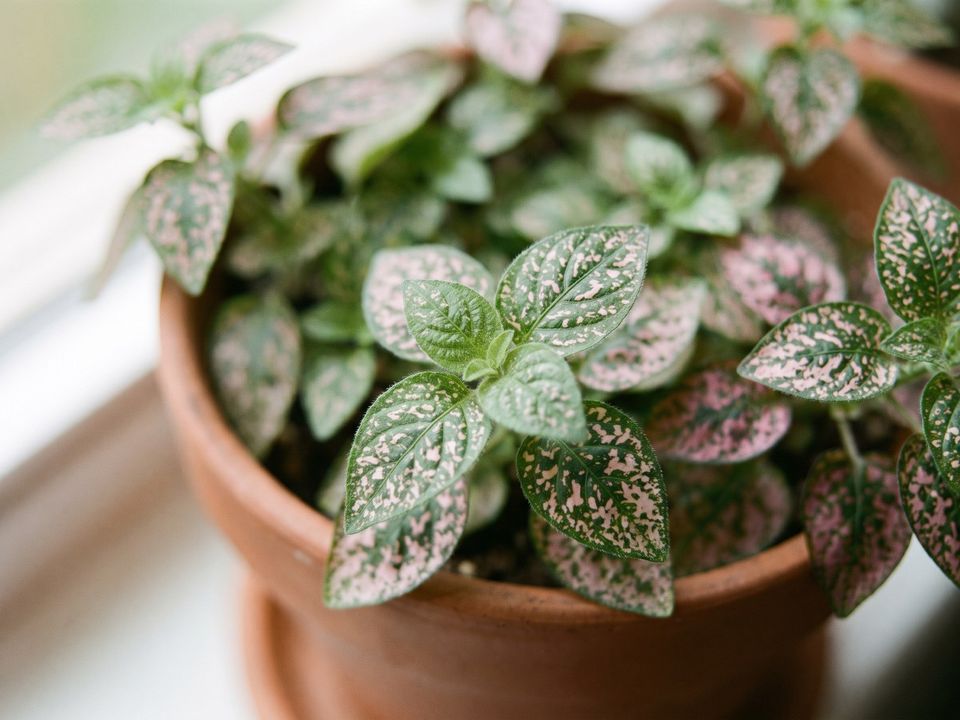
Small, soft oval leaves freckled pink, red, or white in a low mound. Known for its dots, and for getting leggy unless you pinch it.
1.5/5
how easy it is to care for
2.9/5
how much it stands out visually
: Filtered sun
Behind a sheer at a bright window; dots fade in dim light
A sheer curtain or frosted glass at a bright window keeps its dots vivid, and an east window suits it well. Some direct sun is fine, though too much crinkles the leaves; in dim light the dots fade and stems stretch.
Too much sun makes the leaves crinkle and curl, per NC State Extension; too little and the color fades while the stems stretch.
An east window is ideal, or a few feet back from a south or west one.
: Weekly+
Every 3-5 days in summer; the soil stays lightly damp
Thirstier than most, it takes water every 3-5 days in summer and about every 5-8 in winter, so the soil stays lightly damp. It droops fast once it dries, and a good soak usually brings it right back.
Water until it runs out the bottom, then empty the saucer. Let the top of the soil dry just slightly between soaks, which takes 5-7 days in most rooms; soggy soil rots the roots.
Gone for a while? A week is about its limit: soak it the day you leave, and for longer trips, ask a friend to water it.
: Small
A fast, bushy mound about 1-1.5 feet tall
It grows fast into a dense, rounded mound, about 1-1.5 feet tall indoors when you keep it pinched. Left alone it stretches and gets leggy with age, sooner in low light.
Growth is fast, and it gets leggy as it ages, especially in low light. Pinch the stem tips back every few weeks in spring and summer to keep it bushy, and pinch off the little lilac flower spikes too, so it spends its energy on leaves.
: Pet & kid safe
Nothing harmful for dogs, cats, or kids
- DogsSafe
- CatsSafe
- KidsNot yet rated
Nothing harmful here: the ASPCA lists it as non-toxic to dogs and cats, and UC ANR puts it on its safe-plant list for kids. A pet that eats a lot may get a mildly upset stomach, and that’s all.
Kids too: Hypoestes is on the University of California’s list of safe plants. The ASPCA’s only listed signs are mild vomiting and diarrhea.
Cats and dogs: The ASPCA lists it as non-toxic.
Kids: No child poison-centre listing names it.
: Average
50-80°F, growing best above the low 60s; 40%+ humidity
Anywhere from 50-80°F works, though it barely grows until the room passes the low 60s, so keep it clear of cold drafts and frosty glass. It likes 40% humidity or more, and a humidifier nearby helps in winter.
- Temperature
- 50-80°F
- Humidity
- 40%+
: Aphids, mealybugs
Aphids on the tips; mealybugs where leaves meet stems
Aphids bunch on the stem tips and leave the leaves sticky, and mealybugs sit like white cotton where leaves meet stems. Whiteflies flutter up when you brush it, and powdery mildew can dust the leaves white.
- Aphids
- Mealybugs
- Whiteflies
- Powdery mildew
A few. Aphids, mealybugs, and whiteflies can turn up, powdery mildew sometimes dusts the leaves, and root rot follows soggy soil.
Aphids are small, soft bugs bunched on the tips, and they leave the leaves sticky; mealybugs look like tufts of white cotton where the leaves meet the stems. Rinse aphids off in the shower, and wipe mealybugs away with a cotton swab dipped in rubbing alcohol.
Whiteflies are tiny white insects that flutter up when you brush the plant. Wash the plant, then spray it with insecticidal soap, undersides of the leaves included.
Powdery mildew looks like white powder dusted on the leaves. Pinch off the worst leaves and give the plant a little more room and air.
Root rot shows as wilting that doesn’t lift after a soak, with the soil still wet. Let it dry a little and water less often.
: More
Pinch the tips often; feed it lightly in the warm months
Pinch the stem tips every few weeks in spring and summer, snip off the lilac flower spikes, and feed it lightly in the warm months. Repot each spring, or root tip cuttings once a year to start a fresh plant.
- Pinch back12× a year
- Feeding6× a year
- Remove flower spikes3× a year
- Restart from cuttings1× a year
- Repot1× a year
A rich, peat- or compost-based potting mix that still drains fast, in a pot with a drainage hole.
Repot when the roots fill the pot, often every spring. An old, leggy plant is often easier to replace with rooted tip cuttings than to repot (see Propagation).
Feed it lightly: a diluted liquid houseplant fertilizer now and then in spring and summer, and none in winter.
: Suave
Soft, matte leaves freckled pink, red, or white
Soft, matte oval leaves about 2 inches long, freckled pink, red or white, pile into a low mound that hides the soil. Small lilac flower spikes rise now and then.
Where to find me
Not at PILF places
Fun fact
Its seed leaves come up plain green; only the first true leaves show the pink spots.
Designer tips
Playful and graphic: a freckled mound of pink, red, or white that brightens a desk or a mixed planter.
Troubleshooting
It wilts every few days
That’s thirst: it droops fast once the soil dries, often within 3-5 days in summer. A good soak usually brings it right back; if the soil is wet and it’s still wilting, the roots may be rotting, so water less often.
Why is it getting leggy and floppy?
Age and light, usually both: it stretches as it gets older, and faster in a dim spot. Move it nearer a window and pinch each stem tip back by a few leaves, and it bushes out again; the tips root in water for a fresh plant.
The dots are fading
It wants more light. Move it closer to a bright window, behind a sheer if the sun is strong, and the new leaves usually come in brighter.
See all 9
Why are the leaves brown and crispy?
Dry soil, dry air, or too much sun, usually. Keep the soil lightly damp, move it back from strong sun on the leaves, and in winter a humidifier nearby helps.
Little bugs bunched on the tips
Likely aphids: small, soft bugs that gather on new growth and leave the leaves sticky. A rinse in the shower usually clears them.
Should I let it flower?
Your call; the lilac spikes are small. NC State Extension suggests cutting them off so the plant puts its energy into its leaves, and pinching them keeps it bushier too.
My cat chewed it
Nothing harmful there: the ASPCA lists polka dot plant as non-toxic to cats and dogs. A big helping might bring some mild vomiting or diarrhea, and that’s all it lists.
Can it go outside for the summer?
Yes, in part shade. UW-Madison Extension waits until nights stay above 50°F before setting it out; bring it back in before fall nights cool off, and check it for bugs first.
I’m going away for a week
A week is about its limit, so soak it the day you leave. For longer trips, ask a friend to water it.
Propagation
Easily, and it’s the best way to renew a leggy plant.
- Snip a stem tip a few inches long, pull off the lower leaves, and stand it in a glass of water in a bright spot or stick it in damp potting mix; roots come quickly.
- Pot several together for a full plant.
It also grows from seed, which UW–Madison Extension says can sprout in as little as four days in a warm room.
The PILF Matrix
1.5/5
how easy it is to care for
2.9/5
how much it stands out visually
“The one that’s cute for a month, then all legs.”


- measles plant
Rated 1-5, with 5 being easiest
Built from light, water, air, pests, and upkeep.
Rated 1-5, with 5 being easiest
Rated 1-5, with 5 being highest presence
Built from its scale (size, shape, growth) and its look (color and flowers, shine, fullness).
Rated 1-5, with 5 being highest presence
Where it sits and what sun touches it.
- Dim shadeA dark corner or a windowless room; natural light casts no shadow
- Bright shadeBack from the window in a south-, east- or west-facing room, or right by a north-facing one, where only low early or late summer sun reaches it
- Filtered sunBehind a sheer curtain or tinted glass; the sun’s shadows are blurred
- Partial sunIn an east- or west-facing window: up to a few hours of direct sun
- Full sunThe sunniest spot you have, usually a south-facing window, with direct sun 6+ hours a day
How often, and what the soil does between.
- MonthlyEvery 2-3 weeks in summer and 3-5 in winter; the soil dries all the way between
- 2-3× a monthEvery 7-14 days in summer, longer in winter; the top of the soil dries between
- Weekly+About every 4-8 days in summer; the soil stays lightly damp
How much room it usually takes indoors.
Size
- TinyUnder 6 inches tall or wide; for a desk or a sill
- Small6 inches to 1.5 feet tall or wide; for a shelf or a sill
- Medium1.5 to 3 feet tall or wide; for a table or a stand
- Large3 to 6 feet tall or wide; for the floor
- GiantOver 6 feet tall or wide; a statement in the corner
Shape
- TreeA trunk that branches into a canopy
- CaneBare stalks topped with leaves
- UprightStiff stems or leaves rising straight from the soil
- FountainLeaves or fronds arching out from the center
- BushyA full, rounded mound of leaves
- RosetteLeaves radiating from one low point
- ViningTrails, climbs, or both
Growth
How fast it gets there.
- SlowUnder 6 inches of new growth a year
- Moderate6-12 inches a year, mostly in spring and summer
- FastOver 12 inches a year; it may want trimming or training
What risks exist for pets and kids.
- Pet & kid safeNothing to worry about
- Mildly irritatingMay irritate the mouth or stomach if chewed, or for some plants, the skin if handled
- Moderately toxicCan cause illness if eaten, though typically not serious or fatal
- DangerousCan cause serious illness if eaten, including some reports of death
- Not yet ratedNot clearly rated by our sources; please check with your vet or doctor
For its safety ratings, PILF relies on research and guidance from leading sources, including the ASPCA, Pet Poison Helpline, Merck Veterinary Manual, Poison Control, and Children’s Hospital of Philadelphia, and others.
The small jobs beyond watering, over a year.
- Little upkeepA few small jobs a year beyond watering, like a feed now and then
- Some upkeepA small job about once a month beyond watering, like feeding or turning it
- More upkeepA small job every couple of weeks beyond watering, like a wipe, a turn, or a feed
- Most upkeepA small job most weeks beyond watering, like raising the humidity or misting
- TreeA trunk that branches into a canopy
- CaneBare stalks topped with leaves
- UprightStiff stems or leaves rising straight from the soil
- FountainLeaves or fronds arching out from the center
- BushyA full, rounded mound of leaves
- RosetteLeaves radiating from one low point
- ViningTrails, climbs, or both
How fast it gets there.
- SlowUnder 6 inches of new growth a year
- Moderate6-12 inches a year, mostly in spring and summer
- FastOver 12 inches a year; it may want trimming or training
The temperature and humidity it’s comfortable in.
How dry a room it takes.
- Needs 50%+ humidity
- Fine at 35% humidity
- Fine at 15-20% humidity
The bugs that usually find it, by name.
How often pests find it.
- 5+ regular pests
- 3 regular pests
- Pests are rare
The year’s chores: feeding, pruning, repotting, and cleaning.
Chores beyond water (what needs work means).
- Most upkeep
- Some upkeep
- Little upkeep
Its finish, fullness, and texture.
Color, pattern, and flowers.
- SimpleOne green, one texture, nothing to read
- SuaveA sheen, a stripe, or a clean shape that catches the eye up close
- ShowyColor, pattern, or blooms you see from across the room
How the leaves catch light.
- Matte
- Satin
- Glossy or waxy
How much it fills its pot.
- Soil shows
- Soil partly hidden
- Leaves hide the soil