Purple Shamrock
Oxalis triangularis
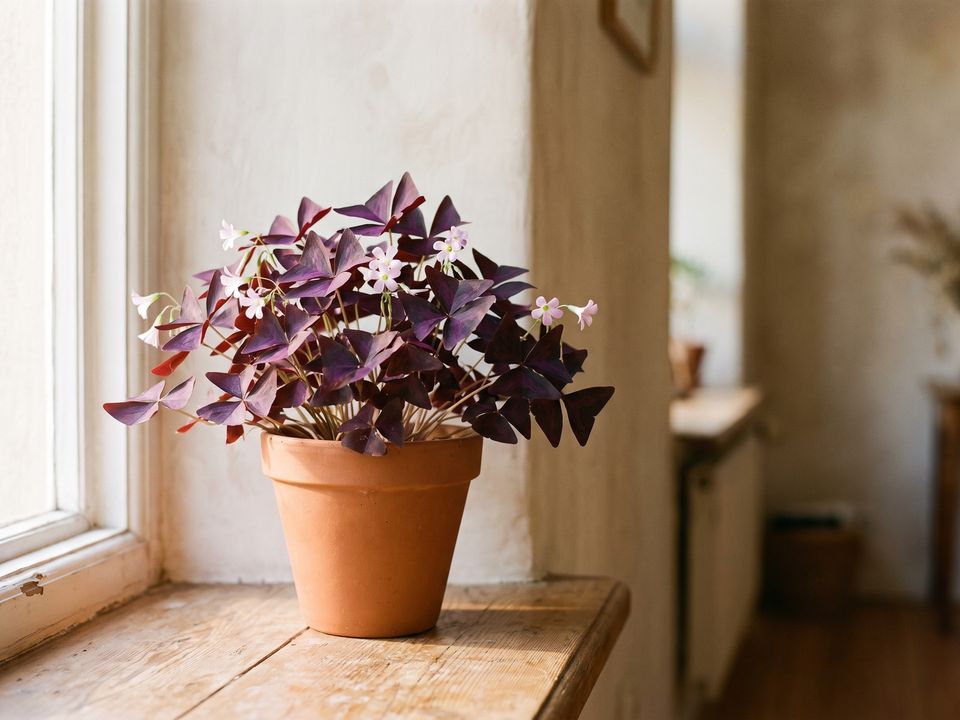
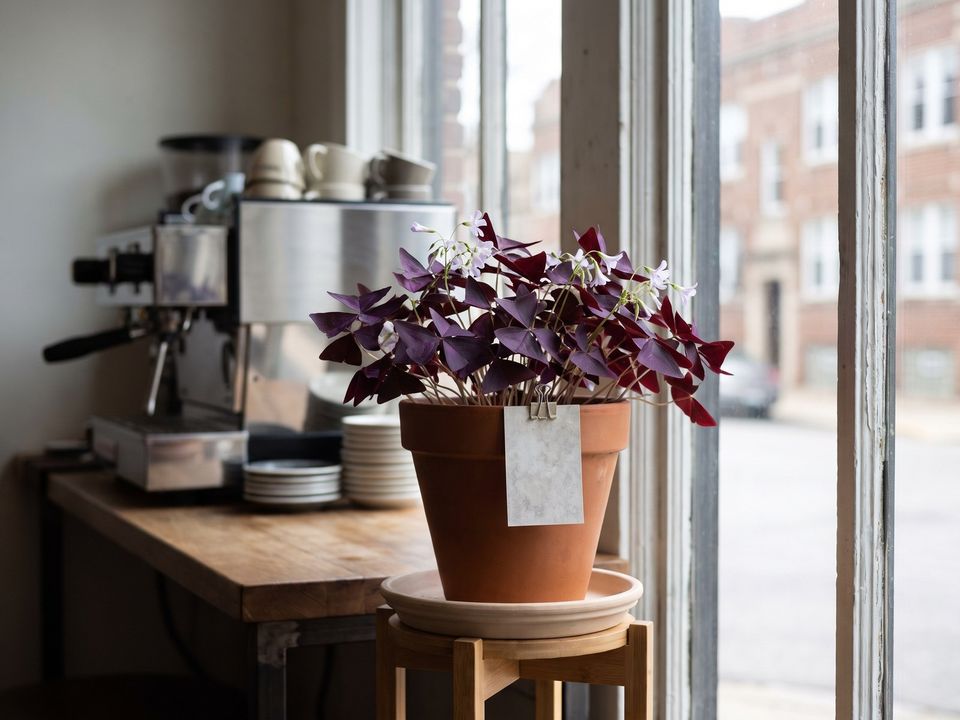
Triangular leaflets in deep purple, on stalks as thin as wire. Wants some sun and takes the odd nap, then comes back.
2.9/5
how easy it is to care for
3.5/5
how much it stands out visually
: Shade to part sun
A bright, cool window keeps it full; shade stretches it
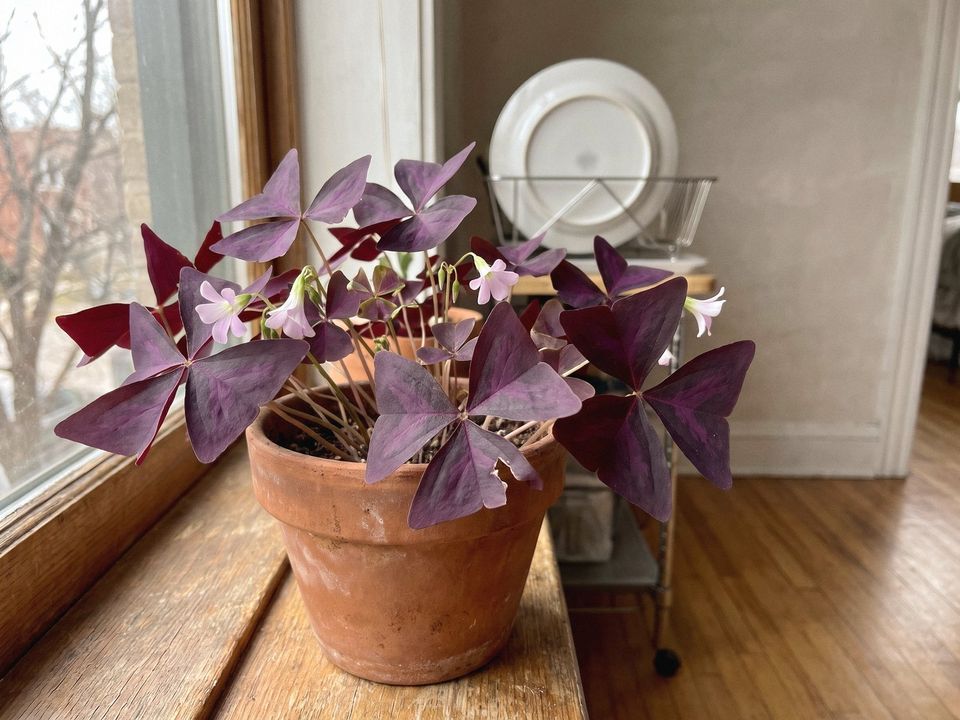
Morning or afternoon sun from a cool east or west window keeps it at its best. Bright light without sun will do, though its stems may stretch toward the glass.
Its leaflets work as a light gauge. On overcast days they can fold partway, much as they do after dark (Penn State Extension calls the habit nyctinasty). Through gray winter weeks that’s normal, but a plant that stays half-shut on bright days may simply want a sunnier sill.
In a south window, ease the dose: set it back from the pane, or draw a sheer, so the leaflets open to softened sun.
Keep that sill cool, though. Oxalis like cool conditions, especially in bloom (Penn State Extension), and NC State gives the genus a comfort range of 50-75°F, so a sill over a heater may run too warm for it.
Half-shut leaflets at noon are its way of asking for more.
: 2-3× a month
Let the surface dry between drinks
About every 7-10 days while it grows, stretching to 10-14 in winter, with the surface dry between. Soggy soil costs the most: NC State ties overwatering to root rot, mushy stems, and yellow leaves.
Often in autumn or after a hot, dry stretch, it may go dormant and its leaves die back (NC State). It hasn’t died. It’s resting on fleshy rhizomes whose scale leaves hold water and nutrients, and Kew lists it as a geophyte, a plant that retreats underground, from the seasonally dry tropics.
When that happens, water barely at all, trim the dead leaves and move the pot somewhere cool and dim. Purple-leaf types need only a short rest (University of Wisconsin Extension); once new shoots appear, bring it back to its sill and pick up the usual rhythm.
A wilt in the middle of its growing season is a different signal: it can point to a dry pot or dry air (NC State), not a rest.
Gone for a while? Ten days is fine. Any longer and it may go dormant; water it once new shoots appear and it grows back.
: Small
Purple leaves in a 6-18 inch mound, 1-2 feet wide
Purple leaflets on slender stalks, in a clump 6-18 inches tall and 1-2 feet wide. Pretty on a sunny sill or a low shelf by the window; snip faded leaves where the stalk meets the rhizome so no stub stays.
What looks like a little shrub has almost no stems above ground. Each leaf rises on its own thin stalk straight from the rhizomes below (Missouri Botanical Garden).
Those rhizomes multiply, so the clump spreads wider with time (NC State lists it as clumping and spreading). Divide it while it rests, or snap off a few of the fleshy scales: NC State notes each one can sprout into another plant.
Low and wide, it reads best at seated eye level: a reception desk, a sill you look across. Flowers rise to about the height of the leaves, often again as fall cools (Missouri Botanical Garden).
: Mildly irritating
Chewing can upset the stomachs of dogs, cats, or kids
- DogsMildly irritating
- CatsMildly irritating
- KidsMildly irritating
A nibble may bring drooling or an upset stomach in a dog or cat, and a sore mouth or stomach in a child. The ASPCA lists it as toxic to pets, though small tastes usually pass.
Large amounts can affect the kidneys, though that’s rare in dogs and cats.
Its sourness comes from soluble oxalates, a different thing from the needle-like crystals in pothos or dumb cane (ASPCA). Serious poisonings mostly involve grazing livestock; a dog or cat that takes a taste more often gets a sore mouth and an upset stomach (Pet Poison Helpline). Tremors are on the ASPCA’s list of signs too.
The leaves also taste fairly bitter, which may keep some animals from coming back for more (ASPCA). For kids, NC State rates it low severity, and its page for the Oxalis genus lists no documented human cases.
If symptoms don’t settle, or anything worries you, your vet or the ASPCA Animal Poison Control Center (a fee may apply) can help; for a child, Poison Control can help.
With a grazing cat or a curious toddler, a high shelf or a sill nobody small can reach keeps the leaves for looking at. Or let it brighten your desk at work instead.
- ASPCA: toxic for dogs.
- Pet Poison Helpline: mild for dogs.
- ASPCA: toxic for cats.
- Pet Poison Helpline: mild for cats.
- NC State Extension: mild for kids.
Cats and dogs: Most of the leading sources agree.
Kids: No poison-centre listing; rated from university extension sources. The extension signs beyond the gut are qualified, so they don’t count.
: Dry OK
55-75°F; dry air is fine
Happiest at 55-75°F, and it shouldn’t sit below 50°F. Humidity can drop to 20% without trouble.
- Temperature
- 55-75°F
: Pest-resistant
Rarely bothered; peek at new growth and leaf undersides
Rarely bothered. Aphids cluster on new growth, while whiteflies and spider mites sit on the leaf undersides. Leaf miners tunnel inside the leaves, so look for winding trails. A peek under a leaf at watering is plenty.
- Aphids
- Whiteflies
- Spider mites
- Leaf miners
Not many. NC State lists no serious pests or diseases, and UW–Madison says aphids or whiteflies turn up now and then.
Aphids are small soft bugs, green or black, clustered on new shoots and under the leaves. Rinse them off under the tap or wipe them away; insecticidal soap is the next step.
Whiteflies look like tiny white moths that flutter up when you brush the plant. Wash the plant, then spray insecticidal soap, especially under the leaves (Clemson’s fix).
Soggy soil rots the bulbs. If it wilts while the soil is wet, let it dry out and empty the saucer.
: Some
Feed monthly while growing; rest it once a year
Feed monthly while it grows, but not during dormancy. Remove yellowed leaves at the base as they appear. When leaves die back, stop watering for about a month in a cool, dark spot, then divide and repot.
- Feed8× a year
- Dormancy rest1× a year
- Clean leaves4× a year
- Repot1× a year
- Divide1× a year
A pot with a drainage hole and an ordinary potting mix that drains fast. It likes being crowded: Clemson and Iowa State both say it grows best potbound.
Repot only when the pot is packed with bulbs, ideally while it’s dormant, when the little bulbs are easy to see (see Propagation).
Food is optional: a dilute houseplant fertilizer once or twice a month while it’s growing or flowering (Clemson), and none while it rests.
: Showy
Deep purple triangles, lightly textured, filling the pot
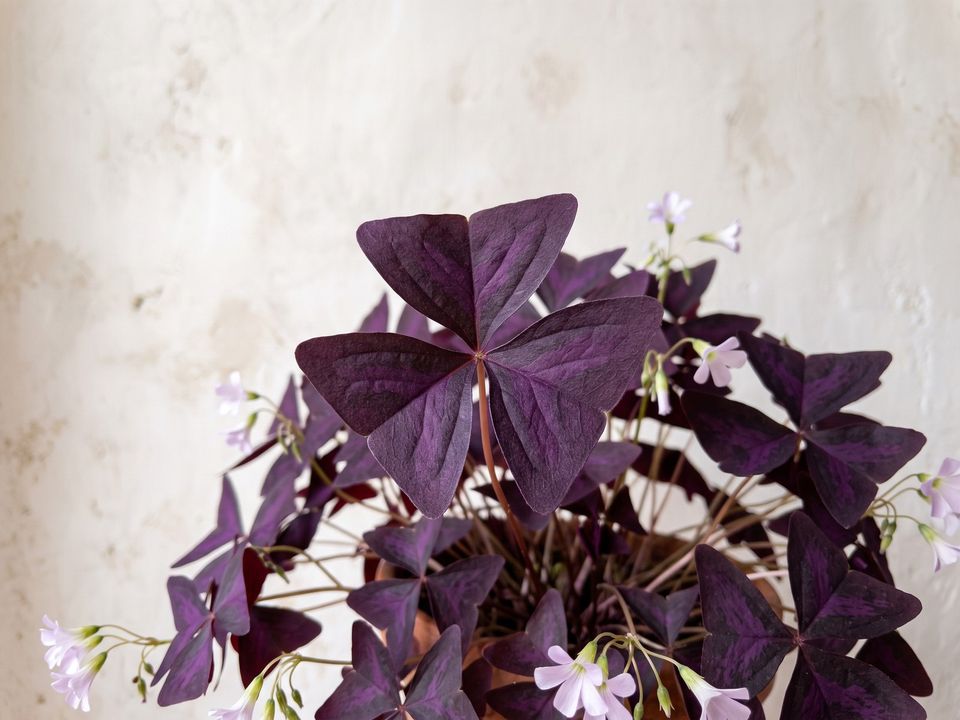
Each leaf is made of three deep purple triangles on wiry stalks. The surface has a slight texture rather than a gloss, and the clump grows full enough to cover the soil.
Where to find me
Not yet pilferableFun fact
Not a true shamrock: the word comes from an Irish name for little clover, meaning white clover. This one is a wood sorrel from South America, sold in pots around St. Patrick’s Day.
Designer tips
Deep purple and a little whimsical, it brings color to a bright kitchen or a sunny sill where green plants blend in.
Troubleshooting
It’s suddenly dying back
It’s most likely going dormant, not dying: NC State says it may rest in autumn, or when it gets too hot or too dry. Let the leaves wither, hold off watering, and set it somewhere cool and dim; UW-Madison says the purple ones need only about a month before new shoots come.
Why do the leaves fold up at night?
That’s normal: its leaves and flowers close at night and on overcast days, then open again in the morning (UW-Madison, Iowa State). Nothing to fix.
Some leaves are turning yellow
A few at a time is normal turnover. Many at once usually means it’s heading into a rest, since Iowa State says the leaves yellow and wither as it goes dormant; if the soil is soggy too, it’s likely getting too much water.
See all 8
Why is it wilting while it’s still growing?
A dry pot or dry air can wilt it mid-season (NC State), and so can soil that stays soggy and rots the bulbs. If it’s been a while, a drink usually sorts it; if the pot has stayed wet, let it dry out and empty the saucer.
My cat nibbled a leaf
Small tastes usually pass: it’s mildly irritating, and Pet Poison Helpline says a taste more often brings a sore mouth and an upset stomach. If your cat ate more than a nibble, or you see trembling, call your vet or the ASPCA Animal Poison Control Center.
The stems are stretching toward the window
It’s reaching for more light: in bright light without sun, its stems may stretch toward the glass. A few hours of morning or afternoon sun from an east or west window keeps it fuller, and the clump carries on either way.
Does it flower?
Yes, often: small white to pink flowers on stems just above the leaves, mostly in spring and summer and often again as fall cools. They close at night too, and cool nights keep them coming longer (Clemson).
Can it go outside for the summer?
Yes, in partial shade: a porch or a bright spot out of the midday heat, since heat can send it dormant. Bring it back in before fall nights drop below 50°F.
Propagation
Easy, by division, best done while it’s dormant (UW–Madison).
- Tip it out and pull the clump of small bulbs apart.
- Replant them just under the surface of fresh mix, several to a pot, and water once new shoots appear.
- NC State notes that even the scale leaves broken off a bulb grow into new plants.
The PILF Matrix
2.9/5
how easy it is to care for
3.5/5
how much it stands out visually
“The one who ghosts you for a month, then comes back better.”


- purple wood sorrel
- love plant
Rated 1-5, with 5 being easiest
Built from light, water, air, pests, and upkeep.
Rated 1-5, with 5 being easiest
Rated 1-5, with 5 being highest presence
Built from its scale (size, shape, growth) and its look (color and flowers, shine, fullness).
Rated 1-5, with 5 being highest presence
Where it sits and what sun touches it.
- Dim shadeA dark corner or a windowless room; natural light casts no shadow
- Bright shadeBack from the window in a south-, east- or west-facing room, or right by a north-facing one, where only low early or late summer sun reaches it
- Filtered sunBehind a sheer curtain or tinted glass; the sun’s shadows are blurred
- Partial sunIn an east- or west-facing window: up to a few hours of direct sun
- Full sunThe sunniest spot you have, usually a south-facing window, with direct sun 6+ hours a day
How often, and what the soil does between.
- MonthlyEvery 2-3 weeks in summer and 3-5 in winter; the soil dries all the way between
- 2-3× a monthEvery 7-14 days in summer, longer in winter; the top of the soil dries between
- Weekly+About every 4-8 days in summer; the soil stays lightly damp
How much room it usually takes indoors.
Size
- TinyUnder 6 inches tall or wide; for a desk or a sill
- Small6 inches to 1.5 feet tall or wide; for a shelf or a sill
- Medium1.5 to 3 feet tall or wide; for a table or a stand
- Large3 to 6 feet tall or wide; for the floor
- GiantOver 6 feet tall or wide; a statement in the corner
Shape
- TreeA trunk that branches into a canopy
- CaneBare stalks topped with leaves
- UprightStiff stems or leaves rising straight from the soil
- FountainLeaves or fronds arching out from the center
- BushyA full, rounded mound of leaves
- RosetteLeaves radiating from one low point
- ViningTrails, climbs, or both
Growth
How fast it gets there.
- SlowUnder 6 inches of new growth a year
- Moderate6-12 inches a year, mostly in spring and summer
- FastOver 12 inches a year; it may want trimming or training
What risks exist for pets and kids.
- Pet & kid safeNothing to worry about
- Mildly irritatingMay irritate the mouth or stomach if chewed, or for some plants, the skin if handled
- Moderately toxicCan cause illness if eaten, though typically not serious or fatal
- DangerousCan cause serious illness if eaten, including some reports of death
- Not yet ratedNot clearly rated by our sources; please check with your vet or doctor
For its safety ratings, PILF relies on research and guidance from leading sources, including the ASPCA, Pet Poison Helpline, Merck Veterinary Manual, Poison Control, and Children’s Hospital of Philadelphia, and others.
The small jobs beyond watering, over a year.
- Little upkeepA few small jobs a year beyond watering, like a feed now and then
- Some upkeepA small job about once a month beyond watering, like feeding or turning it
- More upkeepA small job every couple of weeks beyond watering, like a wipe, a turn, or a feed
- Most upkeepA small job most weeks beyond watering, like raising the humidity or misting
- TreeA trunk that branches into a canopy
- CaneBare stalks topped with leaves
- UprightStiff stems or leaves rising straight from the soil
- FountainLeaves or fronds arching out from the center
- BushyA full, rounded mound of leaves
- RosetteLeaves radiating from one low point
- ViningTrails, climbs, or both
How fast it gets there.
- SlowUnder 6 inches of new growth a year
- Moderate6-12 inches a year, mostly in spring and summer
- FastOver 12 inches a year; it may want trimming or training
The temperature and humidity it’s comfortable in.
How dry a room it takes.
- Needs 50%+ humidity
- Fine at 35% humidity
- Fine at 15-20% humidity
The bugs that usually find it, by name.
How often pests find it.
- 5+ regular pests
- 3 regular pests
- Pests are rare
The year’s chores: feeding, pruning, repotting, and cleaning.
Chores beyond water (what needs work means).
- Most upkeep
- Some upkeep
- Little upkeep
Its finish, fullness, and texture.
Color, pattern, and flowers.
- SimpleOne green, one texture, nothing to read
- SuaveA sheen, a stripe, or a clean shape that catches the eye up close
- ShowyColor, pattern, or blooms you see from across the room
How the leaves catch light.
- Matte
- Satin
- Glossy or waxy
How much it fills its pot.
- Soil shows
- Soil partly hidden
- Leaves hide the soil