Rubber Plant
Ficus elastica
Leathery leaves polished to a mirror shine, on a tree that shoots up fast. Steady light and steady drinks keep it for years.
3.3/5
how easy it is to care for
3.7/5
how much it stands out visually
: Shade to filtered
Near a bright window, shielded from afternoon sun
Bright light with no afternoon sun is its sweet spot, a few feet back from a window. It puts up with partial shade, but bright is where it earns its fast-growing name.
An east window, or a place deep inside a south- or west-facing room, gives it brightness without the afternoon rays Missouri Botanical Garden asks you to spare it. A sheer curtain does the same job closer to the glass.
Its leaves keep a record of the cold. Penn State traces brown blotches on older leaves, and puckered new ones, to temperatures below 40°F, and NC State adds that a temperature drop or cold draft can cost it leaves. Keep it off cold winter glass and clear of the air conditioner in July.
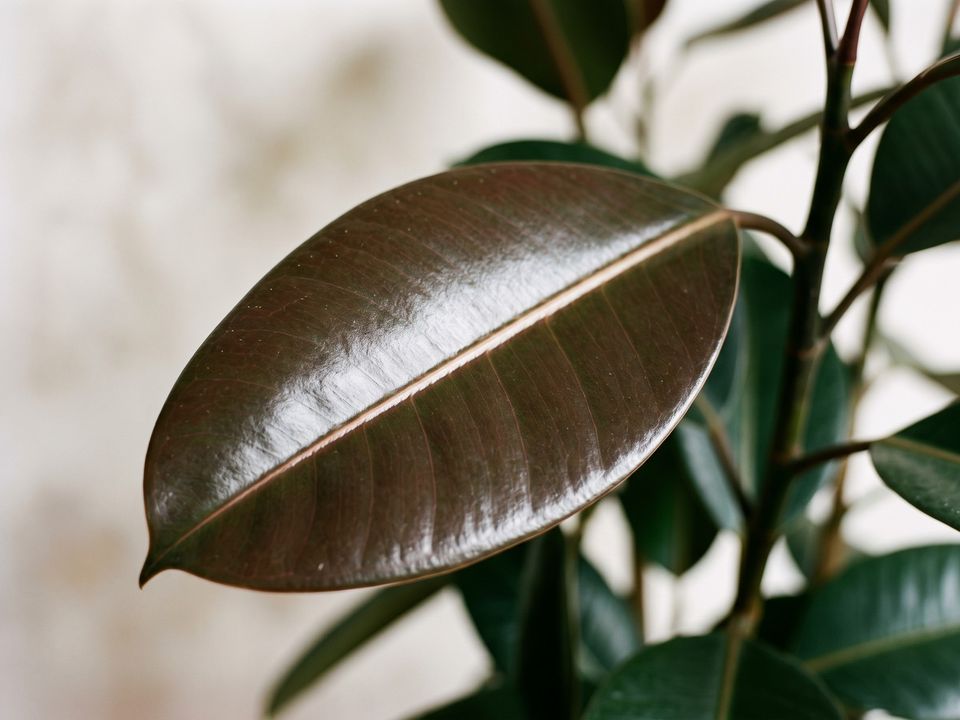
That mirror shine dulls under dust, and on leaves this broad it shows. A soft, damp cloth now and then brings the gloss back (NC State).
Of everything it asks for, steady brightness matters most.
: 2-3× a month
Drinks steadily while growing; drops leaves if soggy
A drink every 7-10 days while it’s growing, every 10-14 from fall to late winter. It handles a dry spell far better than a soggy pot, which can make it drop leaves.
Its big leaves are the gauge. NC State links overwatering to leaf loss, so a lower leaf that yellows and falls soon after watering likely means the pot stayed wet too long; ease off and give it time.
During its winter rest (NC State), heated indoor air runs dry, yet it wants only medium humidity. Skip the misting and keep it out of a heat vent’s blast.
A soil-based mix rather than a light, peaty one suits it (Missouri Botanical Garden), and the extra weight at the base steadies a tall, top-heavy trunk.
Penn State’s guide to ficus diseases notes that leaf spots on indoor plants rarely spread unless the foliage stays wet, so pour at the soil, not over the crown.
Gone for a while? Two weeks is fine if it’s watered the day you leave; it handles dry soil far better than wet.
: Large
A sturdy tree, often 2-10 feet tall indoors
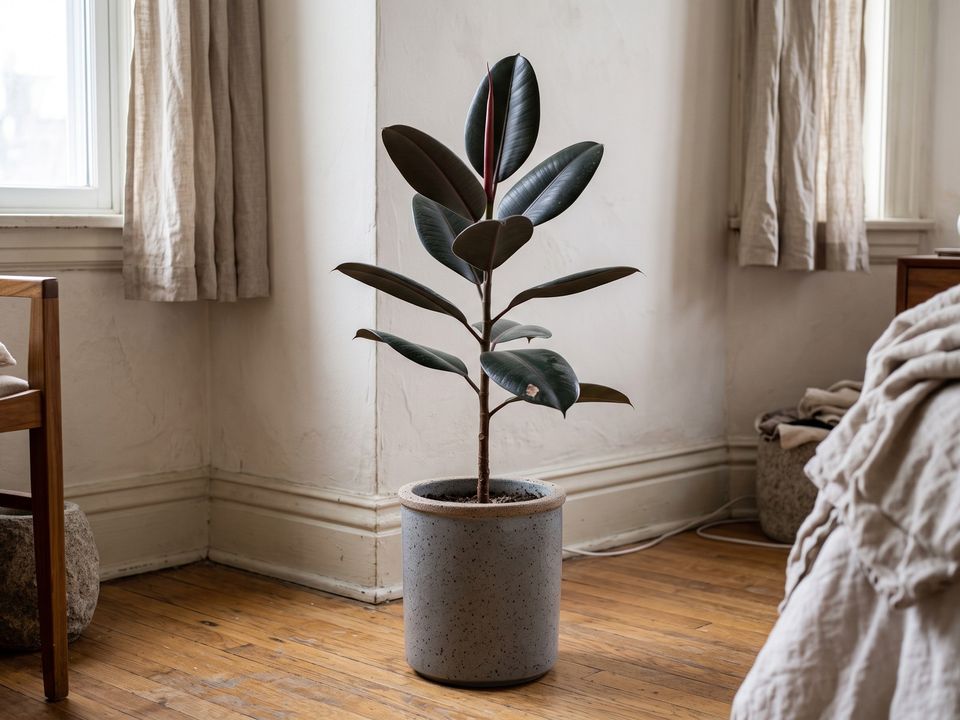
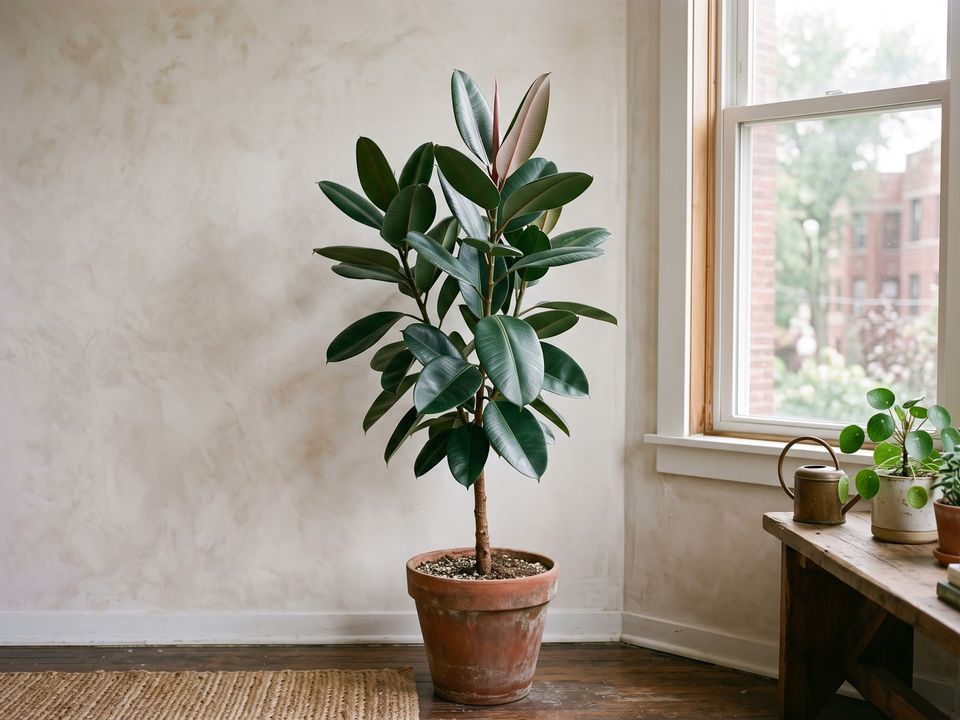
A sturdy tree with foot-long leaves, often 2-10 feet tall indoors. Set it on the floor near a bright window; prune the main stems for a bushier plant, or leave them for a tall, slim tree.
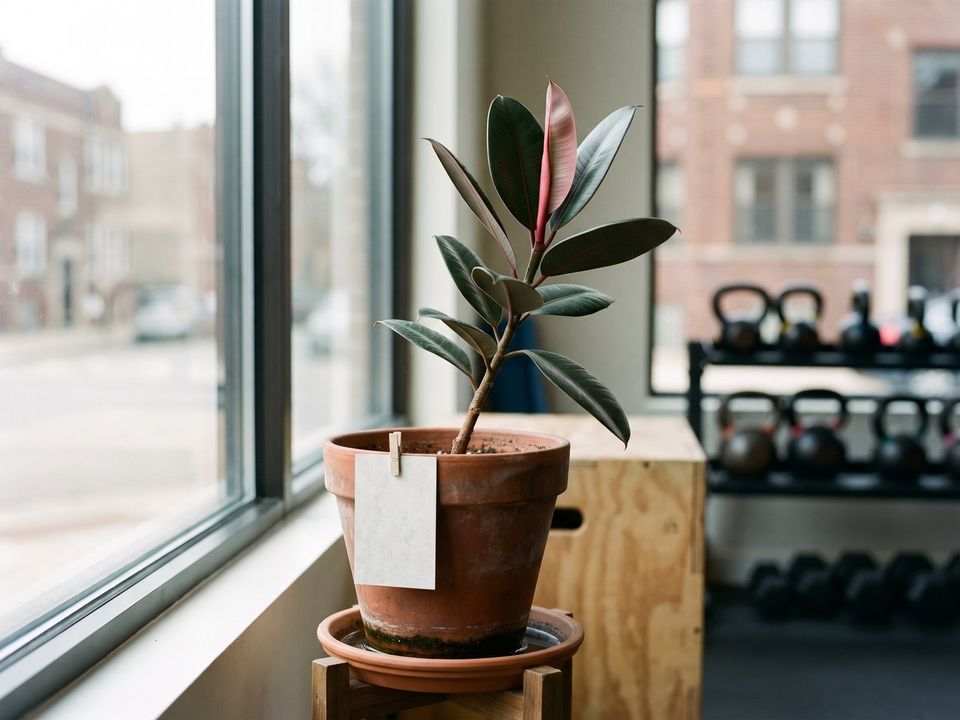
Young plants tend to grow as one stiff, barely branched stem holding leaves that can stretch to 17 inches, and each new leaf comes with a pink or purple stipule (NC State).
As it climbs, its lowest leaves yellow and drop, which NC State calls normal. If the trunk gets bare, the RHS suggests air layering in spring or late summer: the leafy top roots while still attached, so one leggy plant can become two.
Indoors it can easily pass 6-10 feet (Clemson), and a tree that size gets heavy; it does best in large spaces (NC State), so give it a weighty pot and a clear stretch of floor. Its narrow, upright habit suits a tight corner beside the glass, the end of a sofa, or a stretch of wall that needs height without width.
: Mildly irritating
Sap can irritate skin; a chew can upset dogs, cats, or kids
- DogsMildly irritating
- CatsMildly irritating
- KidsMildly irritating
Its milky sap may irritate skin, and a chewed leaf can upset a child’s stomach or sting a pet’s mouth. For dogs and cats, Pet Poison Helpline expects minor drooling, retching or vomiting.
The milky sap can irritate skin, more so in sun, so rinse off any that lands on your hands.
The irritants travel in that milky latex: ficin, an enzyme that breaks down protein, and a compound called ficusin (University of Illinois vet school). A dog or cat that chews a leaf may go off its food for a bit, drool, vomit, or have diarrhea, and it usually passes (Pet Poison Helpline). If you’ve seen "Indian rubber plant" on the ASPCA’s toxic list, that entry is its cousin the weeping fig (F. benjamina).
For a child, a chewed leaf may bring an upset stomach. Any cut leaf or stem beads with sap (NC State), so gloves make pruning tidier. If symptoms don’t settle, Poison Control can help with a child, and your vet or the ASPCA Animal Poison Control Center can help with a pet (a fee may apply).
To keep one around pets or a crawler, pick up any leaf it drops before they find it, and prune while they’re in another room.
- ASPCA: mild for dogs (rates the whole genus).
- Merck Veterinary Manual: mild for dogs (rates the whole genus).
- Pet Poison Helpline: mild for dogs.
- ASPCA: mild for cats (rates the whole genus).
- Merck Veterinary Manual: mild for cats (rates the whole genus).
- Pet Poison Helpline: mild for cats.
- UC ANR: mild for kids.
Cats and dogs: Most of the leading sources agree.
Kids: No poison-centre listing; rated from university extension sources.
: Dry OK
65-80°F; dry air is fine
Happiest at 65-80°F, and it shouldn’t sit below 55°F. Keep it away from cold glass in winter. Humidity can drop to 20% without trouble.
- Temperature
- 65-80°F
: Mealybugs
Mealybugs, scale, mites: check leaf undersides
Mealybugs hide in leaf axils and stem joints, scale clings to stems and midribs, and spider mites sit under the leaves. Thrips in unfurling leaves and aphids on shoot tips come less often. Check those spots first.
- Mealybugs
- Scale
- Spider mites
- Thrips
- Aphids
Not many. UF/IFAS says no pest is a major concern, though scale turns up now and then; mealybugs and spider mites are the others, and root rot if the soil stays wet.
Scale looks like small brown bumps stuck to the stems and the undersides of the leaves. Lift them off with a fingernail or a cotton swab dipped in rubbing alcohol, then check again next week.
Mealybugs look like tufts of white cotton where the leaves meet the stem. Wipe each one off with a swab dipped in rubbing alcohol.
Spider mites leave fine webbing and a pale, speckled look on the leaves. Wipe the big leaves front and back with a damp cloth, or rinse the plant in the shower; thrips, which leave a silvery look, go the same way. If anything keeps coming back, an insecticidal soap spray is the next step.
Root rot shows as yellowing leaves and leaf drop while the soil is still wet. Let the pot dry out, empty the saucer, and water less often.
: More
Feed every 2 weeks in summer; wipe leaves; rotate
Feed every two weeks in spring and summer. Wipe dusty leaves about 6 times a year and quarter-turn it toward the window 4 times. Each spring, prune the main stems and topdress; repot every 2-3 years.
- Feed13× a year
- Clean leaves6× a year
- Prune1× a year
- Topdress1× a year
- Rotate4× a year
A houseplant mix that drains fast, in a pot with a drainage hole; root rot usually comes from a mix that stays wet. A heavy pot keeps a tall one from tipping.
Repot when the roots fill the pot, in late winter or early spring, one pot size up.
Food keeps it growing: a water-soluble houseplant fertilizer every two weeks in spring and summer, and less, or none, in a dim spot or in winter.
: Simple
One plain green, mirror-glossy; soil partly hidden
Each big, leathery leaf is a single solid green with a waxy, mirror-like gloss. The leaves cover much of the soil, with a little still showing around the trunk.
Where to find me
Not yet pilferableFun fact
Each small fig is a sealed bouquet: tiny flowers bloom inside, and only a wasp matched to this fig, squeezing in at the tip, can pollinate them. Without it, no seeds form.
Designer tips
A classic that reads modern: a small indoor tree with big, glossy, leathery leaves.
Troubleshooting
It dropped leaves after I brought it home
It’s reacting to the move: less light, a chill on the way home, and extra water while it settles in all make it shed. Beside a bright window, away from drafts, with a drink every 7-14 days, the new leaves usually hold on.
Why are the leaves turning yellow?
Usually too much water. Letting the soil get slightly dry between soaks and emptying the saucer tend to help; one lowest leaf yellowing and falling now and then is normal as it grows taller.
It’s tall and bare at the bottom
That’s how it climbs. Cut the top off in spring and it branches below the cut, or air-layer the top first, rooting it in damp moss while still attached, for a second plant.
See all 9
The leaves have lost their shine
Dust, most likely; on leaves this broad it shows. A soft, damp cloth now and then brings the mirror gloss back.
White sap dripped from a cut
That’s latex, the milky sap it’s named for; it was once tapped for rubber. It’s sticky and can irritate skin, more so in sun, so gloves help when you prune and a towel below catches drips.
Is it safe for my cat or dog?
It’s mildly irritating: Pet Poison Helpline expects minor drooling, retching, or vomiting if a pet chews a leaf. If vomiting keeps up or your pet seems unwell, call your vet or the ASPCA Animal Poison Control Center.
What’s the pink sheath on the new leaf?
A stipule, a wrapper that protects each new leaf as it unrolls. It dries and falls off on its own.
Can it live in a dim room?
Across the room from a window, yes: it adapts, growing slower and showing more bare stem. A room with no window is too dark for it.
Can it go outside for the summer?
Yes, in shade or morning sun, like a porch or under a tree. Bring it in before fall nights drop below 55°F, check it for bugs, and expect a leaf or two to drop as it settles back in.
Propagation
Yes, by air layering, which is also how you turn a tall, bare-stemmed plant into two good ones.
- About 12 to 18 inches below the tip, strip a few leaves, cut a narrow ring of bark off the stem, dust it with rooting hormone, wrap it in a handful of damp sphagnum moss and seal that in clear plastic.
- Roots show in the moss in several weeks; then cut the stem just below the wrap and pot the top.
- The plant you cut back branches below the cut.
A tip cutting in damp potting mix roots too. Either way, wear gloves for the sap.
The PILF Matrix
3.3/5
how easy it is to care for
3.7/5
how much it stands out visually
“The one that always bounces back.”


- Indian rubber plant
Rated 1-5, with 5 being easiest
Built from light, water, air, pests, and upkeep.
Rated 1-5, with 5 being easiest
Rated 1-5, with 5 being highest presence
Built from its scale (size, shape, growth) and its look (color and flowers, shine, fullness).
Rated 1-5, with 5 being highest presence
Where it sits and what sun touches it.
- Dim shadeA dark corner or a windowless room; natural light casts no shadow
- Bright shadeBack from the window in a south-, east- or west-facing room, or right by a north-facing one, where only low early or late summer sun reaches it
- Filtered sunBehind a sheer curtain or tinted glass; the sun’s shadows are blurred
- Partial sunIn an east- or west-facing window: up to a few hours of direct sun
- Full sunThe sunniest spot you have, usually a south-facing window, with direct sun 6+ hours a day
How often, and what the soil does between.
- MonthlyEvery 2-3 weeks in summer and 3-5 in winter; the soil dries all the way between
- 2-3× a monthEvery 7-14 days in summer, longer in winter; the top of the soil dries between
- Weekly+About every 4-8 days in summer; the soil stays lightly damp
How much room it usually takes indoors.
Size
- TinyUnder 6 inches tall or wide; for a desk or a sill
- Small6 inches to 1.5 feet tall or wide; for a shelf or a sill
- Medium1.5 to 3 feet tall or wide; for a table or a stand
- Large3 to 6 feet tall or wide; for the floor
- GiantOver 6 feet tall or wide; a statement in the corner
Shape
- TreeA trunk that branches into a canopy
- CaneBare stalks topped with leaves
- UprightStiff stems or leaves rising straight from the soil
- FountainLeaves or fronds arching out from the center
- BushyA full, rounded mound of leaves
- RosetteLeaves radiating from one low point
- ViningTrails, climbs, or both
Growth
How fast it gets there.
- SlowUnder 6 inches of new growth a year
- Moderate6-12 inches a year, mostly in spring and summer
- FastOver 12 inches a year; it may want trimming or training
What risks exist for pets and kids.
- Pet & kid safeNothing to worry about
- Mildly irritatingMay irritate the mouth or stomach if chewed, or for some plants, the skin if handled
- Moderately toxicCan cause illness if eaten, though typically not serious or fatal
- DangerousCan cause serious illness if eaten, including some reports of death
- Not yet ratedNot clearly rated by our sources; please check with your vet or doctor
For its safety ratings, PILF relies on research and guidance from leading sources, including the ASPCA, Pet Poison Helpline, Merck Veterinary Manual, Poison Control, and Children’s Hospital of Philadelphia, and others.
The small jobs beyond watering, over a year.
- Little upkeepA few small jobs a year beyond watering, like a feed now and then
- Some upkeepA small job about once a month beyond watering, like feeding or turning it
- More upkeepA small job every couple of weeks beyond watering, like a wipe, a turn, or a feed
- Most upkeepA small job most weeks beyond watering, like raising the humidity or misting
- TreeA trunk that branches into a canopy
- CaneBare stalks topped with leaves
- UprightStiff stems or leaves rising straight from the soil
- FountainLeaves or fronds arching out from the center
- BushyA full, rounded mound of leaves
- RosetteLeaves radiating from one low point
- ViningTrails, climbs, or both
How fast it gets there.
- SlowUnder 6 inches of new growth a year
- Moderate6-12 inches a year, mostly in spring and summer
- FastOver 12 inches a year; it may want trimming or training
The temperature and humidity it’s comfortable in.
How dry a room it takes.
- Needs 50%+ humidity
- Fine at 35% humidity
- Fine at 15-20% humidity
The bugs that usually find it, by name.
How often pests find it.
- 5+ regular pests
- 3 regular pests
- Pests are rare
The year’s chores: feeding, pruning, repotting, and cleaning.
Chores beyond water (what needs work means).
- Most upkeep
- Some upkeep
- Little upkeep
Its finish, fullness, and texture.
Color, pattern, and flowers.
- SimpleOne green, one texture, nothing to read
- SuaveA sheen, a stripe, or a clean shape that catches the eye up close
- ShowyColor, pattern, or blooms you see from across the room
How the leaves catch light.
- Matte
- Satin
- Glossy or waxy
How much it fills its pot.
- Soil shows
- Soil partly hidden
- Leaves hide the soil