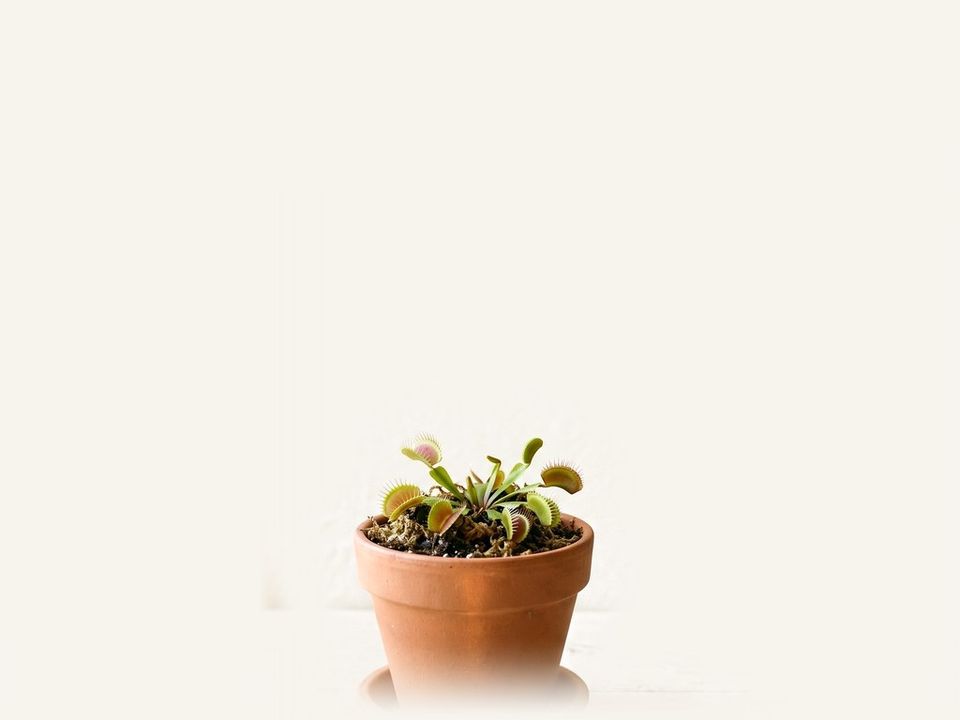
Venus Flytrap
Dionaea muscipula
Also called flytrap
A low rosette of hinged, toothed traps that snap shut on insects. Known as the plant that eats flies, and as a fussy one: rain or distilled water only.
1.0/5
how easy it is to care for
2.2/5
how much it stands out visually
: Full sun
6+ hours of direct sun; a south or west window
Give it 6 or more hours of direct sun: a south or west window, a summer outdoors, or a strong grow light for about 14 hours a day. Strong sun colors the traps red inside; short of it, they grow pale and slow to shut.
In strong sun the traps color up red inside. With too little light it grows weak and pale, and the traps are slow to shut.
The International Carnivorous Plant Society finds an ordinary windowsill is rarely bright enough on its own. A summer on a sunny balcony, or a bright LED grow light for about 14 hours a day, makes the difference.
: Weekly+
Sits in rain or distilled water, topped up every 2-4 days
It stands in a saucer of rain or distilled water, topped up every 2-4 days in summer and 3-7 in winter, so the peat stays wet. Tap water’s minerals build up in the peat, which is why NC State rules it out.
Rain or distilled water only (reverse-osmosis water works too). Tap water carries minerals, and chlorine, that build up in its peat and can kill it, which is why NC State and the International Carnivorous Plant Society both rule it out. The saucer keeps the soil wet and the air around it humid, which is how it grows in the wild.
Gone for a while? A week is fine if its saucer is full of rain or distilled water the day you leave.
: Tiny
A low rosette 3-5 inches tall, slow to grow
A low rosette of traps on flat, leafy stalks, 3-5 inches tall and slow to grow. In late spring a flower stalk up to 12 inches tall can rise above it.
Growth is slow. Traps don’t last forever: after a few meals, or after being set off too often, a trap blackens and dies back, and new ones replace it. Snip black traps off at the base.
: Pet & kid safe
Harmless to dogs, cats, and kids
- DogsSafe
- CatsSafe
- KidsSafe
Harmless to dogs, cats, and kids: the ASPCA lists it as non-toxic to both pets, and UConn’s poison control center counts it safe for kids. A pet digging in its wet peat is more risk to the plant than the reverse.
It isn’t on the Children’s Hospital of Philadelphia, National Capital Poison Center, or University of California lists. The bigger risk runs the other way: a cat that digs in the wet peat or chews the traps can wreck it, so a sunny sill out of reach helps.
- ASPCA: safe for dogs.
- ASPCA: safe for cats.
- UConn Health: safe for kids.
Cats and dogs: The ASPCA lists it as non-toxic.
Kids: No poison-centre listing; rated from university extension sources. Its sap can irritate skin or eyes.
: Average
40-75°F, cooler in winter; its saucer adds humidity
Room warmth suits it while it grows, within 40-75°F, and winter calls for a cool, sunny window at 40-50°F. It likes 40% humidity or more, and its saucer of water takes care of that, so there’s no misting.
- Temperature
- 40-75°F
- Humidity
- 40%+
: Aphids
Few pests; aphids may crowd the new traps
Watch for aphids: small, soft green bugs crowding the newest traps. Otherwise pests are few, though spider mites can leave fine webbing and a speckled look.
- Aphids
Few. NC State lists no serious insect or disease problems; aphids, spider mites, and black spot are the ones to watch.
Aphids are small, soft, green bugs crowding the new traps; spider mites leave fine webbing and a speckled look. Rinse them off with a gentle stream of rain or distilled water, and cut off the worst leaves at the base.
Black spot, a fungus, shows as black patches spreading on healthy leaves. Cut those leaves off at the base and give the plant more sun.
: Most
Top up the saucer, snip black traps, repot yearly
The saucer of rain or distilled water gets topped up every few days, and black traps come off at the base as they appear. Each spring it’s repotted into fresh peat, and each winter it rests 10+ weeks somewhere cool.
- Top up saucer with rain/distilled water only60× a year
- Snip blackened traps12× a year
- Winter dormancy at 35-50f for 10+ weeks1× a year
- Cut flower stalk1× a year
- Repot in fresh peat/sphagnum1× a year
Plain sphagnum moss, or peat moss mixed half and half with coarse sand or vermiculite: no potting soil, no fertilizer, and no perlite, which the International Carnivorous Plant Society finds can carry salts. A tall plastic pot with a drainage hole stays wet the longest.
Repot every one to two years, in spring as it wakes up, into fresh mix, since minerals build up in old peat. That’s the time to divide it, too.
Never fertilizer. Outdoors in summer it catches its own; indoors, feed it now and then while it’s growing: drop a live fly or a rehydrated dried bloodworm into a trap, then gently squeeze the trap so it seals and starts to digest.
: Suave
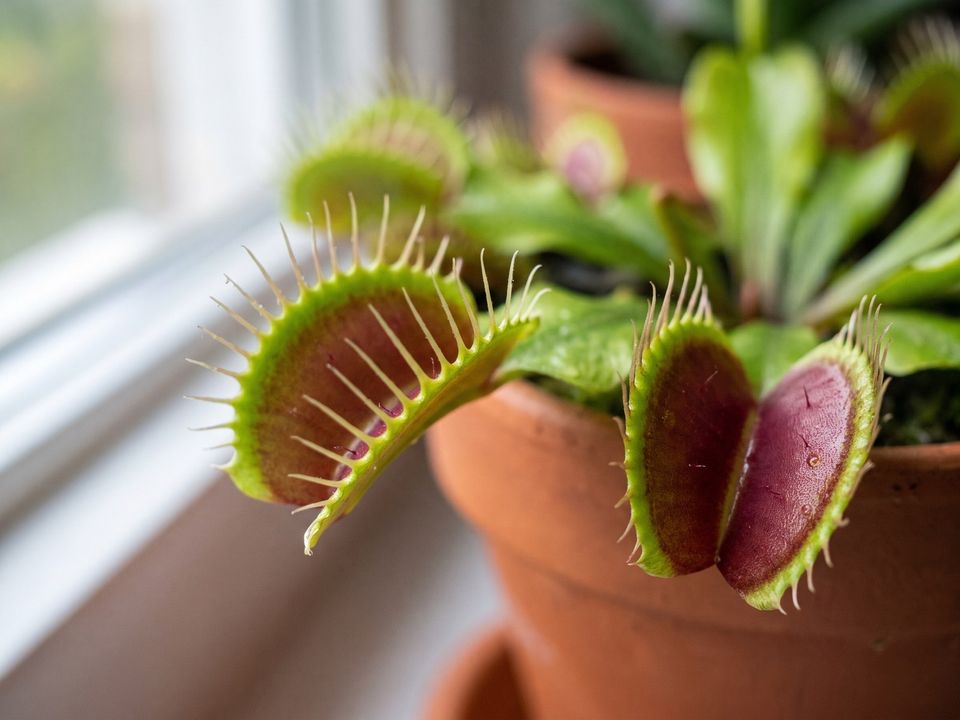
Hinged, toothed traps that blush red inside in sun
Hinged traps edged with teeth sit on flat, leafy stalks, satin green and blushing red inside in strong sun. The low rosette hides part of the soil around it.
Where to find me
Not at PILF places
Fun fact
A trap only snaps shut if its trigger hairs are touched twice within about 20 seconds, so raindrops and debris don’t set it off.
Designer tips
A living curiosity: small, strange, and best up close, in a sunny window where people can watch it work.
Troubleshooting
The traps are turning black
One at a time, that’s normal: a trap wears out after a few meals, and a new one replaces it. Many at once points to tap water, dry peat, too little light or its winter rest; snip the dead ones at the base if they bother you.
Why won’t a trap close?
Something has to touch its trigger hairs twice within about 20 seconds, so one brush or a raindrop doesn’t set it off. A plant short on light, or slowing for winter, also reacts slowly; more sun usually helps.
Can I use tap water if I let it sit out first?
No: the trouble is minerals, and they don’t leave when water sits. They build up in the peat, which is why NC State and the International Carnivorous Plant Society rule tap water out; rain, distilled, or reverse-osmosis water all work.
See all 9
It stopped growing this winter
It’s resting: it slows in fall, and many traps blacken. Keep the saucer topped up in a cool, bright spot around 40-50°F, and it usually wakes in spring.
Do I need to feed it?
Not with fertilizer, ever. Outdoors in summer it catches its own; indoors, a live fly or a rehydrated dried bloodworm now and then while it’s growing is plenty, with a gentle squeeze so the trap seals.
My windowsill doesn’t seem bright enough
Often it isn’t: the International Carnivorous Plant Society finds most windowsills too dim. A south window comes closest, and a summer outdoors in full sun or a bright LED grow light for about 14 hours a day makes the difference.
What’s the tall stalk coming up from the middle?
Its flower stalk, with a cluster of small white flowers held high above the traps in May or June. Snip it off once the flowers fade, as the RHS suggests.
My cat dug in the pot
Nothing harmful for your cat: the ASPCA lists the flytrap as non-toxic to cats and dogs. A pet digging in the wet peat or chewing traps is more of a risk to the plant, so a sunny sill out of reach helps.
Is it rare?
In the wild, yes: it grows only on the coastal plain of North and South Carolina, where it’s endangered and illegal to collect. The ones sold are nursery-grown, per NC State Extension.
Propagation
Yes, by division, when you repot in spring.
- Ease the plant out and pull the clumps apart, each with its own roots, then give each its own pot of fresh mix.
- The International Carnivorous Plant Society also grows new plants from single leaves pulled off at the base; seed takes about five years to make a mature plant.
The PILF Matrix
1.0/5
how easy it is to care for
2.2/5
how much it stands out visually
“The one that snaps at flies and sulks at tap water.”


Rated 1-5, with 5 being easiest
Built from light, water, air, pests, and upkeep.
Rated 1-5, with 5 being easiest
Rated 1-5, with 5 being highest presence
Built from its scale (size, shape, growth) and its look (color and flowers, shine, fullness).
Rated 1-5, with 5 being highest presence
Where it sits and what sun touches it.
- Dim shadeA dark corner or a windowless room; natural light casts no shadow
- Bright shadeBack from the window in a south-, east- or west-facing room, or right by a north-facing one, where only low early or late summer sun reaches it
- Filtered sunBehind a sheer curtain or tinted glass; the sun’s shadows are blurred
- Partial sunIn an east- or west-facing window: up to a few hours of direct sun
- Full sunThe sunniest spot you have, usually a south-facing window, with direct sun 6+ hours a day
How often, and what the soil does between.
- MonthlyEvery 2-3 weeks in summer and 3-5 in winter; the soil dries all the way between
- 2-3× a monthEvery 7-14 days in summer, longer in winter; the top of the soil dries between
- Weekly+About every 4-8 days in summer; the soil stays lightly damp
How much room it usually takes indoors.
Size
- TinyUnder 6 inches tall or wide; for a desk or a sill
- Small6 inches to 1.5 feet tall or wide; for a shelf or a sill
- Medium1.5 to 3 feet tall or wide; for a table or a stand
- Large3 to 6 feet tall or wide; for the floor
- GiantOver 6 feet tall or wide; a statement in the corner
Shape
- TreeA trunk that branches into a canopy
- CaneBare stalks topped with leaves
- UprightStiff stems or leaves rising straight from the soil
- FountainLeaves or fronds arching out from the center
- BushyA full, rounded mound of leaves
- RosetteLeaves radiating from one low point
- ViningTrails, climbs, or both
Growth
How fast it gets there.
- SlowUnder 6 inches of new growth a year
- Moderate6-12 inches a year, mostly in spring and summer
- FastOver 12 inches a year; it may want trimming or training
What risks exist for pets and kids.
- Pet & kid safeNothing to worry about
- Mildly irritatingMay irritate the mouth or stomach if chewed, or for some plants, the skin if handled
- Moderately toxicCan cause illness if eaten, though typically not serious or fatal
- DangerousCan cause serious illness if eaten, including some reports of death
- Not yet ratedNot clearly rated by our sources; please check with your vet or doctor
For its safety ratings, PILF relies on research and guidance from leading sources, including the ASPCA, Pet Poison Helpline, Merck Veterinary Manual, Poison Control, and Children’s Hospital of Philadelphia, and others.
The small jobs beyond watering, over a year.
- Little upkeepA few small jobs a year beyond watering, like a feed now and then
- Some upkeepA small job about once a month beyond watering, like feeding or turning it
- More upkeepA small job every couple of weeks beyond watering, like a wipe, a turn, or a feed
- Most upkeepA small job most weeks beyond watering, like raising the humidity or misting
- TreeA trunk that branches into a canopy
- CaneBare stalks topped with leaves
- UprightStiff stems or leaves rising straight from the soil
- FountainLeaves or fronds arching out from the center
- BushyA full, rounded mound of leaves
- RosetteLeaves radiating from one low point
- ViningTrails, climbs, or both
How fast it gets there.
- SlowUnder 6 inches of new growth a year
- Moderate6-12 inches a year, mostly in spring and summer
- FastOver 12 inches a year; it may want trimming or training
The temperature and humidity it’s comfortable in.
How dry a room it takes.
- Needs 50%+ humidity
- Fine at 35% humidity
- Fine at 15-20% humidity
The bugs that usually find it, by name.
How often pests find it.
- 5+ regular pests
- 3 regular pests
- Pests are rare
The year’s chores: feeding, pruning, repotting, and cleaning.
Chores beyond water (what needs work means).
- Most upkeep
- Some upkeep
- Little upkeep
Its finish, fullness, and texture.
Color, pattern, and flowers.
- SimpleOne green, one texture, nothing to read
- SuaveA sheen, a stripe, or a clean shape that catches the eye up close
- ShowyColor, pattern, or blooms you see from across the room
How the leaves catch light.
- Matte
- Satin
- Glossy or waxy
How much it fills its pot.
- Soil shows
- Soil partly hidden
- Leaves hide the soil