
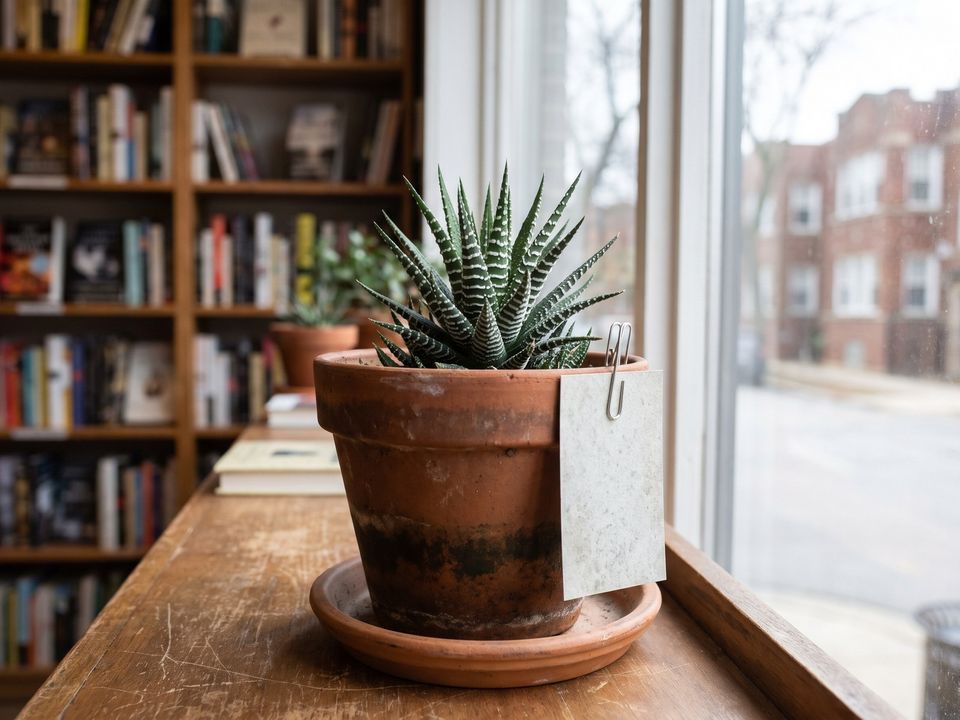
Zebra Haworthia
Haworthiopsis attenuata
Dark green spikes striped in raised white, packed into a palm-sized star. Patient, slow, and happy to be left alone.
3.9/5
how easy it is to care for
2.7/5
how much it stands out visually
: Dim to bright
A bright sill, no direct rays; dim light fades its stripes
It copes with low light, though its stripes fade there; a bright spot just out of the sun’s reach is where it colors up best, and the dark green may even pick up other tints.
Wild plants shelter among rocks and grasses and under shrubs (SANBI). Indoors, the sill of a north-facing window suits it, as does a spot beside an east-facing one or a desk a few feet back from glass that faces south or west.
One wild form, a cliff-dweller from the Enon River, shows what shade does: its leaves spread wider and curl back to catch more light (SANBI). A zebra kept dim may loosen the same way, a hint to inch it windowward if you’d like it tighter.
In January, keep its leaves from touching cold glass; NC State warns against cold drafts and anything under 50°F.
So the rosette itself gives the verdict: snug and upright says the light is working, splayed open says it’s reaching.
: Monthly
About a drink a month, sooner in summer; it hardly minds
Let the pot dry to the bottom between drinks: about every 3-4 weeks in winter, and sooner in warm months, roughly every 14-21 days.
Aim the water at the soil around the rosette, not into its center. Water left pooling between the tight leaves can rot the plant or spot the leaves (Penn State Extension; NC State).
Its leaves keep score. In the wild they fill out firm after rain and fold into a shallow channel in dry spells (SANBI), so a zebra whose leaves have begun to cup and thin is ready for a drink, and a plump one can wait.
Pot it in cactus or succulent mix (NC State).
Gone for a while? A month is fine if it’s soaked the day you leave; its leaves carry it through.
: Small
A starry rosette 4-12 inches tall that clumps out slowly
A spiky rosette 4-12 inches tall that sends up pups around its base, slowly building a clump. Sized for a desk, a windowsill, or a terrarium; a shallow, wide pot gives the pups room.
Each rosette packs 30-40 leaves, each up to about 3 inches long, into a star up to 6 inches across (SANBI). It has no stem, so new rosettes rise from the base, and over the years one plant can become a crowd, spreading toward 2 feet wide if never divided (NC State).
In late spring or early summer it may send up a wiry flower stalk about 16 inches tall, well above the rosette, hung with small white to pale pink tubes (SANBI; NC State).
Because every pup springs from that stemless base, a crowded pot can be eased apart at soil level, each rosette taking a few roots of its own (NC State: offsets and pups).
Seen from above, each rosette reads as a star, so it shows off best below eye height: a low sill, a side table, a desk you look down on.
: Pet & kid safe
Nothing to worry about for dogs, cats, or kids
- DogsSafe
- CatsSafe
- KidsSafe
The ASPCA lists zebra haworthia as non-toxic to dogs and cats, and NC State calls it non-toxic to pets and humans.
The ASPCA’s zebra haworthia entry still files it under an older Haworthia name, but the answer holds either way: its entry for the whole Haworthia group names no harmful compounds, and its recent guide to pet-safe plants calls out Haworthiopsis attenuata by name.
As with any plant, a pet that eats a lot of it may vomit or get an upset stomach, which the ASPCA doesn’t expect to be serious.
So a sill shared with a cat or a desk within a toddler’s reach is fine. The only one at risk is the plant: it grows so slowly that a chewed rosette takes a long time to fill back in, so if yours has a nibbler, a higher shelf keeps it looking whole.
- ASPCA: safe for dogs.
- ASPCA: safe for cats.
- NC State Extension: safe for kids.
Cats and dogs: Most of the leading sources agree.
Kids: No poison-centre listing; rated from university extension sources.
: Dry OK
60-80°F; dry air is fine
Ordinary rooms at 60-80°F suit it, and it shouldn’t sit below 50°F. It comes from dry South African scrub, so humidity down to 5% is fine and there’s no misting to do.
- Temperature
- 60-80°F
- Humidity
- 5-24%
: Mealybugs
Mealybugs in the rosette center; scale on leaves
Mealybugs are the common guest, tucked into new growth at the center of the rosette and under the leaves. Scale sometimes settles on the leaves and at the base of the stem. Peek into the center when you water.
- Mealybugs
- Scale
Very few. Mealybugs are the pest to watch for, scale now and then, and rot from wet soil is the real danger.
Mealybugs look like tufts of white cotton tucked deep between the leaves; scale looks like small brown bumps stuck to them. Dab them off with a cotton swab dipped in rubbing alcohol, then check again next week; if they keep coming back, an insecticidal soap spray is the next step.
Rot shows as leaves going soft and mushy at the base while the soil stays wet. Let the pot dry out completely and water less often from then on; if the whole rosette has gone soft, save a healthy pup and start again (see Propagation).
: Little
Feed and tidy 2× a year; repot every 2-3 years
In spring and summer, feed it sparingly twice with dilute fertilizer. Twice a year, pull dead leaves and dust with a soft brush, not water. Every 2-3 years, repot into fresh gritty mix and divide off the offsets.
- Clean leaves2× a year
- Feed2× a year
A small pot with a drainage hole, not much bigger than the roots, in cactus mix or ordinary potting mix cut half and half with perlite or grit, so it drains fast. A clay pot helps the soil dry out between soaks.
Repot only when the pups fill the pot, in spring, into a pot just a size up; it’s happy a little crowded.
Food is optional: a houseplant fertilizer at half strength or weaker, once or twice in late spring or summer, is all it uses.
: Suave
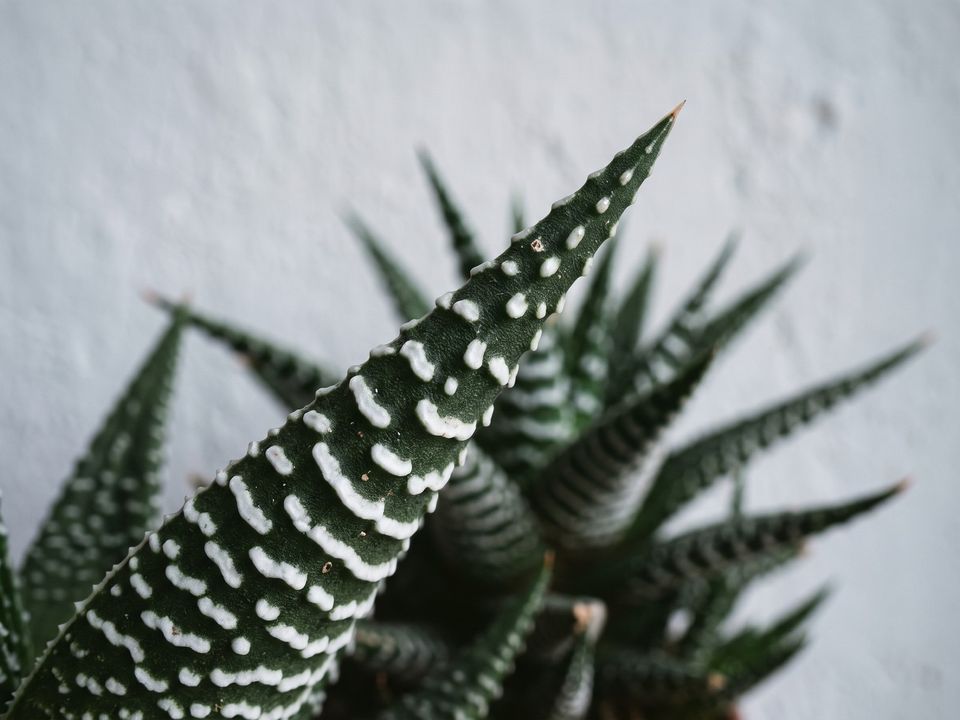
Dark green spikes striped in raised white
Pointed dark green leaves wear raised white bands, like tiny zebra stripes, in a palm-sized star. The surface is waxy and bumpy to the touch, and the rosette leaves some soil showing.
Where to find me
Not yet pilferableFun fact
Those zebra stripes are raised bumps called tubercles. Run a finger over a leaf: this one is bumpy on both sides, while its rarer look-alike, whose name it’s often sold under, is smooth on top.
Designer tips
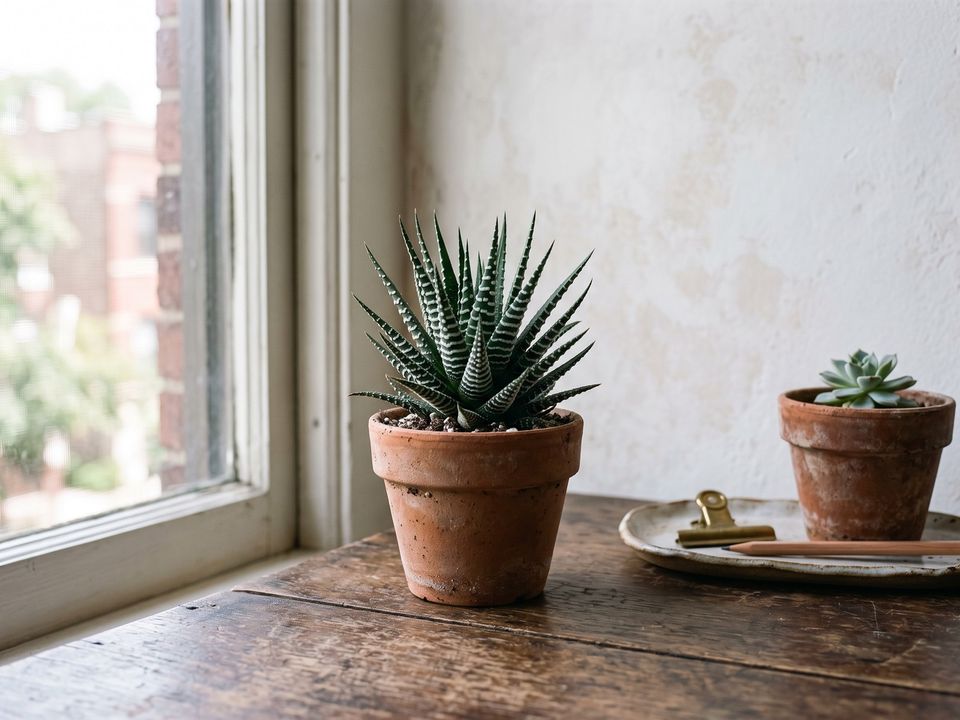
Small and graphic, with crisp white stripes on dark green that suit a modern desk or windowsill.
Troubleshooting
Soft, mushy leaves at the base
Too much water: it’s starting to rot. Give it a long break, at least 14-21 days, so the pot dries all the way down, and empty the saucer; if the whole rosette has gone soft, a healthy pup can start it over.
Why are the stripes fading and the rosette stretching?
Too little light (NC State, UW-Madison Extension). A brighter window, out of strong afternoon sun, usually brings tighter, more boldly striped new leaves.
The leaves are turning red or brown
Too much sun, usually: strong sun through glass stresses it and can scorch the leaves (NC State Extension). Move it back from a south or west window, or to an east one; scorched leaves stay marked, but new ones come in green.
See all 8
The leaves look wrinkled and thin
It’s thirsty, using up the water its leaves store. A good soak usually plumps them back within a few days; if the soil is wet and they still shrivel, the roots may have rotted.
Why hasn’t it grown in months?
It’s slow by nature (NC State), so that’s normal. In a bright window it adds leaves and pups gradually; extra water or fertilizer doesn’t hurry it, and water only risks rot.
What’s the long, thin stalk coming out of the middle?
A flower stalk, carrying small white to pale pink tubes in late spring or summer (NC State). UW-Madison calls them 'less than spectacular'; snip the stalk at the base once they fade, or leave it.
My cat nibbled a leaf
Nothing harmful: the ASPCA lists it as non-toxic to cats and dogs, and NC State calls it non-toxic to people too. A big nibble can upset a stomach, as any plant can, and the rosette is slow to fill back in.
Is mine Haworthiopsis attenuata or fasciata?
Either: both are sold as zebra haworthia. Attenuata has white bumps on both faces of the leaf, while fasciata is smooth on the inner face (NC State); they’re cared for the same way.
Propagation
Yes, easily: the pups that cluster around the base are ready-made plants.
- In spring, when you repot, gently pull or cut away a pup that has a few roots of its own.
- Let the cut end dry until it seals over (UMN Extension advises this for succulent cuttings), then pot it in barely damp cactus mix, where sun doesn’t land on the leaves, while it settles in.
- Single leaves can root too, but a pup gives you a plant right away.
The PILF Matrix
3.9/5
how easy it is to care for
2.7/5
how much it stands out visually
“The one that earned its stripes and kept them.”


- Formerly Haworthia attenuata
Rated 1-5, with 5 being easiest
Built from light, water, air, pests, and upkeep.
Rated 1-5, with 5 being easiest
Rated 1-5, with 5 being highest presence
Built from its scale (size, shape, growth) and its look (color and flowers, shine, fullness).
Rated 1-5, with 5 being highest presence
Where it sits and what sun touches it.
- Dim shadeA dark corner or a windowless room; natural light casts no shadow
- Bright shadeBack from the window in a south-, east- or west-facing room, or right by a north-facing one, where only low early or late summer sun reaches it
- Filtered sunBehind a sheer curtain or tinted glass; the sun’s shadows are blurred
- Partial sunIn an east- or west-facing window: up to a few hours of direct sun
- Full sunThe sunniest spot you have, usually a south-facing window, with direct sun 6+ hours a day
How often, and what the soil does between.
- MonthlyEvery 2-3 weeks in summer and 3-5 in winter; the soil dries all the way between
- 2-3× a monthEvery 7-14 days in summer, longer in winter; the top of the soil dries between
- Weekly+About every 4-8 days in summer; the soil stays lightly damp
How much room it usually takes indoors.
Size
- TinyUnder 6 inches tall or wide; for a desk or a sill
- Small6 inches to 1.5 feet tall or wide; for a shelf or a sill
- Medium1.5 to 3 feet tall or wide; for a table or a stand
- Large3 to 6 feet tall or wide; for the floor
- GiantOver 6 feet tall or wide; a statement in the corner
Shape
- TreeA trunk that branches into a canopy
- CaneBare stalks topped with leaves
- UprightStiff stems or leaves rising straight from the soil
- FountainLeaves or fronds arching out from the center
- BushyA full, rounded mound of leaves
- RosetteLeaves radiating from one low point
- ViningTrails, climbs, or both
Growth
How fast it gets there.
- SlowUnder 6 inches of new growth a year
- Moderate6-12 inches a year, mostly in spring and summer
- FastOver 12 inches a year; it may want trimming or training
What risks exist for pets and kids.
- Pet & kid safeNothing to worry about
- Mildly irritatingMay irritate the mouth or stomach if chewed, or for some plants, the skin if handled
- Moderately toxicCan cause illness if eaten, though typically not serious or fatal
- DangerousCan cause serious illness if eaten, including some reports of death
- Not yet ratedNot clearly rated by our sources; please check with your vet or doctor
For its safety ratings, PILF relies on research and guidance from leading sources, including the ASPCA, Pet Poison Helpline, Merck Veterinary Manual, Poison Control, and Children’s Hospital of Philadelphia, and others.
The small jobs beyond watering, over a year.
- Little upkeepA few small jobs a year beyond watering, like a feed now and then
- Some upkeepA small job about once a month beyond watering, like feeding or turning it
- More upkeepA small job every couple of weeks beyond watering, like a wipe, a turn, or a feed
- Most upkeepA small job most weeks beyond watering, like raising the humidity or misting
- TreeA trunk that branches into a canopy
- CaneBare stalks topped with leaves
- UprightStiff stems or leaves rising straight from the soil
- FountainLeaves or fronds arching out from the center
- BushyA full, rounded mound of leaves
- RosetteLeaves radiating from one low point
- ViningTrails, climbs, or both
How fast it gets there.
- SlowUnder 6 inches of new growth a year
- Moderate6-12 inches a year, mostly in spring and summer
- FastOver 12 inches a year; it may want trimming or training
The temperature and humidity it’s comfortable in.
How dry a room it takes.
- Needs 50%+ humidity
- Fine at 35% humidity
- Fine at 15-20% humidity
The bugs that usually find it, by name.
How often pests find it.
- 5+ regular pests
- 3 regular pests
- Pests are rare
The year’s chores: feeding, pruning, repotting, and cleaning.
Chores beyond water (what needs work means).
- Most upkeep
- Some upkeep
- Little upkeep
Its finish, fullness, and texture.
Color, pattern, and flowers.
- SimpleOne green, one texture, nothing to read
- SuaveA sheen, a stripe, or a clean shape that catches the eye up close
- ShowyColor, pattern, or blooms you see from across the room
How the leaves catch light.
- Matte
- Satin
- Glossy or waxy
How much it fills its pot.
- Soil shows
- Soil partly hidden
- Leaves hide the soil