African Violet
Streptocarpus ionanthus
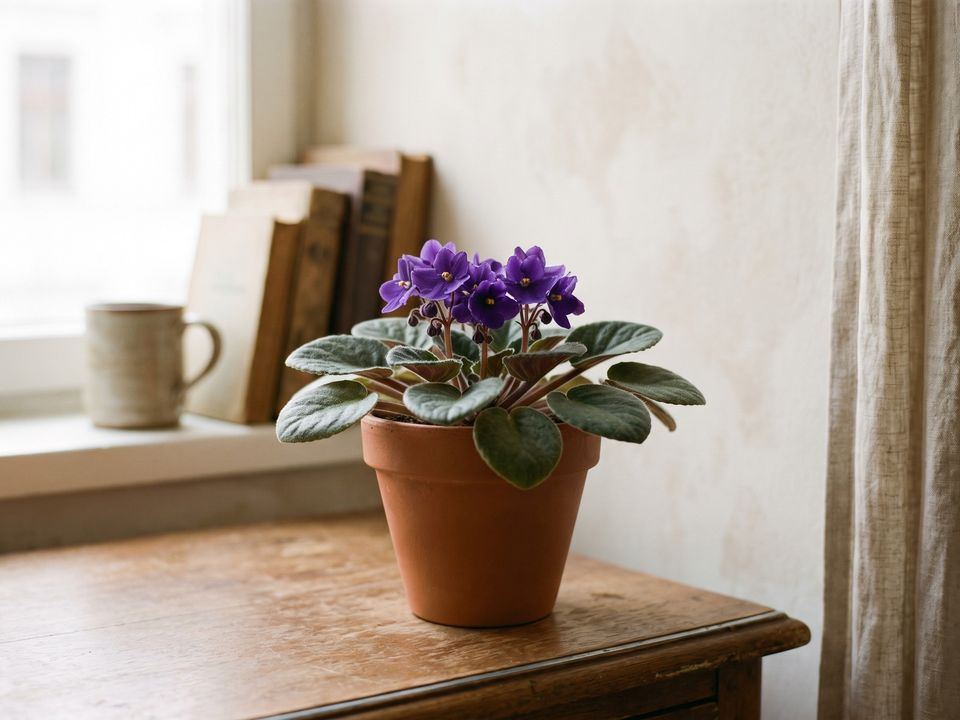
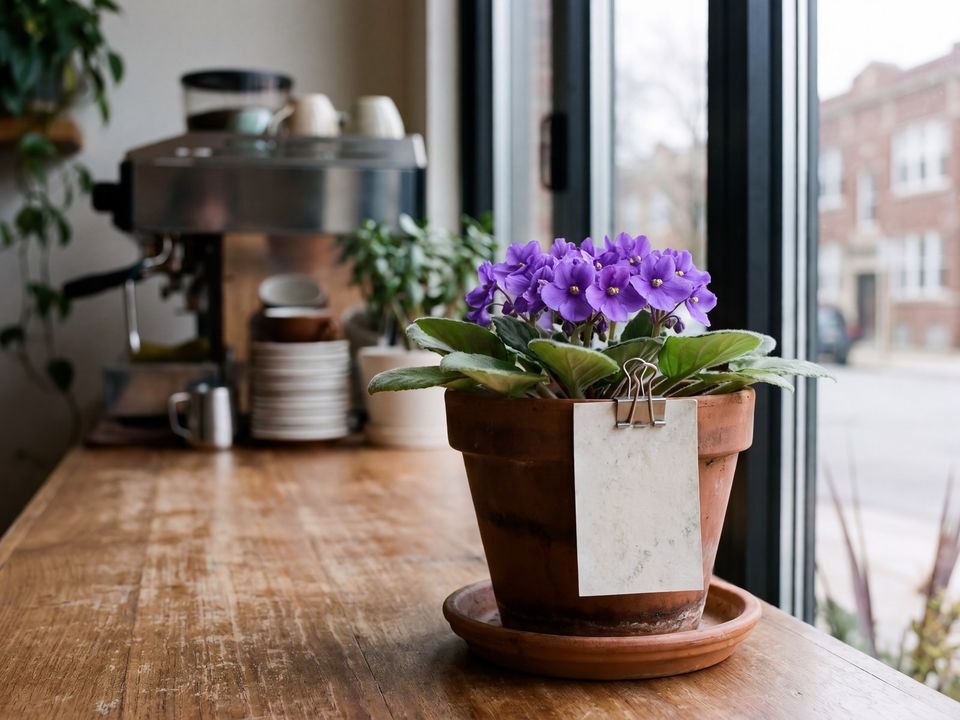
Velvet leaves crowned with blooms most of the year. It asks for warm water, warm nights, and a bright sill.
2.5/5
how easy it is to care for
4.1/5
how much it stands out visually
: Shade to filtered
A bright north or east window; it blooms less in shade
Bright light filtered through a sheer, or a north or east window, keeps the flowers coming. It also grows under fluorescent tubes alone; in a dim corner it may stay leafy and quit blooming.
A north window gives steady light all day and an east one adds soft morning sun, and both suit it for most of the year. In winter a sunnier, warmer window can serve it better (Missouri Botanical Garden). Facing south or west, hang a sheer curtain to turn the glare into the filtered light NC State recommends.
Short on light, the rosette loosens: new leaves come in thin and dark green on long stalks that stretch toward the window, and each flush of flowers is sparser than the last (Clemson Extension). Move it a step closer to the glass and the next flush should fill in.
In winter, keep its fuzzy leaves from resting against a frosty pane. Nights below 60°F can stunt it, and it can take a long time to recover once things warm up (NC State). Missouri Botanical Garden advises keeping it off cold panes at night, so on frigid evenings slide it back a little from the window.
Well lit, it can flower 10-12 months of the year (Clemson Extension), with only short rests between flushes.
: Weekly+
Drinks from a saucer every 5-10 days; keep its leaves dry
Every 5-7 days in summer, 7-10 in winter, with the top of the mix drying between. Fill the saucer rather than the crown; soggy soil rots it.
Its fuzzy leaves scar easily: cold water splashed on them leaves yellow or white rings and streaks (UF Extension; Clemson Extension). Water at room temperature or a touch warmer, and aim below the leaves.
A wick pot can take over the routine. A cord runs from the soil down into a reservoir, and the plant pulls up what it needs (UF Extension). Now and then, pour from the top instead to rinse out built-up fertilizer salts.
It thrives in humid air and can’t stand dry air (NC State), which puts it at odds with a radiator-dried Chicago winter. A tray of damp gravel helps, with the pot’s base resting just clear of the water (UF Extension). After a saucer watering, tip out whatever the soil hasn’t taken up, so the pot isn’t left standing in water (UF Extension).
If a leaf stalk rots where it rests on the pot rim, and that bothers you, a foil collar over the rim and rainwater in place of tap can stop it (Texas A&M). It’ll survive either way.
Gone for a while? Ten days is fine if it’s watered the day you leave; for longer, a wick-watering pot keeps it going.
: Small
A rosette 6-9 inches tall and as wide, full in 2-5 years
A low mound of velvety leaves, 6-9 inches tall and as wide, that fills out in 2-5 years, with clusters of flowers held just above. Fits a sill or a desk; pull yellowed outer leaves to keep the crown clear.
Breeders sort the thousands of named kinds into five size classes, from micro-miniature to large, and some grow as trailers instead of rosettes (NC State).
A standard violet keeps a single crown. Side shoots called suckers pull it out of shape, and Missouri Botanical Garden advises removing them as soon as they appear. It likes a snug pot but wants a fresh one about once a year (UF Extension), with the crown set just above the soil (NC State).
Every leaf is a spare: snap one off with its stalk, push the stalk into potting mix, and tiny plantlets can sprout where it meets the soil (UF Extension).
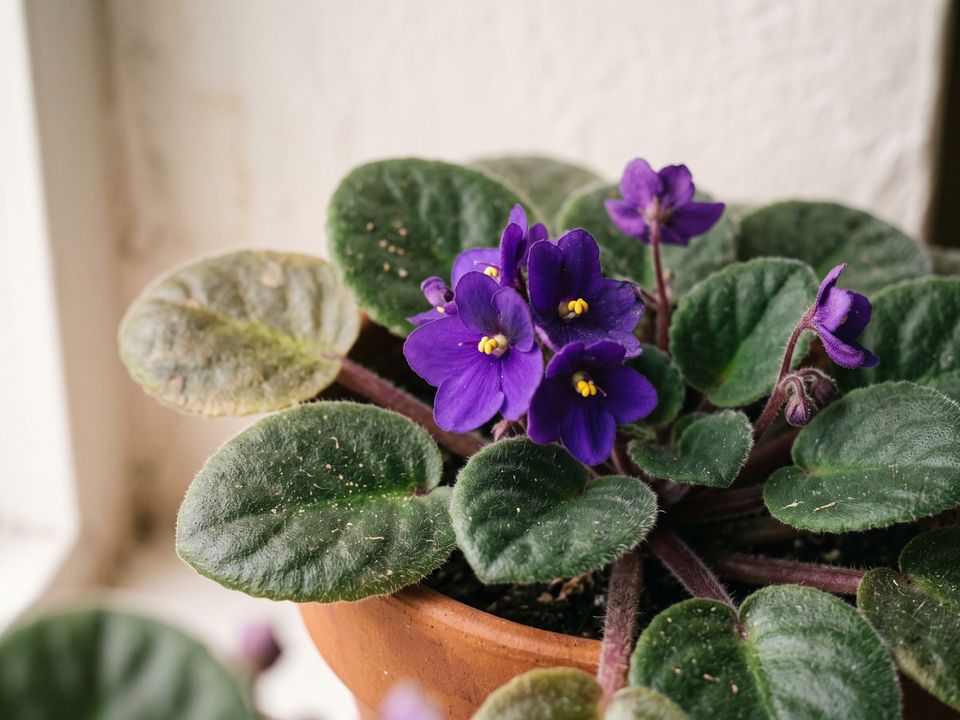
The undersides of its leaves are often red or purple (NC State), so an eye-level shelf, where both sides show, flatters it more than a low table.
: Pet & kid safe
Nothing to worry about for dogs, cats, or kids
- DogsSafe
- CatsSafe
- KidsSafe
The ASPCA lists it as non-toxic for cats and dogs, and poison centers list it as non-toxic for children. A chewed leaf mostly costs the plant.
No hidden catch here. NC State’s Plant Toolbox tags it safe for horses as well as pets, so the velvet rosette is as gentle as it looks.
The bottles kept beside it deserve more care than the plant does. Violets are often fed a weak fertilizer at nearly every watering (UF Extension), and pest sprays carry their own label directions (Clemson Extension). Store both where small hands and paws can’t reach.
If your cat treats the rosette as a chew toy, the likely cost is ragged leaves. A high shelf or a room the cat skips keeps it pretty, and a bitten leaf snapped off at its base leaves room for new ones to fill in.
Cats and dogs: The ASPCA lists it as non-toxic.
Kids: CHOP and Poison Control list it as non-poisonous.
: Average
65-80°F; average humidity is fine
Happiest at 65-80°F, and it shouldn’t sit below 60°F. Keep it away from cold glass in winter. It likes 40-60% humidity and gets by at 30%.
- Temperature
- 65-80°F
- Humidity
- 40-60%
: Cyclamen mites
Cyclamen mites, mealybugs, thrips; peek in the crown
Cyclamen mites hide in the crown center, new leaves, and buds. Mealybugs sit at leaf bases and stems, with root mealybugs in the root ball, and thrips hide in flowers and under leaves. Broad mites favor older bottom leaves.
- Cyclamen mites
- Mealybugs
- Thrips
- Broad mites
Few pests; too much water is the real danger. Mealybugs and thrips turn up now and then, and cyclamen mites rarely.
Mealybugs look like tufts of white cotton where the leaf stalks meet the crown. Dab them with a cotton swab dipped in rubbing alcohol, then check again next week.
Thrips are tiny, slender insects that streak and spot the flowers. Pick off the damaged flowers, rinse the leaves gently with room-temperature water, and use insecticidal soap if they return.
Cyclamen mites are too small to see: the leaves in the very center come in stunted, crinkled, and tightly bunched. There’s no cure at home, so bag the plant and throw it out before they spread to others.
Crown rot and root rot show as a plant that wilts while the soil is still wet; gray fuzzy mold on old flowers is botrytis. Water less, empty the saucer, and pick off spent flowers promptly.
: Most
Feed and rotate every 2 weeks; repot each spring
Feed and quarter-turn it about every 2 weeks all year for steady blooms and an even rosette. Snip spent flower stems and yellowed leaves monthly, and remove suckers as they form. Repot each spring.
- Feed26× a year
- Deadhead12× a year
- Prune4× a year
- Repot1× a year
- Rotate26× a year
A light, fast-draining African violet mix, or half violet mix and half perlite, in a small pot with a drainage hole. Skip decorative pots without one.
Repot once a year, into fresh mix, keeping it in a small pot.
It’s a light, steady eater: an African violet fertilizer at a quarter of the label’s strength each time you water, with a plain-water soak once a month to rinse out the build-up.
: Showy
Velvety leaf mound under near-constant blooms
Fuzzy, deeply textured leaves form a low rosette that covers the soil. Clusters of flowers sit above the leaves for most of the year, so the color seldom takes a break.
Where to find me
Not yet pilferableFun fact
At the first national African violet show, held in Atlanta in 1946, the crowds grew so big that police had to be called in to handle the traffic. The African Violet Society of America was founded soon after.
Designer tips
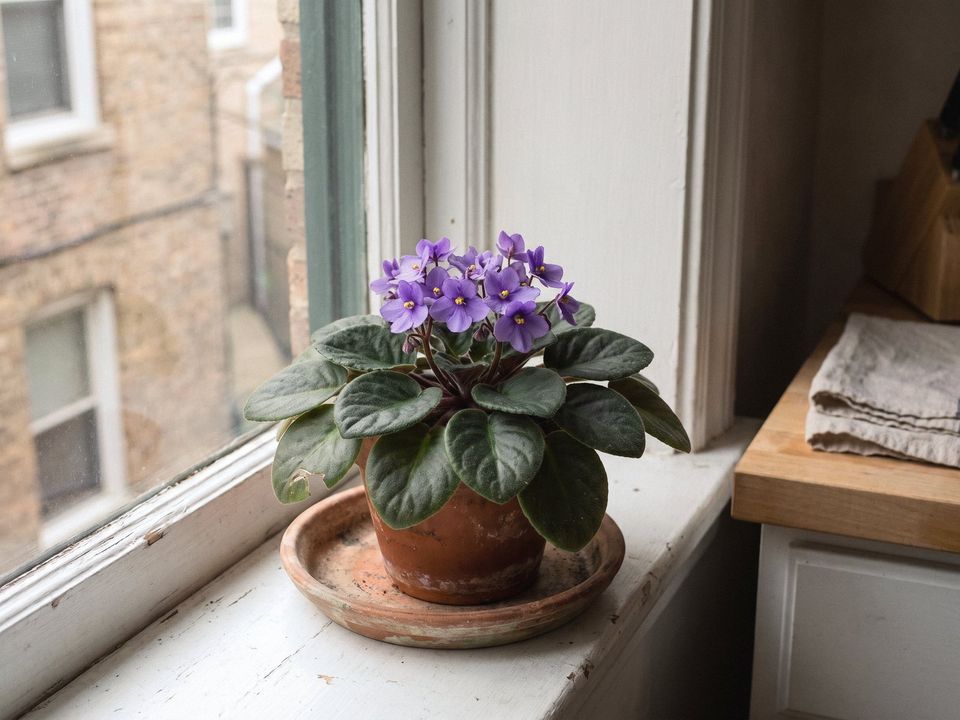
Cottage-sweet and a little retro, it’s a pot of color for a windowsill or a kitchen table.
Troubleshooting
Why won’t it flower?
Light, almost always. It blooms on 14-16 hours of light a day, more than a winter windowsill gives, so a spot nearer a bright window (out of afternoon sun) or a small grow light overhead usually brings the buds back. It stays a healthy leafy plant either way.
It’s wilting, but the soil is wet
Likely root or crown rot from too much water, the usual way violets are lost. Let it dry out and empty the saucer; if the center has gone soft and brown it may not recover, but a healthy leaf can root into a new plant.
Pale rings and spots on the leaves
Water colder than the leaf marks it with pale blotches and rings. Those marks stay, but new leaves usually come in clean if you water at room temperature, from below or under the leaves.
See all 8
Why are the leaves pale or bleached?
Usually too much light, often sun landing on the leaves; a step back from the window helps. Pale leaves on a plant that has also stopped growing may mean it’s hungry: it likes violet food at a quarter strength each time you water.
Why are the center leaves small, crinkled, and bunched?
Likely cyclamen mites, which are too small to see. There’s no home cure, so it’s best bagged and thrown out before they spread, with hands washed before you touch another violet.
Can I grow a new one from a leaf?
Yes, and it’s one of the easiest plants for it. Push the stalk of a healthy leaf into damp perlite or seed-starting mix; roots usually form in 3-4 weeks and tiny plantlets come up at the base in 6-8 weeks.
My cat nibbled the flowers
Nothing harmful: the ASPCA lists African violets as non-toxic to cats, dogs, and horses. Like any plant, a big nibble can upset a stomach, and the plant may look a little ragged for a while.
I’m going away for a week or two
Ten days is usually fine if it’s watered the day you leave. For longer, a wick pot, with a cord drawing water up from a reservoir, keeps it going.
Propagation
Easy, from a single leaf.
- Cut a healthy leaf with an inch to an inch and a half of its stalk, and push the stalk into damp perlite or seed-starting mix at an angle.
- Cover the pot loosely with a clear plastic bag.
- Roots form in three to four weeks, and tiny plantlets come up at the base in six to eight weeks.
Once the plantlets have a few leaves each, pot them up in violet mix; the old leaf can come off once it browns.
The PILF Matrix
2.5/5
how easy it is to care for
4.1/5
how much it stands out visually
“The one in velvet, dressed for a party that never ends.”


- Formerly Saintpaulia ionantha
Rated 1-5, with 5 being easiest
Built from light, water, air, pests, and upkeep.
Rated 1-5, with 5 being easiest
Rated 1-5, with 5 being highest presence
Built from its scale (size, shape, growth) and its look (color and flowers, shine, fullness).
Rated 1-5, with 5 being highest presence
Where it sits and what sun touches it.
- Dim shadeA dark corner or a windowless room; natural light casts no shadow
- Bright shadeBack from the window in a south-, east- or west-facing room, or right by a north-facing one, where only low early or late summer sun reaches it
- Filtered sunBehind a sheer curtain or tinted glass; the sun’s shadows are blurred
- Partial sunIn an east- or west-facing window: up to a few hours of direct sun
- Full sunThe sunniest spot you have, usually a south-facing window, with direct sun 6+ hours a day
How often, and what the soil does between.
- MonthlyEvery 2-3 weeks in summer and 3-5 in winter; the soil dries all the way between
- 2-3× a monthEvery 7-14 days in summer, longer in winter; the top of the soil dries between
- Weekly+About every 4-8 days in summer; the soil stays lightly damp
How much room it usually takes indoors.
Size
- TinyUnder 6 inches tall or wide; for a desk or a sill
- Small6 inches to 1.5 feet tall or wide; for a shelf or a sill
- Medium1.5 to 3 feet tall or wide; for a table or a stand
- Large3 to 6 feet tall or wide; for the floor
- GiantOver 6 feet tall or wide; a statement in the corner
Shape
- TreeA trunk that branches into a canopy
- CaneBare stalks topped with leaves
- UprightStiff stems or leaves rising straight from the soil
- FountainLeaves or fronds arching out from the center
- BushyA full, rounded mound of leaves
- RosetteLeaves radiating from one low point
- ViningTrails, climbs, or both
Growth
How fast it gets there.
- SlowUnder 6 inches of new growth a year
- Moderate6-12 inches a year, mostly in spring and summer
- FastOver 12 inches a year; it may want trimming or training
What risks exist for pets and kids.
- Pet & kid safeNothing to worry about
- Mildly irritatingMay irritate the mouth or stomach if chewed, or for some plants, the skin if handled
- Moderately toxicCan cause illness if eaten, though typically not serious or fatal
- DangerousCan cause serious illness if eaten, including some reports of death
- Not yet ratedNot clearly rated by our sources; please check with your vet or doctor
For its safety ratings, PILF relies on research and guidance from leading sources, including the ASPCA, Pet Poison Helpline, Merck Veterinary Manual, Poison Control, and Children’s Hospital of Philadelphia, and others.
The small jobs beyond watering, over a year.
- Little upkeepA few small jobs a year beyond watering, like a feed now and then
- Some upkeepA small job about once a month beyond watering, like feeding or turning it
- More upkeepA small job every couple of weeks beyond watering, like a wipe, a turn, or a feed
- Most upkeepA small job most weeks beyond watering, like raising the humidity or misting
- TreeA trunk that branches into a canopy
- CaneBare stalks topped with leaves
- UprightStiff stems or leaves rising straight from the soil
- FountainLeaves or fronds arching out from the center
- BushyA full, rounded mound of leaves
- RosetteLeaves radiating from one low point
- ViningTrails, climbs, or both
How fast it gets there.
- SlowUnder 6 inches of new growth a year
- Moderate6-12 inches a year, mostly in spring and summer
- FastOver 12 inches a year; it may want trimming or training
The temperature and humidity it’s comfortable in.
How dry a room it takes.
- Needs 50%+ humidity
- Fine at 35% humidity
- Fine at 15-20% humidity
The bugs that usually find it, by name.
How often pests find it.
- 5+ regular pests
- 3 regular pests
- Pests are rare
The year’s chores: feeding, pruning, repotting, and cleaning.
Chores beyond water (what needs work means).
- Most upkeep
- Some upkeep
- Little upkeep
Its finish, fullness, and texture.
Color, pattern, and flowers.
- SimpleOne green, one texture, nothing to read
- SuaveA sheen, a stripe, or a clean shape that catches the eye up close
- ShowyColor, pattern, or blooms you see from across the room
How the leaves catch light.
- Matte
- Satin
- Glossy or waxy
How much it fills its pot.
- Soil shows
- Soil partly hidden
- Leaves hide the soil