Bromeliad
Guzmania lingulata
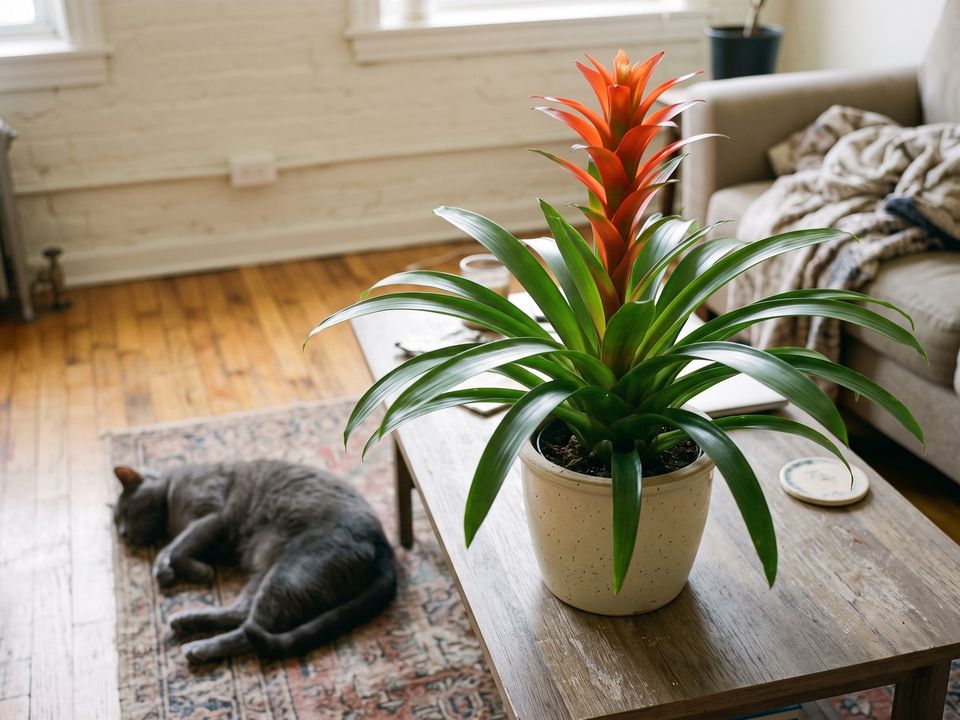
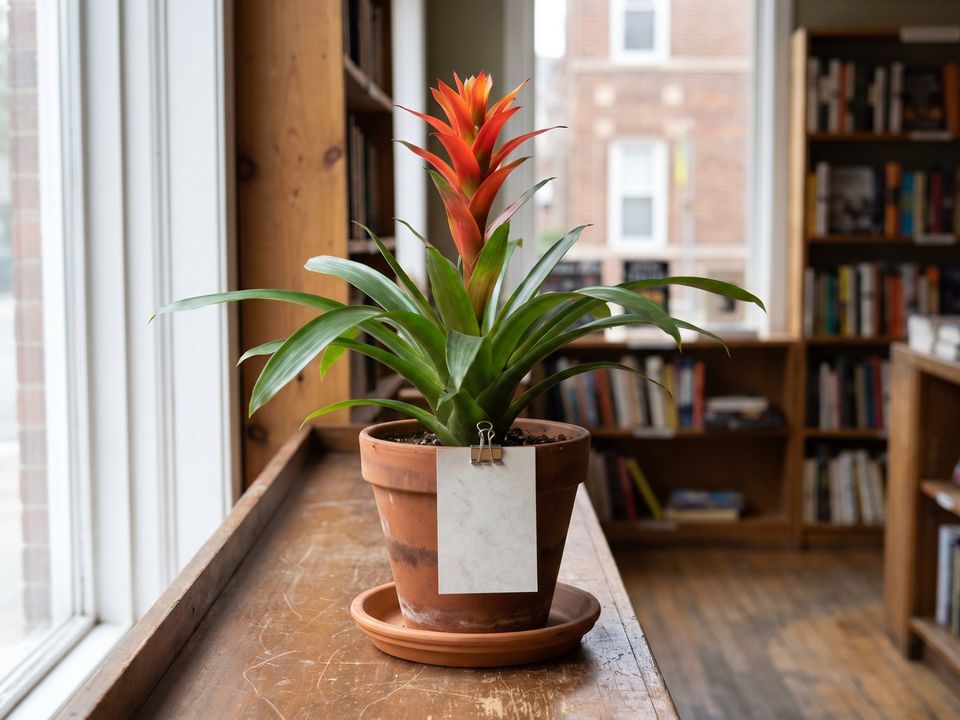
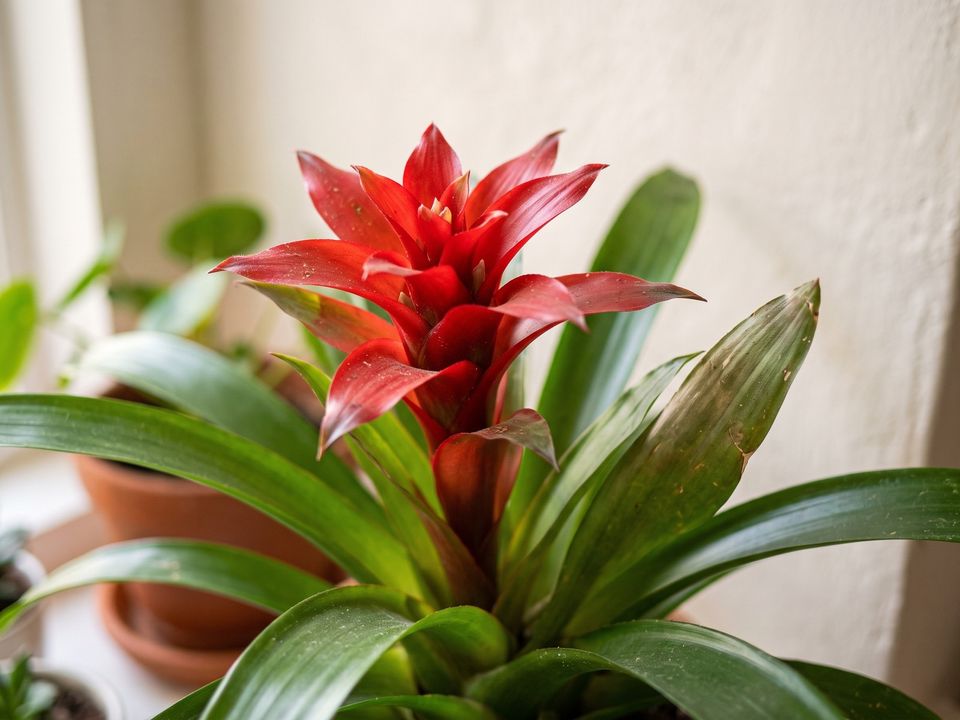
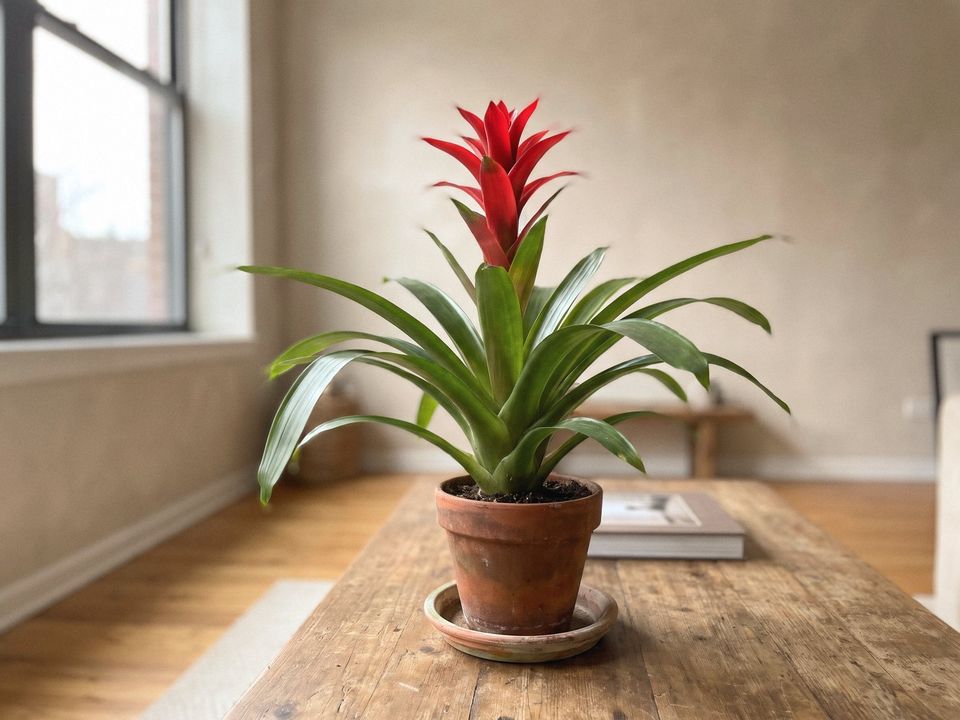
A scarlet star rises from a vase of strappy green leaves. Easy in shade, as long as you keep a little water in its cup.
3.6/5
how easy it is to care for
2.6/5
how much it stands out visually
: Dim to bright
Happy in shade or under overhead lights; out of direct sun
Born to perch beneath a rainforest canopy: a north room or a desk under overhead lights suits it fine, and more light works too, as long as the sun stays off its leaves.
In the wild it perches on trees in the rainforests of tropical America and the West Indies (NC State). Its outdoor ratings there are dappled shade, deep shade, and partial shade with 2-6 hours of sun (NC State). Indoors, those translate to a bright room with the sun’s beam kept off its leaves, which is what it needs to grow well (Missouri Botanical Garden).
It forgives dimmer spots too. That tolerance has made it a fixture of shopping malls and office buildings, where it does well in low and artificial light (Missouri Botanical Garden). A windowless reception desk, its overheads on all day, can carry it through a bloom.
A little morning sun is fine, and a south room works if the plant sits well back from the sunbeams. On light, think of the branch it would perch on: shade overhead, a soft glow all around.
: 2-3× a month
Keep its center cup filled; go easy on the soil below
Refill the cup every 7-10 days in summer and every 10-14 in winter, and give the roots just a splash. In the wild its roots mostly grip a tree, so keep the potting mix on the dry side.
Its overlapping leaves form a vase, a tank in NC State’s word, built to hold water. Every so often, tip out what’s sitting there and pour in fresh, letting the overflow trickle down to the roots. Feed it there too: half-strength liquid fertilizer goes in the cup while it’s growing (NC State).
Roots that evolved to cling to bark do best in bark: an orchid mix lets air reach them and drains off quickly (NC State; Missouri Botanical Garden).
Dry winter indoor air is its harder test, since it wants humid air to prosper (Missouri Botanical Garden). If it summers on a balcony, change the cup water often; standing water outdoors can breed mosquitoes.
Gone for a while? Two weeks is fine if the mix is watered and the cup topped up the day you leave.
: Small
A strappy rosette, 1-2 feet, slow to reach full size
A low vase of strap-shaped leaves that slowly reaches 1-2 feet tall and wide. Set it low to look down into its cup; a glance at the leaves as you refill can catch any scale or mealybugs.
Its leaves can run 18 inches long (NC State), all arching out from one point, so even a modest plant spreads close to its own height.
The flower stalk usually stays shorter than the leaves (Missouri Botanical Garden), so the red sits down inside the vase, best seen from above. That makes it a natural for low furniture: a side table by a sofa, a wide counter, a low bookcase.
In the wild it perches on trunks and branches, and NC State notes it can do the same at home: bound to a piece of wood with its roots wrapped in sphagnum moss, then hung on a wall.
: Pet & kid safe
Nothing to worry about for dogs, cats, or kids
- DogsSafe
- CatsSafe
- KidsSafe
The ASPCA lists it, under the name orange star, as non-toxic to dogs and cats, and no source lists it as harmful to kids.
Good news all around, and the ASPCA’s non-toxic listing even covers horses. Its leaves have smooth edges, without the teeth that line some of its relatives' leaves (NC State; Kew), so there’s nothing to scratch a curious hand.
Eating any plant can upset a pet’s stomach, so a cat that shreds a leaf may vomit, though it isn’t expected to be serious (ASPCA).
For the parent or pet owner, keep an eye on one thing, the water in its cup. If your dog or cat drinks from it, skip the fertilizer there and change the water often. Beyond that, it suits most spots in the house.
Cats and dogs: The ASPCA lists it as non-toxic.
Kids: No poison-centre listing; rated from university extension sources.
: Average
60-85°F; average humidity is fine
Keep it at 60-85°F, away from cold glass in winter. It wants about 35% humidity or more, so average room air suits it.
- Temperature
- 60-85°F
: Scale
Scale and mealybugs; check inside the rosette
Scale and mealybugs are the pests that most often find it. Look on the leaf surfaces and down at the leaf bases and axils inside the rosette. Spider mites are occasional, on leaf undersides.
- Scale
- Mealybugs
- Spider mites
Not many: UF/IFAS calls it fairly pest-free. Scale and mealybugs turn up now and then, and root rot if the mix stays wet.
Scale looks like small brown bumps stuck to the leaves; mealybugs look like tufts of white cotton down between them. Wipe them off with a cotton swab dipped in rubbing alcohol (a fingernail lifts scale), then check again next week.
Spider mites are rarer: fine webbing and a dusty, speckled look, mostly in dry winter air. Rinse the plant in the shower, then try insecticidal soap if they come back.
Rot shows as soft, brown leaves at the base. Let the mix dry out and water less often; if the rosette is lost, pot up any healthy pups.
: Some
Flush the cup every 2 months; feed 3× in summer
Flush the cup with fresh water about 6 times a year: tip it out, then refill. Feed 3 times in summer with half-strength liquid fertilizer, misted on the leaves too. In mid spring, cut off pups and pot them.
- Clean leaves6× a year
- Feed3× a year
- Divide1× a year
- Prune1× a year
A chunky mix that drains fast, like an orchid or bromeliad mix of bark and perlite, in a small pot with a drainage hole. Its roots want air, not soggy soil.
Repot rarely, if ever: each rosette flowers once and slowly declines over a year or two, so the pups get their own pots instead (see Propagation).
Food is optional: a houseplant fertilizer at a third to half strength, on the mix every month or two through spring and summer, is plenty.
: Simple
Strappy green leaves in a vase, with some texture
Long, strap-shaped leaves in one plain green fan out from the center into a vase. The surface has a little texture and sheen, and the leaves cover only part of the soil.
Where to find me
Not yet pilferableFun fact
Guzmania honors Anastasio Guzmán, an 18th-century Spanish pharmacist and naturalist, and lingulata means tongue-shaped, for its long leaves. It’s a cousin of the pineapple.
Designer tips
A shot of color that lasts for months: a tidy, glossy rosette with a bright spike, at home on a table or a desk.
Troubleshooting
It flowered, and now it’s dying
Nothing went wrong: each rosette flowers once, then slowly fades over a year or two (UF/IFAS), making pups at its base as it goes. Pot up the pups once they’re a third to half its size, or leave them for a fuller clump.
How long does the color last?
Usually 2-4 months, says NC State Extension. When the spike fades, cut it off at the base if you like; the leaves stay green for a good while after.
Do I really pour water into the center?
Yes, a little: the cup at the center is how it drinks in the wild. Top it up every 7-10 days in summer and 10-14 in winter, pour it out for fresh every couple of months, and give the mix just a splash.
See all 8
The leaf tips are turning brown
Usually minerals building up in the cup, or dry winter air. Fresh water poured through the cup so it overflows helps, and so does skipping softened water (UW-Madison Extension links the buildup to tip dieback); trim the tips if they bother you.
Why are the leaves going soft and brown at the base?
Too much water in the mix, most likely: UF/IFAS says most bromeliad problems come from root rot. Let the mix dry, empty the saucer, and water more lightly; if the rosette collapses, healthy pups can carry on in their own pots.
Will it flower again?
The mother won’t, but its pups usually do, in 1-3 years. To nudge a full-grown pup along, Clemson Extension suggests sealing it in a clear plastic bag with a ripe apple for a couple of days; the apple’s gas can set off flowering weeks later.
The leaves look pale and yellowish
Likely too much light, says UF/IFAS. A step back from the window or a sheer curtain helps; if they’re dark, soft and drooping instead, it wants a little more light.
My cat chewed a leaf
Nothing harmful: the ASPCA lists it as non-toxic to cats and dogs. Eating any plant can upset a pet’s stomach, and if yours drinks from the cup, skip the fertilizer there and change the water often.
Propagation
Yes, from the pups it makes after flowering: that’s how you keep one going for years.
- When a pup is a third to half the size of its mother, cut it away close to the base with a clean knife and pot it in orchid mix.
- It may have few roots of its own; UF/IFAS says not to worry, they come later.
- Expect it to flower in one to three years.
Or leave the pups where they are for a fuller clump, and cut the old rosette out once it has died back.
The PILF Matrix
3.6/5
how easy it is to care for
2.6/5
how much it stands out visually
“The one that goes out in a blaze of glory and leaves the kids in charge.”


- scarlet star
- vase plant
Rated 1-5, with 5 being easiest
Built from light, water, air, pests, and upkeep.
Rated 1-5, with 5 being easiest
Rated 1-5, with 5 being highest presence
Built from its scale (size, shape, growth) and its look (color and flowers, shine, fullness).
Rated 1-5, with 5 being highest presence
Where it sits and what sun touches it.
- Dim shadeA dark corner or a windowless room; natural light casts no shadow
- Bright shadeBack from the window in a south-, east- or west-facing room, or right by a north-facing one, where only low early or late summer sun reaches it
- Filtered sunBehind a sheer curtain or tinted glass; the sun’s shadows are blurred
- Partial sunIn an east- or west-facing window: up to a few hours of direct sun
- Full sunThe sunniest spot you have, usually a south-facing window, with direct sun 6+ hours a day
How often, and what the soil does between.
- MonthlyEvery 2-3 weeks in summer and 3-5 in winter; the soil dries all the way between
- 2-3× a monthEvery 7-14 days in summer, longer in winter; the top of the soil dries between
- Weekly+About every 4-8 days in summer; the soil stays lightly damp
How much room it usually takes indoors.
Size
- TinyUnder 6 inches tall or wide; for a desk or a sill
- Small6 inches to 1.5 feet tall or wide; for a shelf or a sill
- Medium1.5 to 3 feet tall or wide; for a table or a stand
- Large3 to 6 feet tall or wide; for the floor
- GiantOver 6 feet tall or wide; a statement in the corner
Shape
- TreeA trunk that branches into a canopy
- CaneBare stalks topped with leaves
- UprightStiff stems or leaves rising straight from the soil
- FountainLeaves or fronds arching out from the center
- BushyA full, rounded mound of leaves
- RosetteLeaves radiating from one low point
- ViningTrails, climbs, or both
Growth
How fast it gets there.
- SlowUnder 6 inches of new growth a year
- Moderate6-12 inches a year, mostly in spring and summer
- FastOver 12 inches a year; it may want trimming or training
What risks exist for pets and kids.
- Pet & kid safeNothing to worry about
- Mildly irritatingMay irritate the mouth or stomach if chewed, or for some plants, the skin if handled
- Moderately toxicCan cause illness if eaten, though typically not serious or fatal
- DangerousCan cause serious illness if eaten, including some reports of death
- Not yet ratedNot clearly rated by our sources; please check with your vet or doctor
For its safety ratings, PILF relies on research and guidance from leading sources, including the ASPCA, Pet Poison Helpline, Merck Veterinary Manual, Poison Control, and Children’s Hospital of Philadelphia, and others.
The small jobs beyond watering, over a year.
- Little upkeepA few small jobs a year beyond watering, like a feed now and then
- Some upkeepA small job about once a month beyond watering, like feeding or turning it
- More upkeepA small job every couple of weeks beyond watering, like a wipe, a turn, or a feed
- Most upkeepA small job most weeks beyond watering, like raising the humidity or misting
- TreeA trunk that branches into a canopy
- CaneBare stalks topped with leaves
- UprightStiff stems or leaves rising straight from the soil
- FountainLeaves or fronds arching out from the center
- BushyA full, rounded mound of leaves
- RosetteLeaves radiating from one low point
- ViningTrails, climbs, or both
How fast it gets there.
- SlowUnder 6 inches of new growth a year
- Moderate6-12 inches a year, mostly in spring and summer
- FastOver 12 inches a year; it may want trimming or training
The temperature and humidity it’s comfortable in.
How dry a room it takes.
- Needs 50%+ humidity
- Fine at 35% humidity
- Fine at 15-20% humidity
The bugs that usually find it, by name.
How often pests find it.
- 5+ regular pests
- 3 regular pests
- Pests are rare
The year’s chores: feeding, pruning, repotting, and cleaning.
Chores beyond water (what needs work means).
- Most upkeep
- Some upkeep
- Little upkeep
Its finish, fullness, and texture.
Color, pattern, and flowers.
- SimpleOne green, one texture, nothing to read
- SuaveA sheen, a stripe, or a clean shape that catches the eye up close
- ShowyColor, pattern, or blooms you see from across the room
How the leaves catch light.
- Matte
- Satin
- Glossy or waxy
How much it fills its pot.
- Soil shows
- Soil partly hidden
- Leaves hide the soil