Lucky Bamboo
Dracaena sanderiana
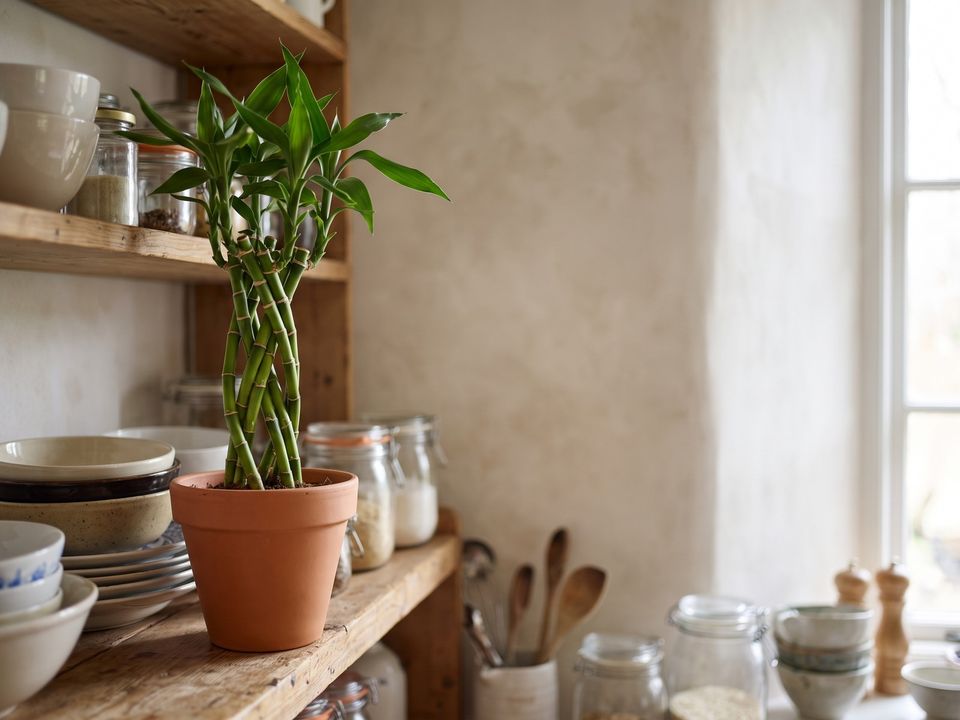
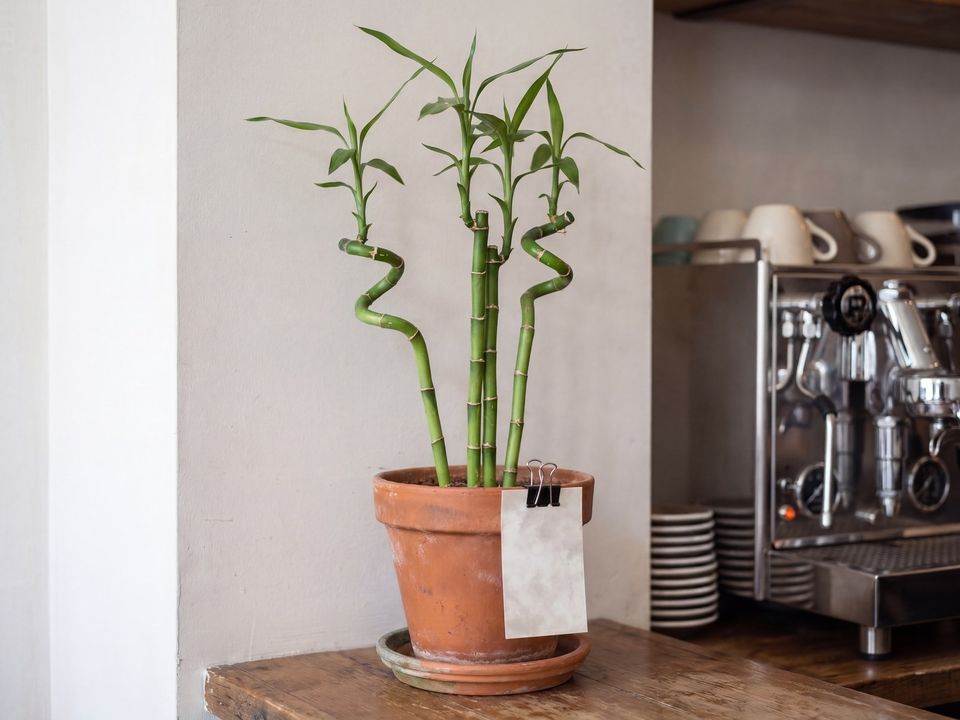
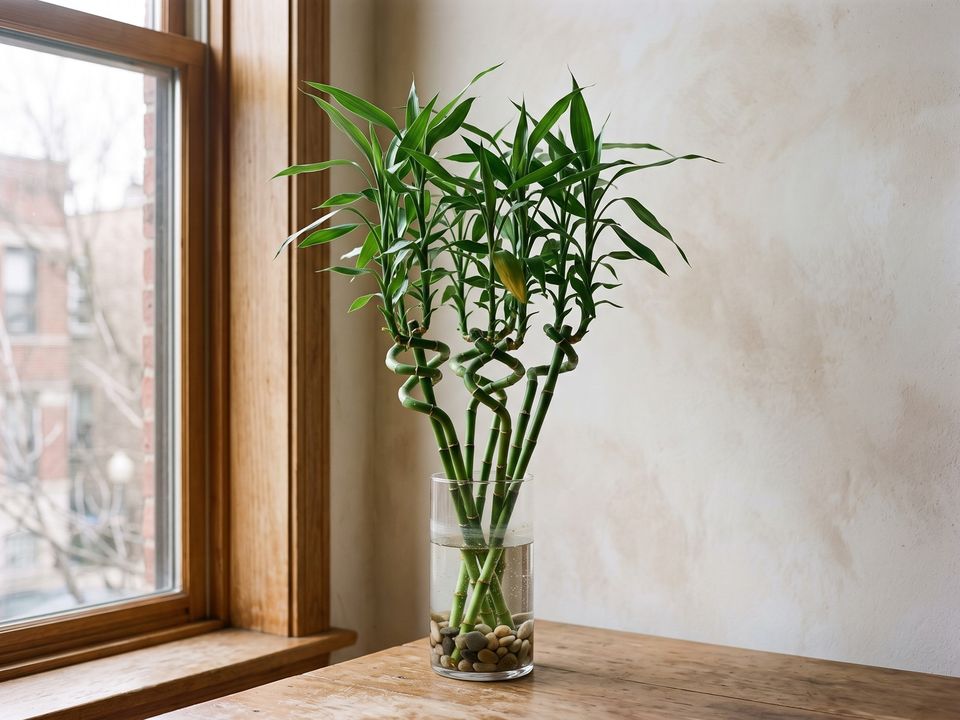
Green canes, curled or braided, with ribbony leaves up top. Lives in a vase of water, happy with a weekly refresh.
3.4/5
how easy it is to care for
1.9/5
how much it stands out visually
: Dim to bright
Shady room or bright one; direct sun browns its leaves
It puts up with low light, but grows best in an east- or north-facing room, set back where direct sun can’t land on its leaves.
NC State files it under dappled sun, the light that filters through a tree canopy all day, and deep shade, with under 2 hours of direct sun.
In a clear glass vase, light falls on the water as well as the leaves, and sunlit water may turn green with algae. A tinted or opaque vase keeps the water clearer.
Summering it outside? NC State says it does well in a container in partial shade, though it’s hardy only in zones 10-12 (Clemson).
Too much sun through the glass shows up as scorched, browning leaves (Missouri Botanical Garden), so let the vase catch the glow, never the beam.
: Weekly+
Keep its roots underwater; swap the water each week
Keep the roots and an inch of cane underwater, changing it weekly; that also keeps mosquitoes from breeding. In soil, soggy soil can yellow leaves and rot the canes.
NC State suggests chlorine-free water. If yours comes from the tap, filling a jug a day ahead of each change may let some chlorine escape. If the tips brown anyway and that bothers you, dry indoor air can be the cause too (NC State). The canes survive either way.
A layer of pebbles or marbles at the bottom of the vase gives the roots something to grip and adds weight, so a tall bundle won’t tip (NC State, Clemson).
Gone for a while? Two weeks is fine if the vase is topped up (or the soil soaked) the day you leave.
: Medium
Bare canes 1-3 feet tall, leafy on top; slow to grow
Sold as single canes, bundles, braids, or spirals, 1-3 feet tall. A heavy vase on a desk, counter, or bookshelf suits it; trim older, lanky stems to the base for fresh growth.
Its leaves run up to 7 inches long and sit widely spaced along the stem, so even a full bundle looks open and airy, never dense (Missouri Botanical Garden, NC State).
Each stalk in a bundle is a length of cane, and a cane set in water roots from its base and sends out new shoots (NC State). Moving a bundle from water into soil? Stake the tall stems until the roots take hold (Clemson).
Prefer stripes? Look for 'White Stripe' or 'Silver Ribbon' (NC State).
Tall and narrow in its glass, it fits where pots can’t: a bathroom shelf, a desk corner, or a row of vases down a long table.
: Mildly irritating
Chewing can upset dogs and cats; rated safe for kids
- DogsMildly irritating
- CatsMildly irritating
- KidsSafe
Despite the name, it’s a dracaena. A dog or cat that chews it may drool, vomit, or go quiet for a while, and it usually passes. CHOP lists it as nonpoisonous for kids.
A cat that chews it may get dilated pupils or a wobbly walk for a while; it passes.
Its irritant is saponin, a soapy compound NC State finds in every part of the plant, roots to leaves. A chewing dog or cat may lose its appetite or seem listless for a spell, and the vomiting can occasionally bring a little blood (NC State). It’s unpleasant to see, but the usual course settles at home.
For kids it’s listed as nonpoisonous (CHOP, Poison Control), and NC State rates it low severity. The sap can irritate skin, so a quick hand-wash after trimming canes or changing the water is plenty.
If symptoms don’t settle or anything worries you, call your vet or the ASPCA Animal Poison Control Center (a fee may apply). For a child, Poison Control can help.
If your cat is a chewer, give it a spot your cat can’t jump to, or a room whose door stays shut. Its slim vase fits a high shelf where a floor plant never could.
- ASPCA: mild for dogs (rates the whole genus).
- Merck Veterinary Manual: mild for dogs (rates the whole genus).
- Pet Poison Helpline: mild for dogs.
- ASPCA: mild for cats (rates the whole genus).
- Merck Veterinary Manual: mild for cats (rates the whole genus).
- Pet Poison Helpline: mild for cats.
- CHOP: safe for kids.
Cats and dogs: Most of the leading sources agree.
Kids: CHOP and Poison Control list it as non-poisonous. Its sap can irritate skin or eyes.
: Average
70-80°F; average humidity is fine
Happiest at 70-80°F, and it shouldn’t sit below 60°F. Keep it away from cold glass in winter. Humidity can drop to 30% without trouble.
- Temperature
- 70-80°F
: Mealybugs
Mealybugs and spider mites; look under the leaves
Mealybugs hide where leaves sheathe the stem and under the leaves; spider mites stay on the undersides. Scale, aphids on new shoots, and thrips can also visit. A glance under a leaf at water-change time is plenty.
- Mealybugs
- Spider mites
- Scale
- Aphids
- Banded greenhouse thrips
- False spider mites
Few. It has no serious pests or diseases; spider mites, mealybugs, and scale turn up now and then, and a stalk can rot in stale water or soggy soil.
Spider mites are the ones to watch in dry winter air: pale speckles on the leaves and, in a bad case, fine webbing. Rinse the leaves in the shower, undersides included; if they come back, an insecticidal soap spray is the next step.
Mealybugs look like tufts of white cotton where the leaves meet the stalk; scale looks like small brown bumps stuck to the leaves. Wipe them off with a cotton swab dipped in rubbing alcohol, then check again next week.
Rot shows as a stalk going yellow and soft. Take that stalk out so it doesn’t spoil the water for the rest, rinse the vase and the other roots, and refill with fresh water.
: Most
Fresh water weekly; feed 6× a year
Change the water weekly with filtered or chlorine-free water, roots covered. Feed at 1/4 strength every other month, scrub the vase and pebbles 4 times a year, and cut lanky stems to the base twice a year.
- Change water (water-grown)52× a year
- Feed (water-grown)6× a year
- Feed (soil-grown)6× a year
- Prune2× a year
- Stake1× a year
- Rinse vase and pebbles4× a year
In water: a vase or glass with pebbles or marbles in the bottom to hold the stalks upright. In soil: an ordinary indoor potting mix that drains fast, in a pot with a drainage hole; stake tall stalks until the roots take hold.
Move it up a size only when the roots crowd its vase or pot, in spring.
It needs a little food to last: plain water keeps it going for a year or more, then it slowly fades. In a vase, add liquid houseplant fertilizer at a quarter strength every other month; in soil, feed it monthly in spring and summer, and no more, since extra fertilizer builds up salts that brown the tips.
: Simple
Plain green canes and ribbony leaves, with a slight sheen
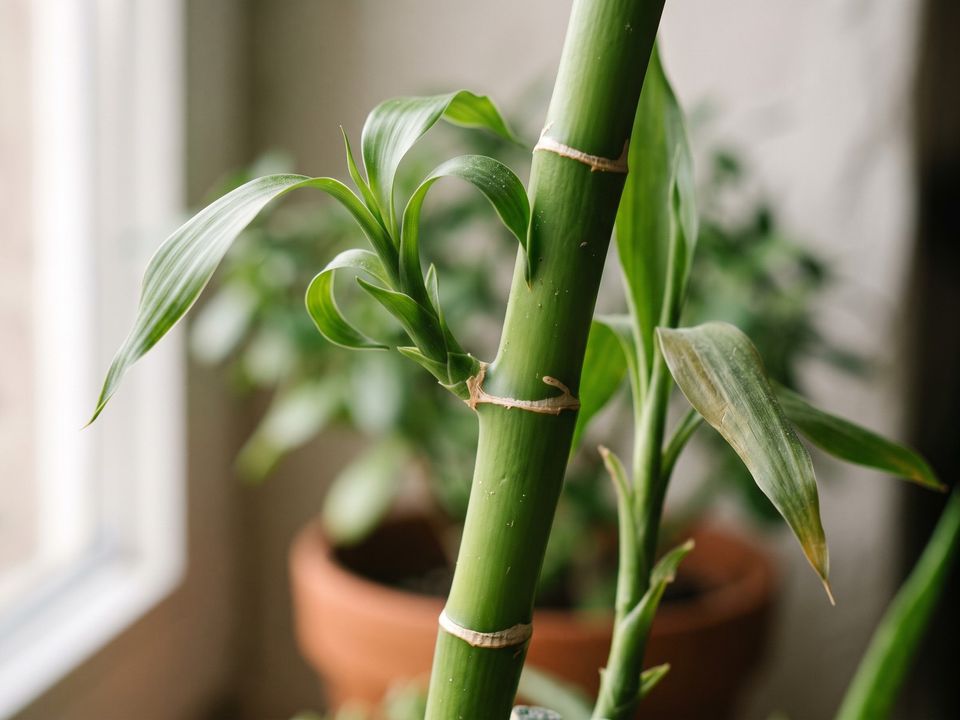
One plain green runs from the canes to the ribbony leaves on top, with no stripes or spots. The leaves have a gentle sheen, and the effect is airy: soil shows between the stems.
Where to find me
Not yet pilferableFun fact
In feng shui, the number of stalks in a bundle carries its own meaning, from love to good health. Four is the count you won’t see, since it isn’t considered lucky.
Designer tips
Clean, graphic, and a little Zen: green stalks in glass suit a desk, a counter, or a pared-back room.
Troubleshooting
Why are the leaves turning yellow?
Check the light first: sun on the leaves yellows and then browns them, so move it back from the window. If it’s already out of the sun, suspect the tap water’s chlorine and fluoride or, in soil, soggy roots.
The leaf tips are brown
Usually what’s in the water, or dry air. Dracaenas are very sensitive to fluoride, and salts from tap water and fertilizer build up too, so rain or distilled water and a light hand with feeding help; snip the brown bits if they bother you.
One stalk is turning yellow and soft
It’s rotting, usually from stale water or soggy soil. Take that stalk out so it doesn’t spoil the water for the rest, rinse the vase and the other roots, and refill with fresh water.
See all 10
I missed a water change
A late change likely won’t hurt it. NC State Extension suggests changing it weekly, which also keeps mosquitoes from breeding in the vase, and topping it up in between is fine.
Should it live in water or soil?
Either. Water is simplest, with fresh water weekly and a quarter-strength feed every other month; in soil it wants a pot with a drainage hole and a stake for tall stalks until the roots take hold.
My cat chewed a leaf
Expect drooling, maybe vomiting or a quiet spell, and in a cat, wide pupils for a while; it’s mildly irritating and usually passes (ASPCA). If it doesn’t settle, call your vet or the ASPCA Animal Poison Control Center.
The water in the vase is turning green
Likely algae: in a clear glass vase, light falls on the water as well as the leaves, and sunlit water may turn green. A tinted or opaque vase keeps it clearer.
Is it really bamboo?
No. It’s a dracaena, a tropical shrub from West Africa in the asparagus family, sold as cut stalks that happen to look like bamboo.
Can it live without a window?
It wants a room with a window, though it can sit well back from it: NC State Extension rates it for shade, deep shade included. Total darkness is the one spot it can’t manage.
Can it go outside for the summer?
Yes, in partial shade once frost is past in late spring; NC State says it does well in a container there. Bring it back in before nights drop below 60°F, and check it for bugs before it comes inside.
Propagation
Easy: a leafy shoot roots in a glass of water.
- Cut a shoot of new growth off the stalk, pull off its lowest leaves, and stand it in water.
- Roots form in 2-3 weeks; keep it in water or pot it up in mix once they’re growing.
The PILF Matrix
3.4/5
how easy it is to care for
1.9/5
how much it stands out visually
“The one with a fake ID: asparagus, but with bamboo energy.”


- water bamboo
Rated 1-5, with 5 being easiest
Built from light, water, air, pests, and upkeep.
Rated 1-5, with 5 being easiest
Rated 1-5, with 5 being highest presence
Built from its scale (size, shape, growth) and its look (color and flowers, shine, fullness).
Rated 1-5, with 5 being highest presence
Where it sits and what sun touches it.
- Dim shadeA dark corner or a windowless room; natural light casts no shadow
- Bright shadeBack from the window in a south-, east- or west-facing room, or right by a north-facing one, where only low early or late summer sun reaches it
- Filtered sunBehind a sheer curtain or tinted glass; the sun’s shadows are blurred
- Partial sunIn an east- or west-facing window: up to a few hours of direct sun
- Full sunThe sunniest spot you have, usually a south-facing window, with direct sun 6+ hours a day
How often, and what the soil does between.
- MonthlyEvery 2-3 weeks in summer and 3-5 in winter; the soil dries all the way between
- 2-3× a monthEvery 7-14 days in summer, longer in winter; the top of the soil dries between
- Weekly+About every 4-8 days in summer; the soil stays lightly damp
How much room it usually takes indoors.
Size
- TinyUnder 6 inches tall or wide; for a desk or a sill
- Small6 inches to 1.5 feet tall or wide; for a shelf or a sill
- Medium1.5 to 3 feet tall or wide; for a table or a stand
- Large3 to 6 feet tall or wide; for the floor
- GiantOver 6 feet tall or wide; a statement in the corner
Shape
- TreeA trunk that branches into a canopy
- CaneBare stalks topped with leaves
- UprightStiff stems or leaves rising straight from the soil
- FountainLeaves or fronds arching out from the center
- BushyA full, rounded mound of leaves
- RosetteLeaves radiating from one low point
- ViningTrails, climbs, or both
Growth
How fast it gets there.
- SlowUnder 6 inches of new growth a year
- Moderate6-12 inches a year, mostly in spring and summer
- FastOver 12 inches a year; it may want trimming or training
What risks exist for pets and kids.
- Pet & kid safeNothing to worry about
- Mildly irritatingMay irritate the mouth or stomach if chewed, or for some plants, the skin if handled
- Moderately toxicCan cause illness if eaten, though typically not serious or fatal
- DangerousCan cause serious illness if eaten, including some reports of death
- Not yet ratedNot clearly rated by our sources; please check with your vet or doctor
For its safety ratings, PILF relies on research and guidance from leading sources, including the ASPCA, Pet Poison Helpline, Merck Veterinary Manual, Poison Control, and Children’s Hospital of Philadelphia, and others.
The small jobs beyond watering, over a year.
- Little upkeepA few small jobs a year beyond watering, like a feed now and then
- Some upkeepA small job about once a month beyond watering, like feeding or turning it
- More upkeepA small job every couple of weeks beyond watering, like a wipe, a turn, or a feed
- Most upkeepA small job most weeks beyond watering, like raising the humidity or misting
- TreeA trunk that branches into a canopy
- CaneBare stalks topped with leaves
- UprightStiff stems or leaves rising straight from the soil
- FountainLeaves or fronds arching out from the center
- BushyA full, rounded mound of leaves
- RosetteLeaves radiating from one low point
- ViningTrails, climbs, or both
How fast it gets there.
- SlowUnder 6 inches of new growth a year
- Moderate6-12 inches a year, mostly in spring and summer
- FastOver 12 inches a year; it may want trimming or training
The temperature and humidity it’s comfortable in.
How dry a room it takes.
- Needs 50%+ humidity
- Fine at 35% humidity
- Fine at 15-20% humidity
The bugs that usually find it, by name.
How often pests find it.
- 5+ regular pests
- 3 regular pests
- Pests are rare
The year’s chores: feeding, pruning, repotting, and cleaning.
Chores beyond water (what needs work means).
- Most upkeep
- Some upkeep
- Little upkeep
Its finish, fullness, and texture.
Color, pattern, and flowers.
- SimpleOne green, one texture, nothing to read
- SuaveA sheen, a stripe, or a clean shape that catches the eye up close
- ShowyColor, pattern, or blooms you see from across the room
How the leaves catch light.
- Matte
- Satin
- Glossy or waxy
How much it fills its pot.
- Soil shows
- Soil partly hidden
- Leaves hide the soil