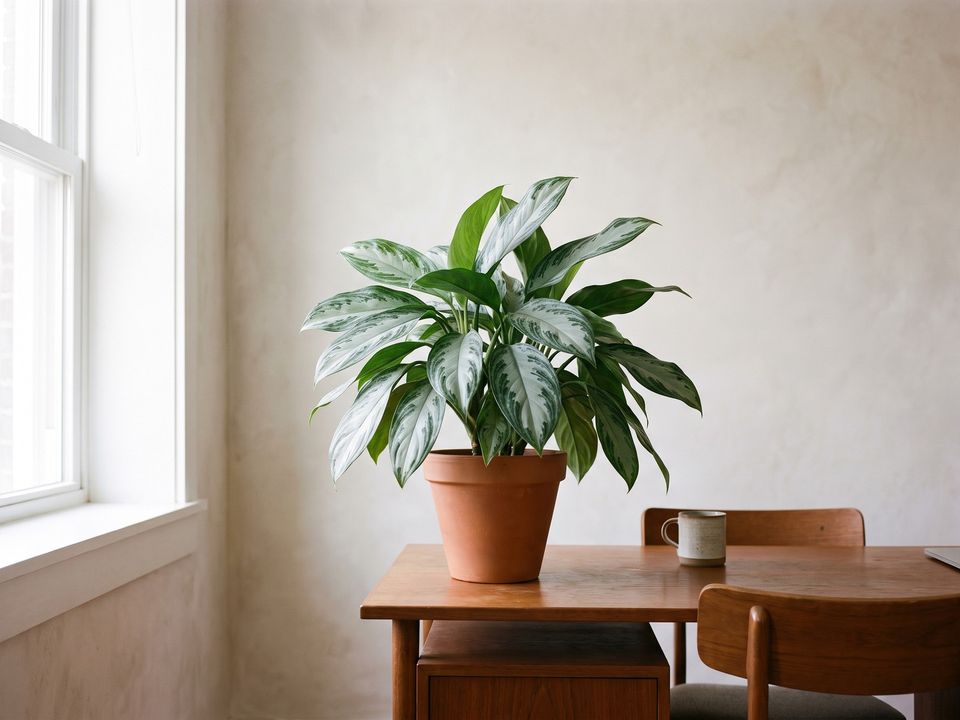
Chinese Evergreen
Aglaonema
Also called aglaonema
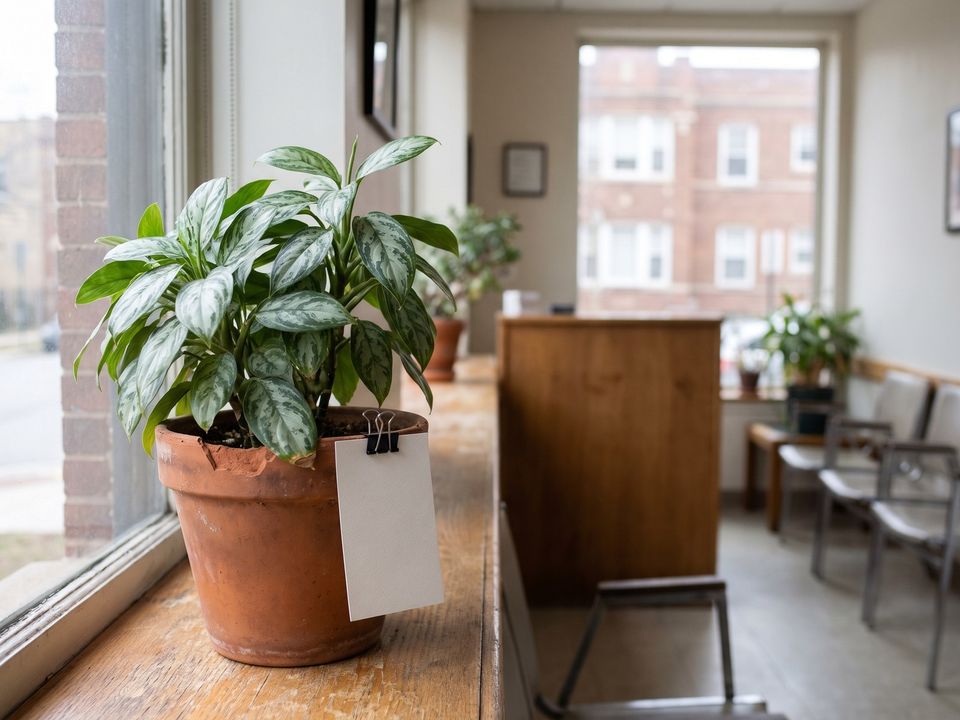
Patterned leaves, some cultivars blushing red, in a tidy mound. At ease with office light, dry air and a skipped drink.
3.5/5
how easy it is to care for
3.5/5
how much it stands out visually
: Dim to filtered
Gets by on overhead lights; fullest near a sheer curtain
No window? A small grow light does the trick.
Overhead lights or a dim corner will keep it going. By a sheer-curtained window, or back from a bright one, it grows best, and may even bloom.
Its native home is the humid, heavily shaded floor of tropical forest across Southeast Asia (University of Florida), so the even, shadowless light of an office is closer to home than it looks.
A north-facing window works, or an east one with a sheer drawn. Facing south or west, set it well back from the glass so the afternoon rays fall short of its leaves.
Light decides whether it flowers at all: kept low, it often won’t (NC State).
Born in the tropics, it takes cold badly. NC State gives 70-80°F by day as its range, so in winter keep its leaves off the window glass.
Dim offices are where it made its name: the University of Florida calls it a favorite for low-light homes and workplaces.
: 2-3× a month
Lean late, not early: every 7-10 days, less in winter
Every 7-10 days from spring to fall, letting the top dry first, and every 10-14 in winter. Overwatering brings on root rot, so it would rather wait a few days than drink early.
A tropical plant that dislikes cold, it doesn’t care for cold water either: NC State advises against it, and a can filled the night before takes care of that.
Clemson ranks it among the most durable houseplants, tolerant even of drought and air-conditioning. Its tell is at the leaf edges: it prefers humidity, and very dry or drafty air may brown them (NC State). If that bothers you, move it out of the blowing air; it’ll keep going either way.
Gone for a while? Two weeks is fine if it’s watered the day you leave. If you turn the heat down while you’re gone, move it away from the window first.
: Medium
Patterned leaves in a clump that slowly fills 1-3 feet
A dense, multi-stemmed clump, often 1-3 feet tall and about as wide, at home on a side table, reception desk or plant stand. An old stem can go bare and jointed like sugarcane; cut it back and root the top to fill in.
The leaves run 4-8 inches long and 2-3 inches wide (NC State), rising on short stalks from several stems at once. It fills out slowly (University of Florida), so the plant you bring home stays close to that size for a good while.
Lower leaves fall away as it ages, so the stems build into trunk-like canes topped with tufts (Missouri Botanical Garden). To rejuvenate a crowded old pot, split it at the roots into smaller pots, the method NC State recommends alongside cuttings.
Because it fills out as a clump of stems rather than one trunk, it reads well low: on the floor at the foot of a tall, bare-legged plant whose base needs company, or as a centerpiece on a long counter.
: Mildly irritating
Chewing can sting the mouths of dogs, cats, or kids
- DogsMildly irritating
- CatsMildly irritating
- KidsMildly irritating
A bite may bring on mouth pain, drooling, and vomiting; the ASPCA lists it as toxic to dogs and cats but rates the severity low. In kids, a chewed leaf can burn the mouth, and the sap may leave a rash.
Every part of it carries calcium-oxalate crystals (NC State). These are raphides, microscopic needles packed into leaves and stalks that lodge in the mouth when bitten (ASPCA), which is why a pet may paw at its face or shake its head.
Most cases can be handled at home with no lasting effects (ASPCA). A little milk or yogurt soon after can soothe the mouth; check the label for xylitol first. If symptoms don’t settle, or anything worries you, call your vet or the ASPCA Animal Poison Control Center (a fee may apply); for a child, Poison Control can help. In the rare case that swelling makes it hard for a pet to swallow or breathe, go straight to a veterinary hospital (ASPCA).
Trimming it? Gloves spare your hands from the sap.
If a toddler or a chewing pet shares the room, snip off any flowers before they turn to red berries, and set it on a shelf or stand above their reach.
- ASPCA: mild for dogs.
- Merck Veterinary Manual: mild for dogs (rates the whole genus).
- Pet Poison Helpline: mild for dogs.
- ASPCA: mild for cats.
- Merck Veterinary Manual: mild for cats (rates the whole genus).
- Pet Poison Helpline: mild for cats.
- NC State Extension: mild for kids.
Cats and dogs: Most of the leading sources agree.
Kids: No poison-centre listing; rated from university extension sources.
: Dry OK
68-80°F; average humidity is fine
Happiest at 68-80°F, and it shouldn’t sit below 55°F. Keep it away from cold glass in winter. Humidity can drop to 25% without trouble.
- Temperature
- 68-80°F
: Pest-resistant
Rarely bothered; peek under leaves and at new growth
Rarely bothered. Mealybugs hide in leaf axils, stem joints, and under leaves, and scale sits on stems and along the veins underneath. Spider mites lurk under leaves, and aphids favor unfurling new growth.
- Mealybugs
- Scale
- Spider mites
- Aphids
Not many. Mealybugs are the one that turns up most, then scale, and root rot if the soil stays wet.
Mealybugs look like tufts of white cotton tucked where the leaves meet the stem. Wipe them off with a cotton swab dipped in rubbing alcohol, then check again next week.
Scale looks like small brown bumps stuck to the stems and the undersides of the leaves; lift them off with a fingernail or the same swab. Spider mites and aphids turn up less often: rinse the whole plant in the shower, undersides included, and try an insecticidal soap if they come back.
Root rot shows as yellowing leaves and a wilting plant while the soil is still wet. Let it dry out, empty the saucer, and water less often from then on.
: Most
Turn every 1-2 weeks, feed monthly, repot every 1-2 years
Turn the pot every week or two to keep it symmetrical, and feed monthly, lightly. Wipe the leaves 4 times a year, and snip off dead or yellow ones. Repot in spring every 1-2 years; remove summer flowers.
- Feed12× a year
- Rotate26× a year
- Clean leaves4× a year
- Deadhead1× a year
- Prune2× a year
- Repot1× a year
Any ordinary potting mix, in a pot with a drainage hole: soggy soil is what rots its roots.
Repot only when the roots fill the pot, and wait for spring to do it, when the longer days give it a growth spurt.
Food is optional: a houseplant fertilizer at half strength a few times in spring and summer is plenty. Too much burns the leaf edges.
: Suave
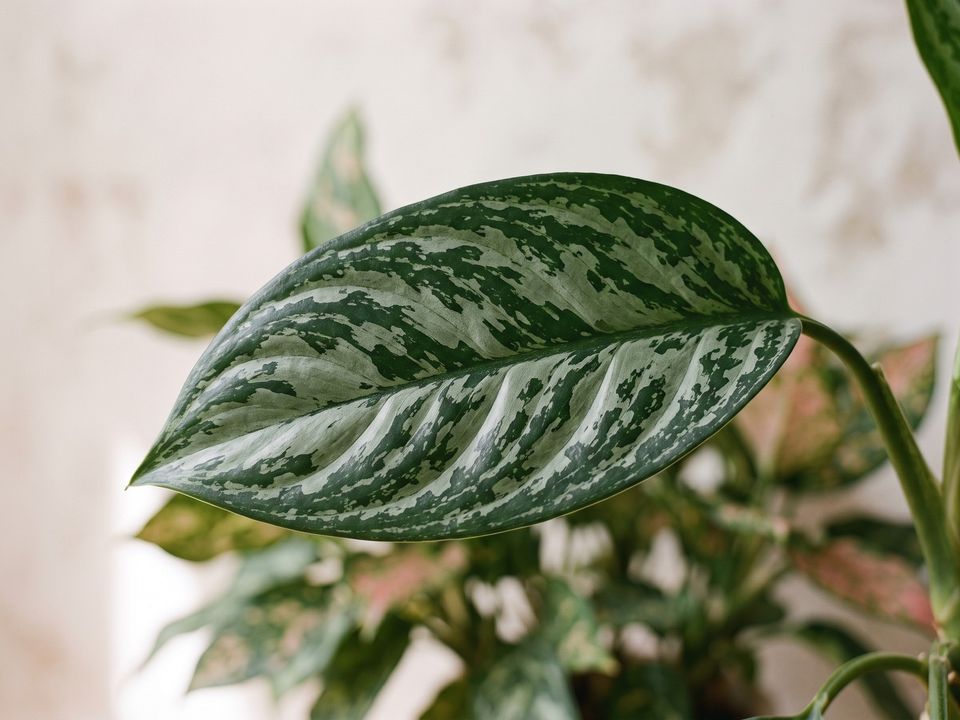
Patterned green leaves, smooth and glossy, in a tidy mound
Each broad leaf carries its own markings against the green, and some cultivars blush red. The leaves are smooth with a gentle gloss, and they crowd into a dense mound that covers the soil.
Where to find me
Not yet pilferableFun fact
Prized in Asia for centuries as a plant that brings good fortune, it probably reached the West around 1885, and Florida nurseries have grown it commercially since the 1930s.
Designer tips
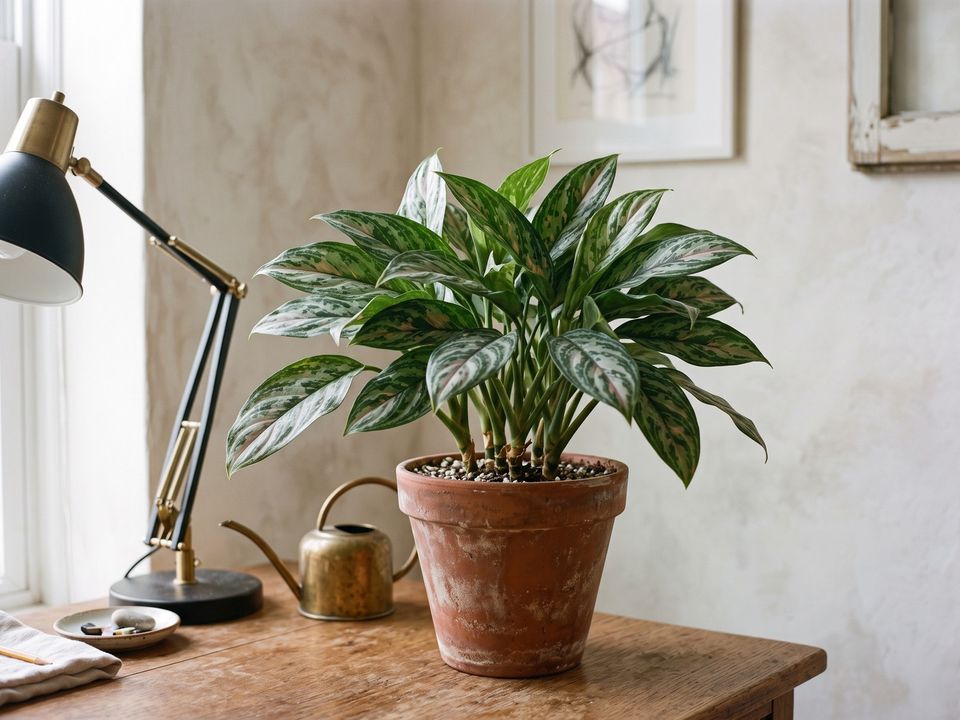
Patterned leaves that read like a bouquet, at home on a desk or a side table as much as in an office lobby.
Troubleshooting
Why are the lower leaves turning yellow?
One at a time, now and then, is just an old leaf retiring; cut it off if you like. Several at once with damp soil likely means too much water, so give it longer between drinks and empty the saucer.
Dark, greasy-looking patches showed up on the leaves
Cold, most likely: a night by chilly glass or a blast from a door in winter does it, and the patches show a couple of days later. A warmer spot heads off more; the marked leaves stay marked, so trim them once new ones come if they bother you.
The leaf edges are browning
Usually dry, drafty air or too much fertilizer. Moving it out of a vent’s path and feeding less tend to help, and clean scissors tidy the brown edges if they bother you.
See all 8
Can it live in a room with no window?
The plain green kinds can, if the lights are on through the day: Arkansas Extension puts its break-even light at about 10 foot-candles, dimmer than most workplaces. The silver, pink, and red kinds do better near a window.
It’s tall and bare at the bottom
That’s how it ages: the lowest leaves drop one by one and the stem shows. For a compact plant again, cut off the leafy top with a short piece of stem and root it in a small pot of damp mix.
My cat chewed a leaf
It’s mildly irritating: expect drooling, pawing at its face, and maybe some vomiting from the calcium-oxalate crystals, and the ASPCA rates the severity low. If vomiting keeps up or swallowing looks hard, call your vet or the ASPCA Animal Poison Control Center.
What’s the pale, hooded thing growing from the middle?
A flower, and a rare one indoors: a whitish-yellow spike inside a green hood, usually in late summer or early fall. Enjoy it, or snip it off to keep the plant full; either is fine.
Can it go outside for the summer?
Only in the warm middle of summer, in full shade, and it’s easier to leave it in. Chicago nights can dip below its 55°F floor, and a chill marks its leaves, so bring it in well before fall.
Propagation
Yes: divide it when you repot, or root the top of a leggy stem.
- To divide, ease the clump out of its pot and pull it apart into pieces that each have a few stems and their own roots.
- Pot each one at the depth it grew before.
An older plant that has dropped its lower leaves and shows a bare stem can be topped: cut off the leafy top with a short piece of stem and set it in a small pot of damp mix to root. Wear gloves, or wash your hands after, since the sap can irritate skin.
The PILF Matrix
3.5/5
how easy it is to care for
3.5/5
how much it stands out visually
“The one that makes a cubicle feel like a corner office.”


Rated 1-5, with 5 being easiest
Built from light, water, air, pests, and upkeep.
Rated 1-5, with 5 being easiest
Rated 1-5, with 5 being highest presence
Built from its scale (size, shape, growth) and its look (color and flowers, shine, fullness).
Rated 1-5, with 5 being highest presence
Where it sits and what sun touches it.
- Dim shadeA dark corner or a windowless room; natural light casts no shadow
- Bright shadeBack from the window in a south-, east- or west-facing room, or right by a north-facing one, where only low early or late summer sun reaches it
- Filtered sunBehind a sheer curtain or tinted glass; the sun’s shadows are blurred
- Partial sunIn an east- or west-facing window: up to a few hours of direct sun
- Full sunThe sunniest spot you have, usually a south-facing window, with direct sun 6+ hours a day
How often, and what the soil does between.
- MonthlyEvery 2-3 weeks in summer and 3-5 in winter; the soil dries all the way between
- 2-3× a monthEvery 7-14 days in summer, longer in winter; the top of the soil dries between
- Weekly+About every 4-8 days in summer; the soil stays lightly damp
How much room it usually takes indoors.
Size
- TinyUnder 6 inches tall or wide; for a desk or a sill
- Small6 inches to 1.5 feet tall or wide; for a shelf or a sill
- Medium1.5 to 3 feet tall or wide; for a table or a stand
- Large3 to 6 feet tall or wide; for the floor
- GiantOver 6 feet tall or wide; a statement in the corner
Shape
- TreeA trunk that branches into a canopy
- CaneBare stalks topped with leaves
- UprightStiff stems or leaves rising straight from the soil
- FountainLeaves or fronds arching out from the center
- BushyA full, rounded mound of leaves
- RosetteLeaves radiating from one low point
- ViningTrails, climbs, or both
Growth
How fast it gets there.
- SlowUnder 6 inches of new growth a year
- Moderate6-12 inches a year, mostly in spring and summer
- FastOver 12 inches a year; it may want trimming or training
What risks exist for pets and kids.
- Pet & kid safeNothing to worry about
- Mildly irritatingMay irritate the mouth or stomach if chewed, or for some plants, the skin if handled
- Moderately toxicCan cause illness if eaten, though typically not serious or fatal
- DangerousCan cause serious illness if eaten, including some reports of death
- Not yet ratedNot clearly rated by our sources; please check with your vet or doctor
For its safety ratings, PILF relies on research and guidance from leading sources, including the ASPCA, Pet Poison Helpline, Merck Veterinary Manual, Poison Control, and Children’s Hospital of Philadelphia, and others.
The small jobs beyond watering, over a year.
- Little upkeepA few small jobs a year beyond watering, like a feed now and then
- Some upkeepA small job about once a month beyond watering, like feeding or turning it
- More upkeepA small job every couple of weeks beyond watering, like a wipe, a turn, or a feed
- Most upkeepA small job most weeks beyond watering, like raising the humidity or misting
- TreeA trunk that branches into a canopy
- CaneBare stalks topped with leaves
- UprightStiff stems or leaves rising straight from the soil
- FountainLeaves or fronds arching out from the center
- BushyA full, rounded mound of leaves
- RosetteLeaves radiating from one low point
- ViningTrails, climbs, or both
How fast it gets there.
- SlowUnder 6 inches of new growth a year
- Moderate6-12 inches a year, mostly in spring and summer
- FastOver 12 inches a year; it may want trimming or training
The temperature and humidity it’s comfortable in.
How dry a room it takes.
- Needs 50%+ humidity
- Fine at 35% humidity
- Fine at 15-20% humidity
The bugs that usually find it, by name.
How often pests find it.
- 5+ regular pests
- 3 regular pests
- Pests are rare
The year’s chores: feeding, pruning, repotting, and cleaning.
Chores beyond water (what needs work means).
- Most upkeep
- Some upkeep
- Little upkeep
Its finish, fullness, and texture.
Color, pattern, and flowers.
- SimpleOne green, one texture, nothing to read
- SuaveA sheen, a stripe, or a clean shape that catches the eye up close
- ShowyColor, pattern, or blooms you see from across the room
How the leaves catch light.
- Matte
- Satin
- Glossy or waxy
How much it fills its pot.
- Soil shows
- Soil partly hidden
- Leaves hide the soil