Croton
Codiaeum variegatum
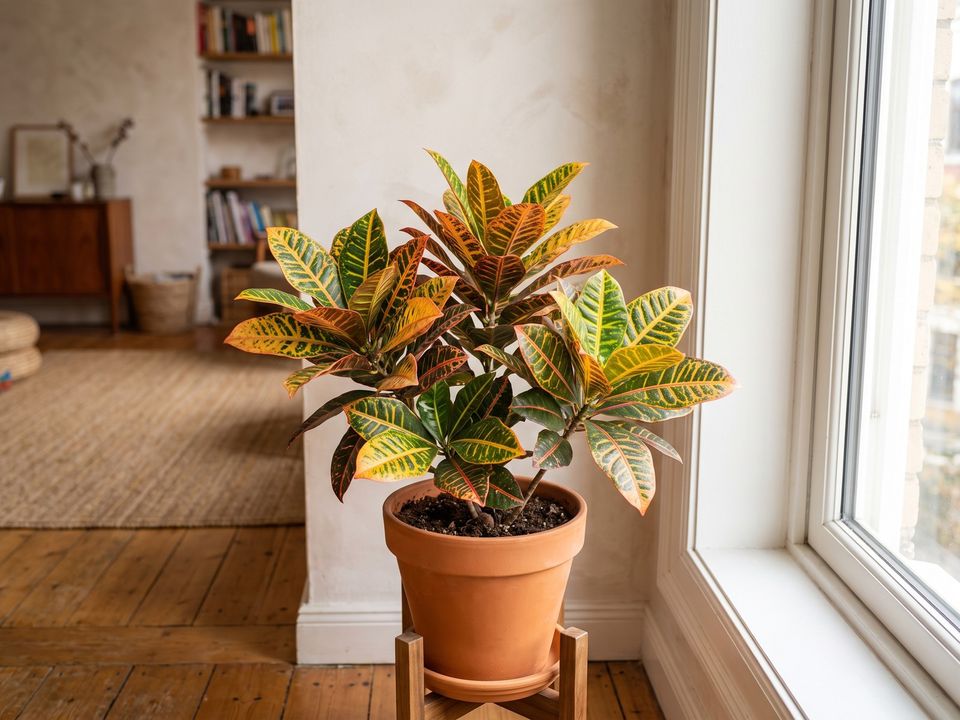
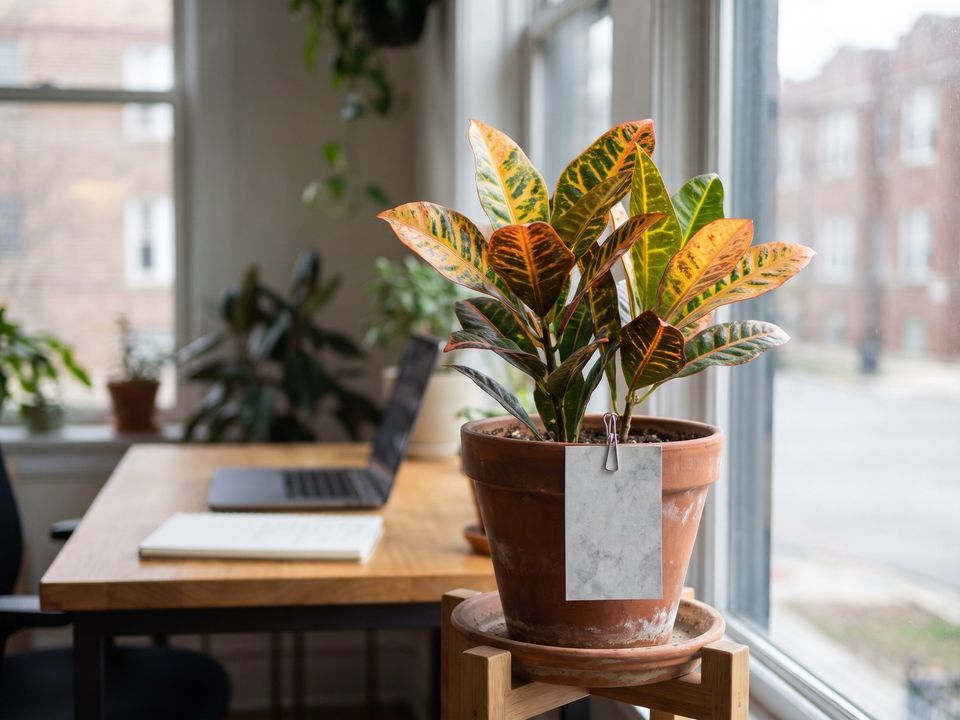
Glossy leaves splashed red, orange, and gold, like a sunset that stays. Picky about light, and its color tells you how it’s doing.
1.8/5
how easy it is to care for
3.9/5
how much it stands out visually
: Shade to part sun
Bright light with a little sun; too much dulls its color
An east or west window with some direct sun keeps its leaves blazing and the plant full, though strong sun can fade them. Bright shade works too, but the colors dull and lower leaves may drop.
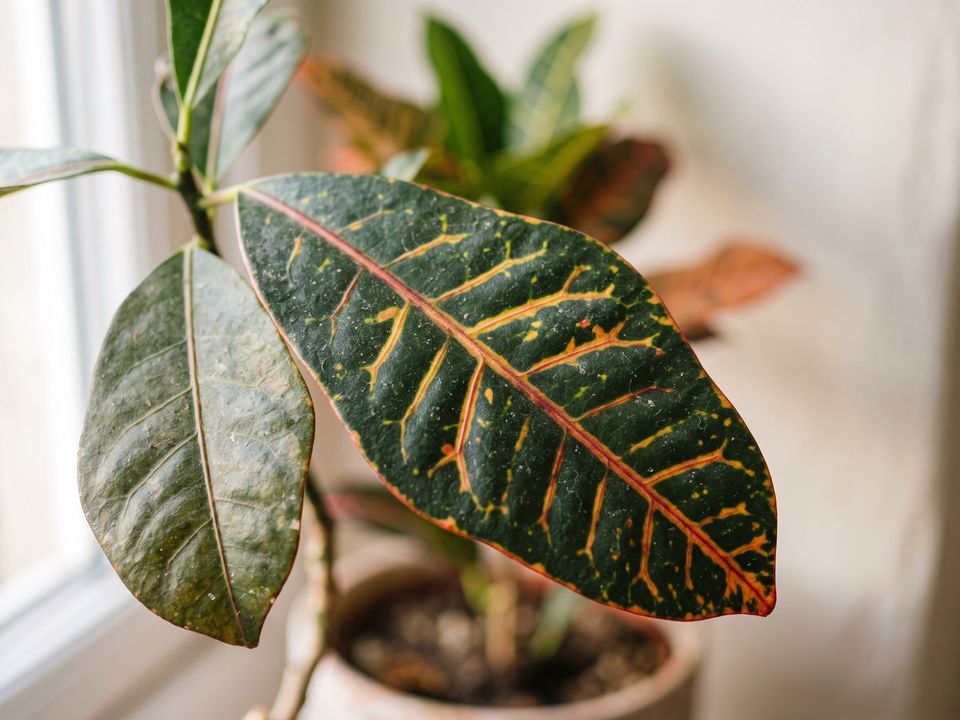
Its new leaves open mostly green and pick up their yellows, oranges, and reds as they mature, as long as the light is there (UF/IFAS). So watch the top of the plant: if fresh growth stays green weeks after it opens, the spot is likely too dim, and in time the older, painted leaves can slip back toward green too (University of Wisconsin Extension).
Too much can wash it out as well. Strong sun can fade the reds and oranges and leave a gray, chalky cast on the leaves (UF/IFAS; University of Wisconsin Extension). Bleached rather than green means the spot is too harsh, not too dark.
Picking one for a dimmer room? UF names 'Petra' as a cultivar that holds its color indoors, though even it loses some without enough light.
Its newest leaves are the gauge: green ones ask for more sun, gray ones for less.
: Weekly+
Water freely, let it dry a little; ease off in winter
Every 5-7 days from spring to fall, letting the surface dry slightly between, and every 7-10 days in winter. Leave it dry too long and it drops its bottom leaves; keep it soggy and it can wilt.
When you do water, be generous: NC State says to water it liberally through the growing months, so the whole root ball gets a drink, and to go sparingly once winter comes. Missouri Botanical Garden frames the same rhythm as soil kept moist but not wet, with less water from fall to late winter.
Cold worries it as much as thirst does. It does best between 60 and 85°F (University of Wisconsin Extension), and if it spends summer outdoors, NC State says to bring it inside once temperatures fall to 50°F.
A croton that wilts while its pot is still wet is likely overwatered (UF/IFAS), not parched, so hold off on the next drink and give it time.
Gone for a while? Ten days is fine if it’s watered the day you leave.
: Medium
A bushy shrub, up to about 3 feet indoors
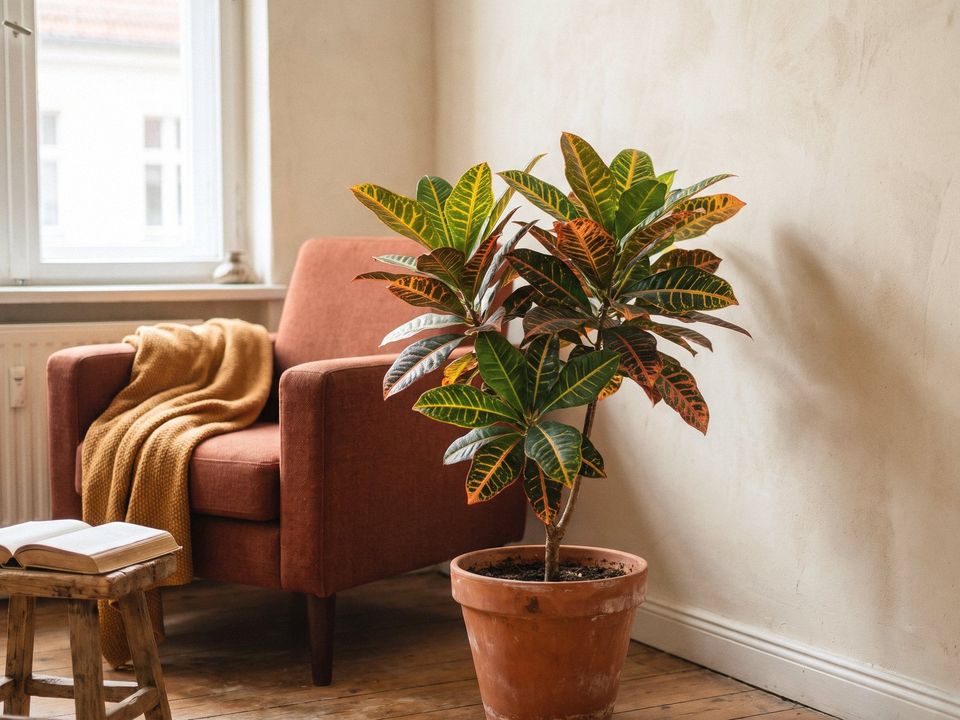
A full, branching shrub 2-3 feet tall, its leaves clustered toward the tips of the stems. Set it on a wide sunny sill or a sturdy stand, or among plain green plants, where it does all the decorating.
Wild crotons grow into shrubs 8-10 feet tall (NC State; UF/IFAS), and the potted one keeps the woody build. Young stems are green; older ones turn brown and woody, pocked with oval scars where leaves once grew (NC State).
In a dim corner those bare, scarred stretches lengthen and the plant goes loose; more light makes a more compact croton (University of Wisconsin Extension).
Cut a stem and it bleeds milky sap. That cut can root: UC Master Gardeners suggest letting it scab over, dipping it in rooting hormone, and covering the pot with a plastic bag to hold humidity until it takes.
In a room of ferns and philodendrons, it’s the one warm note: reds and oranges where everything else is green.
: Mildly irritating
Sap can irritate skin; a chew can upset dogs, cats, or kids
- DogsMildly irritating
- CatsMildly irritating
- KidsMildly irritating
A chewed leaf may bring on drooling, vomiting, or diarrhea in a dog or cat; Pet Poison Helpline calls it mild. For kids, NC State rates it low severity, a concern only in large amounts, and the sap can irritate skin.
Its milky sap can irritate skin, and sap in an eye is painful.
Its defense is chemical. NC State names diterpene esters as the irritant, carried in every part of the plant. A brush with the sap usually stings for a few minutes at most; handle it often, though, and an allergic rash can develop after repeated contact (NC State).
A nibble usually settles at home with nothing more than time. If symptoms don’t settle, or anything worries you, Poison Control can help with a child, and your vet or the ASPCA Animal Poison Control Center (a fee may apply) for a pet.
With a crawler or a chewer at home, give it a sunny sill they can’t reach, and wear gloves when you prune, as the RHS suggests.
- Pet Poison Helpline: mild for dogs.
- Pet Poison Helpline: mild for cats.
- NC State Extension: mild for kids.
Cats and dogs: Most of the leading sources agree.
Kids: No poison-centre listing; rated from university extension sources.
: Average
60-85°F; average humidity is fine
Happiest at 60-85°F, and it shouldn’t sit below 50°F. It wants at least 40% humidity.
- Temperature
- 60-85°F
: Spider mites
Mites, mealybugs, scale: check under leaves and stems
Spider mites hide on leaf undersides, mealybugs in leaf axils and along stems, and scale on leaf stalks and twigs. Thrips sometimes visit the leaf surfaces. Flip a leaf when you water to spot trouble early.
- Spider mites
- Mealybugs
- Scale insects
- Thrips
Spider mites are its big enemy, especially in dry winter air; mealybugs, scale, and thrips turn up now and then.
Spider mites leave pale speckles and fine webbing, and the colors go dull. Rinse the whole plant in the shower now and then, undersides of the leaves included; if they come back, an insecticidal soap spray is the next step.
Thrips are tiny, slender insects that turn leaves silvery and speckled; rinse them off the same way.
Mealybugs look like tufts of white cotton where the leaves meet the stem; scale looks like small brown bumps. Wipe them off with a cotton swab dipped in rubbing alcohol, then check again next week.
: Little
Rinse leaves 4× a year; feed 2×; prune, repot in spring
Rinse the leaves 4 times a year, in shade, which also helps against mites, and feed once or twice in spring and summer. In early spring, cut leggy stems back to about 4 inches and repot 1-2 inches up.
- Feed2× a year
- Prune1× a year
- Repot1× a year
- Clean leaves4× a year
A rich potting mix that drains fast, in a pot with a drainage hole.
Repot when it outgrows its pot, in spring, into a pot only an inch or two wider.
Food helps it grow: a houseplant fertilizer once or twice in spring and summer, or more often if you want it bigger faster, and none in winter.
: Suave
Red, orange, and gold splashes on glossy green leaves
Green leaves wear splashes of red, orange, and gold, with a glossy, waxy finish. Branching stems carry them in clusters, and the soil stays partly visible beneath.
Where to find me
Not yet pilferableFun fact
Two classic cultivars are named for one famous couple: 'Eleanor Roosevelt', with gold-spotted leaves that turn dark red, and 'Franklin Roosevelt', splashed yellow, orange and pink.
Designer tips
Loud, tropical color for a sunny room: it works like a bouquet that lasts.
Troubleshooting
Why is it dropping leaves?
It’s reacting to a change: a move, a cold draft, less light, or soil that stayed too wet or too dry, and crotons are known for it. A warm, bright spot away from drafts and steady watering usually settle it.
It dropped leaves after I brought it home
Usually a passing shock: a move is the classic trigger, and leaf drop is how it shows it (UW-Madison Extension). Give it your brightest, warmest spot, water every 5-7 days, and leave it be while it settles.
Why are the top leaves drooping?
Likely thirst: its newest leaves wilt first, which makes them a handy watering signal (UF/IFAS). A soak usually stands it back up; if you watered only recently, too much water is the likelier cause, so give it time.
See all 9
Why are the new leaves green instead of colorful?
New leaves start green and color up as they mature. If they stay green for weeks, it likely wants more light: an east or west window with some direct sun usually brings the color in.
Why do the leaves look faded and dull?
Strong sun or spider mites. Check under the leaves for fine webbing and pale speckles; if they’re clean, a gray, chalky cast means too much sun, so pull it a foot or two back from the glass.
There’s fine webbing under the leaves
Spider mites, its most common pest, especially in dry winter air. A rinse in the shower, undersides included, usually clears them and helps keep them off; insecticidal soap is the next step if they return.
Can it go outside for the summer?
Yes, in a sunny or partly shaded spot, eased into it gradually. Bring it back in before nights drop to 50°F, and expect a few dropped leaves from the move.
My dog chewed a leaf
It’s mildly irritating: Pet Poison Helpline says a chewed croton may bring drooling, vomiting, or diarrhea, usually mild. If your dog seems unwell or it doesn’t settle, call your vet or the ASPCA Animal Poison Control Center.
The sap got on my skin
Mildly irritating: the milky sap usually stings skin for a few minutes at most (NC State), though it’s painful in an eye and stains fabric for good. Wash it off with soap and water; gloves help when you prune.
Propagation
Yes: stem cuttings in summer, or air layering in spring.
- Take a cutting a few inches long with a few leaves, dip the cut end in rooting hormone and plant it in damp mix.
- Somewhere warm, it roots in about a month.
- Wear gloves, since the sap irritates skin.
The PILF Matrix
1.8/5
how easy it is to care for
3.9/5
how much it stands out visually
“The one who needs the spotlight, literally.”


- garden croton
Rated 1-5, with 5 being easiest
Built from light, water, air, pests, and upkeep.
Rated 1-5, with 5 being easiest
Rated 1-5, with 5 being highest presence
Built from its scale (size, shape, growth) and its look (color and flowers, shine, fullness).
Rated 1-5, with 5 being highest presence
Where it sits and what sun touches it.
- Dim shadeA dark corner or a windowless room; natural light casts no shadow
- Bright shadeBack from the window in a south-, east- or west-facing room, or right by a north-facing one, where only low early or late summer sun reaches it
- Filtered sunBehind a sheer curtain or tinted glass; the sun’s shadows are blurred
- Partial sunIn an east- or west-facing window: up to a few hours of direct sun
- Full sunThe sunniest spot you have, usually a south-facing window, with direct sun 6+ hours a day
How often, and what the soil does between.
- MonthlyEvery 2-3 weeks in summer and 3-5 in winter; the soil dries all the way between
- 2-3× a monthEvery 7-14 days in summer, longer in winter; the top of the soil dries between
- Weekly+About every 4-8 days in summer; the soil stays lightly damp
How much room it usually takes indoors.
Size
- TinyUnder 6 inches tall or wide; for a desk or a sill
- Small6 inches to 1.5 feet tall or wide; for a shelf or a sill
- Medium1.5 to 3 feet tall or wide; for a table or a stand
- Large3 to 6 feet tall or wide; for the floor
- GiantOver 6 feet tall or wide; a statement in the corner
Shape
- TreeA trunk that branches into a canopy
- CaneBare stalks topped with leaves
- UprightStiff stems or leaves rising straight from the soil
- FountainLeaves or fronds arching out from the center
- BushyA full, rounded mound of leaves
- RosetteLeaves radiating from one low point
- ViningTrails, climbs, or both
Growth
How fast it gets there.
- SlowUnder 6 inches of new growth a year
- Moderate6-12 inches a year, mostly in spring and summer
- FastOver 12 inches a year; it may want trimming or training
What risks exist for pets and kids.
- Pet & kid safeNothing to worry about
- Mildly irritatingMay irritate the mouth or stomach if chewed, or for some plants, the skin if handled
- Moderately toxicCan cause illness if eaten, though typically not serious or fatal
- DangerousCan cause serious illness if eaten, including some reports of death
- Not yet ratedNot clearly rated by our sources; please check with your vet or doctor
For its safety ratings, PILF relies on research and guidance from leading sources, including the ASPCA, Pet Poison Helpline, Merck Veterinary Manual, Poison Control, and Children’s Hospital of Philadelphia, and others.
The small jobs beyond watering, over a year.
- Little upkeepA few small jobs a year beyond watering, like a feed now and then
- Some upkeepA small job about once a month beyond watering, like feeding or turning it
- More upkeepA small job every couple of weeks beyond watering, like a wipe, a turn, or a feed
- Most upkeepA small job most weeks beyond watering, like raising the humidity or misting
- TreeA trunk that branches into a canopy
- CaneBare stalks topped with leaves
- UprightStiff stems or leaves rising straight from the soil
- FountainLeaves or fronds arching out from the center
- BushyA full, rounded mound of leaves
- RosetteLeaves radiating from one low point
- ViningTrails, climbs, or both
How fast it gets there.
- SlowUnder 6 inches of new growth a year
- Moderate6-12 inches a year, mostly in spring and summer
- FastOver 12 inches a year; it may want trimming or training
The temperature and humidity it’s comfortable in.
How dry a room it takes.
- Needs 50%+ humidity
- Fine at 35% humidity
- Fine at 15-20% humidity
The bugs that usually find it, by name.
How often pests find it.
- 5+ regular pests
- 3 regular pests
- Pests are rare
The year’s chores: feeding, pruning, repotting, and cleaning.
Chores beyond water (what needs work means).
- Most upkeep
- Some upkeep
- Little upkeep
Its finish, fullness, and texture.
Color, pattern, and flowers.
- SimpleOne green, one texture, nothing to read
- SuaveA sheen, a stripe, or a clean shape that catches the eye up close
- ShowyColor, pattern, or blooms you see from across the room
How the leaves catch light.
- Matte
- Satin
- Glossy or waxy
How much it fills its pot.
- Soil shows
- Soil partly hidden
- Leaves hide the soil