Poinsettia
Euphorbia pulcherrima
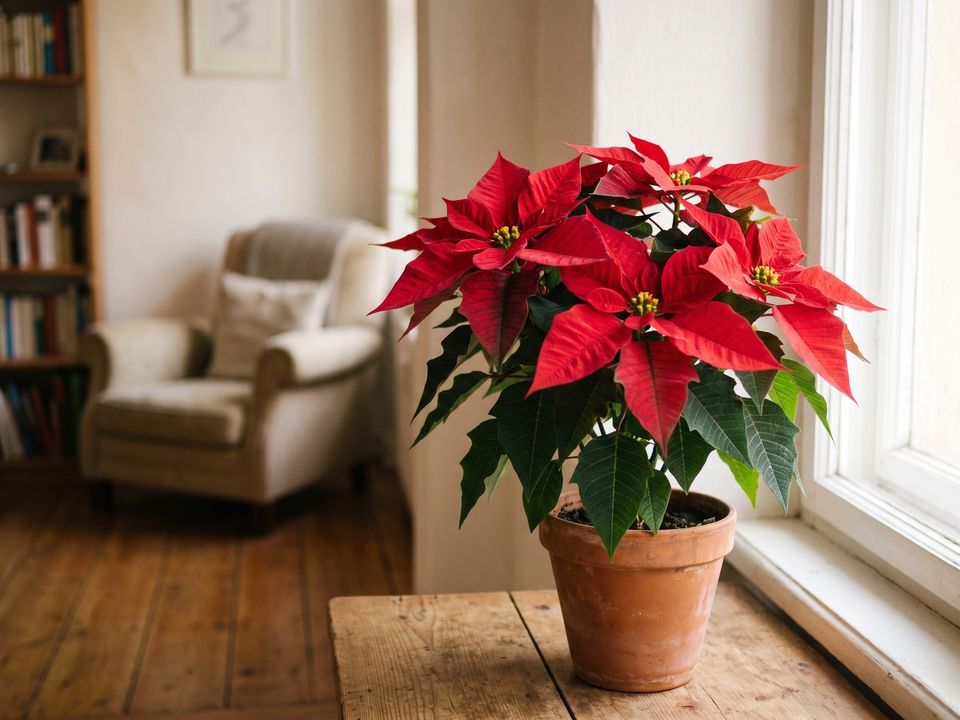
Fire-red leaves crown a bushy mound of deep green, from winter into spring. Bringing the color back next year takes work.
1.7/5
how easy it is to care for
3.2/5
how much it stands out visually
: Shade to part sun
A bright window with some sun; gets by farther back
Thrives in a bright window that catches some direct sun, and gets by farther back out of the sun’s reach. Sun is what feeds the summer growth that becomes next winter’s bushy plant.
In December, low winter sun at an eastern window lights the red bracts from the side for a morning hour or two, and the plant takes every bit. Grown outdoors, NC State gives it 4-5 hours of direct light daily, a fair target for an indoor sill as well.
Its real quirk is about the dark. It’s a short-day plant: the bracts color up only after weeks of long, unbroken nights, at least 12 hours of darkness for 8-12 weeks (University of Illinois Extension). Any light at night after October 1 can delay or stop the show (UF/IFAS).
To bring the red back next year, give it full days at the window and nights in a closet or under a box from early October; UF/IFAS notes color comes on fastest at 14-14.5 hours of dark. Skip the routine and it stays a leafy green shrub, a fine plant in its own right. Sun by day, true dark by night: that’s the whole calendar it keeps.
: Weekly+
Let the surface dry between drinks; it hates soggy soil
About every 5-7 days in summer and 7-10 in winter, with the surface of the soil drying between. Kept wet, it tends to answer with yellowing, falling leaves.
Most come home wrapped in a decorative foil sleeve, which can hold water around the roots. Slip it off, or poke holes in the bottom, so the roots aren’t left sitting in standing water (University of Minnesota Extension).
Warmth is the other thing to manage. The University of Wisconsin Extension suggests 60-68°F and warns that rooms over 75 speed up its aging, so a cooler room slows its aging. A chill or a hot, dry draft is often what sets the bracts and leaves dropping early, so give it a spot clear of heat ducts and drafty doors.
Gone for a while? A week is fine if it’s soaked the day you leave; much longer and it wilts and drops leaves.
: Medium
A leafy mound that grows steadily to 1-2 feet, rarely 3
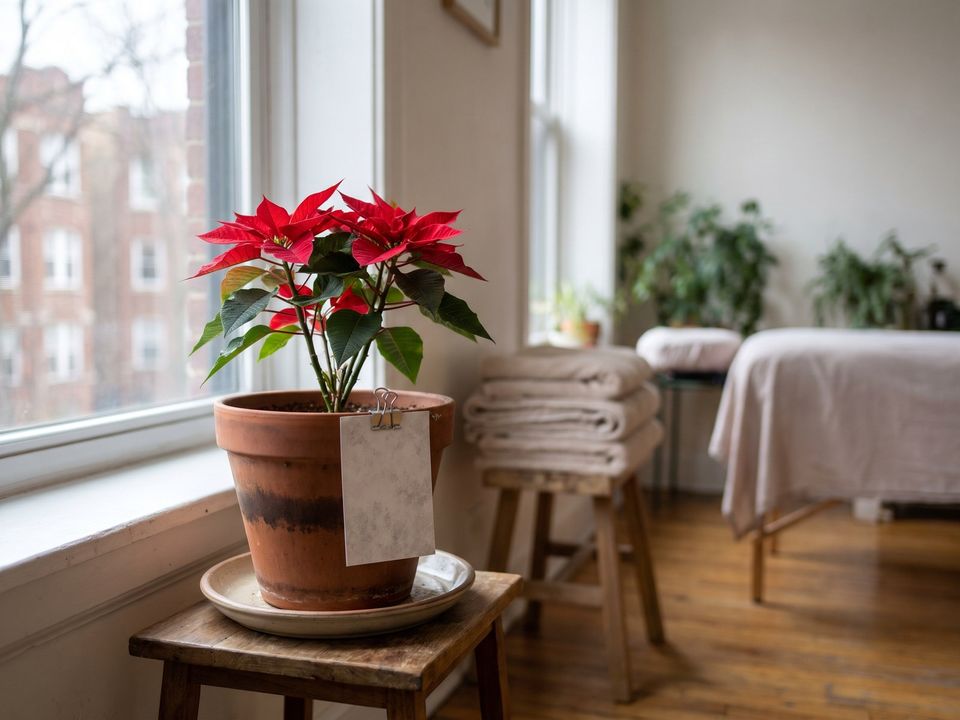
A rounded bush of deep green leaves crowned with color, 1-2 feet tall as sold, rarely 3. Pinch the stem tips in summer: each pinch means more branches, and more branches mean more red come winter.
In the dry tropical forests of Mexico and Guatemala, the same species grows into a shrub or small tree up to 10 feet high and 8 wide (NC State). The many-stemmed pot you bring home owes its dense branching to a phytoplasma that growers pass on by grafting (Penn State), while breeding since the mid-1950s brought larger, longer-lasting bracts (University of Illinois Extension).
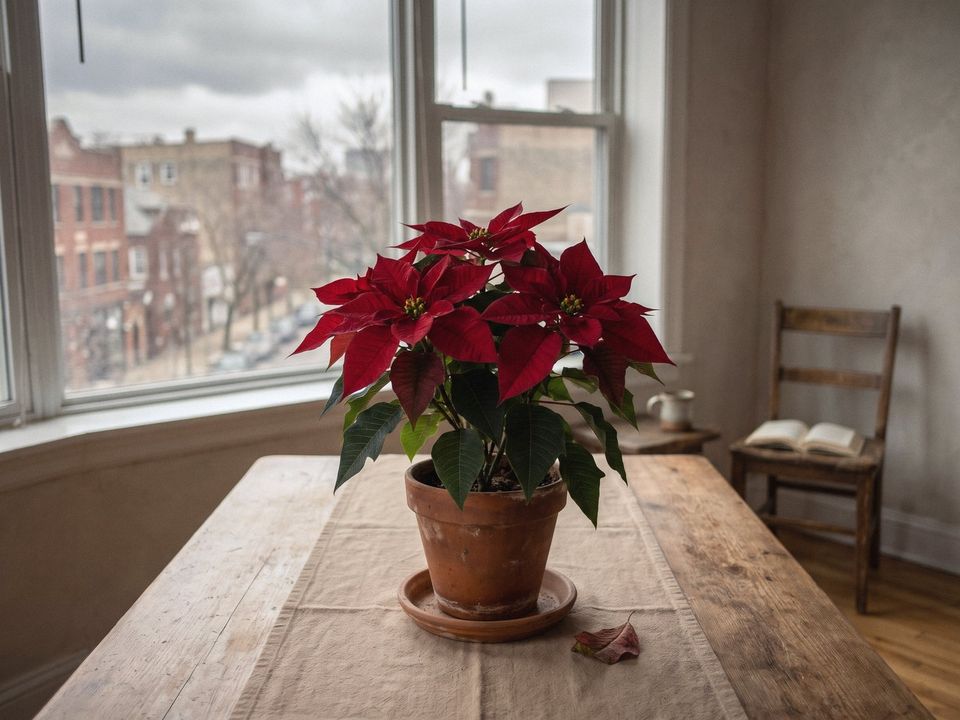
Once its tiny flowers shed pollen, it drops its bracts and many leaves (University of Illinois Extension), so a spring poinsettia can look bare. That’s the time to cut it back and let summer growth rebuild the mound; stem cuttings taken in early summer root into new plants (NC State).
Its bracts open flat, like a crown, so the show is best seen from above: set it low, at the center of a holiday table or on a hearth.
: Mildly irritating
Chewing can upset the stomachs of dogs, cats, or kids
- DogsMildly irritating
- CatsMildly irritating
- KidsMildly irritating
A pet that chews it may get a sore mouth or an upset stomach, sometimes with vomiting. For kids, Poison Control calls it nonpoisonous, though the milky sap can still redden skin.
Good news: its scary reputation is bigger than the plant. The ASPCA calls it "generally over-rated in toxicity."
The sap carries diterpenoid euphorbol esters and saponin-like detergents (Pet Poison Helpline). A pet that chews a leaf may drool, and the signs usually clear on their own.
The scare began more than a century ago, with a story of a child found beside a wild poinsettia. Researchers later found no poisonous dose, even at about 1.25 pounds, some 500-600 leaves (Poison Control). The leaves reportedly taste awful, so most chewers quit after one bite (UC Agriculture and Natural Resources).
The sap can cause a rash, and in pets, rarely a mild pink eye (Pet Poison Helpline). Some people with latex allergies have reacted after touching the leaves (University of Illinois Extension), so gloves help when you prune.
If symptoms don’t settle or anything worries you, Poison Control can help with a child, and your vet or the ASPCA can help with a pet (a fee may apply). A mantel or high table keeps it clear of toddlers and curious pets alike, with the color still on show.
- ASPCA: mild for dogs.
- Merck Veterinary Manual: mild for dogs (rates the whole genus).
- Pet Poison Helpline: mild for dogs.
- ASPCA: mild for cats.
- Merck Veterinary Manual: mild for cats (rates the whole genus).
- Pet Poison Helpline: mild for cats.
- : mild for kids.
Cats and dogs: Most of the leading sources agree.
Kids: Poison Control: children who eat it can get mouth irritation and stomach upset; not dangerous.
: Average
65-70°F; average humidity is fine
Happiest at 65-70°F, and it shouldn’t sit below 60°F. Keep it away from cold glass in winter. Humidity can drop to 30% without trouble.
- Temperature
- 65-70°F
: Whiteflies
Whiteflies mostly; check leaf undersides first
Whiteflies are the likeliest guests, tucked under the leaves, with pupal skins on older ones. Spider mites and aphids also sit on the undersides. Mealybugs hide on stems and in leaf axils, scale on stems and leaves.
- Whiteflies
- Spider mites
- Aphids
- Mealybugs
- Scale
Whiteflies and mealybugs are the usual pests; spider mites and scale turn up too, and soggy soil rots the roots and stems.
Whiteflies are tiny, powdery white insects that rise in a cloud when you brush the plant, leaving yellowing, sticky leaves. Wash the plant well, then spray the undersides of the leaves with insecticidal soap.
Mealybugs look like tufts of white cotton where leaves meet the stem; scale looks like small brown bumps. Wipe them off with a cotton swab dipped in rubbing alcohol, then check again next week. Spider mites leave fine speckling and webbing; insecticidal soap handles them.
Rot shows as stems going soft and dark at the soil line, usually in a pot left standing in water. Empty the foil and saucer after every soak.
: More
Rotate monthly, feed 8× spring-summer, prune in spring
Turn the pot monthly and feed half-strength every 3-4 weeks from spring through summer. Pinch tips 3 times a year until mid-August. Prune in spring and repot in early summer, then give 6-8 weeks of long dark nights.
- Feed8× a year
- Prune1× a year
- Pinch3× a year
- Repot1× a year
- Clean leaves2× a year
- Rotate12× a year
- Rebloom darkness1× a year
It comes in a potting mix that drains fast. Keep it in a pot with a drainage hole, out of the foil or with holes poked through it.
Repot in early summer, if you keep it past the holidays, into a pot 2 to 4 inches wider, with a rich potting mix.
Food is optional while it’s in color. If you keep it past the holidays, an all-purpose houseplant fertilizer in spring and summer keeps it growing.
: Suave
Deep green mound with fire-red leaves, matte, filling the pot
Deep green leaves form a rounded bush, topped with fire-red leaves as the standout. Every leaf is matte and smooth, with no gloss, and the foliage is dense enough to cover the soil.
Where to find me
Not yet pilferableFun fact
The Aztecs called it cuetlaxochitl, roughly "a flower that withers," and put it to work: its red leaves made a reddish-purple dye for cloth and cosmetics, and its milky sap was a fever remedy.
Designer tips
Classic holiday color: festive in red, quieter and more modern in white or pale pink.
Troubleshooting
It’s dropping leaves
Cold or a draft, most often: Clemson Extension says anything below 50°F causes chilling injury and leaf drop. Move it away from doors, cold glass, and heat vents; soggy soil in a foil sleeve, or a pot that dried out, can do it too.
Why is it wilting?
Thirst, or roots sitting in water. If it’s been about a week since its last drink, a good soak usually revives it quickly; if water has pooled in the foil, the roots are drowning, so drain it and let the surface dry before the next soak.
It came wrapped in a foil sleeve
Slip it off, or poke holes in the bottom, so water can’t pool around the roots (University of Minnesota Extension). Water trapped in the foil is a common way to rot the roots and stems.
See all 9
I heard poinsettias are poisonous
Its reputation is bigger than the plant: it’s mildly irritating, and the ASPCA calls it "generally over-rated in toxicity." For kids, Poison Control calls it nonpoisonous, with mouth irritation or an upset stomach that passes.
My cat nibbled a leaf. What now?
Probably nothing, or a bit of drooling or vomiting from the irritating sap. If the vomiting keeps up or your pet seems unwell, call your vet or the ASPCA Animal Poison Control Center.
Tiny white bugs fly up when I brush it
Likely whiteflies, its most common pest; the young sit still on the undersides of the leaves. Wash the plant well, then spray the leaf undersides with insecticidal soap.
How do I get it to color up again next year?
Long, fully dark nights in fall: from the first week of October, about 8 weeks of 14-hour nights in total darkness (a closet, or a box over it), with bright light by day. Even a lamp left on at night can stop it, UF/IFAS warns.
Can I keep it after the holidays?
Yes, if you like a project: cut the stems back to 4-6 inches in early spring, move it outside once nights stay above 60°F, pinch it through summer, and start the dark nights in October. Or enjoy it for the season and compost it; plenty of people do.
What are the little yellow buttons in the middle?
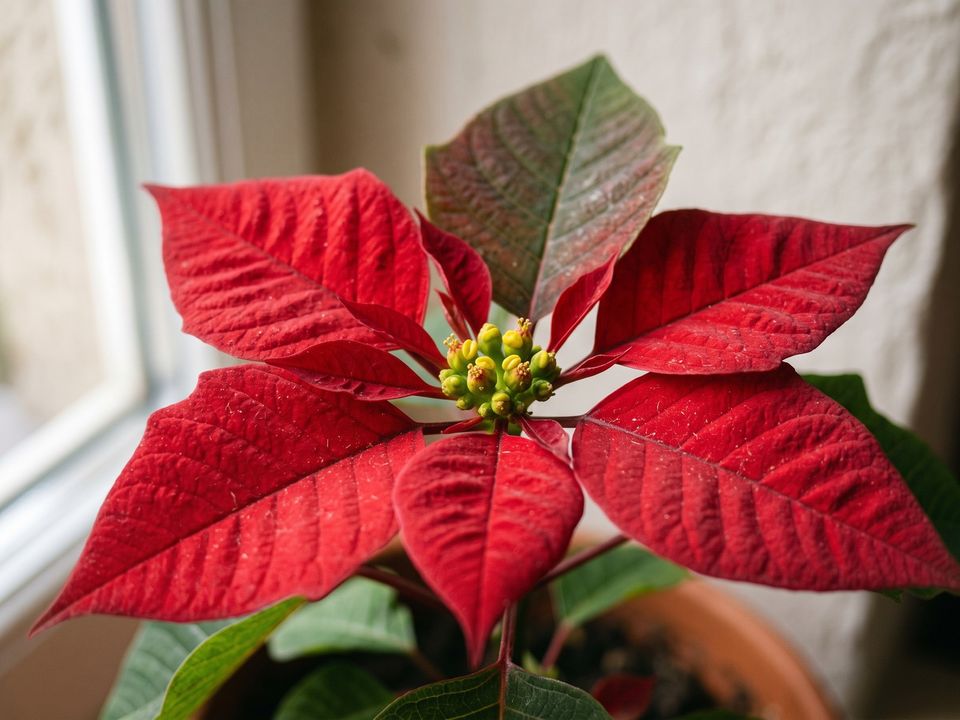
Those are its real flowers, called cyathia. The colored 'petals' around them are bracts: modified leaves that color up in the long nights of fall.
Propagation
Possible, from stem cuttings in early summer, though most people simply enjoy it for the season.
- Cut a stem tip a few inches long, dip the end in rooting hormone, and set it in a damp mix of peat moss, perlite and vermiculite, kept warm and bright until it roots.
- Mind the milky sap.
The PILF Matrix
1.7/5
how easy it is to care for
3.2/5
how much it stands out visually
“The one that glows up for the show but doesn’t show up for much mo'.”


Rated 1-5, with 5 being easiest
Built from light, water, air, pests, and upkeep.
Rated 1-5, with 5 being easiest
Rated 1-5, with 5 being highest presence
Built from its scale (size, shape, growth) and its look (color and flowers, shine, fullness).
Rated 1-5, with 5 being highest presence
Where it sits and what sun touches it.
- Dim shadeA dark corner or a windowless room; natural light casts no shadow
- Bright shadeBack from the window in a south-, east- or west-facing room, or right by a north-facing one, where only low early or late summer sun reaches it
- Filtered sunBehind a sheer curtain or tinted glass; the sun’s shadows are blurred
- Partial sunIn an east- or west-facing window: up to a few hours of direct sun
- Full sunThe sunniest spot you have, usually a south-facing window, with direct sun 6+ hours a day
How often, and what the soil does between.
- MonthlyEvery 2-3 weeks in summer and 3-5 in winter; the soil dries all the way between
- 2-3× a monthEvery 7-14 days in summer, longer in winter; the top of the soil dries between
- Weekly+About every 4-8 days in summer; the soil stays lightly damp
How much room it usually takes indoors.
Size
- TinyUnder 6 inches tall or wide; for a desk or a sill
- Small6 inches to 1.5 feet tall or wide; for a shelf or a sill
- Medium1.5 to 3 feet tall or wide; for a table or a stand
- Large3 to 6 feet tall or wide; for the floor
- GiantOver 6 feet tall or wide; a statement in the corner
Shape
- TreeA trunk that branches into a canopy
- CaneBare stalks topped with leaves
- UprightStiff stems or leaves rising straight from the soil
- FountainLeaves or fronds arching out from the center
- BushyA full, rounded mound of leaves
- RosetteLeaves radiating from one low point
- ViningTrails, climbs, or both
Growth
How fast it gets there.
- SlowUnder 6 inches of new growth a year
- Moderate6-12 inches a year, mostly in spring and summer
- FastOver 12 inches a year; it may want trimming or training
What risks exist for pets and kids.
- Pet & kid safeNothing to worry about
- Mildly irritatingMay irritate the mouth or stomach if chewed, or for some plants, the skin if handled
- Moderately toxicCan cause illness if eaten, though typically not serious or fatal
- DangerousCan cause serious illness if eaten, including some reports of death
- Not yet ratedNot clearly rated by our sources; please check with your vet or doctor
For its safety ratings, PILF relies on research and guidance from leading sources, including the ASPCA, Pet Poison Helpline, Merck Veterinary Manual, Poison Control, and Children’s Hospital of Philadelphia, and others.
The small jobs beyond watering, over a year.
- Little upkeepA few small jobs a year beyond watering, like a feed now and then
- Some upkeepA small job about once a month beyond watering, like feeding or turning it
- More upkeepA small job every couple of weeks beyond watering, like a wipe, a turn, or a feed
- Most upkeepA small job most weeks beyond watering, like raising the humidity or misting
- TreeA trunk that branches into a canopy
- CaneBare stalks topped with leaves
- UprightStiff stems or leaves rising straight from the soil
- FountainLeaves or fronds arching out from the center
- BushyA full, rounded mound of leaves
- RosetteLeaves radiating from one low point
- ViningTrails, climbs, or both
How fast it gets there.
- SlowUnder 6 inches of new growth a year
- Moderate6-12 inches a year, mostly in spring and summer
- FastOver 12 inches a year; it may want trimming or training
The temperature and humidity it’s comfortable in.
How dry a room it takes.
- Needs 50%+ humidity
- Fine at 35% humidity
- Fine at 15-20% humidity
The bugs that usually find it, by name.
How often pests find it.
- 5+ regular pests
- 3 regular pests
- Pests are rare
The year’s chores: feeding, pruning, repotting, and cleaning.
Chores beyond water (what needs work means).
- Most upkeep
- Some upkeep
- Little upkeep
Its finish, fullness, and texture.
Color, pattern, and flowers.
- SimpleOne green, one texture, nothing to read
- SuaveA sheen, a stripe, or a clean shape that catches the eye up close
- ShowyColor, pattern, or blooms you see from across the room
How the leaves catch light.
- Matte
- Satin
- Glossy or waxy
How much it fills its pot.
- Soil shows
- Soil partly hidden
- Leaves hide the soil