Kimberly Queen Fern
Nephrolepis obliterata 'Kimberly Queen'
Also called Australian sword fern
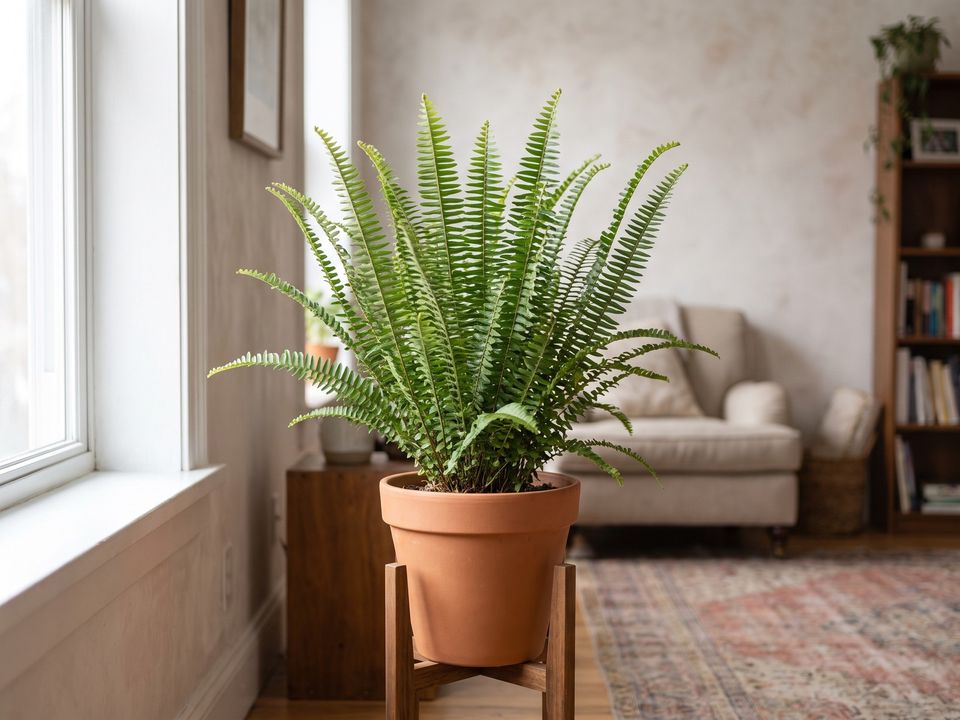
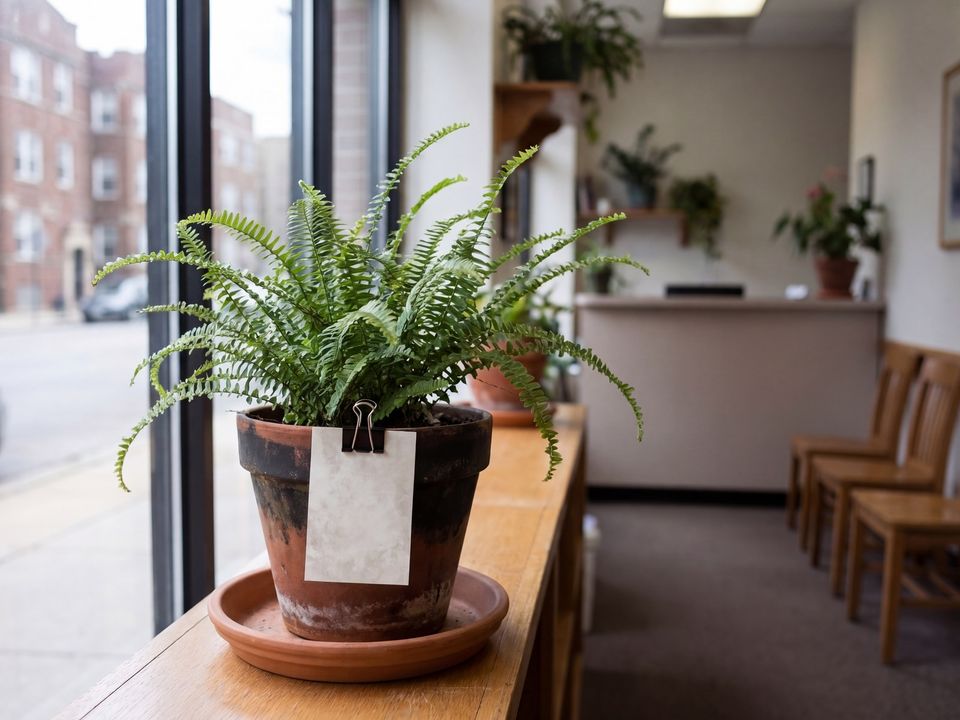
Dark green fronds rise like swords, then arch into a full fountain. Keep it damp and bright, and it holds its crown.
2.8/5
how easy it is to care for
3.3/5
how much it stands out visually
: Shade to filtered
Loves bright rooms; a little morning sun is fine
Bright but mostly sunless is its sweet spot: right by a north window, or a few feet back from an east or west one; a little morning sun is fine. It also tolerates medium light deeper in the room.
A south-facing room works too, if the fern stands well across from the window, or a sheer curtain keeps the sun’s beam off its fronds.
The Kimberly Queen is the most sun-tolerant of the porch ferns (Clemson). Indoors, though, it does its best in bright light with no sun on its fronds. If it spends summer outside, bring it in before nights drop below 50°F (Clemson).
Among porch ferns, it’s the one that forgives a little sun.
: Weekly+
Wants evenly damp soil; sheds leaflets when parched
Let it go bone-dry and it may shed fronds; cut back, it can regrow. Watering every 5-7 days in summer, 7-10 in winter, keeps the soil evenly damp, the way it likes it.
Moist air matters to it nearly as much as moist soil. Texas A&M’s interior-plant guide says it does best with higher humidity and cooler nights, so a bathroom with a window, or a cool bedroom, suits it better than a sill above a heat vent.
If its leaflet tips brown in dry winter air, and that bothers you, try double potting: set its pot inside a larger one lined with damp sphagnum moss, a trick Wisconsin Extension suggests for its Boston fern cousin. The fern survives without it, browned tips and all.
Gone for a while? A week is fine if it’s soaked the day you leave and moved back from the window. Much longer and it needs a plant sitter.
: Medium
Upright fronds that steadily fill a 2-3 foot fountain
Stiff fronds rise and then arch, 2-3 feet tall and wide. Set it on the floor where the arches can spill past the pot’s rim, and snip browned fronds at the soil so new ones keep rising.
It grows more upright than other porch ferns and is usually planted in containers rather than hanging baskets (Clemson). That posture suits a floor pot where a Boston fern would sprawl: the end of a console, the corner by an armchair, or a matched pair on either side of a doorway.
In time its spread can reach several feet (Texas A&M), so give it elbow room away from busy paths.
When it crowds its pot, it can be divided (Clemson). In spring, slice the root ball into halves or quarters, as Wisconsin Extension describes for Boston fern, and pot each piece. Bringing it in from a summer porch to keep as a houseplant? Clemson suggests just shaking off loose fronds and leaflets first.
: Pet & kid safe
Nothing to worry about for dogs, cats, or kids
- DogsSafe
- CatsSafe
- KidsSafe
Its cousins in the genus, Boston fern and bold sword fern, appear on the ASPCA’s non-toxic list for dogs and cats; the Children’s Hospital of Philadelphia rates Boston fern harmless for kids.
Its own species, Nephrolepis obliterata, hasn’t been rated by the ASPCA yet, so its Safe rating rests on close kin. Several more of the genus appear on that same list, filed under names like feather palm and Fluffy Ruffles, and NC State tags the Boston fern safe for horses as well as cats and dogs.
So it is a reasonable choice for a nursery or near the dog bed. If a nibbler leaves its fronds ragged, a plant stand lifts them out of reach while new ones fill in.
- ASPCA: safe for dogs.
- Pet Poison Helpline: safe for dogs.
- ASPCA: safe for cats.
- Pet Poison Helpline: safe for cats.
- CHOP: safe for kids.
Cats and dogs: Most of the leading sources agree.
Kids: No poison-centre listing; rated from university extension sources.
: Average
65-95°F; average humidity is fine
Happiest at 65-95°F, and it shouldn’t sit below 50°F. It wants at least 35% humidity.
- Temperature
- 65-95°F
: Pest-resistant
Rarely bothered; look under fronds and at the crown
Rarely bothered. Scale can settle on frond undersides and stalks, and mealybugs may tuck into the frond bases and crown. Brown spore dots on healthy fronds are normal, not scale.
- Scale
- Mealybugs
Few. Scale and mealybugs are the ones to watch indoors, and root rot if the soil stays soggy.
Scale looks like small brown bumps stuck along the stems and under the leaflets. Snip off badly infested fronds, as UW–Madison suggests, and wipe the rest with a cotton swab dipped in rubbing alcohol.
Mealybugs look like tufts of white cotton where the fronds meet the base. Swab them off the same way, then check again next week.
Spider mites, which UF/IFAS lists for its cousin the Boston fern, leave the fronds dull and speckled, mostly in warm, dry air. Rinse the whole plant in the shower; insecticidal soap is the next step.
: Most
Turn weekly, trim monthly, feed 4× in summer
Give it a quarter or half turn weekly. Monthly, cut brown or old fronds at the base and shake off loose leaflets. Feed 4 times, late spring to summer; repot or divide every few years in spring.
- Feed4× a year
- Prune12× a year
- Clean leaves12× a year
- Rotate52× a year
A pot with a drainage hole and a mix that holds moisture but still drains fast, such as a peat-based potting mix with some vermiculite (UW–Madison’s mix for Boston fern).
Repot every few years, in spring; that’s also the time to divide it (see Propagation).
Food is optional: a houseplant fertilizer at half strength every 4 to 6 weeks in spring and summer, and far less in winter. Too much browns the fronds (UW–Madison).
: Simple
Dark green fronds, matte and smooth, filling the pot
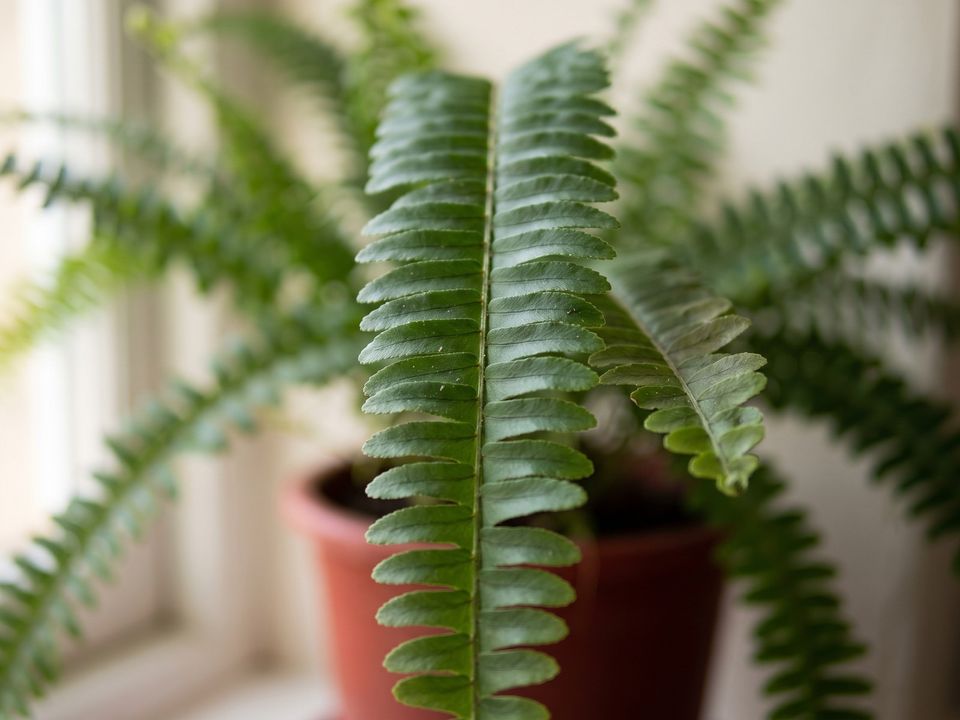
Stiff fronds in one plain dark green rise like swords, then arch into a fountain. The leaflets are matte and smooth, and the crown is so full the soil disappears beneath it.
Where to find me
Not yet pilferableFun fact
Flip a frond and you may find neat rows of dark brown dots. They’re spore cases, the fern’s stand-in for seeds, set in a tidy pattern, and not bugs or disease.
Designer tips
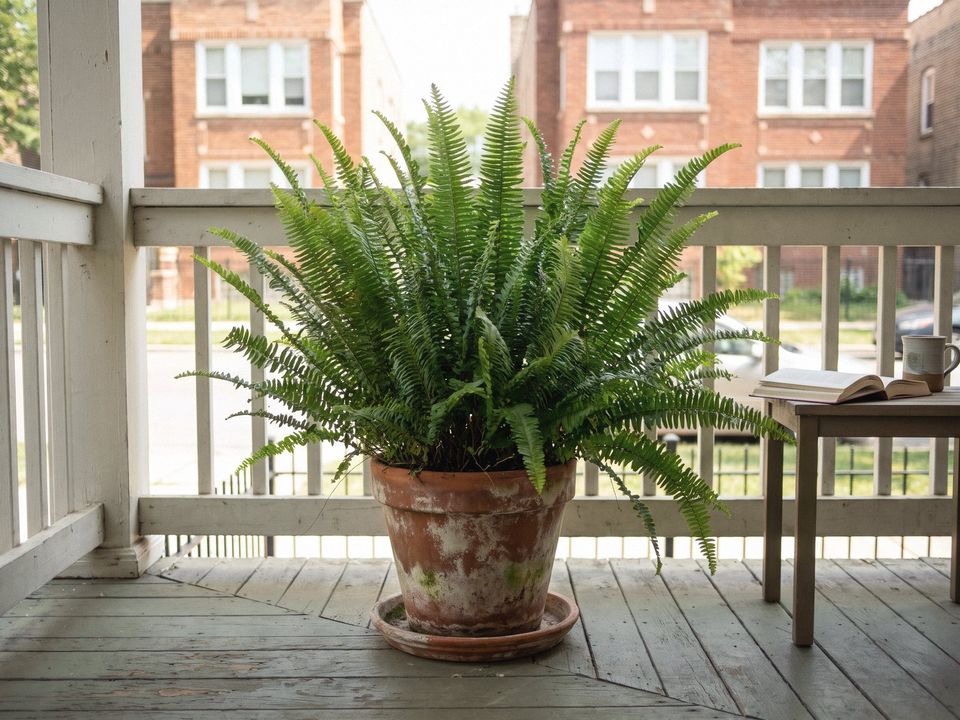
Full, fresh, and a little tropical, it softens a corner indoors and dresses up a shady porch in summer.
Troubleshooting
The fronds are turning brown and crispy
Usually thirst or dry air; UW-Madison links brown fern tips to dry indoor air. Evenly damp soil, with a drink every 5-7 days, and a spot away from heating vents help, and the brown fronds snip off at the base whenever you like.
Why are the older fronds turning yellow?
One old frond at a time is normal; cut it off at the base. Many at once while the soil stays soggy likely means too much water, so give it a little longer between drinks.
It’s dropping little leaflets everywhere
Some shedding is normal, and a gentle shake now and then drops the loose ones in one go. A lot at once usually means it went too dry; back on a drink every 5-7 days, it can regrow.
See all 9
Why does it look worse in winter?
Dry heated air and short days. A spot away from vents and soil that stays damp help, a humidifier nearby helps more, and fresh fronds usually return in spring.
There are brown dots under the fronds
Brown dots on healthy fronds are spores, a normal part of being a fern. Scale looks different: small brown bumps stuck along the stalks and undersides, which lift off with a cotton swab dipped in rubbing alcohol.
Can it live without a window?
Not well. It wants a room with a window, though it can sit across the room from it, out of the sun’s reach.
Can it go outside for the summer?
Yes, and a shady porch suits it well; it’s the most sun-tolerant of the porch ferns (Clemson). Water it more often in the heat, and bring it in before nights drop below 50°F, checking it for bugs first.
My cat keeps nibbling the fronds
Nothing harmful there: its close cousins, Boston fern and sword fern, are on the ASPCA’s non-toxic list for cats and dogs. If the nibbling leaves the fronds ragged, a plant stand lifts them out of reach while new ones fill in.
How is it different from a Boston fern?
It’s a different species, Nephrolepis obliterata from Australia, and it grows more upright. The care is much the same: steady moisture and no sun on the fronds.
Propagation
By division, in spring when you repot.
- Ease it out of the pot and cut the root ball straight down into halves or quarters with a sharp knife, keeping as many fronds as you can on each piece (UW–Madison’s method for Boston fern).
- Pot each piece at the same depth and keep it evenly moist while it settles in.
The PILF Matrix
2.8/5
how easy it is to care for
3.3/5
how much it stands out visually
“The one who treats hydration like a personality.”


Rated 1-5, with 5 being easiest
Built from light, water, air, pests, and upkeep.
Rated 1-5, with 5 being easiest
Rated 1-5, with 5 being highest presence
Built from its scale (size, shape, growth) and its look (color and flowers, shine, fullness).
Rated 1-5, with 5 being highest presence
Where it sits and what sun touches it.
- Dim shadeA dark corner or a windowless room; natural light casts no shadow
- Bright shadeBack from the window in a south-, east- or west-facing room, or right by a north-facing one, where only low early or late summer sun reaches it
- Filtered sunBehind a sheer curtain or tinted glass; the sun’s shadows are blurred
- Partial sunIn an east- or west-facing window: up to a few hours of direct sun
- Full sunThe sunniest spot you have, usually a south-facing window, with direct sun 6+ hours a day
How often, and what the soil does between.
- MonthlyEvery 2-3 weeks in summer and 3-5 in winter; the soil dries all the way between
- 2-3× a monthEvery 7-14 days in summer, longer in winter; the top of the soil dries between
- Weekly+About every 4-8 days in summer; the soil stays lightly damp
How much room it usually takes indoors.
Size
- TinyUnder 6 inches tall or wide; for a desk or a sill
- Small6 inches to 1.5 feet tall or wide; for a shelf or a sill
- Medium1.5 to 3 feet tall or wide; for a table or a stand
- Large3 to 6 feet tall or wide; for the floor
- GiantOver 6 feet tall or wide; a statement in the corner
Shape
- TreeA trunk that branches into a canopy
- CaneBare stalks topped with leaves
- UprightStiff stems or leaves rising straight from the soil
- FountainLeaves or fronds arching out from the center
- BushyA full, rounded mound of leaves
- RosetteLeaves radiating from one low point
- ViningTrails, climbs, or both
Growth
How fast it gets there.
- SlowUnder 6 inches of new growth a year
- Moderate6-12 inches a year, mostly in spring and summer
- FastOver 12 inches a year; it may want trimming or training
What risks exist for pets and kids.
- Pet & kid safeNothing to worry about
- Mildly irritatingMay irritate the mouth or stomach if chewed, or for some plants, the skin if handled
- Moderately toxicCan cause illness if eaten, though typically not serious or fatal
- DangerousCan cause serious illness if eaten, including some reports of death
- Not yet ratedNot clearly rated by our sources; please check with your vet or doctor
For its safety ratings, PILF relies on research and guidance from leading sources, including the ASPCA, Pet Poison Helpline, Merck Veterinary Manual, Poison Control, and Children’s Hospital of Philadelphia, and others.
The small jobs beyond watering, over a year.
- Little upkeepA few small jobs a year beyond watering, like a feed now and then
- Some upkeepA small job about once a month beyond watering, like feeding or turning it
- More upkeepA small job every couple of weeks beyond watering, like a wipe, a turn, or a feed
- Most upkeepA small job most weeks beyond watering, like raising the humidity or misting
- TreeA trunk that branches into a canopy
- CaneBare stalks topped with leaves
- UprightStiff stems or leaves rising straight from the soil
- FountainLeaves or fronds arching out from the center
- BushyA full, rounded mound of leaves
- RosetteLeaves radiating from one low point
- ViningTrails, climbs, or both
How fast it gets there.
- SlowUnder 6 inches of new growth a year
- Moderate6-12 inches a year, mostly in spring and summer
- FastOver 12 inches a year; it may want trimming or training
The temperature and humidity it’s comfortable in.
How dry a room it takes.
- Needs 50%+ humidity
- Fine at 35% humidity
- Fine at 15-20% humidity
The bugs that usually find it, by name.
How often pests find it.
- 5+ regular pests
- 3 regular pests
- Pests are rare
The year’s chores: feeding, pruning, repotting, and cleaning.
Chores beyond water (what needs work means).
- Most upkeep
- Some upkeep
- Little upkeep
Its finish, fullness, and texture.
Color, pattern, and flowers.
- SimpleOne green, one texture, nothing to read
- SuaveA sheen, a stripe, or a clean shape that catches the eye up close
- ShowyColor, pattern, or blooms you see from across the room
How the leaves catch light.
- Matte
- Satin
- Glossy or waxy
How much it fills its pot.
- Soil shows
- Soil partly hidden
- Leaves hide the soil