Mini Monstera
Rhaphidophora tetrasperma
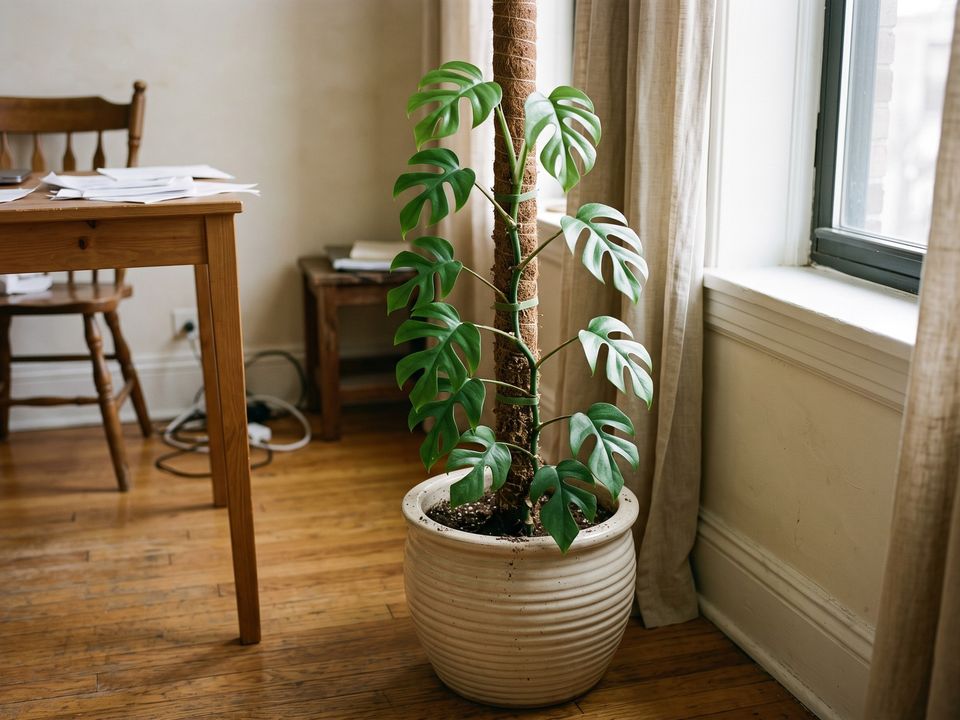
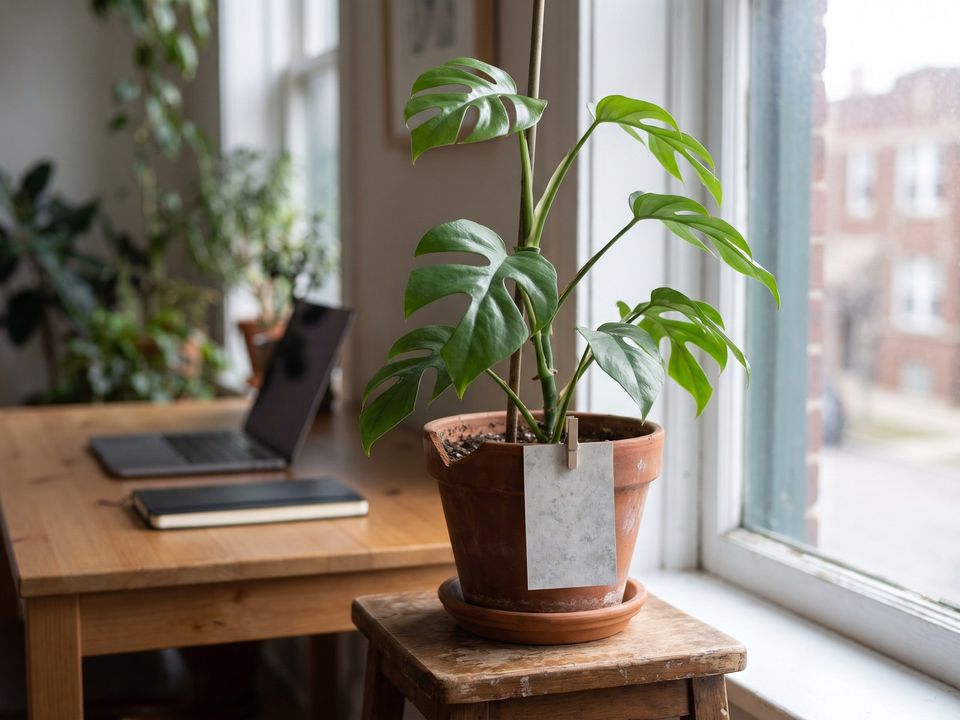
Slim stems race up a pole, their leaves often split or holed. Give it bright light and something to climb, and it shows off fast.
2.4/5
how easy it is to care for
3.6/5
how much it stands out visually
: Shade to filtered
Bright, mostly out of the sun; a little won’t hurt it
Wants bright light without direct sun, close to a window, where it can climb fast enough to soon need a pole. A little sun won’t hurt; it’s long, strong sun it can’t take.
An east window gives it a little morning sun and bright shade after. A west window works with a sheer curtain to soften the afternoon.
The leaves tell you how the spot is working. Yellowing can mean too little light (NC State), but overwatering yellows them as well, so check the room before you reach for the watering can. Too much sun can scorch leaves (NC State), so scorched ones ask for a step back.
Bright without the glare is all it asks.
: 2-3× a month
Every 7-10 days in summer; droops and curls when thirsty
Every 7-10 days in summer, 10-14 in winter, with the mix drying about an inch down between. Leaves droop and curl when it’s thirsty; a pot that stays wet invites root rot.
Rainforest air is the part a Chicago home can’t copy. NC State says it does best at around 60% humidity, and indoor winter air is often drier than that. Brown leaf edges and spots are the usual result (NC State ties them to dry soil or dry air).
If the browning bothers you, try a spot away from radiators and heat vents, a bright bathroom, or a cluster of other plants around it; a small humidifier helps most. It survives a few crisp edges regardless.
NC State keeps it between 65 and 80°F and out of drafts. A vine tied to its pole stands wherever the pot does, so give that pot a place well away from the front door.
Gone for a while? Ten days is fine if you soak it the day you leave. It may droop by the time you’re back, then perk up after a drink.
: Large
Slim stems of split leaves, climbing 3-6 feet fast
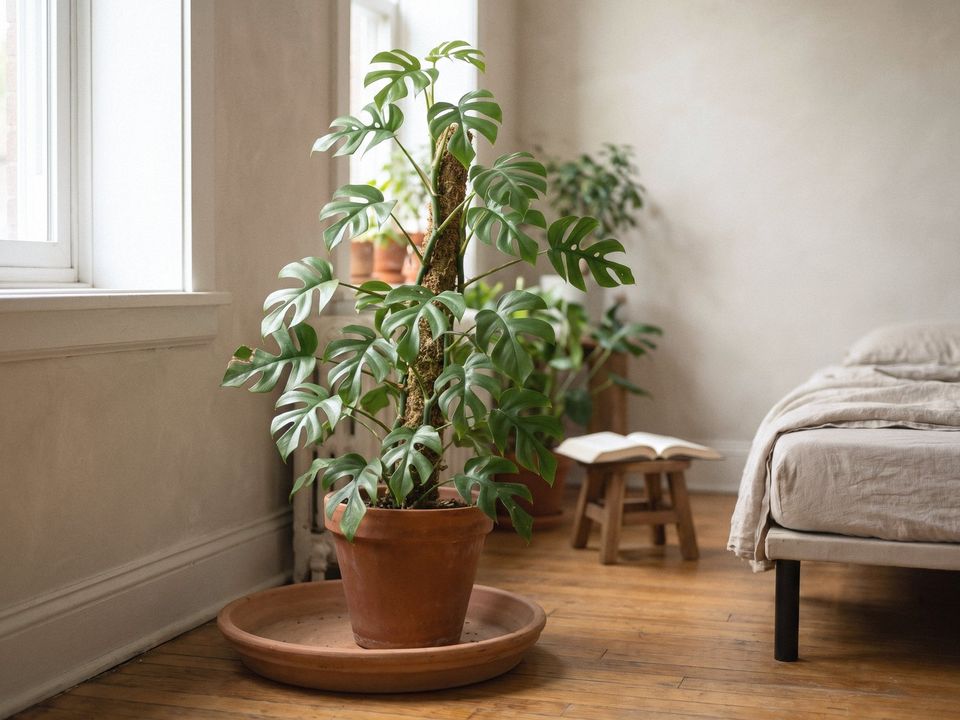
Slender stems climb a moss pole or trellis, or trail from a hanging basket or high shelf, and indoors can quickly reach 3-6 feet. Tie new growth to the support as it lengthens; trim any vine that wanders.
Short aerial roots along its slim stems grip moss or bark and carry it upward (NC State), so even a narrow pole is enough to hold it.
If it outgrows that pole, you can trim the lead stem and root the cut piece, since stem cuttings are how it’s propagated (NC State). Wound back onto the same pole, a rooted cutting thickens the column.
NC State puts its spread at 1-4 feet, so trained upright it stays a slim green column: a vertical line beside a desk or a window frame that a mounded plant can’t draw.
: Mildly irritating
Chewing can sting the mouths of dogs, cats, or kids
- DogsMildly irritating
- CatsMildly irritating
- KidsMildly irritating
Chewing it may bring mouth pain, drooling, or vomiting in pets, and mouth irritation or trouble swallowing in kids. It isn’t on the ASPCA’s list; NC State flags its calcium oxalates and rates it low severity.
Every part of the plant carries calcium-oxalate crystals (NC State), the tiny needles behind that sting. A pet may paw at its mouth, drool, or vomit for a while, and a child may drool heavily or get a sore stomach. Both usually pass on their own at home. Very rarely the mouth or throat swells; if breathing ever looks hard, call right away.
The sap can irritate skin, so NC State suggests gloves when you handle or prune it.
If symptoms don’t settle, or anything worries you, Poison Control can help with a child, and the ASPCA Animal Poison Control Center can help with a pet (a fee may apply).
In a home with chewers, grow it high, on a tall stand or a shelf, which can help keep leaves out of easy reach, though cats and climbers may still find them.
- NC State Extension: mild for kids.
Cats and dogs: NC State covers this plant; Pet Poison Helpline and ASPCA pages are for Monstera deliciosa (related-plant proxy).
Kids: CHOP covers oxalate plants in general, not this plant; drooling and stomach signs come from NC State.
: Average
65-80°F; average humidity is fine
Happiest at 65-80°F, and it shouldn’t sit below 60°F, so keep it off cold glass in winter. It likes around 60% humidity and gets by at 35%.
- Temperature
- 65-80°F
- Humidity
- 60-60%
: Spider mites
Spider mites, fungus gnats; check leaf undersides
Spider mites hide on leaf undersides and fungus gnats hang around the soil surface and potting mix, so check both spots. Scale is occasional, tucked on foliage and under the leaf and petiole sheaths.
- Spider mites
- Fungus gnats
- Scale
A few. NC State Extension names spider mites, scale, and fungus gnats, plus leaf spot and root rot if the mix stays wet.
Spider mites leave a faded, speckled look and fine webbing, mostly in warm, dry air. Rinse the whole plant in the shower, undersides of the leaves included; if they come back, spray it with insecticidal soap.
Scale looks like small brown bumps stuck to the stems and leaves. Scrape them off with a fingernail or a cotton swab dipped in rubbing alcohol, then check again next week.
Fungus gnats are tiny dark flies hovering around the pot; their larvae live in wet mix. Let the top of the mix dry between soaks and don’t leave water in the saucer, and they die off.
Bacterial leaf spot shows as dark, soggy-looking spots, and root rot as yellowing and wilting while the mix is still wet. Cut off spotted leaves, keep water off the leaves, and let the pot dry out before the next soak.
: Some
Tie up and feed 6× in spring-summer; repot yearly
From spring through summer, tie new stems to the support and feed about 6 times as growth extends. Each spring, repot one size up and trim leggy stems, wearing gloves because the sap irritates skin.
- Stake6× a year
- Feed6× a year
- Repot1× a year
- Prune1× a year
A light mix that drains fast, in a pot with a drainage hole: potting mix with some perlite or orchid bark mixed in works.
Repot when the roots crowd the pot, one size up, in spring. Set the moss pole or trellis in at the same time, so you don’t disturb the roots later.
Food is optional, but a fast grower uses it: a balanced houseplant fertilizer at half strength once a month in spring and summer, and none in winter.
: Suave
Green leaves split or holed; slight sheen, partly filling the pot
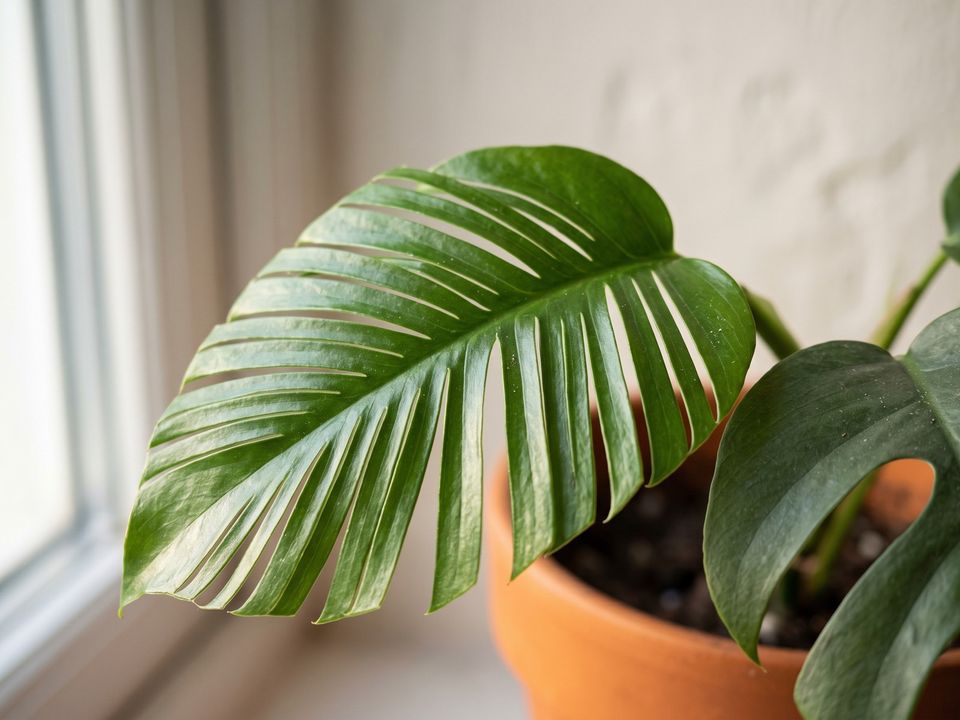
Slim stems carry green leaves that often split or open into holes, like a small Monstera’s. The surface has a slight sheen, and the foliage covers the soil only in part, so some of it shows.
Where to find me
Not yet pilferableFun fact
In the wet forests from southern Thailand down to Peninsular Malaysia, it climbs trees, clinging with aerial roots. The moss pole in your living room is its stand-in for the tree.
Designer tips
A jungle vine in miniature: split leaves climbing a pole give a small room the look of a big monstera without the sprawl.
Troubleshooting
Is it a baby Monstera?
No, and it won’t grow into one. It’s Rhaphidophora tetrasperma, a cousin in the same family; NC State Extension says plainly it’s neither a monstera nor a philodendron, and it stays a slender vine that splits its smaller leaves while young.
Some leaves are turning yellow
Too much water or too little light, per NC State Extension. If the mix has stayed soggy, give it longer between drinks, about 7-10 days in summer, and empty the saucer; if not, a spot closer to a window usually helps.
Why is it drooping?
Usually thirst: if the mix is dry, a good soak usually has it standing again soon. If the mix is wet and it still droops, the roots may be rotting, so let it dry out and water less often.
See all 8
Why is it long and leggy?
It’s a climber looking for something to climb, and maybe for more light. A moss pole or trellis with the stems tied on, a spot closer to a window, and a trim of the longest stems all help; the cut pieces root easily in water.
Why are the leaf edges brown and crispy?
Dry air or dry soil. It likes humid air, around 60% per NC State, so a humidifier nearby helps in winter, and a drink every 7-10 days in summer covers the soil side; it carries on with a few crisp edges either way.
Pale speckles and fine webbing on the leaves
Spider mites, the pest that most often finds it, usually under the leaves in warm, dry air. A rinse in the shower, undersides included, usually knocks them back, and insecticidal soap is the next step if they return.
Tiny flies keep hovering around the pot
Fungus gnats, likely: their larvae live in wet mix. Letting the top of the mix dry between drinks and keeping the saucer empty usually clears them.
My cat chewed a leaf
Expect drooling, pawing at its face, or some vomiting: calcium oxalate crystals make it mildly irritating, and NC State rates it low severity. If your cat has trouble swallowing or breathing, or keeps vomiting, call your vet or the ASPCA Animal Poison Control Center.
Propagation
Easily, from a stem cutting.
- Cut a piece of vine with a node and an aerial root (the little brown nub along the stem) and stand it in water or damp mix in a warm, bright spot.
- Pot it up once the roots are a few inches long.
Several cuttings in one pot make a fuller plant faster.
The PILF Matrix
2.4/5
how easy it is to care for
3.6/5
how much it stands out visually
“The one catfishing as a Monstera, and getting away with it.”


Rated 1-5, with 5 being easiest
Built from light, water, air, pests, and upkeep.
Rated 1-5, with 5 being easiest
Rated 1-5, with 5 being highest presence
Built from its scale (size, shape, growth) and its look (color and flowers, shine, fullness).
Rated 1-5, with 5 being highest presence
Where it sits and what sun touches it.
- Dim shadeA dark corner or a windowless room; natural light casts no shadow
- Bright shadeBack from the window in a south-, east- or west-facing room, or right by a north-facing one, where only low early or late summer sun reaches it
- Filtered sunBehind a sheer curtain or tinted glass; the sun’s shadows are blurred
- Partial sunIn an east- or west-facing window: up to a few hours of direct sun
- Full sunThe sunniest spot you have, usually a south-facing window, with direct sun 6+ hours a day
How often, and what the soil does between.
- MonthlyEvery 2-3 weeks in summer and 3-5 in winter; the soil dries all the way between
- 2-3× a monthEvery 7-14 days in summer, longer in winter; the top of the soil dries between
- Weekly+About every 4-8 days in summer; the soil stays lightly damp
How much room it usually takes indoors.
Size
- TinyUnder 6 inches tall or wide; for a desk or a sill
- Small6 inches to 1.5 feet tall or wide; for a shelf or a sill
- Medium1.5 to 3 feet tall or wide; for a table or a stand
- Large3 to 6 feet tall or wide; for the floor
- GiantOver 6 feet tall or wide; a statement in the corner
Shape
- TreeA trunk that branches into a canopy
- CaneBare stalks topped with leaves
- UprightStiff stems or leaves rising straight from the soil
- FountainLeaves or fronds arching out from the center
- BushyA full, rounded mound of leaves
- RosetteLeaves radiating from one low point
- ViningTrails, climbs, or both
Growth
How fast it gets there.
- SlowUnder 6 inches of new growth a year
- Moderate6-12 inches a year, mostly in spring and summer
- FastOver 12 inches a year; it may want trimming or training
What risks exist for pets and kids.
- Pet & kid safeNothing to worry about
- Mildly irritatingMay irritate the mouth or stomach if chewed, or for some plants, the skin if handled
- Moderately toxicCan cause illness if eaten, though typically not serious or fatal
- DangerousCan cause serious illness if eaten, including some reports of death
- Not yet ratedNot clearly rated by our sources; please check with your vet or doctor
For its safety ratings, PILF relies on research and guidance from leading sources, including the ASPCA, Pet Poison Helpline, Merck Veterinary Manual, Poison Control, and Children’s Hospital of Philadelphia, and others.
The small jobs beyond watering, over a year.
- Little upkeepA few small jobs a year beyond watering, like a feed now and then
- Some upkeepA small job about once a month beyond watering, like feeding or turning it
- More upkeepA small job every couple of weeks beyond watering, like a wipe, a turn, or a feed
- Most upkeepA small job most weeks beyond watering, like raising the humidity or misting
- TreeA trunk that branches into a canopy
- CaneBare stalks topped with leaves
- UprightStiff stems or leaves rising straight from the soil
- FountainLeaves or fronds arching out from the center
- BushyA full, rounded mound of leaves
- RosetteLeaves radiating from one low point
- ViningTrails, climbs, or both
How fast it gets there.
- SlowUnder 6 inches of new growth a year
- Moderate6-12 inches a year, mostly in spring and summer
- FastOver 12 inches a year; it may want trimming or training
The temperature and humidity it’s comfortable in.
How dry a room it takes.
- Needs 50%+ humidity
- Fine at 35% humidity
- Fine at 15-20% humidity
The bugs that usually find it, by name.
How often pests find it.
- 5+ regular pests
- 3 regular pests
- Pests are rare
The year’s chores: feeding, pruning, repotting, and cleaning.
Chores beyond water (what needs work means).
- Most upkeep
- Some upkeep
- Little upkeep
Its finish, fullness, and texture.
Color, pattern, and flowers.
- SimpleOne green, one texture, nothing to read
- SuaveA sheen, a stripe, or a clean shape that catches the eye up close
- ShowyColor, pattern, or blooms you see from across the room
How the leaves catch light.
- Matte
- Satin
- Glossy or waxy
How much it fills its pot.
- Soil shows
- Soil partly hidden
- Leaves hide the soil