Moth Orchid
Phalaenopsis
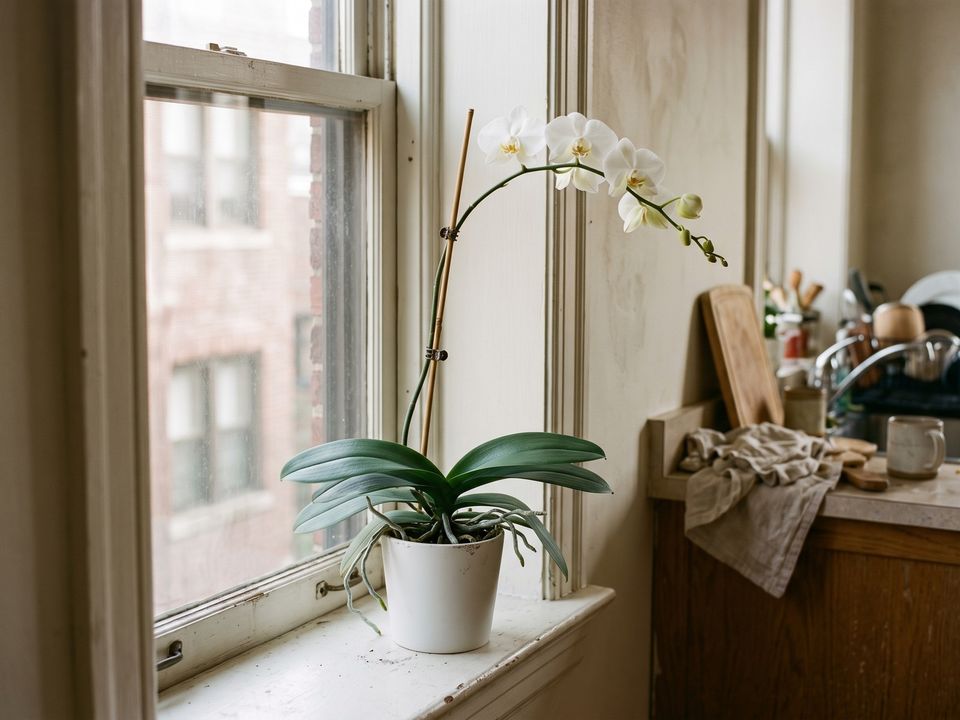
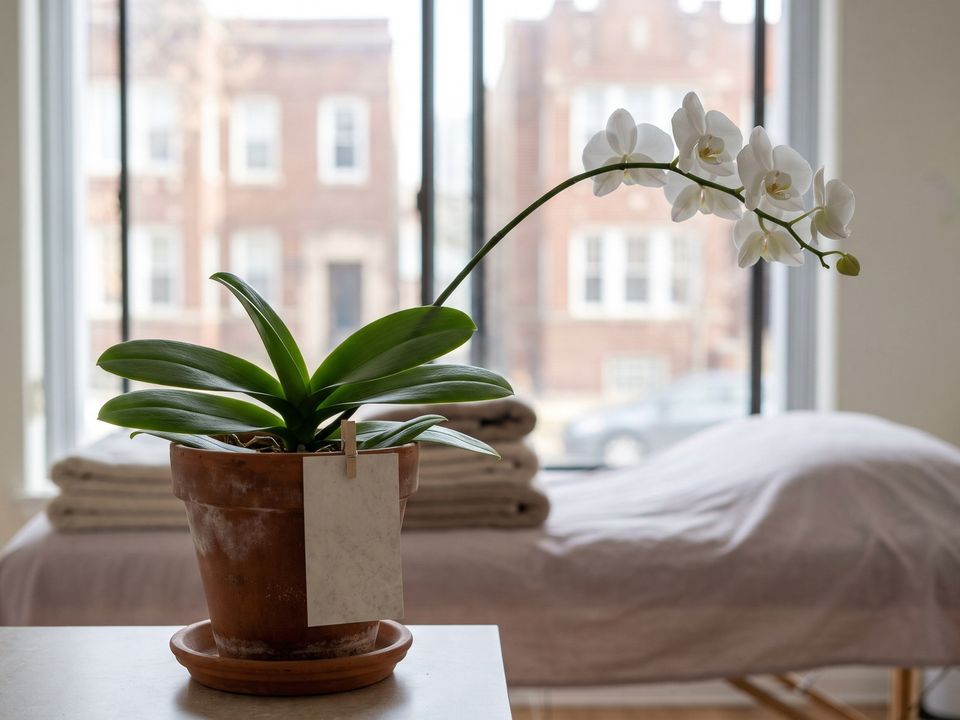
Moth-winged blooms open one by one up an arching spike, for months. It flowers about once a year, and may rebloom.
2.8/5
how easy it is to care for
3.3/5
how much it stands out visually
: Shade to filtered
Made for an east sill; fine in bright shade too
An east windowsill is its natural home; it also gets by in bright shade, kept out of direct afternoon sun. Tucked too far into shadow, it may keep its leaves but skip its next bloom.
In the wild, moth orchids cling to trees in the shade of warm, humid forests (Penn State Extension), and on Borneo most species grow toward the base of the trunk, in low light (Kew). One Bornean cousin, P. pantherina, lives high in the canopy in bright, diffuse light (Kew).
Indoors, an east window is the classic spot (NC State, Clemson). A west window works as well, and a south one with some success (Penn State), as long as the sun is filtered or kept off the leaves, since summer sun can scorch them (RHS).
Growing it under a lamp? Leave headroom: the flower spike climbs as it buds and may end up brushing the bulbs (Penn State).
Picture the light on a shaded tree trunk, steady and soft, with a little morning sun at most, and give it the closest match you have.
: 2-3× a month
The bark dries partway between drinks, never fully
About every 7 days in summer and every 7-10 in winter, with the bark drying partway between, not all the way through. Running a day or two behind bothers it less than bark kept wet, which smothers its thick roots.
Chunky bark is its usual potting mix, a stand-in for the trees its roots grip in the wild (Penn State). When you repot, NC State suggests a bark-based orchid mix.
Bark holds little food of its own, so NC State suggests a balanced fertilizer at quarter strength every week, or half strength twice a month.
In dry winter air, a bud or two may drop before opening (Penn State); if that bothers you, a more humid room may help.
Gone for a while? Two weeks is fine if it gets a good soak and a full drain the day you leave.
: Small
A slow fan of broad leaves; in bloom, up to about 2 feet
Slow-growing broad leaves stay low and close to the pot while the flower spike carries it to 1-2 feet. When the last bloom drops, cut the spike above a node below the lowest flower; it may branch and bloom again.
It grows from one short, central stem, adding leaves in two opposite rows (plant patents call this monopodial growth); the wild Phalaenopsis amabilis usually holds just 3-5 (Kew). Thick, fleshy roots grow from the lower stem (Kew).
About every two years, NC State suggests repotting into fresh bark, since the old mix breaks down around those roots.
Now and then a small offshoot sprouts low on the spike, and it can be detached and potted on its own (plant patent).
In bloom it leans its flowers out to one side, so give it clear air there: the end of a windowsill, or a shelf edge where the blooms can hang past.
: Pet & kid safe
Nothing to worry about for dogs, cats, or kids
- DogsSafe
- CatsSafe
- KidsSafe
The ASPCA lists moth orchids as non-toxic to dogs and cats, and NC State tags them the same. For kids, Connecticut’s poison control center lists orchids as safe.
Any plant can upset a stomach that isn’t used to it; for a moth orchid, that’s the whole of it.
If a toddler gets a taste and anything worries you, Poison Control is there to ask.
Here it’s the plant that needs protecting. A cat that bats at dangling things may snap a spike long before it ever gets sick, so set it where the blooms sit beyond paw’s reach, and enjoy it with a pet-safe set-up.
- ASPCA: safe for dogs.
- ASPCA: safe for cats.
- UConn Health: safe for kids.
Cats and dogs: The ASPCA lists it as non-toxic.
Kids: No poison-centre listing; rated from university extension sources.
: Average
60-85°F; average humidity is fine
Keep it at 60-85°F. Keep it away from cold glass in winter. It likes 50-70% humidity and gets by at 30%.
- Temperature
- 60-85°F
- Humidity
- 50-70%
: Scale
Scale and mealybugs; check leaf undersides and the base
Scale tucks along the underside of the leaf midrib and under the leaf sheaths. Mealybugs wait in leaf axil crevices, at the base, and on flowers. Thrips (flowers, foliage) and mites (leaf undersides) are occasional.
- Scale
- Mealybugs
- Thrips
- Spider mites / false spider mites
Not many. Scale and mealybugs are the usual pests, with thrips and spider mites now and then; rot is the real danger (NC State, UConn).
Scale looks like small brown or tan bumps stuck to the leaves, often underneath; mealybugs look like tufts of white cotton where the leaves meet. Wipe them off with a cotton swab dipped in rubbing alcohol, then check again next week; if they come back, insecticidal soap is the next step.
Spider mites leave pale speckles and fine webbing under the leaves; thrips leave silvery streaks on leaves and flowers. Rinse the plant in the sink, undersides included, then follow up with insecticidal soap.
Rot shows as a leaf going soft, yellow, or black at the base, usually after water sat in the crown or the bark stayed soggy. Cut the soft leaf off, keep water out of the crown, and let the pot drain well from then on. Brown spots on the flowers are a fungus called botrytis (NC State): pick those flowers off and keep water off the blooms.
: Most
Feed twice a month, flush monthly, repot every 2 years
Feed at half strength twice a month, lighter in winter, and run clear water through the pot monthly. Stake the new spike in winter, cut it after the last bloom, and repot in spring or summer every 2 years.
- Feed24× a year
- Flush salts12× a year
- Stake1× a year
- Deadhead1× a year
- Cool nights to trigger spike1× a year
- Repot1× a year
Orchid bark in a pot with plenty of drainage holes, never ordinary potting soil: in the wild its roots cling to trees, and they need air.
Repot every two years, into fresh bark, once it has finished blooming and never while it’s in flower (Clemson Extension). A few roots climbing out over the rim is normal; a pot packed solid with roots means it’s time.
Feed it a balanced fertilizer at half strength twice a month, or at quarter strength weekly, from spring into early fall (NC State, Clemson).
: Suave
Broad, waxy green leaves with space between stems
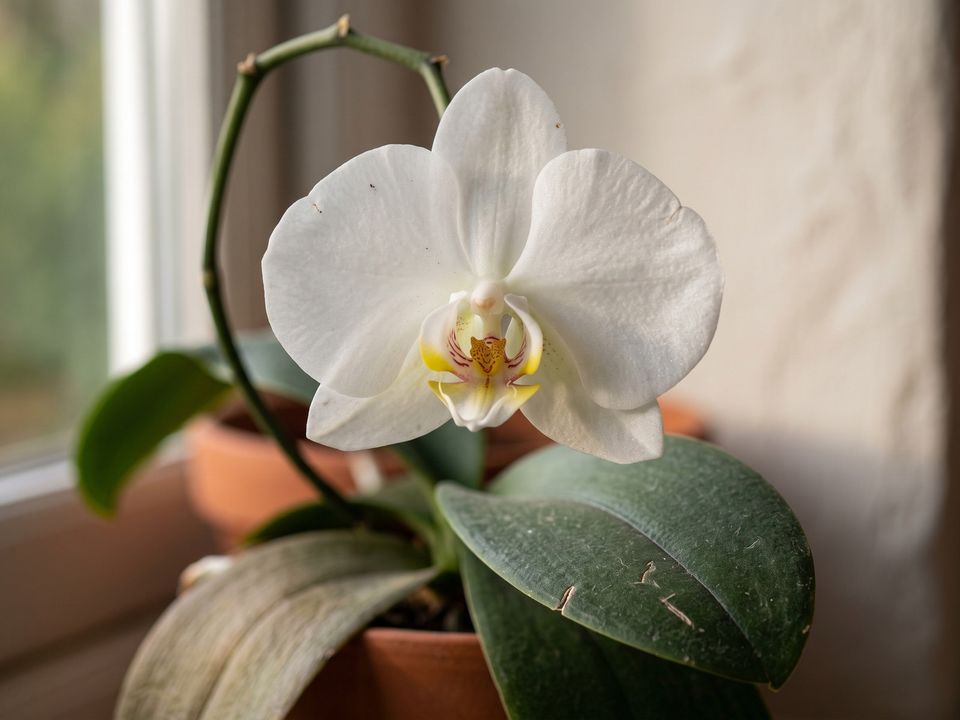
Each wide, deep green leaf has a waxy gloss, as if polished. The plant is open rather than bushy, with leaves low and soil showing between the stems.
Where to find me
Not yet pilferableFun fact
Botanists saw moths in flight in its flowers, so Phalaenopsis comes from the Greek for 'moth' and 'like.' One spike can stay in bloom three months or longer.
Designer tips
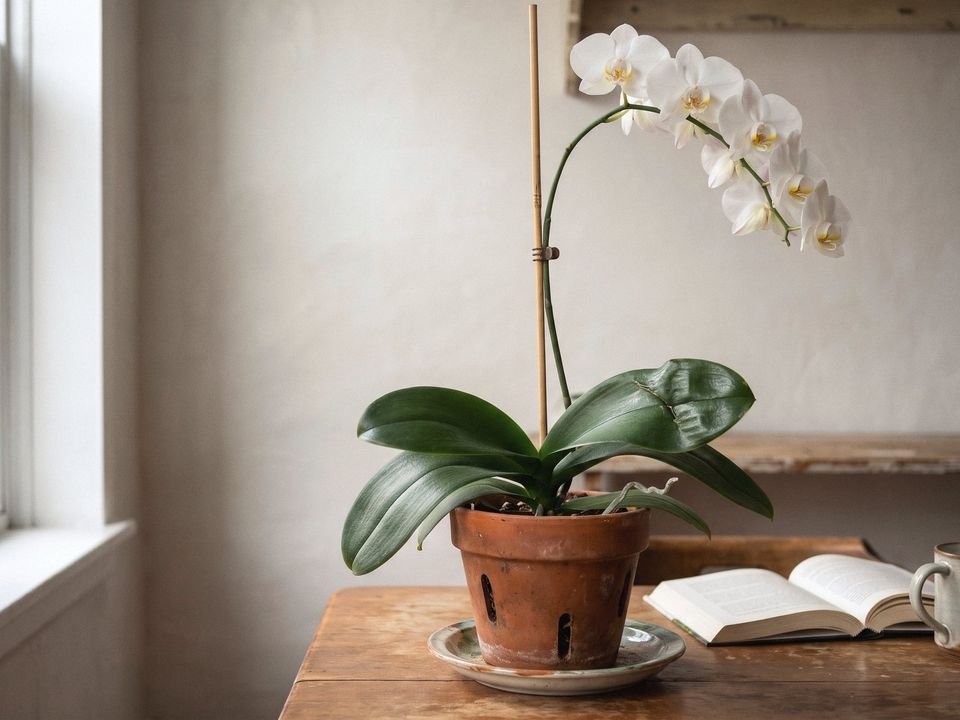
Elegant and a little formal: one arching spike of flowers turns a table into a centerpiece.
Troubleshooting
How do I get it to bloom again?
Cool fall nights usually set off a new spike: several weeks of nights in the upper 50s or low 60s, 10-15 degrees cooler than the days (Iowa State, Illinois Extension). NC State notes that modern dwarf hybrids skip the chill.
Should I cut the spike after the flowers drop?
Either way works. Cut just above a node below the lowest flower and it often branches and blooms again in 6-9 weeks (UConn), or cut it down to the leaves for a stronger spike within a year (Clemson); a spike that browns and dries comes off at the base.
Silvery roots are growing out of the pot
Those are air roots, and they’re normal: in the wild they cling to tree bark. Leave them be; firm, silvery green roots are healthy, and only brown, mushy ones have rotted.
See all 9
The leaves are limp and wrinkled
Its roots aren’t taking up water, either after a long dry spell or from rot after too much. Firm green roots after a soak mean it just wants watering about weekly; brown, mushy ones can be trimmed off and the plant repotted in fresh bark.
Why did the buds dry up and fall off?
A change it didn’t like: a move, a draft, a temperature swing, dry air, or a missed watering (NC State calls it bud blast). A steady spot from the time buds form until they open usually helps.
A leaf is going soft and yellow at the base
Likely rot, usually after water sat in the crown, the cup where the leaves meet, or the bark stayed soggy. Cut the soft leaf off and tip any water out of the crown after watering from then on.
How long do the flowers last?
For months: NC State puts it at four or more on a healthy plant. After that it rests, and it may bloom again about once a year.
Can I water it with ice cubes?
Yes, if it’s potted in bark: in a study at Ohio State and the University of Georgia, moth orchids given three ice cubes a week bloomed just as long as ones given room-temperature water. A soak in the sink does the same job and rinses the bark through.
My cat chewed the flowers
It’s safe: the ASPCA lists moth orchids as non-toxic to cats and dogs. Eating any plant can upset a stomach, so a little vomiting is possible, but the plant isn’t poisonous.
Propagation
Not practical at home, so enjoy this one as it is.
- Now and then a baby plant, called a keiki, sprouts from a node on the flower spike.
- Once it has roots of its own, cut it off with a bit of spike and pot it in orchid bark.
The PILF Matrix
2.8/5
how easy it is to care for
3.3/5
how much it stands out visually
“The one from the grocery store acting like it’s from Paris.”


- phal
- moon orchid
Rated 1-5, with 5 being easiest
Built from light, water, air, pests, and upkeep.
Rated 1-5, with 5 being easiest
Rated 1-5, with 5 being highest presence
Built from its scale (size, shape, growth) and its look (color and flowers, shine, fullness).
Rated 1-5, with 5 being highest presence
Where it sits and what sun touches it.
- Dim shadeA dark corner or a windowless room; natural light casts no shadow
- Bright shadeBack from the window in a south-, east- or west-facing room, or right by a north-facing one, where only low early or late summer sun reaches it
- Filtered sunBehind a sheer curtain or tinted glass; the sun’s shadows are blurred
- Partial sunIn an east- or west-facing window: up to a few hours of direct sun
- Full sunThe sunniest spot you have, usually a south-facing window, with direct sun 6+ hours a day
How often, and what the soil does between.
- MonthlyEvery 2-3 weeks in summer and 3-5 in winter; the soil dries all the way between
- 2-3× a monthEvery 7-14 days in summer, longer in winter; the top of the soil dries between
- Weekly+About every 4-8 days in summer; the soil stays lightly damp
How much room it usually takes indoors.
Size
- TinyUnder 6 inches tall or wide; for a desk or a sill
- Small6 inches to 1.5 feet tall or wide; for a shelf or a sill
- Medium1.5 to 3 feet tall or wide; for a table or a stand
- Large3 to 6 feet tall or wide; for the floor
- GiantOver 6 feet tall or wide; a statement in the corner
Shape
- TreeA trunk that branches into a canopy
- CaneBare stalks topped with leaves
- UprightStiff stems or leaves rising straight from the soil
- FountainLeaves or fronds arching out from the center
- BushyA full, rounded mound of leaves
- RosetteLeaves radiating from one low point
- ViningTrails, climbs, or both
Growth
How fast it gets there.
- SlowUnder 6 inches of new growth a year
- Moderate6-12 inches a year, mostly in spring and summer
- FastOver 12 inches a year; it may want trimming or training
What risks exist for pets and kids.
- Pet & kid safeNothing to worry about
- Mildly irritatingMay irritate the mouth or stomach if chewed, or for some plants, the skin if handled
- Moderately toxicCan cause illness if eaten, though typically not serious or fatal
- DangerousCan cause serious illness if eaten, including some reports of death
- Not yet ratedNot clearly rated by our sources; please check with your vet or doctor
For its safety ratings, PILF relies on research and guidance from leading sources, including the ASPCA, Pet Poison Helpline, Merck Veterinary Manual, Poison Control, and Children’s Hospital of Philadelphia, and others.
The small jobs beyond watering, over a year.
- Little upkeepA few small jobs a year beyond watering, like a feed now and then
- Some upkeepA small job about once a month beyond watering, like feeding or turning it
- More upkeepA small job every couple of weeks beyond watering, like a wipe, a turn, or a feed
- Most upkeepA small job most weeks beyond watering, like raising the humidity or misting
- TreeA trunk that branches into a canopy
- CaneBare stalks topped with leaves
- UprightStiff stems or leaves rising straight from the soil
- FountainLeaves or fronds arching out from the center
- BushyA full, rounded mound of leaves
- RosetteLeaves radiating from one low point
- ViningTrails, climbs, or both
How fast it gets there.
- SlowUnder 6 inches of new growth a year
- Moderate6-12 inches a year, mostly in spring and summer
- FastOver 12 inches a year; it may want trimming or training
The temperature and humidity it’s comfortable in.
How dry a room it takes.
- Needs 50%+ humidity
- Fine at 35% humidity
- Fine at 15-20% humidity
The bugs that usually find it, by name.
How often pests find it.
- 5+ regular pests
- 3 regular pests
- Pests are rare
The year’s chores: feeding, pruning, repotting, and cleaning.
Chores beyond water (what needs work means).
- Most upkeep
- Some upkeep
- Little upkeep
Its finish, fullness, and texture.
Color, pattern, and flowers.
- SimpleOne green, one texture, nothing to read
- SuaveA sheen, a stripe, or a clean shape that catches the eye up close
- ShowyColor, pattern, or blooms you see from across the room
How the leaves catch light.
- Matte
- Satin
- Glossy or waxy
How much it fills its pot.
- Soil shows
- Soil partly hidden
- Leaves hide the soil