Stromanthe Triostar
Stromanthe thalia 'Triostar'
Also called tricolor stromanthe
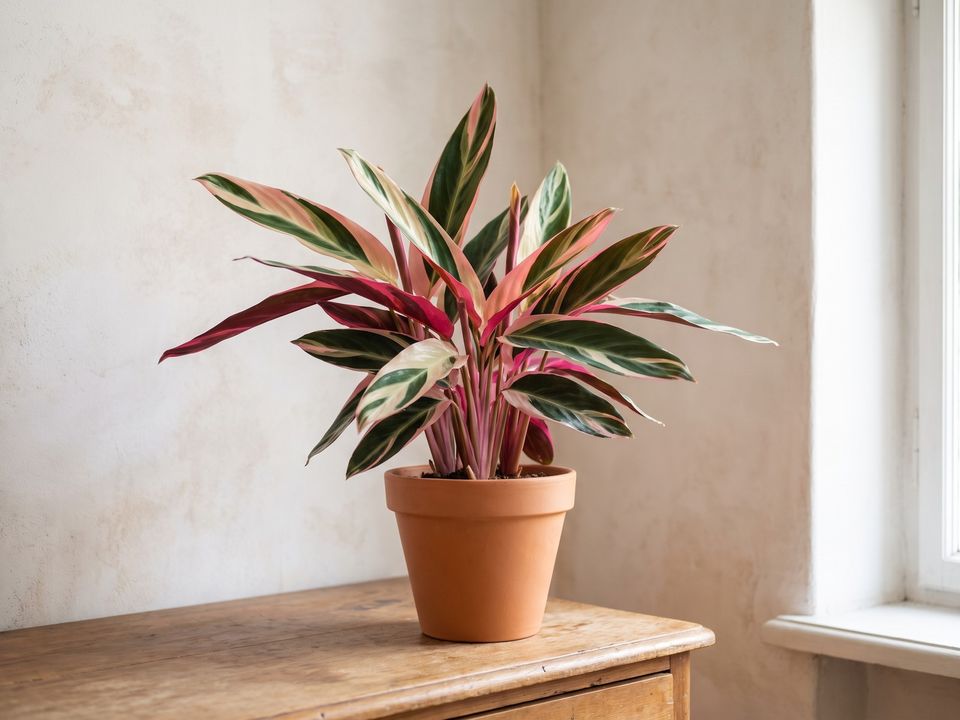
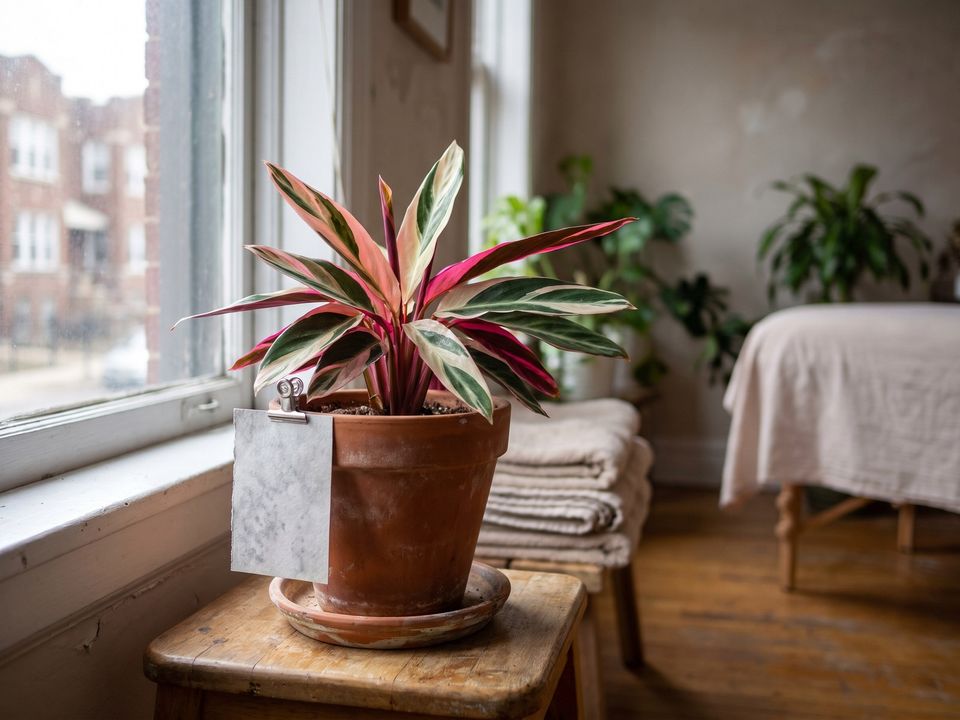
Leaves streaked cream, pink, and green over rosy undersides, on pink stems. Damp soil and humid air keep it at its best.
2.2/5
how easy it is to care for
3.6/5
how much it stands out visually
: Bright shade
Near a window but shaded; less light means less pink
Its pink runs richest close to a sunny window, in a spot the rays never reach. A dimmer room keeps it growing, only paler; direct sun can scorch the leaves.
Morning light from an east window suits it, and so can the sill of a north window (RHS). If your room faces south, set it well back, with a sheer between it and the glass.
Watch it through a day and you’ll see the leaves move. In the morning they turn east to catch the early light. By midday they stand more upright, so less of each blade faces the strongest sun (University of Wisconsin Extension).
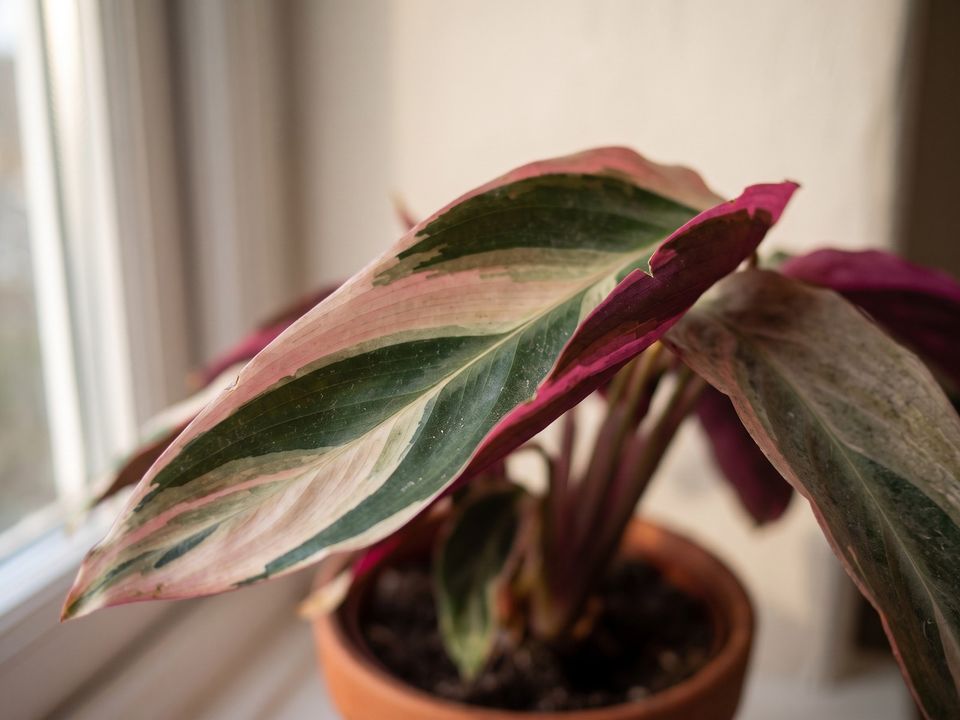
The cream and pink vary from leaf to leaf. Some leaves come in nearly all cream, and others are nearly all green with a few streaks (University of Wisconsin Extension), so one greener leaf isn’t a verdict on its spot.
Pink is the first color to fade when light runs short, so let the newest leaves tell you whether it wants a move closer to the window.
: Weekly+
Every 5-7 days in summer; evenly moist, not soggy
Aim for soil that’s evenly moist, never mud: every 5-7 days in summer, 7-10 in winter. Dry soil bothers it, and soggy soil can rot the roots.
Its leaf edges are the first to complain about dry air: when the heat comes on in winter, they can dry out from the edges in (University of Wisconsin Extension). If that bothers you, running a humidifier or setting the pot on damp pebbles may help (NC State); the RHS suggests 60 percent humidity or more. It gets by without either, just with crisper edges.
Are browned tips bothering you? Rainwater, or filtered or distilled water, may help, since the RHS notes it’s sensitive to fluoride in tap water. It carries on with or without the switch.
When it needs a new pot, the RHS advises going only slightly larger.
Gone for a while? A week is fine if it’s watered well the day you leave. Much longer and dry soil browns the leaf edges.
: Medium
A leafy clump about 1.5-3 feet tall
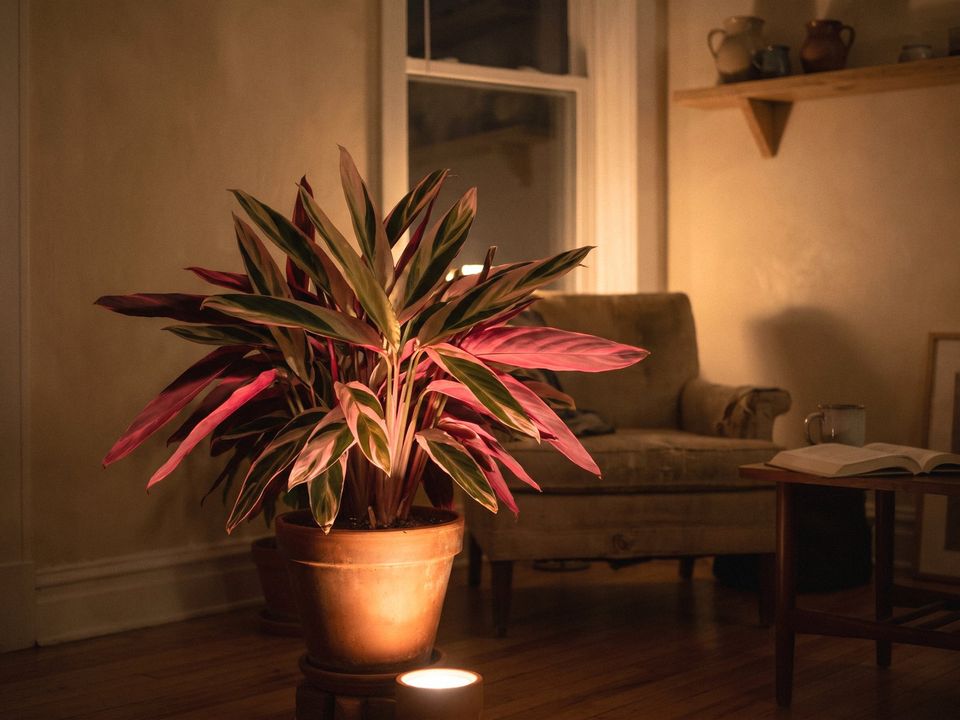
Long leaves on pink stems rise from a clump at the base, 1.5-3 feet tall and 1-2 feet wide. Pretty on a plant stand or the floor, in a pot with room for the clump to widen.
It spreads from rhizomes, short creeping stems under the soil (University of Wisconsin Extension), so new shoots fill the pot outward over time. Leaves also come from branching stems, not only from the base (Missouri Botanical Garden), which gives an older plant its layered, full look.
Those rhizomes are where it splits: in spring, before new growth starts, the clump can be cut apart along them (NC State). The RHS suggests repotting every 2-3 years.
Its pink stems hide inside the mound when seen from above, so a spot where you meet it from the side, like a stand beside a window, shows them off.
: Pet & kid safe
Nothing to worry about for dogs, cats, or kids
- DogsSafe
- CatsSafe
- KidsSafe
Nothing harmful here for dogs, cats, or kids. NC State tags it pet friendly, the ASPCA lists its cousin the prayer plant as non-toxic, and extension sources rate it nonpoisonous.
It belongs to the prayer-plant family, Marantaceae (NC State), so the cousin on the ASPCA’s list is close kin, not a distant one.
The bigger risk runs the other way. A cat that chews the long, glossy leaves can leave tears and bite marks in the cream and pink, and each damaged leaf keeps its scars.
With a toddler, a heavy pot keeps the plant upright when small hands tug at the stems. If a cat starts batting the pink leaves around, a spot out of its reach keeps the color unmarked.
- UConn Extension: safe for kids.
Cats and dogs: No vet database lists it; rated from university extension sources.
Kids: No poison-centre listing; rated from university extension sources.
: Average
65-80°F; likes humid air
Happiest at 65-80°F, and it shouldn’t sit below 50°F. It wants at least 45% humidity.
- Temperature
- 65-80°F
: Spider mites
Spider mites on leaf undersides; mealybugs, aphids too
Spider mites are the common guest, so flip a leaf and look underneath. Mealybugs tuck into leaf axils, petiole bases, and the crown, and aphids favor new unfurling leaves. A weekly peek spots trouble early.
- Spider mites
- Mealybugs
- Aphids
Spider mites are the pest to watch, especially in dry winter air. Mealybugs and aphids turn up now and then, and root and stem rot if the soil stays soggy (per NC State Extension).
Spider mites leave fine webbing and a dusty, speckled look, mostly under the leaves. Rinse the whole plant in the shower, undersides included, and do it again each week until they’re gone; if they hang on, spray insecticidal soap. More humid air helps keep them away.
Mealybugs look like tufts of white cotton where the leaf stalks meet; aphids are small, soft, green bugs on new leaves. Wipe mealybugs off with a cotton swab dipped in rubbing alcohol, and rinse aphids off in the shower.
Rot shows as stems going soft and dark at the base while the soil is wet. Cut those stems off, empty the saucer, and let the top of the soil dry a little before the next soak.
: More
Feed every 2-3 weeks in growth; divide each spring
While it grows in spring and summer, give it low-nitrogen liquid feed every 2-3 weeks, about 10 times a year. Snip dried leaves as needed, and wipe dust off twice a year. Divide the clump each spring.
- Feed10× a year
- Prune6× a year
- Divide1× a year
- Clean leaves2× a year
A rich potting mix that holds moisture but drains fast, in a pot with a drainage hole.
Repot when the clump fills the pot, in spring before new growth starts; that’s also the time to divide it (see Propagation).
Food is optional: a houseplant fertilizer now and then in spring and summer, and none in fall and winter (per UW–Madison Extension).
: Showy
Cream, pink, and green streaks over rosy undersides
Each long leaf is streaked cream, pink, and green, with a rosy underside, on pink stems. The surface has a gentle sheen, and the clump is full enough to cover part of the soil.
Where to find me
Not yet pilferableFun fact
It’s sold as Triostar, Tristar, and Tricolor, three names for the same plant. In 2008, Florida’s nursery growers' association named it a Florida Plant of the Year.
Designer tips
Painterly and a little theatrical: cream, pink, and green on top, hot pink underneath.
Troubleshooting
The leaf edges are browning and crisping
Dry air, almost always: UW-Madison Extension says the leaves dry out from the edges when humidity runs low, as it does in most homes in winter. A humidifier or a tray of wet pebbles helps if it bothers you; the brown stays, and the plant carries on with it.
Why are the leaves curling?
Usually thirst: it doesn’t like dry soil (NC State Extension), and the leaves curl when it runs short. A good soak, then a drink every 5-7 days in summer, keeps it steadier; dry air adds to it, so a humidifier helps too.
Why is it losing its pink and cream?
Not enough light, most likely, since its colors are best in bright light (UW-Madison). Closer to a window, out of the sun’s reach, new leaves usually come in brighter; the faded ones stay as they are, and some leaves run greener regardless.
See all 8
The leaves fold up at night
That’s normal: like its cousin the prayer plant, it folds its leaves up at night and opens them again in the morning. It’s the best time to see the pink undersides.
Fine webbing under the leaves
Spider mites, its most common pest, especially in dry winter air. A rinse in the shower, undersides included, once a week until they’re gone usually clears them, and more humid air helps keep them away.
Pale or brown patches on the leaves
Sun landing on the leaves, likely. A step back from the window or a sheer curtain stops it; the marked leaves stay marked, so cut them at the base once new ones come, if you like.
Why are the stems going soft at the base?
Too much water: NC State Extension notes root and stem rot from overwatering. Cut off the soft stems, empty the saucer, and let the top of the soil dry a little between drinks.
Is it safe for my cat or dog?
Yes, nothing harmful: NC State Extension tags it pet friendly, and the ASPCA lists its cousin the prayer plant as non-toxic. Chewed leaves keep their tears and bite marks, though, so a spot out of reach mostly protects the color.
Propagation
Yes, by division, in spring before new growth starts.
- Ease it out of its pot and gently pull or cut the clump into pieces, each with several leaves and its own roots.
- Pot them at the same depth, keep the soil evenly moist, and give them a humid spot while they settle in.
The PILF Matrix
2.2/5
how easy it is to care for
3.6/5
how much it stands out visually
“The one that’s a triple-threat star with the ego to boot.”


Rated 1-5, with 5 being easiest
Built from light, water, air, pests, and upkeep.
Rated 1-5, with 5 being easiest
Rated 1-5, with 5 being highest presence
Built from its scale (size, shape, growth) and its look (color and flowers, shine, fullness).
Rated 1-5, with 5 being highest presence
Where it sits and what sun touches it.
- Dim shadeA dark corner or a windowless room; natural light casts no shadow
- Bright shadeBack from the window in a south-, east- or west-facing room, or right by a north-facing one, where only low early or late summer sun reaches it
- Filtered sunBehind a sheer curtain or tinted glass; the sun’s shadows are blurred
- Partial sunIn an east- or west-facing window: up to a few hours of direct sun
- Full sunThe sunniest spot you have, usually a south-facing window, with direct sun 6+ hours a day
How often, and what the soil does between.
- MonthlyEvery 2-3 weeks in summer and 3-5 in winter; the soil dries all the way between
- 2-3× a monthEvery 7-14 days in summer, longer in winter; the top of the soil dries between
- Weekly+About every 4-8 days in summer; the soil stays lightly damp
How much room it usually takes indoors.
Size
- TinyUnder 6 inches tall or wide; for a desk or a sill
- Small6 inches to 1.5 feet tall or wide; for a shelf or a sill
- Medium1.5 to 3 feet tall or wide; for a table or a stand
- Large3 to 6 feet tall or wide; for the floor
- GiantOver 6 feet tall or wide; a statement in the corner
Shape
- TreeA trunk that branches into a canopy
- CaneBare stalks topped with leaves
- UprightStiff stems or leaves rising straight from the soil
- FountainLeaves or fronds arching out from the center
- BushyA full, rounded mound of leaves
- RosetteLeaves radiating from one low point
- ViningTrails, climbs, or both
Growth
How fast it gets there.
- SlowUnder 6 inches of new growth a year
- Moderate6-12 inches a year, mostly in spring and summer
- FastOver 12 inches a year; it may want trimming or training
What risks exist for pets and kids.
- Pet & kid safeNothing to worry about
- Mildly irritatingMay irritate the mouth or stomach if chewed, or for some plants, the skin if handled
- Moderately toxicCan cause illness if eaten, though typically not serious or fatal
- DangerousCan cause serious illness if eaten, including some reports of death
- Not yet ratedNot clearly rated by our sources; please check with your vet or doctor
For its safety ratings, PILF relies on research and guidance from leading sources, including the ASPCA, Pet Poison Helpline, Merck Veterinary Manual, Poison Control, and Children’s Hospital of Philadelphia, and others.
The small jobs beyond watering, over a year.
- Little upkeepA few small jobs a year beyond watering, like a feed now and then
- Some upkeepA small job about once a month beyond watering, like feeding or turning it
- More upkeepA small job every couple of weeks beyond watering, like a wipe, a turn, or a feed
- Most upkeepA small job most weeks beyond watering, like raising the humidity or misting
- TreeA trunk that branches into a canopy
- CaneBare stalks topped with leaves
- UprightStiff stems or leaves rising straight from the soil
- FountainLeaves or fronds arching out from the center
- BushyA full, rounded mound of leaves
- RosetteLeaves radiating from one low point
- ViningTrails, climbs, or both
How fast it gets there.
- SlowUnder 6 inches of new growth a year
- Moderate6-12 inches a year, mostly in spring and summer
- FastOver 12 inches a year; it may want trimming or training
The temperature and humidity it’s comfortable in.
How dry a room it takes.
- Needs 50%+ humidity
- Fine at 35% humidity
- Fine at 15-20% humidity
The bugs that usually find it, by name.
How often pests find it.
- 5+ regular pests
- 3 regular pests
- Pests are rare
The year’s chores: feeding, pruning, repotting, and cleaning.
Chores beyond water (what needs work means).
- Most upkeep
- Some upkeep
- Little upkeep
Its finish, fullness, and texture.
Color, pattern, and flowers.
- SimpleOne green, one texture, nothing to read
- SuaveA sheen, a stripe, or a clean shape that catches the eye up close
- ShowyColor, pattern, or blooms you see from across the room
How the leaves catch light.
- Matte
- Satin
- Glossy or waxy
How much it fills its pot.
- Soil shows
- Soil partly hidden
- Leaves hide the soil