String of Pearls
Curio rowleyanus
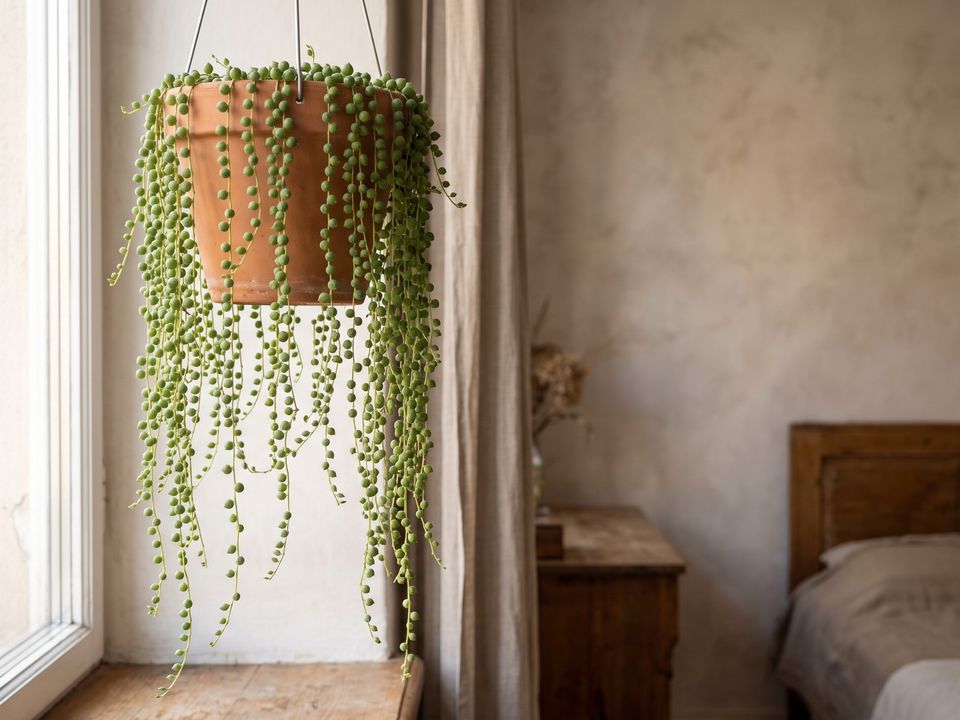
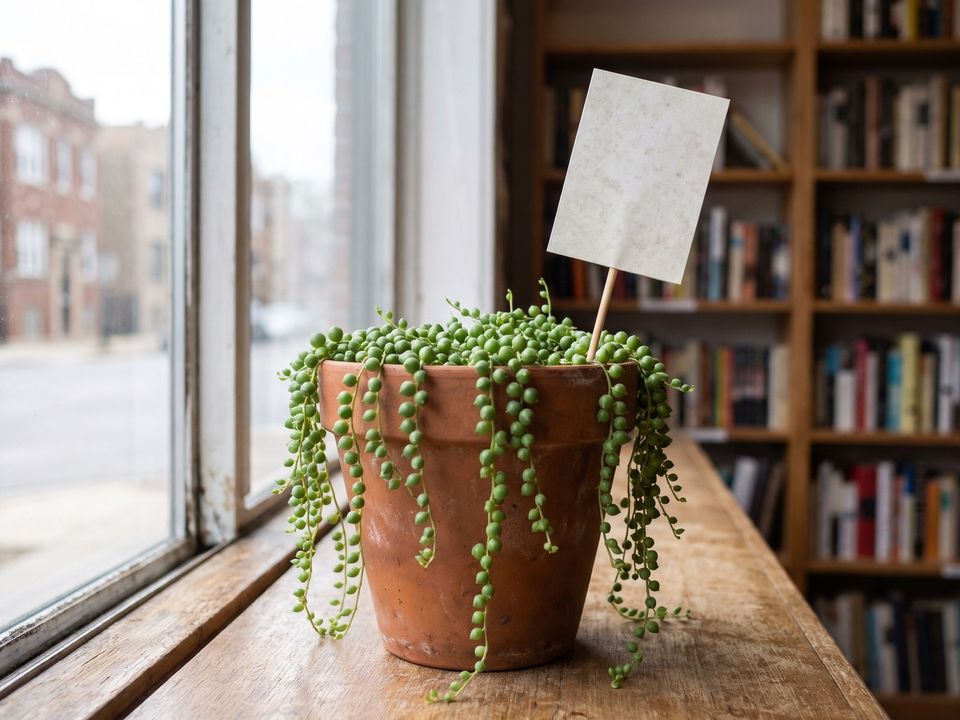
Strands of pea-sized green pearls pour over the pot’s edge. Each bead stores water, so it drinks rarely and likes bright light.
3.6/5
how easy it is to care for
2.6/5
how much it stands out visually
: Shade to part sun
By a bright window; gentle sun is fine, harsh sun burns
Dim light is one of three things NC State says it won’t tolerate; the other two involve your watering can. Keep it bright and shielded from strong sun; a touch of gentle sun is fine.
In the wild it tucks itself under shrubs and between rocks in dry country (NC State), and that’s the light to copy: plenty of brightness, with something taking the edge off the sun.
An east or west window works well (RHS). Near a south-facing one, hang it back from the glass or behind a sheer, because harsh rays can scorch the pearls (NC State).
Summering it outside? NC State suggests partial shade there, and it can’t take any frost, so bring it in well before the first cold night of fall.
In short: all the light you can give, as long as none of it is harsh enough to scorch a pearl.
: 2-3× a month
Drinks about twice a month; dislikes soggy and bone-dry
About every 10-14 days in summer, every 2-3 weeks in winter. It forgives a missed week, but not soggy soil, which rots it, nor a long stretch bone dry.
A round leaf offers the least surface for what it holds, which cuts water loss (University of Wisconsin Extension), and each pearl’s core is made of water-storage cells (Missouri Botanical Garden). That’s how it coasts for a couple of weeks between drinks.
In winter it prefers to be cool, around 50-60 degrees (NC State).
Limp, wilting strands can mean overwatering or underwatering (NC State). Think back over the past few weeks: the answer is usually in your memory, not the pot.
Gone for a while? Three weeks is fine; soak it the day you leave and the pearls carry it through.
: Medium
Beaded strands that trail 1-3 feet from the pot
Kept full, it reaches 1-2 feet, with beaded strands that swing 1-3 feet below the rim like a curtain. Hang it high or set it on a mantel, and tuck snipped strands back in to fill out the crown.
In the wild it never hangs at all. Its stems creep across dry ground, rooting wherever they touch soil and knitting into a dense mat (Missouri Botanical Garden). A pot rim is just the first edge it has found to fall over.
That rooting habit makes it easy to renew, which matters: NC State notes these plants tend to die back after several years. Rather than nursing a thinning old plant, lay 3-5 inch cuttings on fresh mix with a few nodes covered, and they’ll root. A single pearl dropped on soil can root too, though slowly and less reliably.
Hang a few pots at staggered heights in a window and the strands read as a bead curtain, one that keeps getting longer.
: Moderately toxic
Call the vet if a cat chews it; can upset dogs and kids
- DogsMildly irritating
- CatsModerately toxic
- KidsMildly irritating
A dog or child who eats a few pearls may vomit or get diarrhea, and the sap can leave a rash on skin. Cats can react beyond the stomach, with tremors or slowed breathing, so call the vet if yours chews it.
Cats are the exception: beyond an upset stomach, a cat that chews it may show agitation, tremors, or slowed breathing or heart rate (Pet Poison Helpline).
The trouble traces to a pyrrolizidine alkaloid in the leaves and sap, which NC State ranks low in severity overall.
Hands meet the sap most when you trim, repot, or take cuttings, and gloves keep it off skin it might irritate (NC State, RHS).
For a child or dog, a stomach upset usually passes on its own. If it doesn’t settle, or anything worries you, Poison Control or your vet can talk you through it. With a cat, call the vet or the ASPCA Animal Poison Control Center (a fee may apply) as soon as you know it chewed some.
Good news if you still want one: it does well in a hanging pot, and the ASPCA notes that makes it easier to keep from pets. With a cat at home, hang it well clear of shelves, sills and furniture a cat could leap from, and pick up any pearls that fall.
- Pet Poison Helpline: toxic for cats.
- NC State Extension: mild for kids.
Dogs: ASPCA news article and one extension source; no database entry.
Cats: Most of the leading sources agree.
Kids: No poison-centre listing; rated from university extension sources.
: Dry OK
50-80°F; dry air is fine
Anywhere from 50-80°F suits it, and humidity can drop to about 10% without trouble.
- Temperature
- 50-80°F
: Mealybugs
Mealybugs and aphids; check nodes and new tips
Mealybugs hide at the stem nodes, between the pearls, and at the soil line, while aphids gather on soft new tips. Whiteflies sometimes sit under the strands, and fungus gnats in the moist top layer of mix.
- Mealybugs
- Aphids
- Whiteflies
- Fungus gnats
Few pests; root rot from wet soil is how most are lost.
Mealybugs look like tufts of white cotton on the strands; aphids are small, soft bugs on new growth. Dab them off with a cotton swab dipped in rubbing alcohol, then check again next week. If they come back, an insecticidal soap spray is the next step.
Fungus gnats are tiny dark flies around soil that stays damp, a sign it’s getting too much water. Water less often and they fade away.
Rot shows as pearls going soft and brown near the soil, then strands dying back. Snip off healthy strand tips to root as a backup, let the pot dry out, and water less often from then on.
: Little
Light feed and repot in spring; trim weak stems
In spring, give it one light feed and repot into a shallow clay pot every 1-2 years. Trim weak, straggly stems back to the base as needed. Once it dies back, root 3-5 inch cuttings every few years.
- Feed1× a year
- Repot1× a year
- Prune1× a year
A shallow pot with a drainage hole, clay rather than plastic so the soil dries faster, filled with cactus mix, or potting mix cut up to half and half with coarse sand, grit or perlite. Its roots are shallow, so a deep pot only holds extra wet soil.
Repot every year or two, in spring, into a pot only a little bigger.
Food is optional: a light feeding in spring is plenty.
: Simple
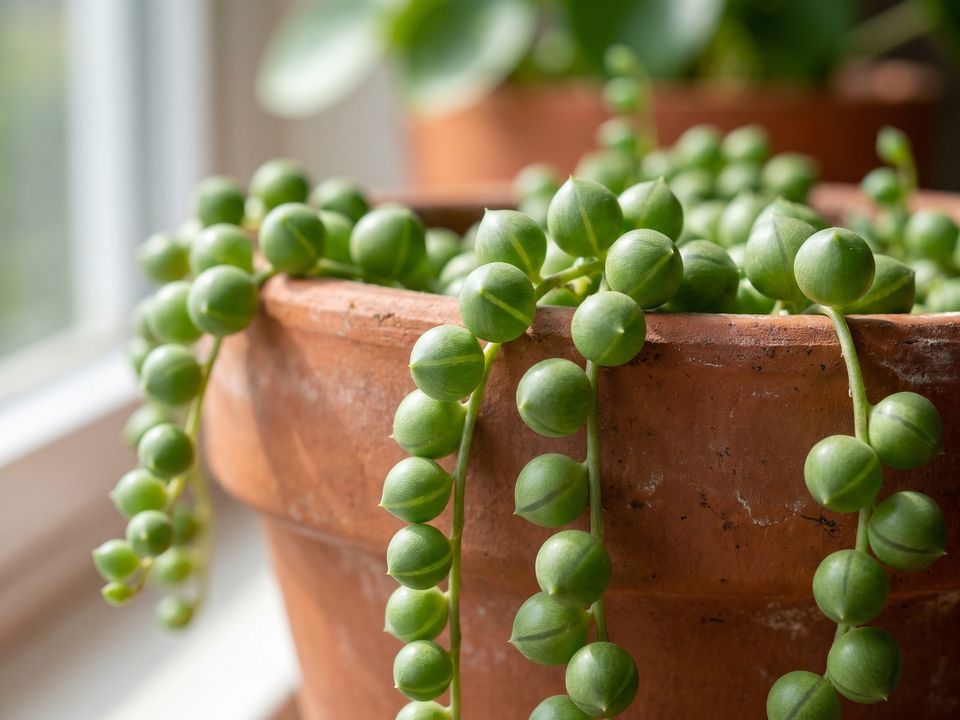
Plain green pearls, slightly glossy, soil partly hidden
Pea-sized green beads, all one plain color, string together into strands that spill over the rim. Each pearl is smooth and slightly glossy, and the strands leave some soil still showing.
Where to find me
Not yet pilferableFun fact
It’s a daisy cousin, and its white puffs, with red stamens and gold tips, smell like cinnamon. Indoors those blooms are rare, so catching one is a treat.
Designer tips
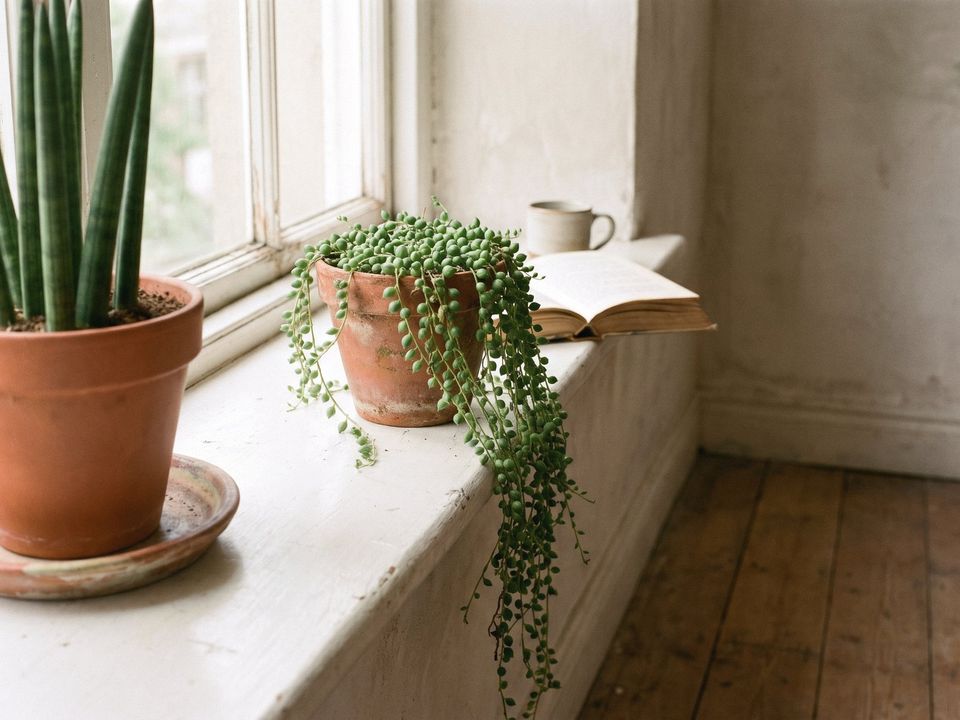
A cascade of green beads: playful, sculptural, and best seen hanging at eye level.
Troubleshooting
The pearls look shriveled
It’s thirsty: UW-Madison Extension says slightly shriveled pearls are the sign to water. A good soak usually plumps them back up.
Why are the pearls turning soft and brown?
Likely too much water, with the roots starting to rot. Snip a few healthy strand tips to root as a backup, let the pot dry right out, and water less often.
It’s thin and straggly on top
Usually not enough light: it’s sensitive to low light, so a spot by your brightest window, shielded from harsh sun, helps. Older plants thin out too, since NC State notes they tend to die back after several years; tucking cuttings into the pot fills the top.
See all 8
My cat chewed some pearls
It’s moderately toxic for cats: Pet Poison Helpline lists vomiting, drooling, and diarrhea, and in some cats tremors or slowed breathing. Call your vet or the ASPCA Animal Poison Control Center as soon as you know.
Is it safe for my dog or kids?
Mildly irritating: a dog or child who eats a few pearls may vomit or get diarrhea, which usually passes, and the sap can leave a rash on skin (NC State). If it doesn’t settle, call your vet, or Poison Control for a child.
Can it live without a window?
Not well: dim light is one of the things NC State says it won’t tolerate. It does best beside a bright window, shielded from harsh sun.
Can it go outside for the summer?
Yes, in partial shade, like a porch with morning sun, kept out of the rain so the soil can dry. Bring it back in while nights are still above 50°F, since it can’t take frost.
Does it flower?
Sometimes, in summer: small white flowers with red and yellow stamens and a cinnamon scent. It rarely happens indoors, though a cool, dry winter rest makes it more likely (UW-Madison Extension).
Propagation
Easy and quick: a strand roots wherever its nodes touch damp soil.
- Snip a few inches of strand, strip the pearls from the bottom end, and push it into damp cactus mix, or lay the whole piece flat with its nodes pressed into the mix.
- Keep it barely moist until it’s growing.
The PILF Matrix
3.6/5
how easy it is to care for
2.6/5
how much it stands out visually
“The one who clutches its pearls at anything but perfect.”


- Formerly Senecio rowleyanus
Rated 1-5, with 5 being easiest
Built from light, water, air, pests, and upkeep.
Rated 1-5, with 5 being easiest
Rated 1-5, with 5 being highest presence
Built from its scale (size, shape, growth) and its look (color and flowers, shine, fullness).
Rated 1-5, with 5 being highest presence
Where it sits and what sun touches it.
- Dim shadeA dark corner or a windowless room; natural light casts no shadow
- Bright shadeBack from the window in a south-, east- or west-facing room, or right by a north-facing one, where only low early or late summer sun reaches it
- Filtered sunBehind a sheer curtain or tinted glass; the sun’s shadows are blurred
- Partial sunIn an east- or west-facing window: up to a few hours of direct sun
- Full sunThe sunniest spot you have, usually a south-facing window, with direct sun 6+ hours a day
How often, and what the soil does between.
- MonthlyEvery 2-3 weeks in summer and 3-5 in winter; the soil dries all the way between
- 2-3× a monthEvery 7-14 days in summer, longer in winter; the top of the soil dries between
- Weekly+About every 4-8 days in summer; the soil stays lightly damp
How much room it usually takes indoors.
Size
- TinyUnder 6 inches tall or wide; for a desk or a sill
- Small6 inches to 1.5 feet tall or wide; for a shelf or a sill
- Medium1.5 to 3 feet tall or wide; for a table or a stand
- Large3 to 6 feet tall or wide; for the floor
- GiantOver 6 feet tall or wide; a statement in the corner
Shape
- TreeA trunk that branches into a canopy
- CaneBare stalks topped with leaves
- UprightStiff stems or leaves rising straight from the soil
- FountainLeaves or fronds arching out from the center
- BushyA full, rounded mound of leaves
- RosetteLeaves radiating from one low point
- ViningTrails, climbs, or both
Growth
How fast it gets there.
- SlowUnder 6 inches of new growth a year
- Moderate6-12 inches a year, mostly in spring and summer
- FastOver 12 inches a year; it may want trimming or training
What risks exist for pets and kids.
- Pet & kid safeNothing to worry about
- Mildly irritatingMay irritate the mouth or stomach if chewed, or for some plants, the skin if handled
- Moderately toxicCan cause illness if eaten, though typically not serious or fatal
- DangerousCan cause serious illness if eaten, including some reports of death
- Not yet ratedNot clearly rated by our sources; please check with your vet or doctor
For its safety ratings, PILF relies on research and guidance from leading sources, including the ASPCA, Pet Poison Helpline, Merck Veterinary Manual, Poison Control, and Children’s Hospital of Philadelphia, and others.
The small jobs beyond watering, over a year.
- Little upkeepA few small jobs a year beyond watering, like a feed now and then
- Some upkeepA small job about once a month beyond watering, like feeding or turning it
- More upkeepA small job every couple of weeks beyond watering, like a wipe, a turn, or a feed
- Most upkeepA small job most weeks beyond watering, like raising the humidity or misting
- TreeA trunk that branches into a canopy
- CaneBare stalks topped with leaves
- UprightStiff stems or leaves rising straight from the soil
- FountainLeaves or fronds arching out from the center
- BushyA full, rounded mound of leaves
- RosetteLeaves radiating from one low point
- ViningTrails, climbs, or both
How fast it gets there.
- SlowUnder 6 inches of new growth a year
- Moderate6-12 inches a year, mostly in spring and summer
- FastOver 12 inches a year; it may want trimming or training
The temperature and humidity it’s comfortable in.
How dry a room it takes.
- Needs 50%+ humidity
- Fine at 35% humidity
- Fine at 15-20% humidity
The bugs that usually find it, by name.
How often pests find it.
- 5+ regular pests
- 3 regular pests
- Pests are rare
The year’s chores: feeding, pruning, repotting, and cleaning.
Chores beyond water (what needs work means).
- Most upkeep
- Some upkeep
- Little upkeep
Its finish, fullness, and texture.
Color, pattern, and flowers.
- SimpleOne green, one texture, nothing to read
- SuaveA sheen, a stripe, or a clean shape that catches the eye up close
- ShowyColor, pattern, or blooms you see from across the room
How the leaves catch light.
- Matte
- Satin
- Glossy or waxy
How much it fills its pot.
- Soil shows
- Soil partly hidden
- Leaves hide the soil