Chinese Money Plant
Pilea peperomioides
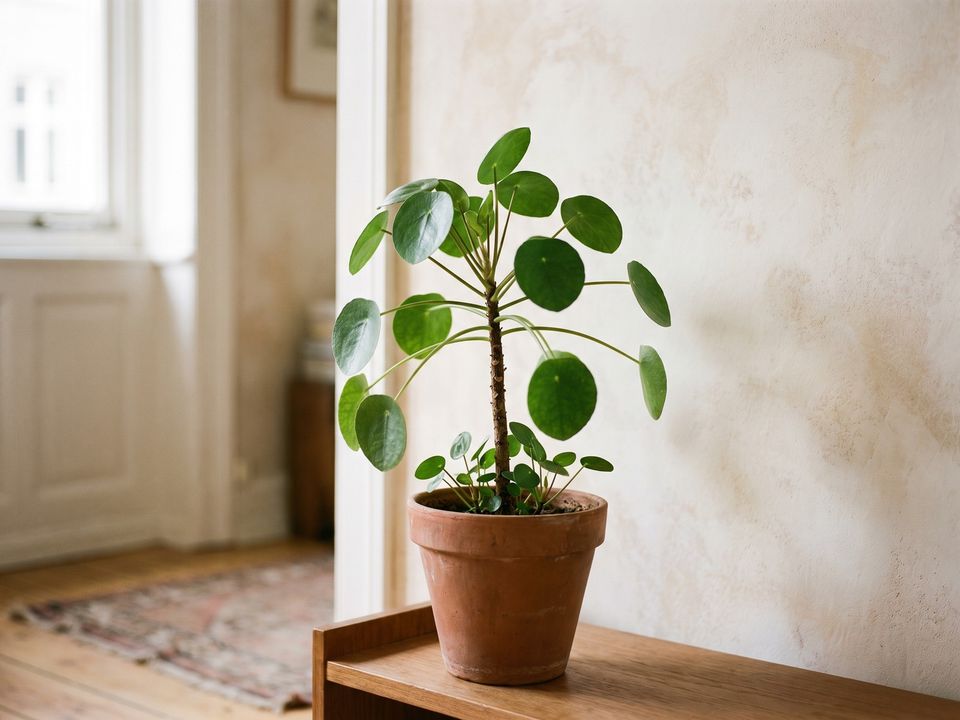
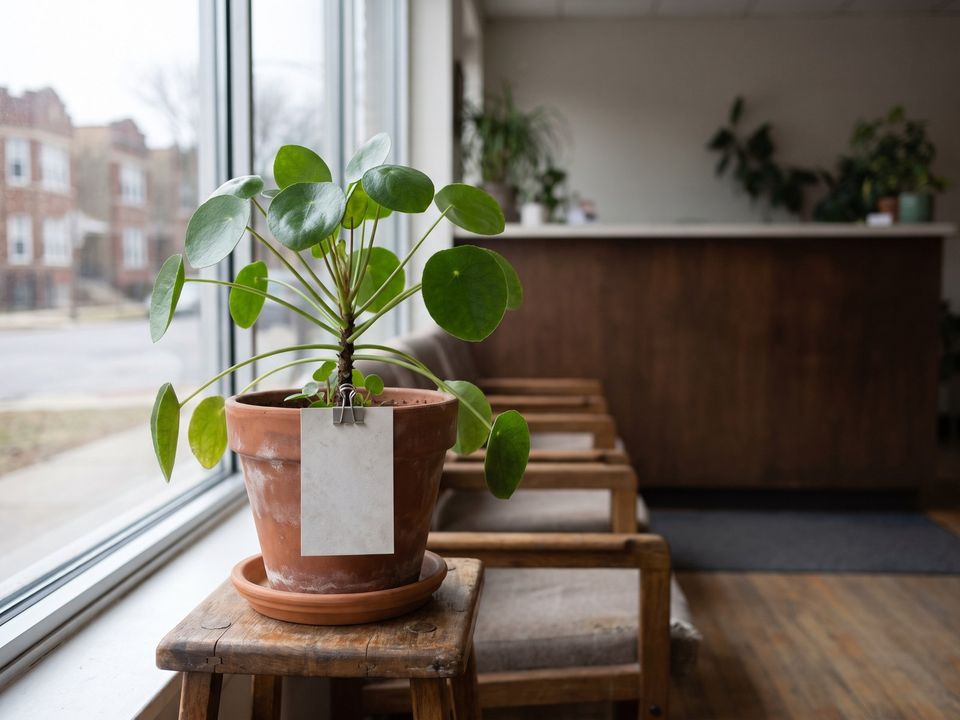
Green coins float on slender stalks around one upright stem. Quick to grow, quicker to share: pups pop up around its base.
3.1/5
how easy it is to care for
2.7/5
how much it stands out visually
: Shade to filtered
Bright but sun-shy; goes leggy in a dim room
Near a window but out of direct rays, it stays compact, its coins stacked close. Given less light, it stretches, and the pancakes space out up a leggy stem.
Its native ground is moist, shaded rock in the mountain forests of western Yunnan and southwest Sichuan, roughly 5,000-10,000 feet (1,500-3,000 m) up (Kew; University of Connecticut). Cool air and a canopy overhead: that’s the light it evolved under.
Indoors, try the sill of a north window, or a step or two in from an east or west one, and set it well back from a south window (RHS). A sheer curtain on a brighter window works as well. If its coins blush red-brown, that’s likely a sign of too much sun on its leaves (RHS). If the color bothers you, a step back from the glass lets the new leaves come in green.
Picture those mountain rocks under the trees, and give it the indoor version.
: 2-3× a month
Every 7-10 days, onto the soil and never the leaves
About every 7-10 days in summer, 10-14 in winter, poured onto the soil beneath its round leaves rather than over them. Kept soggy, its roots can rot.
NC State warns that wet foliage can lead to leaf spots, and a parasol of flat-held coins can cradle droplets where a drooping leaf would shed them. A spout slipped under the canopy beats a sprinkle from above.
It also minds a blast of hot or cold: come January, keep it off the radiator shelf and away from a leaky window, since NC State advises sparing it both heat sources and drafts.
Gone for a while? Ten days is fine if it’s watered the day you leave.
: Small
A fast-growing clump of coins, 8-12 inches tall and wide
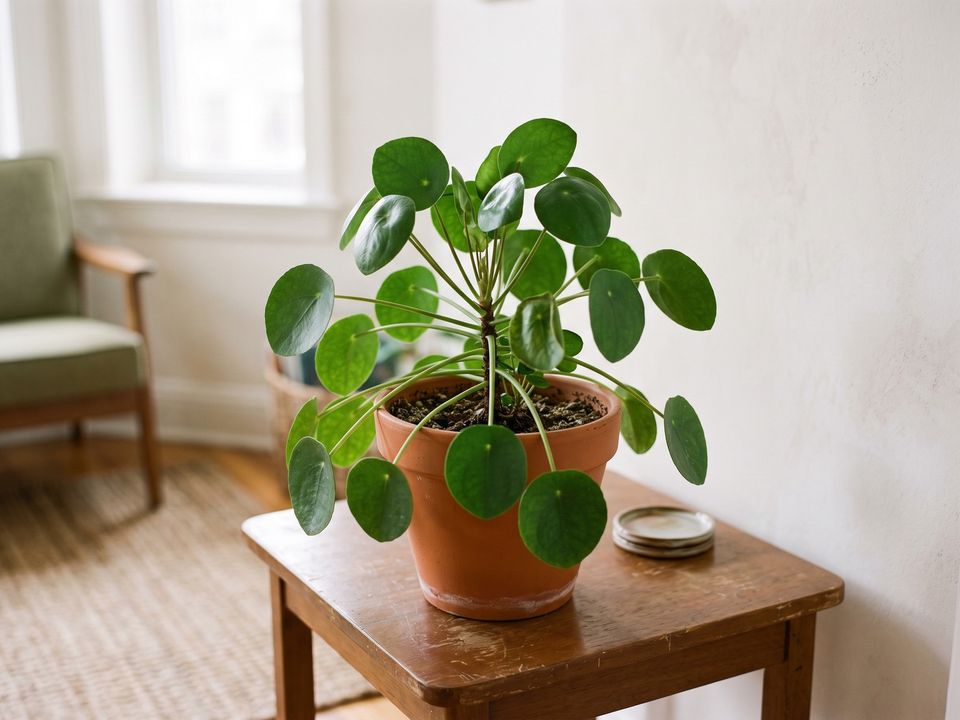
One fast-growing upright stem stacked with round, 4-inch leaves, 8-12 inches tall and as wide. Made for a desk, sill, or bookshelf; pups pop up around the base, so leave them for a fuller pot or lift them out to share.
Its babies come two ways. Some sprout from the main stem; others push up through the soil a few inches away, still tied to the mother by a cord-like root underground (UC Master Gardeners). Once a pup reaches 2-3 inches, cut it free and give it its own pot. Spring and early summer, when it’s growing hardest, is the best time (NC State).
With age, the single stem firms up and can darken from green to brown (UC Master Gardeners).
Set it where light catches the coins from the side, on a desk corner or the end of a shelf, and each leaf seems to hover on its stalk. A row of pups in matching small pots dresses a sill nicely.
: Pet & kid safe
Nothing to worry about for dogs, cats, or kids
- DogsSafe
- CatsSafe
- KidsSafe
NC State lists it as safe for pets and children. The ASPCA doesn’t name it, but rates five of its Pilea cousins non-toxic to dogs and cats, aluminum plant among them.
It’s a member of the nettle family, yet its leaves are smooth and hairless (NC State), with none of the stinging hairs that give nettles their reputation. With NC State rating it safe for children and pets, a toddler who grabs a coin or a dog who mouths a stem is unlikely to come to harm.
If your cat treats the swaying coins as toys, the plant is the one likely to come off worse. A high shelf keeps its round leaves whole.
- ASPCA, on the related aluminum plant: safe for dogs.
- ASPCA, on the related aluminum plant: safe for cats.
- NC State Extension: safe for kids.
Cats and dogs: Most of the leading sources agree.
Kids: No poison-centre listing; rated from university extension sources.
: Dry OK
60-75°F; average humidity is fine
Happiest at 60-75°F, and it shouldn’t sit below 50°F. Humidity can drop to 25% without trouble.
- Temperature
- 60-75°F
: Spider mites
Spider mites, mealybugs: check leaf undersides
Spider mites and mealybugs find it most often. Flip the leaves to check the undersides, and look at the stalk bases and stem crown. Scale, fungus gnats, and thrips are occasional: check stems, new leaves, and the topsoil.
- Spider mites
- Mealybugs
- Scale insects
- Fungus gnats
- Thrips
Not many. Mealybugs, scale, spider mites, and fungus gnats turn up now and then, and root rot if the soil stays soggy.
Mealybugs look like tufts of white cotton on the stems and under the leaves; scale looks like small brown bumps stuck to the stalks. Wipe them off with a cotton swab dipped in rubbing alcohol (a fingernail lifts scale), then check again next week.
Spider mites leave fine webbing and a dusty, speckled look, mostly in warm, dry air. Rinse the whole plant in the shower, undersides of the leaves included; if they come back, an insecticidal soap spray is the next step.
Fungus gnats are tiny black flies that hover around the pot; their larvae live in damp soil, so let it dry a little more between soaks. Keep water off the leaves too: wet leaves can get leaf spot.
: Most
Quarter-turn weekly; feed monthly in spring-summer
Quarter-turn it every week for even growth. Feed monthly in spring and summer at half strength, and remove dead leaves 4 times a year. Each spring, check the roots and repot about every 2 years; lift pups out to share.
- Feed6× a year
- Repot1× a year
- Divide1× a year
- Clean leaves4× a year
- Rotate26× a year
Any houseplant potting mix that drains fast, in a pot with a drainage hole, only a little bigger than the roots: a roomy pot holds water it can’t use.
It grows fast, so repot every couple of years, in spring, one pot size up. That’s also the time to pull off pups for their own pots (see Propagation).
A balanced houseplant fertilizer every month or two from April to September keeps the leaves green; pale, yellowing leaves are often its way of asking for it.
: Simple
Round green coins on slender stalks, lightly glossy
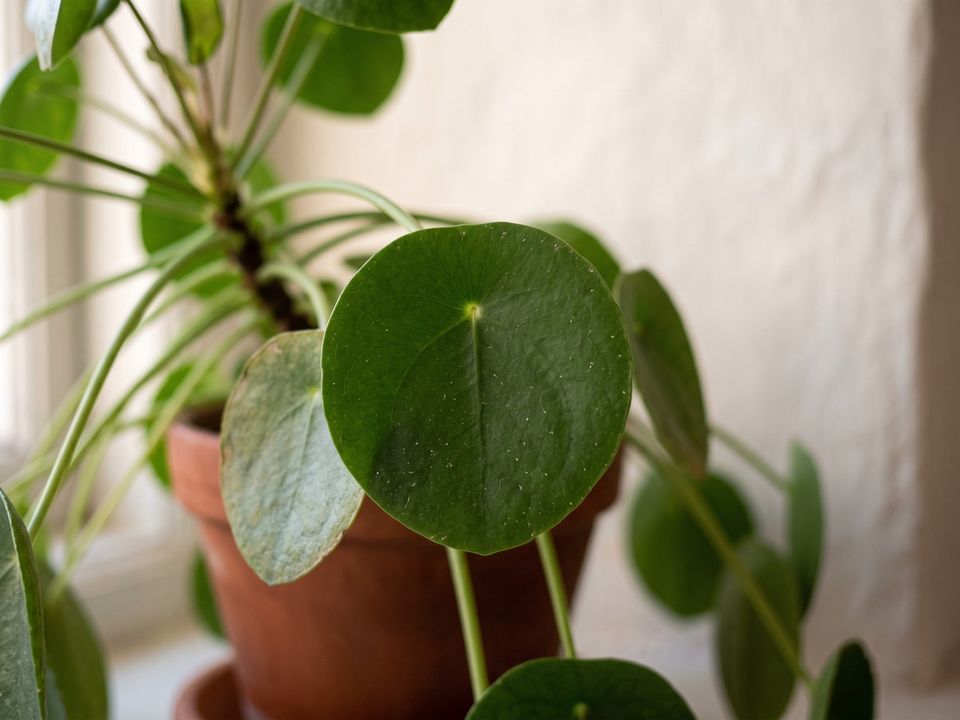
Round, coin-shaped leaves in one plain green float on slender stalks around a single upright stem. Their surface has a gentle gloss, and the soil still peeks out between them.
Where to find me
Not yet pilferableFun fact
A Norwegian missionary carried cuttings home by way of India in 1946. Gardeners passed them hand to hand across Scandinavia for decades, and it’s often called the friendship plant.
Designer tips
Playful and graphic, its round coins on long stalks read as mid-century modern.
Troubleshooting
It’s leaning toward the window
It’s reaching for the light. A quarter turn of the pot each time you water usually straightens it over a few weeks.
Why are the leaves drooping?
Usually thirst, and a good soak likely stands the stalks back up within a day. If the soil is wet and it still droops, the roots may be rotting: let it dry out, empty the saucer, and water less often.
Why are the leaves curling or cupping?
Something’s off with water or light: soil left bone dry or kept soggy can both do it, so a soak every 7-10 days with the saucer emptied is the reset. If watering’s been steady, it likely wants a little more light, closer to the window.
See all 8
The leaves are turning pale and yellow
Usually hunger: the RHS says yellowing pileas often need feeding, so a half-strength feed monthly in spring and summer helps. One old leaf at the bottom yellowing now and then is normal.
Little plants are coming up in the pot
Those are its pups, and a sign it’s happy. Leave them for a fuller pot, or once one reaches 2-3 inches, cut it free with a bit of root and give it its own pot.
Why is it tall and gangly, with small leaves?
Not enough light. A spot closer to a window helps, and if the bare stem bothers you, cut the top off in spring or summer: it roots in water in 3-6 weeks, and the stump sends out new growth.
Why are there brown or reddish patches on the leaves?
A red-brown flush likely means sun on the leaves, and a step back from the glass lets new ones come in green. Small brown spots can be leaf spot from water sitting on the leaves, so pour at the soil instead.
Is it safe for my cat or dog?
Yes: NC State lists it as safe for pets and children, and the ASPCA rates five of its Pilea cousins non-toxic, aluminum plant among them. Eating any plant can upset a stomach, so a big nibble might mean a little vomiting.
Propagation
One of the easiest plants to share: it makes its own.
- Pups come up from the roots around the base.
- Once one has a few leaves of its own, dig down beside it, cut it free with a bit of root, and pot it up in damp mix.
The cut-off top of a tall plant roots in a glass of water or damp mix in 3-6 weeks. Even a single leaf with its stalk will root. Spring and early summer are the best time.
The PILF Matrix
3.1/5
how easy it is to care for
2.7/5
how much it stands out visually
“The one that proves money does grow on ~~trees~~ plants.”


- UFO plant
- missionary plant
- pilea
Rated 1-5, with 5 being easiest
Built from light, water, air, pests, and upkeep.
Rated 1-5, with 5 being easiest
Rated 1-5, with 5 being highest presence
Built from its scale (size, shape, growth) and its look (color and flowers, shine, fullness).
Rated 1-5, with 5 being highest presence
Where it sits and what sun touches it.
- Dim shadeA dark corner or a windowless room; natural light casts no shadow
- Bright shadeBack from the window in a south-, east- or west-facing room, or right by a north-facing one, where only low early or late summer sun reaches it
- Filtered sunBehind a sheer curtain or tinted glass; the sun’s shadows are blurred
- Partial sunIn an east- or west-facing window: up to a few hours of direct sun
- Full sunThe sunniest spot you have, usually a south-facing window, with direct sun 6+ hours a day
How often, and what the soil does between.
- MonthlyEvery 2-3 weeks in summer and 3-5 in winter; the soil dries all the way between
- 2-3× a monthEvery 7-14 days in summer, longer in winter; the top of the soil dries between
- Weekly+About every 4-8 days in summer; the soil stays lightly damp
How much room it usually takes indoors.
Size
- TinyUnder 6 inches tall or wide; for a desk or a sill
- Small6 inches to 1.5 feet tall or wide; for a shelf or a sill
- Medium1.5 to 3 feet tall or wide; for a table or a stand
- Large3 to 6 feet tall or wide; for the floor
- GiantOver 6 feet tall or wide; a statement in the corner
Shape
- TreeA trunk that branches into a canopy
- CaneBare stalks topped with leaves
- UprightStiff stems or leaves rising straight from the soil
- FountainLeaves or fronds arching out from the center
- BushyA full, rounded mound of leaves
- RosetteLeaves radiating from one low point
- ViningTrails, climbs, or both
Growth
How fast it gets there.
- SlowUnder 6 inches of new growth a year
- Moderate6-12 inches a year, mostly in spring and summer
- FastOver 12 inches a year; it may want trimming or training
What risks exist for pets and kids.
- Pet & kid safeNothing to worry about
- Mildly irritatingMay irritate the mouth or stomach if chewed, or for some plants, the skin if handled
- Moderately toxicCan cause illness if eaten, though typically not serious or fatal
- DangerousCan cause serious illness if eaten, including some reports of death
- Not yet ratedNot clearly rated by our sources; please check with your vet or doctor
For its safety ratings, PILF relies on research and guidance from leading sources, including the ASPCA, Pet Poison Helpline, Merck Veterinary Manual, Poison Control, and Children’s Hospital of Philadelphia, and others.
The small jobs beyond watering, over a year.
- Little upkeepA few small jobs a year beyond watering, like a feed now and then
- Some upkeepA small job about once a month beyond watering, like feeding or turning it
- More upkeepA small job every couple of weeks beyond watering, like a wipe, a turn, or a feed
- Most upkeepA small job most weeks beyond watering, like raising the humidity or misting
- TreeA trunk that branches into a canopy
- CaneBare stalks topped with leaves
- UprightStiff stems or leaves rising straight from the soil
- FountainLeaves or fronds arching out from the center
- BushyA full, rounded mound of leaves
- RosetteLeaves radiating from one low point
- ViningTrails, climbs, or both
How fast it gets there.
- SlowUnder 6 inches of new growth a year
- Moderate6-12 inches a year, mostly in spring and summer
- FastOver 12 inches a year; it may want trimming or training
The temperature and humidity it’s comfortable in.
How dry a room it takes.
- Needs 50%+ humidity
- Fine at 35% humidity
- Fine at 15-20% humidity
The bugs that usually find it, by name.
How often pests find it.
- 5+ regular pests
- 3 regular pests
- Pests are rare
The year’s chores: feeding, pruning, repotting, and cleaning.
Chores beyond water (what needs work means).
- Most upkeep
- Some upkeep
- Little upkeep
Its finish, fullness, and texture.
Color, pattern, and flowers.
- SimpleOne green, one texture, nothing to read
- SuaveA sheen, a stripe, or a clean shape that catches the eye up close
- ShowyColor, pattern, or blooms you see from across the room
How the leaves catch light.
- Matte
- Satin
- Glossy or waxy
How much it fills its pot.
- Soil shows
- Soil partly hidden
- Leaves hide the soil