Coffee Plant
Coffea arabica
Also called arabica coffee
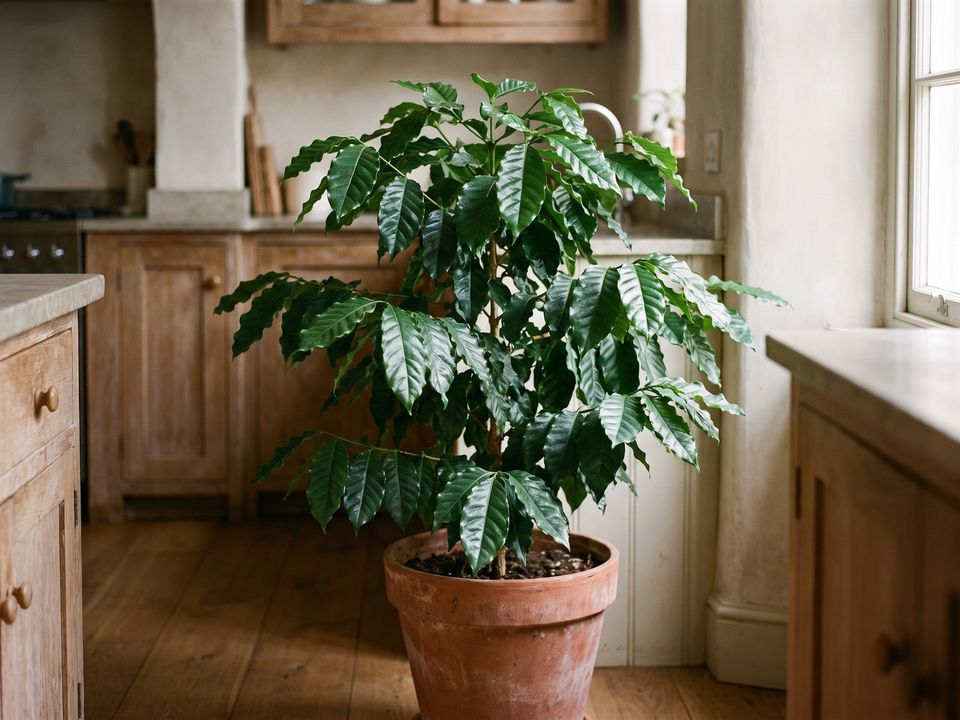
Glossy, rippled leaves on a little tree that may one day bloom and set red cherries. Wants bright light and humid air.
2.0/5
how easy it is to care for
3.6/5
how much it stands out visually
: Shade to filtered
Near a bright window; dimmer light means no blooms
Flowers are what bright light buys: close to a window, with a sheer where the sun is strong, it may bloom in time. Set it farther back and it gets by, likely without a single flower.
On farms it’s usually grown as an understory crop, in the shade of taller trees (UC Agriculture and Natural Resources). On the windowsill, sources split. Missouri Botanical Garden says indoor plants like bright, sunny windows, while UC ANR would keep it near a window but out of direct sun.
Both can be right: an east window suits it, and a south or west one works behind a sheer curtain drawn through summer afternoons. NC State notes its leaves may drop below 55°F, so keep it away from cold glass in winter.
Set outside for the summer, it wants that farm canopy back: NC State and Missouri Botanical Garden both say it prefers partial or light shade outdoors, so a covered porch suits it better than an open deck.
: Weekly+
Keep it evenly damp, never soggy or bone-dry
Every 5-7 days in summer and 7-10 in winter, for soil that stays moist but never soggy. UC ANR finds it sensitive both ways: it may wilt if it dries out, and soil that stays wet can rot its roots.
Coffee wants damp air as much as damp soil: NC State lists high humidity alongside bright light as what it needs indoors, and UC ANR describes a plant that likes humid air. A heated Chicago apartment in January runs far drier than that, so a room humidifier or a bright bathroom gets it closer.
Its soil can lean acidic, and NC State says it does best in a mix heavy with organic material; Missouri Botanical Garden adds that the mix should drain fast.
Gone for a while? A week is fine if it’s watered well the day you leave. Much longer and it wilts and drops leaves, so ask someone to water it.
: Large
An upright little tree, growing steadily up to 6 feet
Glossy leaves line upright branches, up to about 6 feet indoors. Farms prune it to about 6 feet for hand-picking, and the same shears hold yours at any height you like.
Outdoors in warm climates it grows into a tree of 10-15 feet (Missouri Botanical Garden), and the RHS gives up to 4-8 meters. The one on your floor is that same tree, on a much shorter leash.
Age shows in the wood: older branches and the trunk turn dark gray and fissured (NC State), so a plant bought as a glossy sprout grows into real bark.
Those dark leaves read best against a pale wall, where their shine carries across the room.
: Mildly irritating
Chewing can upset the stomachs of dogs, cats, or kids
- DogsMildly irritating
- CatsMildly irritating
- KidsMildly irritating
Its leaves carry caffeine, so a pet or child who chews one may vomit or get diarrhea, and a pet may pant or turn restless. It usually passes with watching at home.
Its leaves carry caffeine, which can affect the heart and nerves in large amounts; no pet poison database lists the coffee plant itself.
Caffeine belongs to the methylxanthines, the same family behind chocolate’s reputation with pets (ASPCA). Dogs and cats seem more sensitive to it than people are, and the warnings center on concentrated sources like unused grounds and whole beans (Pet Poison Helpline).
If a pet does react, signs usually show within 1-2 hours (Pet Poison Helpline). If symptoms don’t settle, or anything worries you, call your vet or the ASPCA Animal Poison Control Center (a fee may apply). For a child, Poison Control can help.
If your dog eats whatever hits the floor, pick up fallen leaves and berries and give the pot a stand it can’t reach. With a cat, a room you can close off works too.
- UC ANR: mild for kids.
Cats and dogs: No vet database lists it; rated from university extension sources. Signs beyond a stomach upset are reported only in large amounts, rarely or from one part of the plant, so they don’t raise the rating.
Kids: No poison-centre listing; rated from university extension sources.
: Average
Likes humid air, 50-70%; off cold glass in winter
Happiest at 60-80°F, and it shouldn’t sit below 55°F. Keep it away from cold glass in winter. It likes 50-70% humidity and gets by at 40%.
- Temperature
- 60-80°F
- Humidity
- 50-70%
: Scale
Scale, mites, mealybugs; check leaf undersides
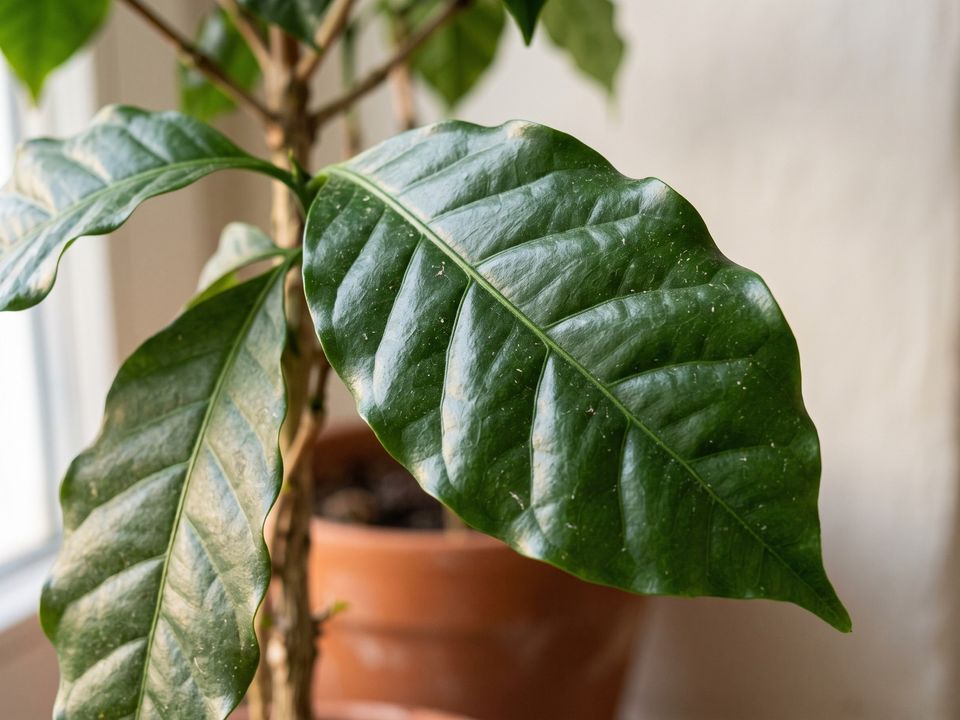
Scale, spider mites, and mealybugs all find it: look along stems and leaf veins, under the leaves, and where leaves join the stem. Thrips sometimes visit new growth. Mites favor dry air, so look closely in winter.
- Scale
- Spider mites
- Mealybugs
- Thrips
Scale, mealybugs, and mites are its usual pests (per NC State Extension and UF/IFAS), with thrips now and then, and root rot if the soil stays soggy.
Scale looks like small brown bumps stuck to the stems and leaves; mealybugs look like tufts of white cotton where the leaves join. Wipe them off with a cotton swab dipped in rubbing alcohol (a fingernail lifts scale), then check again next week.
Spider mites leave fine webbing and a dusty, speckled look, and like dry winter air. Thrips leave leaves silvery and streaked. Rinse the whole plant in the shower, undersides included, and try insecticidal soap if either comes back.
Root rot shows as wilting, yellowing leaves while the soil is still wet, and brown, soft roots. Empty the saucer, water a little less, and check that the pot drains.
: More
Feed every 2 weeks in summer; quarter turn monthly
Feed every two weeks in spring and summer, and give it a quarter turn toward the window each month. Wipe the leaves twice a year, prune once in spring to hold its size, and repot every 2-3 years.
- Feed13× a year
- Prune1× a year
- Clean leaves2× a year
- Rotate12× a year
A rich potting mix that holds moisture but drains fast, in a pot with a drainage hole.
Repot when the roots fill the pot, in spring, one size up. Salts from tap water and fertilizer build up as a white crust on the soil (per Clemson Extension); fresh mix at repotting clears them.
Food helps: a balanced houseplant fertilizer through spring and summer, at the strength on the label. Too much builds up salts that brown the leaf edges.
: Simple
Glossy, rippled green leaves, full to the soil
Each leaf is one plain deep green, waxy and glossy, with a gentle ripple across its surface. They line the branches closely enough to hide the soil, like a small tree in full dress.
Where to find me
Not yet pilferableFun fact
After 3-4 years, it may bloom with jasmine-scented white stars that pollinate themselves. The cherries take 9-11 months to ripen red, and each holds two beans.
Designer tips
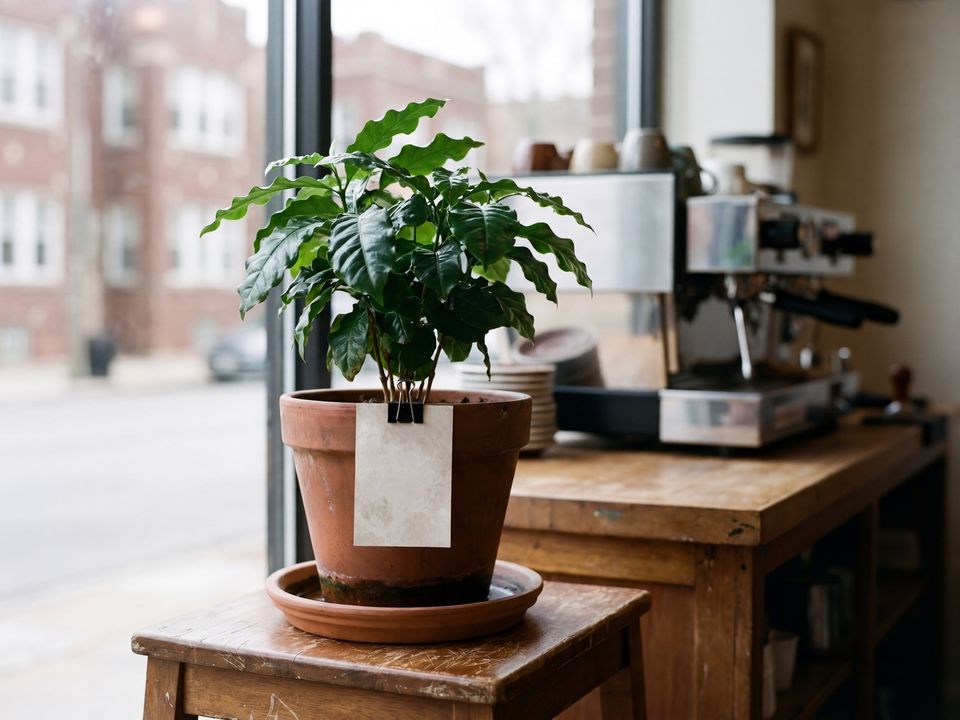
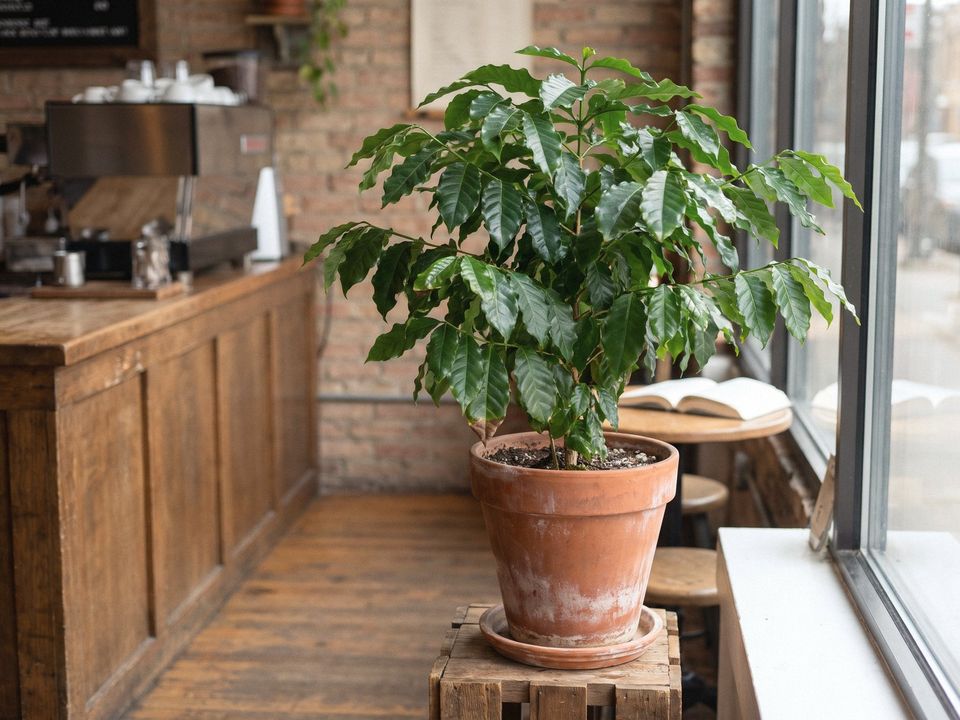
Glossy, dark, and full, it looks at home in a kitchen or a café, and it comes with a story: flowers, then berries.
Troubleshooting
The leaf edges are brown and crispy
Usually dry air, though Clemson Extension also names uneven watering, pests and salt buildup. A humidifier nearby in winter, evenly moist soil, and a good flush of water through the pot now and then all help; the brown bits stay brown, so trim them if they bother you.
It’s dropping leaves
Likely cold, a move, or a dry spell. NC State Extension says it can drop leaves below 55°F, so check for a cold window or a draft, and a new spot can bring a few weeks of leaf drop (Clemson Extension). With evenly moist soil, new leaves usually follow.
Why is it wilting?
Thirst or soggy roots. If it’s been a week or more since its last drink, it’s likely thirsty, and a good soak usually stands it back up. If you watered lately and the soil’s still wet, the roots may be rotting, so empty the saucer and let it dry a little first.
See all 9
Why are the leaves pale or yellow?
Too little light, too little food or pests, per Clemson Extension. A spot closer to a window and a feed through spring and summer help, and a look under the leaves rules out scale and mites.
Black spots on the leaves
Most likely too much water: coffee tends to get black leaf spots when its soil stays wet. Give it a little longer between soaks and empty the saucer.
My dog chewed a leaf
It’s mildly irritating: the caffeine in its leaves may bring vomiting or diarrhea, and a dog may pant or turn restless, with signs usually showing within 1-2 hours (Pet Poison Helpline). If they don’t settle, call your vet or the ASPCA Animal Poison Control Center.
When will it flower?
Usually at three or four years old (NC State Extension), and only with good light. The small, star-shaped white flowers smell like jasmine and open in clusters where the leaves meet the stem.
Can I make coffee from it?
In principle, yes. Arabica flowers pollinate themselves (UF/IFAS), so one plant can set fruit, and each berry turns from green to red around two seeds that become beans once processed and roasted. Expect a novelty cup, not a pantry supply.
Can it go outside for the summer?
Yes, in shade: NC State Extension says it can summer outdoors and prefers partial or light shade there, so a covered porch suits it better than an open deck. Bring it in before nights drop below 60°F, and check it for bugs first.
Propagation
Not easily. Growers start coffee from fresh seed, and stem cuttings need rooting hormone and careful conditions (per UF/IFAS), so most people just grow the one they have.
If yours fruits, the seeds inside the ripe red berries can be sown fresh.
The PILF Matrix
2.0/5
how easy it is to care for
3.6/5
how much it stands out visually
“The one that was single-origin before it was cool.”


Rated 1-5, with 5 being easiest
Built from light, water, air, pests, and upkeep.
Rated 1-5, with 5 being easiest
Rated 1-5, with 5 being highest presence
Built from its scale (size, shape, growth) and its look (color and flowers, shine, fullness).
Rated 1-5, with 5 being highest presence
Where it sits and what sun touches it.
- Dim shadeA dark corner or a windowless room; natural light casts no shadow
- Bright shadeBack from the window in a south-, east- or west-facing room, or right by a north-facing one, where only low early or late summer sun reaches it
- Filtered sunBehind a sheer curtain or tinted glass; the sun’s shadows are blurred
- Partial sunIn an east- or west-facing window: up to a few hours of direct sun
- Full sunThe sunniest spot you have, usually a south-facing window, with direct sun 6+ hours a day
How often, and what the soil does between.
- MonthlyEvery 2-3 weeks in summer and 3-5 in winter; the soil dries all the way between
- 2-3× a monthEvery 7-14 days in summer, longer in winter; the top of the soil dries between
- Weekly+About every 4-8 days in summer; the soil stays lightly damp
How much room it usually takes indoors.
Size
- TinyUnder 6 inches tall or wide; for a desk or a sill
- Small6 inches to 1.5 feet tall or wide; for a shelf or a sill
- Medium1.5 to 3 feet tall or wide; for a table or a stand
- Large3 to 6 feet tall or wide; for the floor
- GiantOver 6 feet tall or wide; a statement in the corner
Shape
- TreeA trunk that branches into a canopy
- CaneBare stalks topped with leaves
- UprightStiff stems or leaves rising straight from the soil
- FountainLeaves or fronds arching out from the center
- BushyA full, rounded mound of leaves
- RosetteLeaves radiating from one low point
- ViningTrails, climbs, or both
Growth
How fast it gets there.
- SlowUnder 6 inches of new growth a year
- Moderate6-12 inches a year, mostly in spring and summer
- FastOver 12 inches a year; it may want trimming or training
What risks exist for pets and kids.
- Pet & kid safeNothing to worry about
- Mildly irritatingMay irritate the mouth or stomach if chewed, or for some plants, the skin if handled
- Moderately toxicCan cause illness if eaten, though typically not serious or fatal
- DangerousCan cause serious illness if eaten, including some reports of death
- Not yet ratedNot clearly rated by our sources; please check with your vet or doctor
For its safety ratings, PILF relies on research and guidance from leading sources, including the ASPCA, Pet Poison Helpline, Merck Veterinary Manual, Poison Control, and Children’s Hospital of Philadelphia, and others.
The small jobs beyond watering, over a year.
- Little upkeepA few small jobs a year beyond watering, like a feed now and then
- Some upkeepA small job about once a month beyond watering, like feeding or turning it
- More upkeepA small job every couple of weeks beyond watering, like a wipe, a turn, or a feed
- Most upkeepA small job most weeks beyond watering, like raising the humidity or misting
- TreeA trunk that branches into a canopy
- CaneBare stalks topped with leaves
- UprightStiff stems or leaves rising straight from the soil
- FountainLeaves or fronds arching out from the center
- BushyA full, rounded mound of leaves
- RosetteLeaves radiating from one low point
- ViningTrails, climbs, or both
How fast it gets there.
- SlowUnder 6 inches of new growth a year
- Moderate6-12 inches a year, mostly in spring and summer
- FastOver 12 inches a year; it may want trimming or training
The temperature and humidity it’s comfortable in.
How dry a room it takes.
- Needs 50%+ humidity
- Fine at 35% humidity
- Fine at 15-20% humidity
The bugs that usually find it, by name.
How often pests find it.
- 5+ regular pests
- 3 regular pests
- Pests are rare
The year’s chores: feeding, pruning, repotting, and cleaning.
Chores beyond water (what needs work means).
- Most upkeep
- Some upkeep
- Little upkeep
Its finish, fullness, and texture.
Color, pattern, and flowers.
- SimpleOne green, one texture, nothing to read
- SuaveA sheen, a stripe, or a clean shape that catches the eye up close
- ShowyColor, pattern, or blooms you see from across the room
How the leaves catch light.
- Matte
- Satin
- Glossy or waxy
How much it fills its pot.
- Soil shows
- Soil partly hidden
- Leaves hide the soil