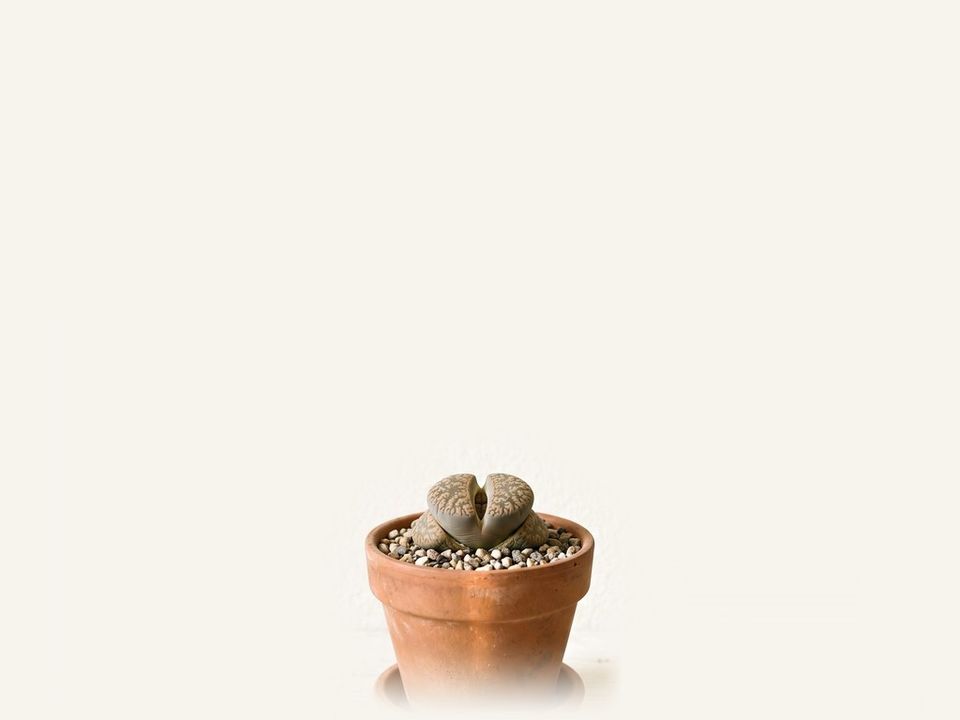
Living Stones
Lithops spp.
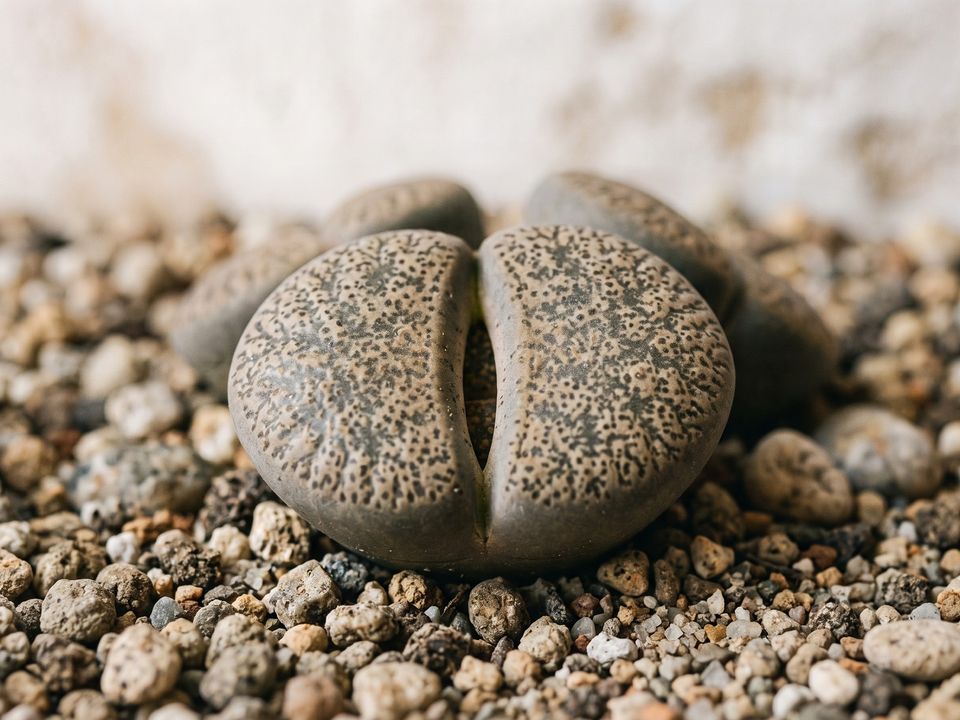
A pair of plump, fused leaves, speckled like a pebble. Known for growing a new pair inside the old each year, and for being easy to overwater.
2.7/5
how easy it is to care for
1.8/5
how much it stands out visually
: Part sun
4-5 hours of morning sun; a south or east window
Morning sun does it: 4-5 hours of direct sun before lunch, then shade, from a south window or an open east one. Short of light it stretches, leans, and greens; a move into stronger sun goes best a little at a time.
Without enough sun it grows tall and thin, leans toward the glass, turns greenish and eventually dies (UW–Madison Extension). No other spot in the house will do.
Moving it into stronger sun? Do it gradually. UW–Madison warns a sudden move can sunburn it badly enough to kill it.
: Monthly
Every 10-16 days while growing; dry through winter
A soak every 10-16 days in late spring and from late summer into fall, the mix drying fully between. Winter and early spring go dry while a new pair grows inside the old, and midsummer gets little.
When you do water, drench it, let it drain, and let the soil dry out completely, which takes 14-30 days in a sunny window. It also rests in midsummer, so water very little then. The dry spell matters: watered too soon, the old leaves keep growing and the plant develops badly (UW–Madison). Start again once the old pair has shrunk to a papery husk, and if in doubt, don’t.
Gone for a while? Six weeks is fine, and far longer in winter, when it wants no water at all.
: Tiny
One fused pair, 0.5-1 inch tall and 1-3 inches wide
A single fused pair of leaves, 0.5-1 inch tall and 1-3 inches wide, replaced each year by a new pair grown inside it. Growth is slow, though an older plant can clump into several heads.
Growth is slow, and an older plant can form a small clump of several heads over the years. There’s nothing to prune; leave the dry husk of the old leaves to fall away on its own.
: Pet & kid safe
Nothing harmful for dogs, cats, or kids
- DogsSafe
- CatsSafe
- KidsSafe
Nothing harmful here for dogs, cats, or kids: the ASPCA lists living stones as non-toxic to both pets, and they’re on the University of California’s safe-plant list. A curious cat may still bat one out of its pot.
Kids too: it’s on the University of California’s safe-plant list, and UW–Madison calls it non-toxic to people and pets. The ASPCA notes that eating any plant can upset a pet’s stomach, and a curious cat can bat one clean out of its pot, so a sill it can’t reach helps.
- ASPCA: safe for dogs (rates the whole genus).
- ASPCA: safe for cats (rates the whole genus).
- hort.extension.wisc.edu: safe for kids.
Cats and dogs: The ASPCA lists it as non-toxic.
Kids: No poison-centre listing; rated from university extension sources.
: Dry OK
Happiest from the mid 60s up; keep it off frosty glass
It takes 40-80°F, happiest from the mid 60s up, and handles heat well where the air moves. Dry air down to 10% suits it; on a winter sill, keep it off frosty glass.
- Temperature
- 40-80°F
- Humidity
- 10%+
: Mealybugs
Bugs are rare; mealybugs may hide in the slit
Bugs are rare, and mealybugs are the likeliest: white cotton tucked into the slit or around the base. Spider mites and thrips can leave a dull, speckled look.
- Mealybugs
Water is the real enemy; bugs are rare. NC State lists the usual sap-suckers, but UW–Madison calls overwatering the chief cause of an early death.
Rot shows as a body going yellow, soft, and mushy, sometimes with brown spots or splitting (NC State). Let the pot dry right out and water far less; a body that has turned to mush won’t firm up again.
Mealybugs look like white cotton in the slit or around the base; lift them out with a cotton swab dipped in rubbing alcohol. Spider mites and thrips leave a dull, speckled look: rinse it gently, let it dry in the sun, and use insecticidal soap if they come back.
: Little
Dry rests twice a year; repot every 10-20 years
The real work is timing: a dry rest from winter into spring and another in midsummer, and the old pair cleared away once it’s a papery husk. A repot can wait 10-20 years, and food is barely needed.
- Seasonal dry-rest routine (stop water summer and winter)2× a year
- Remove spent outer leaf husks1× a year
- Repotevery 10 years
Cactus mix, or potting mix with plenty of sand, perlite or grit stirred in, in a pot with a drainage hole. Give the roots depth: UW–Madison suggests a pot 3 to 5 inches deep, and small clay pots are the classic (Arkansas Extension).
Set it with the top of the plant just above the soil; a layer of gravel around it looks natural and keeps the body dry. Repot rarely, only when it’s crowding its pot: UW–Madison says one can stay in the same pot for 10 or 20 years.
Barely any: UW–Madison says feed sparingly, with a low-nitrogen, high-potassium fertilizer (a cactus food), and only while it’s growing.
: Suave
Speckled like a pebble, with a slit across the top
Two plump, fused leaves, satin and speckled like a pebble, meet at a slit across the top, with soil showing around them. It passes for a stone until you look twice, and in fall a daisy-like flower may open from the slit.
Where to find me
Not at PILF places
Fun fact
Each year a new leaf pair grows inside the old one, turned 90°, and soaks up the old pair until it is a papery husk.
Designer tips
A tiny, strange sculpture for a sunny sill; it passes for a pebble until you look twice.
Troubleshooting
It’s shriveling and wrinkling
In winter or spring, with a new pair showing in the slit, that’s normal: the new leaves are drawing on the old ones (UW-Madison). Hold off on water until the old pair is a papery husk. Outside that season, wrinkling likely means thirst, and a soak helps.
Why is it soft and yellow?
Likely too much water: NC State lists a yellow, mushy body as the sign. Let the pot dry right out and water far less often; a head that has gone fully to mush usually doesn’t firm up again.
How do I know when to water it?
Go by the season first. In late spring and from late summer into fall, a soak every 10-16 days suits it, with the mix drying all the way and a few more dry days after; winter and early spring go without.
See all 8
It’s growing tall, pale, and leaning
Not enough sun: UW-Madison says it stretches, leans, and turns greenish without it. Move it to your sunniest window a little at a time, since a sudden jump into strong sun can scorch it.
Why did the leaves split, or grow a second pair on top?
Likely water at the wrong time. NC State lists splitting as a sign of overwatering, and UW-Madison says watering while the new pair forms keeps the old pair growing. Hold off until the old leaves have shrunk to a husk.
I’m away for six weeks
That suits it: six weeks is fine, and far longer in winter, when it wants no water at all.
When does it flower?
In fall or early winter, if it’s had enough sun. A daisy-like yellow, pale orange, or white flower pushes out of the slit, often as big as the plant, and opens on sunny afternoons (UW-Madison).
My cat took a bite
Nothing harmful there: the ASPCA lists living stones as non-toxic to cats and dogs. Any plant can upset a pet’s stomach a little, and a sill out of paw’s reach keeps it from being batted out of its pot.
Propagation
Not really practical at home. Division only works on an older plant with several heads: lift it, cut carefully through the roots between them, and replant each one right away (UW–Madison).
From seed it’s a long game: seedlings come up in a few weeks, but UW–Madison says they take three to four years to flower.
The PILF Matrix
2.7/5
how easy it is to care for
1.8/5
how much it stands out visually
“The ones you’ll love to death with a watering can.”

EASE
2.4/5
how easy it is to care for
PRESENCE
2.6/5
how much it stands out visually
FullSoak monthlyTiny sizePet & kid safe

EASE
2.2/5
how easy it is to care for
PRESENCE
2.7/5
how much it stands out visually
BrightSoak weekly+Small sizePet & kid safe

EASE
1.8/5
how easy it is to care for
PRESENCE
2.8/5
how much it stands out visually
BrightSoak weekly+Small sizePet & kid safe
- pebble plants
Where it sits and what sun touches it.
- Dim shadeA dark corner or a windowless room; natural light casts no shadow
- Bright shadeBack from the window in a south-, east- or west-facing room, or right by a north-facing one, where only low early or late summer sun reaches it
- Filtered sunBehind a sheer curtain or tinted glass; the sun’s shadows are blurred
- Partial sunIn an east- or west-facing window: up to a few hours of direct sun
- Full sunThe sunniest spot you have, usually a south-facing window, with direct sun 6+ hours a day
How often, and what the soil does between.
- MonthlyEvery 2-3 weeks in summer and 3-5 in winter; the soil dries all the way between
- 2-3× a monthEvery 7-14 days in summer, longer in winter; the top of the soil dries between
- Weekly+About every 4-8 days in summer; the soil stays lightly damp
How much room it usually takes indoors.
Size
- TinyUnder 6 inches tall or wide; for a desk or a sill
- Small6 inches to 1.5 feet tall or wide; for a shelf or a sill
- Medium1.5 to 3 feet tall or wide; for a table or a stand
- Large3 to 6 feet tall or wide; for the floor
- GiantOver 6 feet tall or wide; a statement in the corner
Shape
- TreeA trunk that branches into a canopy
- CaneBare stalks topped with leaves
- UprightStiff stems or leaves rising straight from the soil
- FountainLeaves or fronds arching out from the center
- BushyA full, rounded mound of leaves
- RosetteLeaves radiating from one low point
- ViningTrails, climbs, or both
Growth
How fast it gets there.
- SlowUnder 6 inches of new growth a year
- Moderate6-12 inches a year, mostly in spring and summer
- FastOver 12 inches a year; it may want trimming or training
What risks exist for pets and kids.
- Pet & kid safeNothing to worry about
- Mildly irritatingMay irritate the mouth or stomach if chewed, or for some plants, the skin if handled
- Moderately toxicCan cause illness if eaten, though typically not serious or fatal
- DangerousCan cause serious illness if eaten, including some reports of death
- Not yet ratedNot clearly rated by our sources; please check with your vet or doctor
For its safety ratings, PILF relies on research and guidance from leading sources, including the ASPCA, Pet Poison Helpline, Merck Veterinary Manual, Poison Control, and Children’s Hospital of Philadelphia, and others.
The small jobs beyond watering, over a year.
- Little upkeepA few small jobs a year beyond watering, like a feed now and then
- Some upkeepA small job about once a month beyond watering, like feeding or turning it
- More upkeepA small job every couple of weeks beyond watering, like a wipe, a turn, or a feed
- Most upkeepA small job most weeks beyond watering, like raising the humidity or misting
- TreeA trunk that branches into a canopy
- CaneBare stalks topped with leaves
- UprightStiff stems or leaves rising straight from the soil
- FountainLeaves or fronds arching out from the center
- BushyA full, rounded mound of leaves
- RosetteLeaves radiating from one low point
- ViningTrails, climbs, or both
How fast it gets there.
- SlowUnder 6 inches of new growth a year
- Moderate6-12 inches a year, mostly in spring and summer
- FastOver 12 inches a year; it may want trimming or training
The temperature and humidity it’s comfortable in.
How dry a room it takes.
- Needs 50%+ humidity
- Fine at 35% humidity
- Fine at 15-20% humidity
The bugs that usually find it, by name.
How often pests find it.
- 5+ regular pests
- 3 regular pests
- Pests are rare
The year’s chores: feeding, pruning, repotting, and cleaning.
Chores beyond water.
- Most upkeep
- Some upkeep
- Little upkeep
Its finish, fullness, and texture.
Color, pattern, and flowers.
- SimpleOne green, one texture, nothing to read
- SuaveA sheen, a stripe, or a clean shape that catches the eye up close
- ShowyColor, pattern, or blooms you see from across the room
How the leaves catch light.
- Matte
- Satin
- Glossy or waxy
How much it fills its pot.
- Soil shows
- Soil partly hidden
- Leaves hide the soil