Mistletoe Cactus
Rhipsalis baccifera
Also called spaghetti cactus
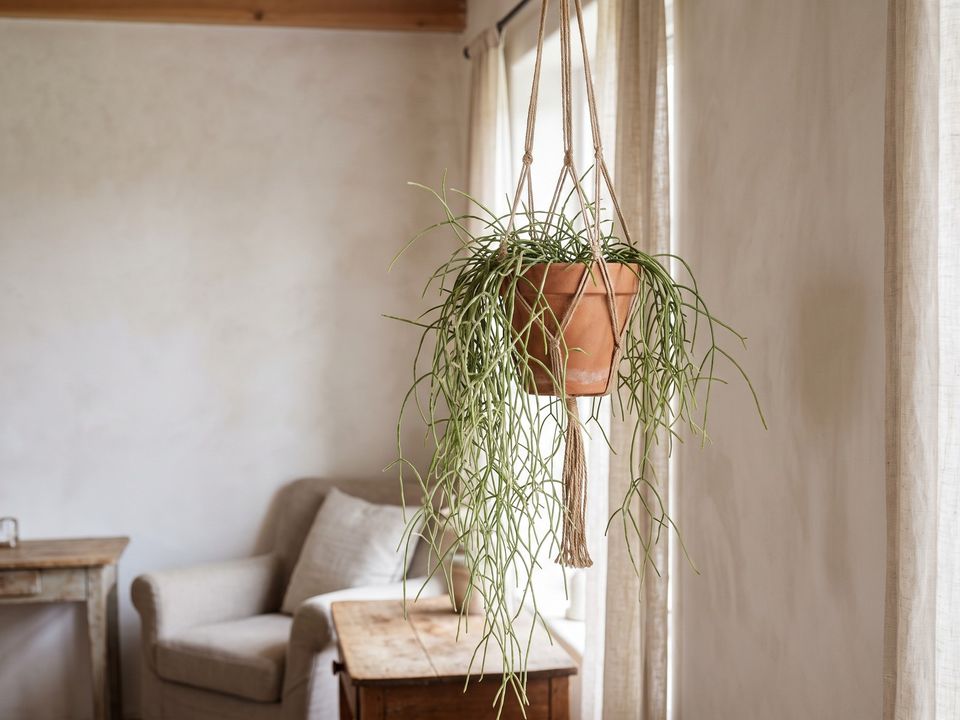
Spaghetti-thin strands spill from the pot in a long green cascade. A spineless cactus that’s easy to live with.
3.1/5
how easy it is to care for
2.4/5
how much it stands out visually
: Shade to filtered
Lots of daylight, with little sun on its stems
Indoors it wants lots of daylight but little sun on its stems, which NC State warns can scorch them. A summer outside in partial shade can firm up the stems and coax out flowers.
Let its strands brush the sill of a north-facing window, or hang it several feet back from an east or west one. In a south-facing room, hang it where a sheer curtain’s soft shadow falls across the stems instead of open glare.
In the wild it perches in understory trees (NC State), beneath the canopy rather than above it. Indoors, that translates to a spot with plenty of daylight and little direct sun.
If it spends summer outside, bring it in before nights fall below 60°F, the bottom of the range NC State gives it.
Think of it as a cactus that would rather have a tree’s shade than the open desert.
: 2-3× a month
Thirstier than a desert cactus; ease off in winter
Likely every 7-10 days, with the top of the soil drying between: far more often than a desert cactus, and a little less in winter. Thirst shows as puckered, limp stems; too much shows as mushy ones.
In a pot, NC State suggests a gritty cactus mix that leans slightly acidic.
Through winter it slows down, and keeping the mix just moist then is plenty (RHS).
It also wants more humid air than its spiny relatives. If the stem tips brown once the heat comes on in winter, and that bothers you, a pebble tray beneath the pot or a humidifier in the room may help (NC State). The trade-off: NC State warns that damp air left sitting still invites fungus, so give the strands room to breathe. Brown tips or not, the plant survives.
Gone for a while? Two weeks is fine if it’s watered the day you leave; for longer trips, ask someone to give it a soak.
: Medium
Thin strands that slowly cascade 2-4 feet, longer with age
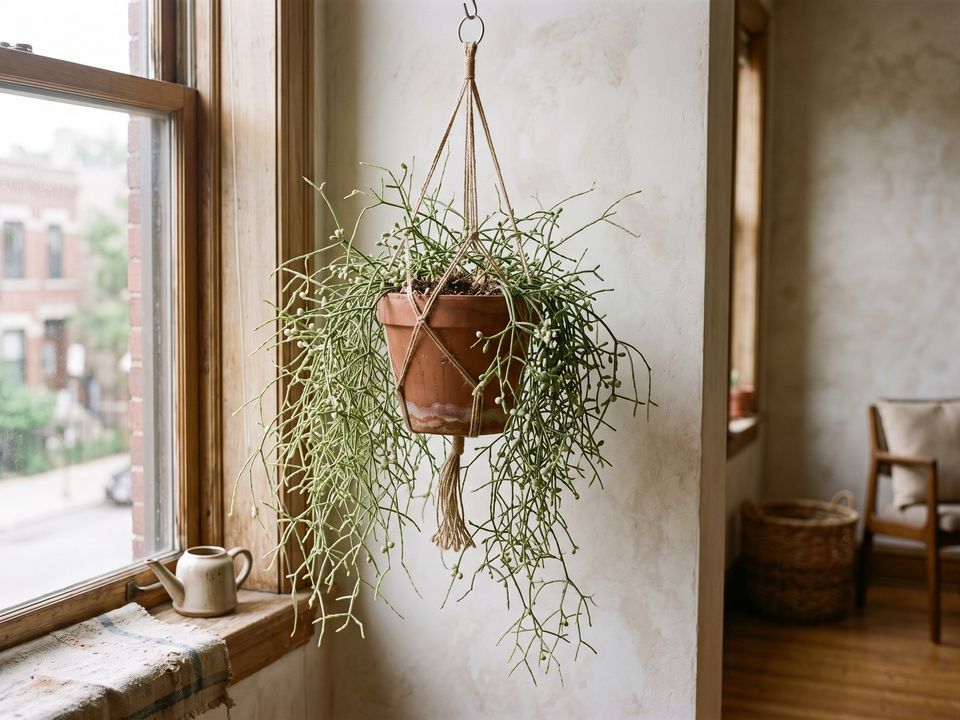
Made for a hanging pot or a tall stand: the strands slowly cascade 2-4 feet and, given years, can trail 4-6 feet and spread 1-2 feet wide. Trim them for a bushier head, or let them grow long.
In the trees where it grows wild, its strands can hang up to 30 feet (NC State). Indoors, the RHS expects it to take 5-10 years to grow to full length.
Look closely at a young stem and you’ll see tiny woolly tufts with a few bristles. They wear off as the stem matures and leave it smooth (NC State).
Give it a hook or a high shelf with a few feet of open air beneath, where the strands can fall. Seen from below, a full pot looks like a mop of green hair let down.
A short length snipped from one of its reed-thin strands can root and start another pot (NC State).
: Pet & kid safe
Nothing to worry about for dogs, cats, or kids
- DogsSafe
- CatsSafe
- KidsSafe
The ASPCA lists it as non-toxic to dogs, cats, and even horses. It has no spines to prick a child, and cactus sap is just a handling note: rinse a child’s hands after they touch a cut stem.
The ASPCA files it under an older name, Rhipsalis cassutha, one of its former names (NC State spells it cassytha).
Don’t confuse it with the holiday mistletoe hung in doorways. American mistletoe (Phoradendron) belongs to a different family entirely, and the ASPCA lists it as toxic. The cactus only borrowed the name.
The ASPCA does note that eating any plant may bring on vomiting or an upset stomach in a dog or cat; that isn’t expected to be serious.
Dangling strands are an open invitation to a cat’s paw. If yours bats or chews, give it a hook above paw height, for the plant’s sake more than the cat’s.
Cats and dogs: The ASPCA lists it as non-toxic.
Kids: No poison-centre listing; rated from university extension sources. Its sap can irritate skin or eyes.
: Average
60-80°F; average humidity is fine
Happiest at 60-80°F, and it shouldn’t sit below 55°F. Keep it away from cold glass in winter. It wants at least 35% humidity.
- Temperature
- 60-80°F
: Mealybugs
Mealybugs on stems and forks; mites in dry air
Mealybugs are the common find, so check the stems and where branches fork. Spider mites favor the stems when the air is dry, and aphids gather on young stem tips and flowers. Start your look at the forks.
- Mealybugs
- Spider mites
- Aphids
Not many. Mealybugs are the usual pest, spider mites and aphids turn up now and then, and soggy soil rots the stems.
Mealybugs look like tufts of white cotton tucked where the strands branch. Wipe them off with a cotton swab dipped in rubbing alcohol, then check again next week.
Spider mites leave fine speckling and webbing; aphids are small, soft, pear-shaped bugs clustered on new growth. Rinse the whole plant in the shower, and if they come back, spray it with insecticidal soap.
Rot shows as soft, mushy stems while the soil is still wet. Cut them off, let the pot dry out more between soaks, and water less often.
: Little
Feed monthly in summer; repot every 2-3 years
Feed monthly through spring and summer, 6 times a year, with a dilute low-nitrogen fertilizer. Trim long strands once in that season if you want a bushier head. Repot every 2-3 years in spring, into epiphytic cactus mix.
- Feed6× a year
- Prune1× a year
A mix that drains fast, in a pot with a drainage hole: cactus mix works, or ordinary potting mix with perlite and a little orchid bark stirred in, closer to the bark it clings to in the wild.
Repot every year, after it flowers, into fresh mix in a pot the same size; it doesn’t need a bigger one to do well.
Food is optional: a houseplant or tomato fertilizer at half strength once a month in spring and summer is plenty, and none in winter.
: Simple
Plain green strands, matte and smooth, in a full cascade
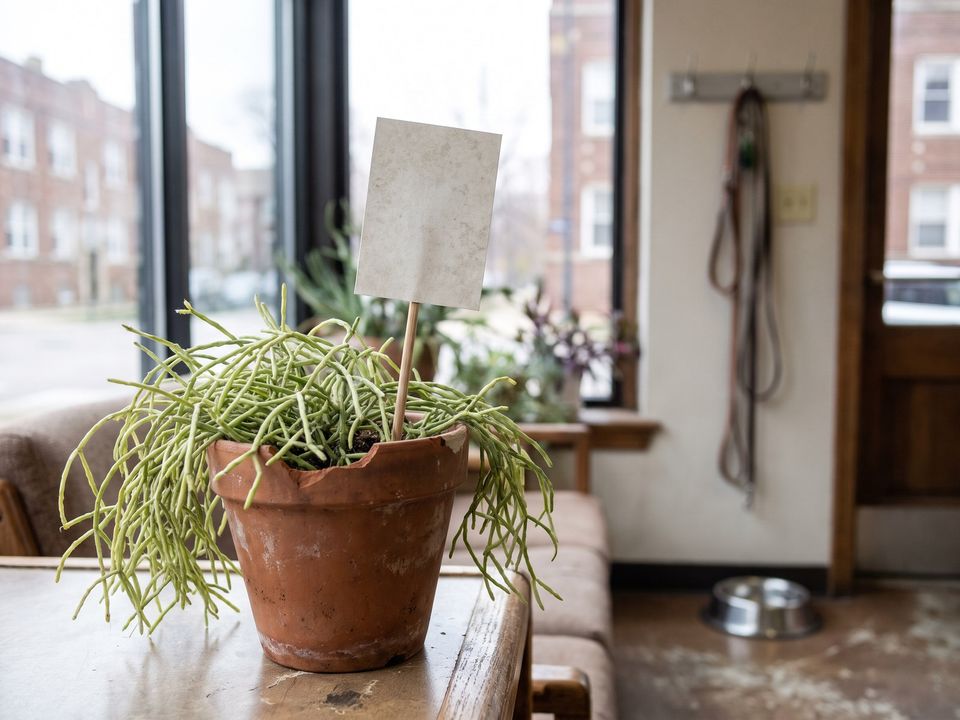
Spaghetti-thin strands in one plain green spill over the pot’s rim. Each is matte and smooth to the touch, and together they hang thick enough to hide the soil.
Where to find me
Not yet pilferableFun fact
Its botanical name reads like a description: Rhipsalis is Greek for wickerwork, for the reed-thin stems, and baccifera means berry-bearing.
Designer tips
Soft, airy, and a little wild, it suits a relaxed, plant-filled room and looks like nothing else in a hanging pot.
Troubleshooting
The stem tips are turning yellow
Too much water, usually. Letting the top of the soil dry between soaks and emptying the saucer helps, and new growth comes in green again.
Why are some stems soft and mushy?
Rot from soggy soil. Cut the soft stems off, let the pot dry out more, and water less often; if the base has gone soft, a few healthy strands root easily in damp cactus mix as a fresh start.
The strands look puckered and limp
That’s thirst: it drinks far more than a desert cactus. A good soak usually firms them up, and a drink every 7-10 days in summer keeps them that way.
See all 9
Why are the stems pale or scorched?
Too much sun on them; NC State warns direct sun can scorch the stems. A spot farther back from the window, or an east one with only morning sun, keeps new growth green.
Is it really a cactus? Where are the spines?
Yes, a true cactus, but a jungle one that grows on tree branches in the wild. That’s why it has no real spines, and why it wants more water and less sun than a desert cactus.
My cat keeps batting at the strands
No harm to the cat: the ASPCA lists it, under its old name Rhipsalis cassutha, as non-toxic to cats and dogs, though eating any plant can upset a stomach. A hook above paw height keeps the strands full.
Tiny white flowers and berries appeared
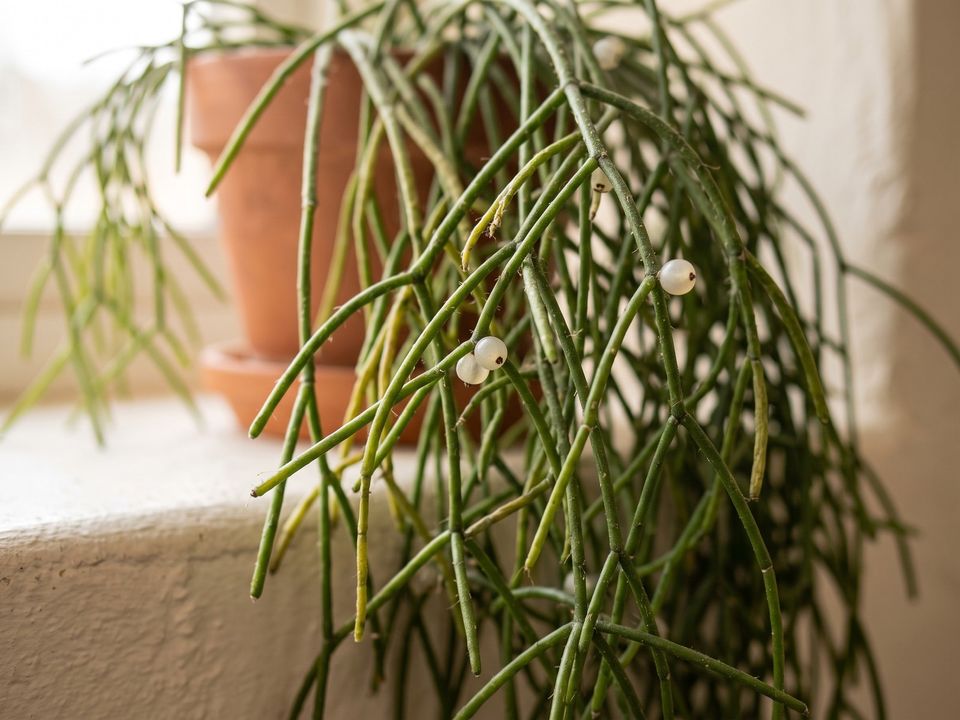
Its flowers and fruit. Small white flowers open along the strands in late winter and early spring, and little white or pale pink berries can follow; nothing to do, and a sign it’s doing well.
Why hasn’t it flowered?
A fall rest often sets buds: a month or two somewhere cooler, below the mid 60s, with long dark nights and no lamp on in the evening, the New York Botanical Garden’s method. Once buds form, it’s happiest left in place.
Can it go outside for the summer?
Yes, in shade: a porch or under a tree, out of afternoon sun. Bring it back in before nights fall below 60°F, and check it for bugs first.
Propagation
Yes, from stem cuttings, best in spring or summer.
- Snip a few strands, each a few inches long, push the cut ends into a small pot of damp cactus mix, and keep it lightly moist and where sun doesn’t land on the leaves until they start to grow.
- Several strands in one pot make a fuller plant sooner.
The PILF Matrix
3.1/5
how easy it is to care for
2.4/5
how much it stands out visually
“The one cactus that gives you kisses, not cuts.”


Rated 1-5, with 5 being easiest
Built from light, water, air, pests, and upkeep.
Rated 1-5, with 5 being easiest
Rated 1-5, with 5 being highest presence
Built from its scale (size, shape, growth) and its look (color and flowers, shine, fullness).
Rated 1-5, with 5 being highest presence
Where it sits and what sun touches it.
- Dim shadeA dark corner or a windowless room; natural light casts no shadow
- Bright shadeBack from the window in a south-, east- or west-facing room, or right by a north-facing one, where only low early or late summer sun reaches it
- Filtered sunBehind a sheer curtain or tinted glass; the sun’s shadows are blurred
- Partial sunIn an east- or west-facing window: up to a few hours of direct sun
- Full sunThe sunniest spot you have, usually a south-facing window, with direct sun 6+ hours a day
How often, and what the soil does between.
- MonthlyEvery 2-3 weeks in summer and 3-5 in winter; the soil dries all the way between
- 2-3× a monthEvery 7-14 days in summer, longer in winter; the top of the soil dries between
- Weekly+About every 4-8 days in summer; the soil stays lightly damp
How much room it usually takes indoors.
Size
- TinyUnder 6 inches tall or wide; for a desk or a sill
- Small6 inches to 1.5 feet tall or wide; for a shelf or a sill
- Medium1.5 to 3 feet tall or wide; for a table or a stand
- Large3 to 6 feet tall or wide; for the floor
- GiantOver 6 feet tall or wide; a statement in the corner
Shape
- TreeA trunk that branches into a canopy
- CaneBare stalks topped with leaves
- UprightStiff stems or leaves rising straight from the soil
- FountainLeaves or fronds arching out from the center
- BushyA full, rounded mound of leaves
- RosetteLeaves radiating from one low point
- ViningTrails, climbs, or both
Growth
How fast it gets there.
- SlowUnder 6 inches of new growth a year
- Moderate6-12 inches a year, mostly in spring and summer
- FastOver 12 inches a year; it may want trimming or training
What risks exist for pets and kids.
- Pet & kid safeNothing to worry about
- Mildly irritatingMay irritate the mouth or stomach if chewed, or for some plants, the skin if handled
- Moderately toxicCan cause illness if eaten, though typically not serious or fatal
- DangerousCan cause serious illness if eaten, including some reports of death
- Not yet ratedNot clearly rated by our sources; please check with your vet or doctor
For its safety ratings, PILF relies on research and guidance from leading sources, including the ASPCA, Pet Poison Helpline, Merck Veterinary Manual, Poison Control, and Children’s Hospital of Philadelphia, and others.
The small jobs beyond watering, over a year.
- Little upkeepA few small jobs a year beyond watering, like a feed now and then
- Some upkeepA small job about once a month beyond watering, like feeding or turning it
- More upkeepA small job every couple of weeks beyond watering, like a wipe, a turn, or a feed
- Most upkeepA small job most weeks beyond watering, like raising the humidity or misting
- TreeA trunk that branches into a canopy
- CaneBare stalks topped with leaves
- UprightStiff stems or leaves rising straight from the soil
- FountainLeaves or fronds arching out from the center
- BushyA full, rounded mound of leaves
- RosetteLeaves radiating from one low point
- ViningTrails, climbs, or both
How fast it gets there.
- SlowUnder 6 inches of new growth a year
- Moderate6-12 inches a year, mostly in spring and summer
- FastOver 12 inches a year; it may want trimming or training
The temperature and humidity it’s comfortable in.
How dry a room it takes.
- Needs 50%+ humidity
- Fine at 35% humidity
- Fine at 15-20% humidity
The bugs that usually find it, by name.
How often pests find it.
- 5+ regular pests
- 3 regular pests
- Pests are rare
The year’s chores: feeding, pruning, repotting, and cleaning.
Chores beyond water (what needs work means).
- Most upkeep
- Some upkeep
- Little upkeep
Its finish, fullness, and texture.
Color, pattern, and flowers.
- SimpleOne green, one texture, nothing to read
- SuaveA sheen, a stripe, or a clean shape that catches the eye up close
- ShowyColor, pattern, or blooms you see from across the room
How the leaves catch light.
- Matte
- Satin
- Glossy or waxy
How much it fills its pot.
- Soil shows
- Soil partly hidden
- Leaves hide the soil