Hoya
Hoya carnosa
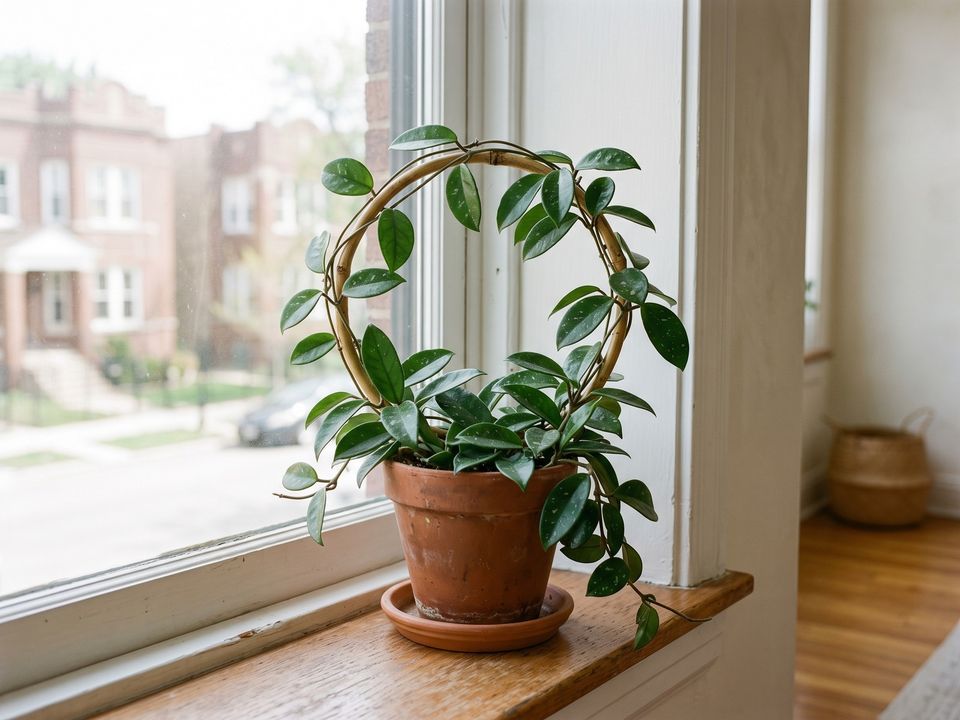
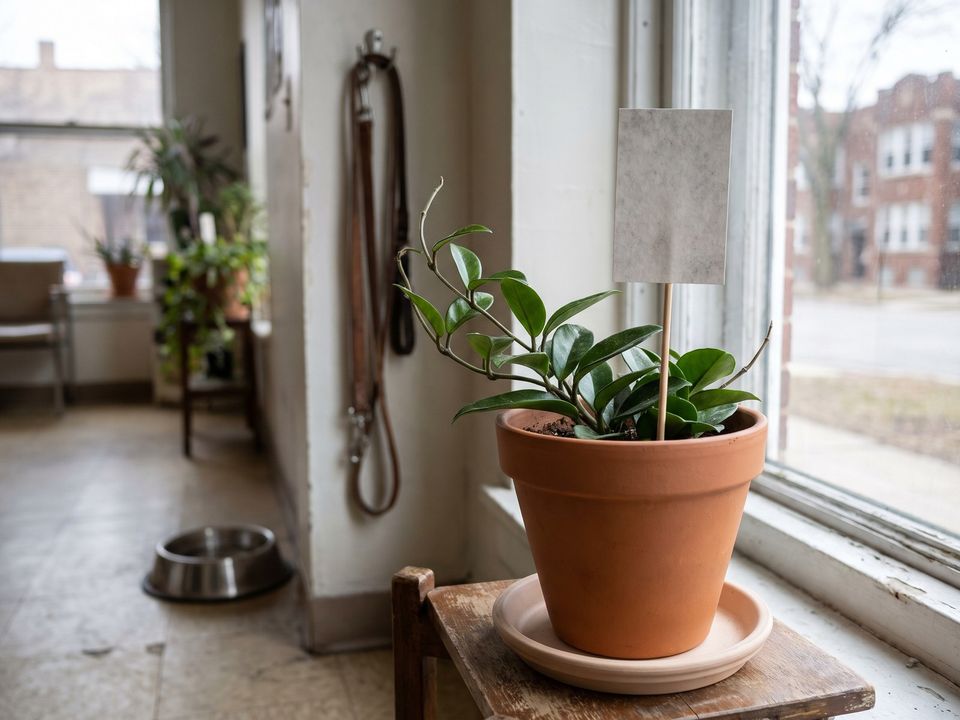
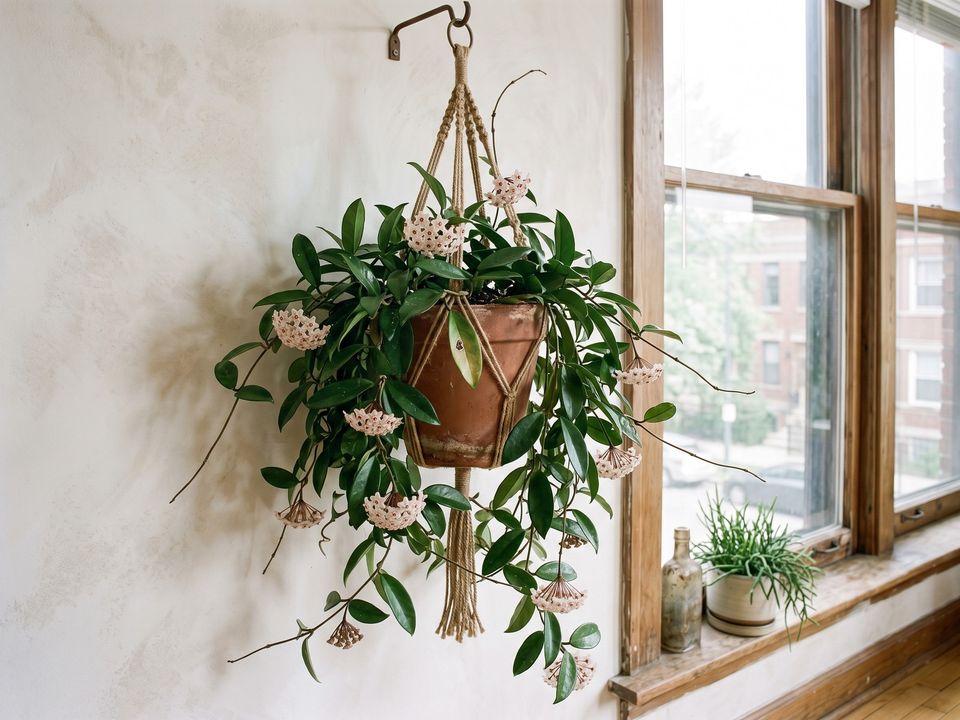
Glossy leaves on twining vines, then balls of starry pink flowers that look like porcelain. Easy on water, happy in a snug pot.
Also called wax plant and porcelain flower
3.3/5
how easy it is to care for
2.0/5
how much it stands out visually
: Shade to part sun
Flowers in bright light; just leaves in a dimmer room
Bright light, with some morning sun, is what sets its starry clusters; back in the room you’ll likely get vines and no flowers.
NC State notes most hoyas want bright light, dappled shade or full morning sun, and none need sun all day, which makes an east window an easy match for the vines. Facing south or west, give it some distance from the panes, or a sheer curtain, on summer afternoons.
Once buds do form, Penn State Extension’s advice is to leave it be: no moving, no turning, no pampering.
Come summer, it can spend time outdoors in partial shade; bring it in before nights dip below 50°F (NC State).
Its place, then, is the brightest window you have that still spares it the all-day glare.
: 2-3× a month
A drink every 10-14 days, the mix drying between
Every 10-14 days in summer, stretching to 2-3 weeks in winter, with the mix drying out in between. Too wet or too dry, it answers the same way, by dropping leaves, so steady beats generous.
Hung in a basket, it makes Clemson’s weight test easy: lift the pot right after watering, then again a week or so later, and a light basket is ready for the next drink. Pour it at room temperature, since NC State warns cold water can shock a hoya.
A snug pot helps twice. NC State notes a root-bound hoya holds less excess water around its roots, and Clemson warns that an oversized pot can lead to root rot, so step up no more than 2 inches at a time, and only when you must.
Dry radiator air can invite spider mites (NC State). If they show up and that bothers you, rinse the waxy leaves in the shower; it gets by either way.
Gone for a while? Three weeks is fine if it’s watered the day you leave; the waxy leaves carry it through.
: Medium
Vines that reach 2-4 feet, trailing or on a hoop
Indoors the vines reach 2-4 feet, with paired leaves on stems that twine on their own. They tend to grow better on a hoop or trellis, or can spill from a basket; prune in early spring if it wanders.
In Southeast Asia, Japan and Taiwan (NC State), it climbs trees as an epiphyte, and the small roots along its stems are how it holds the bark. Given a conservatory to fill, it can climb 4-8 meters, about 13-26 feet (RHS), so the vine in your pot is the compact edition.
The University of Florida notes the scent is subtle enough that you have to come close, so hang it where noses pass: a basket over a kitchen sink, or a vine trained along a shelf at standing height.
: Pet & kid safe
Nothing to worry about for dogs, cats or kids
Under the name honey plant, the ASPCA rates it non-toxic to dogs, cats and even horses. For kids, CHOP and UConn’s poison center call it non-poisonous.
Good news on every count: the ASPCA lists it as non-toxic. Its twisted-leaf form, 'Krinkle Kurl' (sold as Hindu rope plant), gets the same listing for dogs and cats.
The ASPCA’s one caution applies to any plant at all: eating leaves can upset a dog’s or cat’s stomach. Unpleasant, but not expected to be life-threatening.
Its flowers may drip a sticky sap (NC State), tacky on the shelf below.
With a crawling baby or a grazing cat at home, this is one of the easy yeses. Hang it in a basket if your cat treats vines as toys, mostly to protect the plant.
- ASPCA: safe for dogs.
- ASPCA: safe for cats.
- CHOP: safe for kids.
Cats and dogs: The ASPCA lists it as non-toxic.
Kids: CHOP lists it as non-poisonous.
: Dry OK
61-75°F; dry air is fine
Happiest at 61-75°F, and it shouldn’t sit below 50°F. Humidity can drop to 20% without trouble.
- Temperature
- 61-75°F
: Mealybugs
Mealybugs in the leaf joints; a few others occasionally
Mealybugs are the common guest, so check the stems, especially where leaves join. Spider mites favor leaf undersides, flat mites and thrips the leaves and tips, scale the stems, aphids new growth, gnats wet mix.
- Mealybugs
- Fungus gnats
- Spider mites
- Flat mites
- Scale
- Banded greenhouse thrips
- Aphids
Not many. Mealybugs are the pest to watch for, and rot is the risk if the soil stays wet.
Mealybugs look like tufts of white cotton tucked where the leaves meet the vine. Wipe each one off with a cotton swab dipped in rubbing alcohol and check again next week; if they keep coming, insecticidal soap is the next step.
Scale looks like small brown bumps stuck to the stems and leaves; a fingernail lifts them. Spider mites turn up when the air is too dry, leaving a speckled look and fine webbing between the leaves and stems: rinse the plant in the shower, undersides of the leaves included.
Fungus gnats, the tiny flies over the soil, mean the mix is staying too wet. Let it dry out between soaks and they die off.
Root rot, from overwatering, is the one disease that matters: leaves drop while the soil is still wet. Let it dry out and water less often from then on.
: Some
Feed monthly in growth; train vines 4× a year
Feed monthly through spring and summer, and wind the stems onto a hoop or trellis about 4 times a year. Trim for shape in early spring, sparing the flower spurs. Repot only every several years, when it has outgrown its pot.
- Feed6× a year
- Prune1× a year
- Train vines on support4× a year
A small pot with a drainage hole and a chunky, airy mix that drains fast: potting soil, orchid bark and perlite in roughly equal parts.
It flowers best a little rootbound, so there’s no rush. Repot only when it outgrows its pot, in spring or summer but not while it’s in bud or bloom, into a pot only one size up.
Food is optional, but it helps it bloom: a light dose of liquid houseplant fertilizer, at half or quarter strength, regularly through spring and summer, and none in winter.
: Suave
Waxy green leaves on twining vines, with porcelain stars
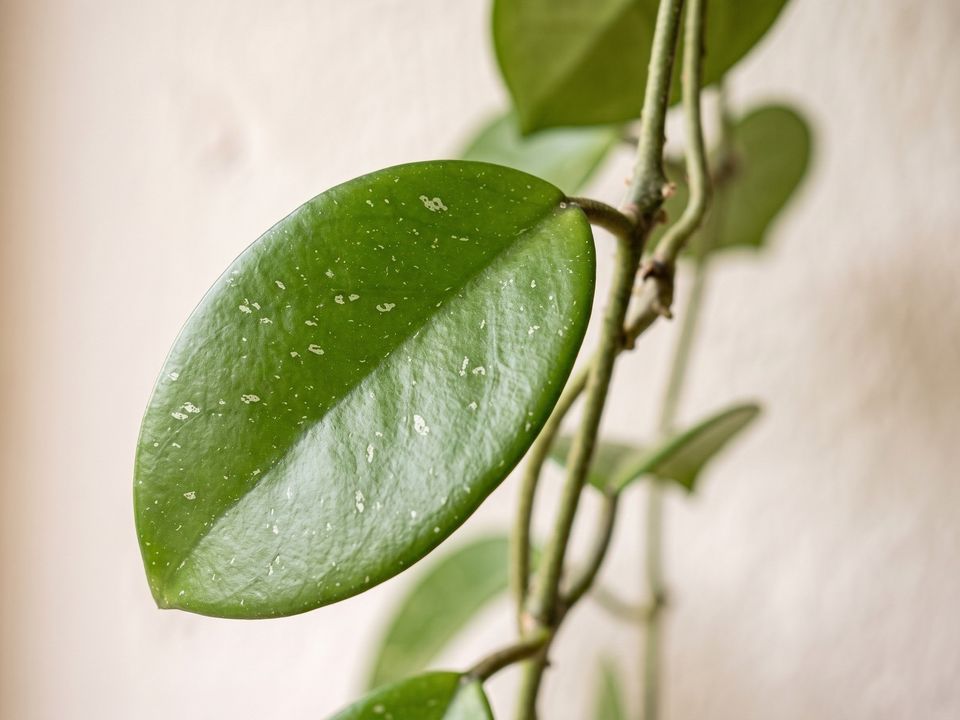
Thick, waxy leaves with a glossy finish pair up along twining vines, leaving some soil showing. Flowers arrive as round clusters of starry pink blooms that look like porcelain.
Where to find me
Not yet pilferableFun fact
After a bloom, leave the short stub that held the flowers (a peduncle): it’s the plant’s own record of past blooms, and new clusters come from that spur for years, so trimming it costs you a round.
Designer tips
Wound around a hoop it reads as a small sculpture; trailing from a hanging pot it softens a bright window.
Troubleshooting
Why hasn’t it flowered?
Usually light: bright light, with some morning sun, is what sets the flowers, and in a dimmer spot it makes vines instead. Age matters too, since most don’t bloom until they’re two or three years old; a snug pot and leaving the old flower spurs on both help.
Leaves are yellowing and dropping
Most often too much water, so a little longer between soaks and an empty saucer usually settle it. A hoya left dry for weeks drops leaves the same way, and a good soak is the fix there.
The leaves look wrinkled
It’s thirsty. A good soak usually plumps them back up; some growers wait for a slight pucker before they water, which is fine, just not much further.
See all 10
Why did the buds fall off?
Something changed: a move to different light, a swing in temperature or a change in watering, the three causes Iowa State Extension names. Once buds form, it does best left where it is, turned only after it blooms.
Sticky drops on the leaves
If it’s flowering, that’s nectar: NC State notes the flowers can drip a sticky sap. Sticky leaves with no flowers around point to sap-sucking bugs, usually mealybugs or scale, so a look under the leaves and at the leaf joints is worth it.
Should I cut off the old flower stalks?
Better not: those short, stubby spurs are where it flowers again, often for years. The spent flowers fall on their own.
Some leaves are turning red
Strong afternoon sun through glass, usually; it’s the plant reacting to light, not a disease. A foot back from the window or a sheer between them usually stops it, and the plant is fine either way.
What are the little roots growing out of the vine?
Aerial roots, which it climbs with. They help it hold on to a hoop or trellis, and they don’t mean anything’s wrong.
Is it safe for my cat or dog?
Yes: the ASPCA lists it, as honey plant, as non-toxic to cats, dogs and even horses. As with any plant, a big nibble can mean some vomiting, but it isn’t poisonous.
Can it go outside for the summer?
Yes, in partial shade, and Clemson Extension says a summer outdoors helps it grow and bloom. Bring it in before nights dip below 50°F, and check it for bugs on the way in.
Propagation
Yes, from stem cuttings: easy to root, slow to become a full plant.
- Cut a piece of vine with one or two nodes (the joints the leaves grow from) and push the bottom node into damp mix.
- Growers see roots in 3-4 weeks and a first new shoot 4 to 6 weeks after that; at home, expect it to be slower.
A single leaf will often root, but it won’t grow a vine unless a node came with it.
The PILF Matrix
3.3/5
how easy it is to care for
2.0/5
how much it stands out visually
Friend
The ones that are always there, never needy.
“The one that turns plant people into hoarders.”


How easy it is to care for. Built from light, water, air, pests and upkeep.
Rated 1-5, with 5 being easiest.
How much it stands out visually. Built from its scale (size, shape, growth) and its look (color and flowers, shine, fullness).
Rated 1-5, with 5 being highest presence.
Where it sits and what sun touches it.
- Dim shadeA dark corner or a windowless room; natural light casts no shadow
- Bright shadeBack from the window in a south-, east- or west-facing room, or right by a north-facing one, where only low early or late summer sun reaches it
- Filtered sunBehind a sheer curtain or tinted glass; the sun’s shadows are blurred
- Partial sunIn an east- or west-facing window: up to a few hours of direct sun
- Full sunThe sunniest spot you have, usually a south-facing window, with direct sun 6+ hours a day
How often, and what the soil does between.
- MonthlyEvery 2-3 weeks in summer and 3-5 in winter; the soil dries all the way between
- 2-3× a monthEvery 7-14 days in summer, longer in winter; the top of the soil dries between
- Weekly+About every 4-8 days in summer; the soil stays lightly damp
How much room it usually takes indoors.
Size
- TinyUnder 6 inches tall or wide; for a desk or a sill
- Small6 inches to 1.5 feet tall or wide; for a shelf or a sill
- Medium1.5 to 3 feet tall or wide; for a table or a stand
- Large3 to 6 feet tall or wide; for the floor
- GiantOver 6 feet tall or wide; a statement in the corner
Shape
- TreeA trunk that branches into a canopy
- CaneBare stalks topped with leaves
- UprightStiff stems or leaves rising straight from the soil
- FountainLeaves or fronds arching out from the center
- BushyA full, rounded mound of leaves
- RosetteLeaves radiating from one low point
- ViningTrails, climbs, or both
Growth
How fast it gets there.
- SlowUnder 6 inches of new growth a year
- Moderate6-12 inches a year, mostly in spring and summer
- FastOver 12 inches a year; it may want trimming or training
What happens and how bad (the worst of dogs, cats and kids).
- Pet & kid safeNothing to worry about
- Mildly irritatingMay irritate the mouth or stomach if chewed, or for some plants, the skin if handled
- Moderately toxicCan cause illness if eaten, though typically not serious or fatal
- Highly toxicCan cause serious illness if eaten, including some reports of death
- Not yet ratedNot clearly rated by our sources; please check with your vet or doctor
For its safety ratings, PILF relies on research and guidance from leading sources, including the ASPCA, Pet Poison Helpline, Merck Veterinary Manual, Poison Control and Children’s Hospital of Philadelphia, and others.
The small jobs beyond watering, over a year.
- Little upkeepA few small jobs a year beyond watering, like a feed now and then
- Some upkeepA small job about once a month beyond watering, like feeding or turning it
- More upkeepA small job every couple of weeks beyond watering, like a wipe, a turn or a feed
- Most upkeepA small job most weeks beyond watering, like raising the humidity or misting
- TreeA trunk that branches into a canopy
- CaneBare stalks topped with leaves
- UprightStiff stems or leaves rising straight from the soil
- FountainLeaves or fronds arching out from the center
- BushyA full, rounded mound of leaves
- RosetteLeaves radiating from one low point
- ViningTrails, climbs, or both
How fast it gets there.
- SlowUnder 6 inches of new growth a year
- Moderate6-12 inches a year, mostly in spring and summer
- FastOver 12 inches a year; it may want trimming or training
The temperature and humidity it’s comfortable in.
How dry a room it takes.
- Needs 50%+ humidity
- Fine at 35%
- Fine at 15-20%
The bugs that usually find it, by name.
How often pests find it.
- 5+ regular pests
- 3 regular pests
- Pests are rare
The year’s chores: feeding, pruning, repotting and cleaning.
Chores beyond water (what needs work means).
- Most upkeep
- Some upkeep
- Little upkeep
Its finish, fullness and texture.
Color, pattern and flowers.
- SimpleOne green, one texture, nothing to read
- SuaveA sheen, a stripe or a clean shape that catches the eye up close
- ShowyColor, pattern or blooms you see from across the room
How the leaves catch light.
- Matte
- Satin
- Glossy or waxy
How much it fills its pot.
- Soil shows
- Soil partly hidden
- Leaves hide the soil