Pencil Cactus
Euphorbia tirucalli
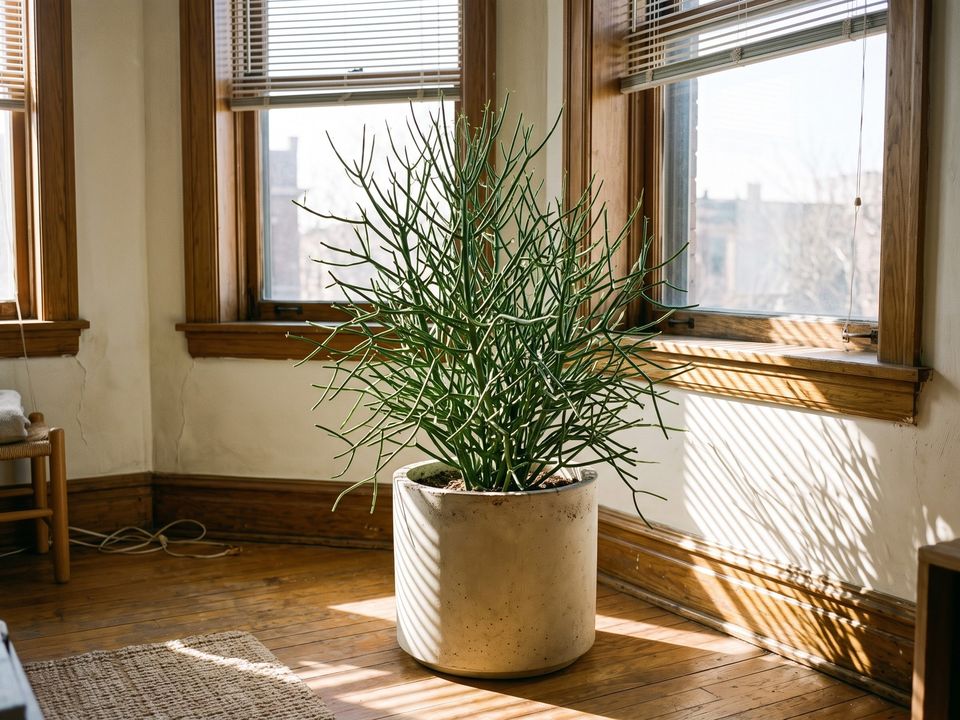
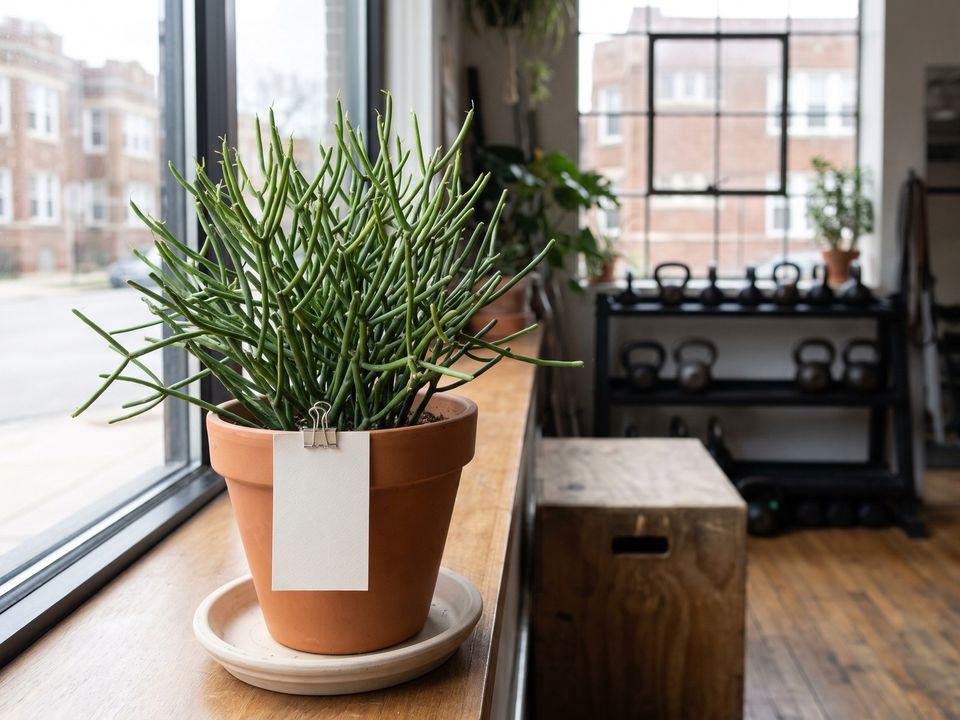
Spineless green pencils branch into a little tree of sticks. Thrives on sun and neglect; the milky sap is the one thing to respect.
3.7/5
how easy it is to care for
2.1/5
how much it stands out visually
: Shade to full sun
Wants a sunny window; copes with bright light out of sun
Direct sun is where it thrives, and the strong light turns its branch tips orange. Bright light just out of the sun keeps it going.
A south-facing window is its best seat, with the most sun for those tips to color in. West glass comes next; east gives it mornings only.
On a 'Sticks of Fire', the color follows the season more than the light: reddish-gold stems fade toward yellow in summer and turn red again in winter, and 'Flame' colors most intensely in winter (NC State).
Summering it on a patio? Where summers run hot, NC State suggests some afternoon shade, so a corner that loses the sun after lunch beats an open, baking deck.
Its wild ground is open savanna, rocky ridges, and grassy hills, with little cover (SANBI). Indoors, the brightest glass you have is where the tips turn orange.
: Monthly
Every 1-2 weeks in growth, dry between; far less in winter
Winter needs a drink only every 3-4 weeks, letting the pot dry through; summer quickens that to every 1-2 weeks. Its pencil stems store water, and overwatering can rot the roots.
The long winter gaps suit a plant from hard, dry country. Wild plants cope with low rainfall and poor, eroded, even salty ground (a 2013 study of it as a biofuel crop), and Missouri Botanical Garden rates its needs dry to medium.
A coarse, gritty pot mix is a nod to that hard country: NC State suggests a loamy soil with peat moss or leaf mold, cut with sand or other grit, and light on rich organic matter.
Gone for a while? A month is fine if it’s watered the day you leave; it’s built for drought.
: Large
A slow little tree of green sticks, up to 6 feet indoors
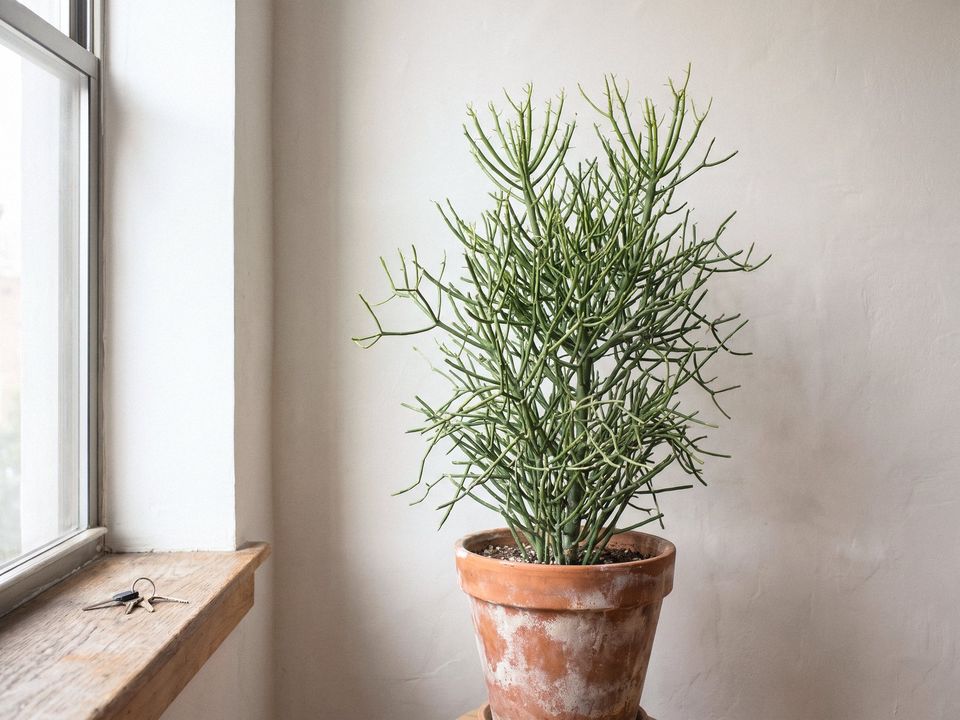
A woody trunk and brown limbs carry clusters of green pencils, growing slowly to as much as 6 feet indoors. Against a plain wall, the tangle reads like a sculpture; prune in gloves, since every cut bleeds sap.
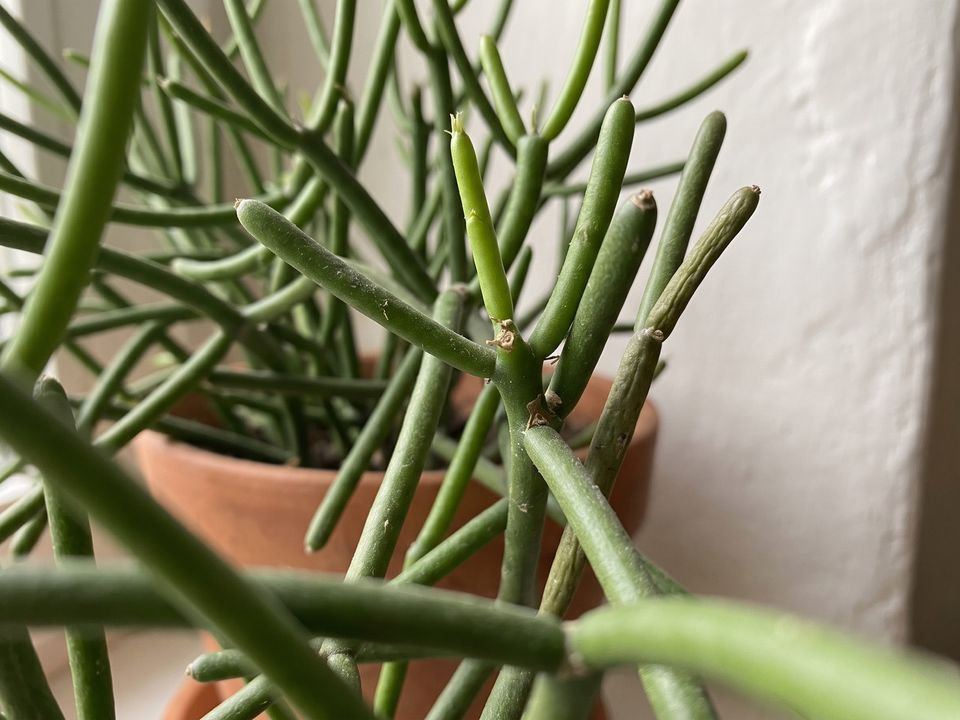
Each green pencil forks into more pencils, so the crown fills in by multiplying sticks rather than leaves (NC State describes pencil-thick branchlets in clusters). Those thin sticks let light and the view through, so it can stand beside a south-facing pane without walling it off.
When it gets too tall, trim from the bottom up, so the sap doesn’t drip onto you as you work (UC Agriculture and Natural Resources). The cut pieces root (NC State lists stem cuttings), so a trim can become one to share.
Left to itself in frost-free ground, it can reach 20-30 feet with a 10-foot spread (Missouri Botanical Garden).
: Mildly irritating
Sap can irritate skin; a chew can upset dogs, cats, or kids
- DogsMildly irritating
- CatsMildly irritating
- KidsMildly irritating
A chew may irritate the mouth and stomach of a pet or child, sometimes with drooling or vomiting. Its milky sap can also cause a skin rash, and it’s the part to keep out of eyes.
The ASPCA calls it generally over-rated in toxicity, but the milky sap irritates skin and can badly hurt eyes: wear gloves to cut it, and keep it from your face.
The irritants are diterpene esters in the latex, which runs through every part of the plant, roots to seeds (NC State). Even sap that has dried on a stem still stings, so wear gloves to handle or cut it, and wash with soap and water afterward (UC Agriculture and Natural Resources).
For a pet or child who chews a piece, the usual course is an irritated mouth, some drooling or a bout of vomiting that settles on its own (ASPCA). It looks harmless, with no spines to warn anyone off, and the brittle branchlets snap when a tail or elbow brushes past, beading latex at the break (UC ANR; SANBI). If sap reaches an eye, rinse it with plenty of water right away and call Poison Control for a person; for anything else that worries you, your vet or the ASPCA Animal Poison Control Center (a fee may apply) can help with a pet.
Still want one? Give it a sunny spot off the main path, where nobody bumps it, and prune while kids and pets are in another room.
- ASPCA: mild for dogs.
- Pet Poison Helpline: mild for dogs.
- ASPCA: mild for cats.
- Pet Poison Helpline: mild for cats.
- NC State Extension: mild for kids.
Cats and dogs: Most of the leading sources agree.
Kids: No poison-centre listing; rated from university extension sources. The extension signs beyond the gut are qualified, so they don’t count.
: Dry OK
50-75°F; dry air is fine
Keep it at 50-75°F. Humidity can drop to 10% without trouble.
- Temperature
- 50-75°F
: Pest-resistant
Rarely bothered; peek at stems, tips, and soil line
Rarely bothered. If anything turns up, spider mites favor the green stems and branch tips, mealybugs the branch forks and soil line, and aphids the soft new tips. Nematodes work at the roots.
- Spider mites
- Mealybugs
- Aphids
- Nematodes
Not many. Mealybugs and spider mites now and then, aphids on new growth, and root rot if the soil stays wet.
Mealybugs look like tufts of white cotton where the branches fork. Dab them with a cotton swab dipped in rubbing alcohol (gloves on, gently: a snapped twig bleeds sap), then check again next week.
Spider mites leave fine webbing and a dusty, speckled look; aphids are small, soft, green bugs clustered on the tips. Rinse either off in the shower, and try insecticidal soap if they come back.
Root rot shows as stems going soft or black at the base while the soil is still wet. Let it dry right out and water less often; if the base is gone, root a healthy tip (see Propagation).
: Little
Turn 4× a year, feed twice in summer, prune once
Turn the pot toward the light 4 times a year and feed it twice in spring and summer, diluted. Prune once in summer, in gloves with a sterile blade, keeping sap off skin and eyes. Repot every 2-3 years.
- Feed2× a year
- Rotate4× a year
- Prune1× a year
A gritty cactus mix that drains fast, in a pot with a drainage hole; a heavy clay pot keeps a tall one from tipping.
Repot only when the roots fill the pot, in spring or summer, into a pot only slightly bigger, since extra soil stays wet. Wear gloves: a knocked branch bleeds sap.
Food is optional: a cactus fertilizer once a month in summer is plenty, and none in winter.
: Simple
Plain green pencils, matte and smooth, with open gaps
Slender spineless stems in a single plain green branch into a little tree of sticks. Their surface is matte and smooth, and the branching stays open, so soil shows between the stems.
Where to find me
Not yet pilferableFun fact
Where winters are warm, it’s planted as a living hedge or barrier, a tangle of green sticks. Its milky sap is caustic: it can blister skin and harm eyes, so wear gloves to prune.
Designer tips
Wild and sculptural, it gives a sunny corner a desert-modern look, like a bundle of green sticks in a pot.
Troubleshooting
The branches are drooping or shriveling
Water, one way or the other: UF/IFAS notes too much and too little look alike. If it’s been weeks since a drink, it’s likely thirsty; if you’ve watered often, let the pot dry out and empty the saucer.
Why are the stems going soft or black at the base?
Likely root rot from soggy soil. Let the pot dry out completely and water less often; if the base is too far gone, a healthy tip can be rooted as a fresh start.
What’s the white sap, and is it dangerous?
It’s a latex that’s mildly irritating to skin, and the part to keep out of eyes, where NC State says it can damage the cornea. Gloves and glasses help when you cut it; wash sap off with soap and water, and if any reaches an eye, rinse well and call Poison Control.
See all 9
The tiny leaves are falling off
That’s normal: its small leaves appear at the branch tips and soon drop, and the green branches do the plant’s work.
My cat chewed a branch
It’s mildly irritating: expect a sore mouth, drooling, and maybe some vomiting, and the ASPCA calls it generally over-rated in toxicity. If your cat keeps vomiting, won’t eat or got sap in its eyes, call your vet or the ASPCA Animal Poison Control Center.
Why has my 'Sticks on Fire' turned yellow or green?
Season and sun. NC State says its reddish-gold stems fade toward yellow in summer and turn red again in winter; if it’s plain green, a sunnier window usually brings the color back.
I snapped a branch and it’s dripping white sap
Its branchlets are brittle and bead milky latex wherever they break (UC ANR), and the plant carries on. Wash any sap off skin with soap and water; the broken piece can dry for four days to a week, then root in barely damp cactus mix.
Can it go outside for the summer?
Yes, in full sun on a south-facing balcony or sunny patio, eased out over a week or so. Where summers run hot, some afternoon shade helps (NC State); bring it in before fall nights drop below 50°F.
Is it really a cactus?
No: it’s a Euphorbia, a succulent cousin of the poinsettia, with no spines. The cactus name comes from its desert looks and its love of sun.
Propagation
Yes, easily, from a cutting. Gloves and glasses on first: the cut bleeds milky sap.
- Cut a branch tip about a hand’s length long and lay it on a paper towel for four days to a week, until the cut end dries and seals.
- Then stand it in barely damp cactus mix and water sparingly until it roots, in about a month.
The PILF Matrix
3.7/5
how easy it is to care for
2.1/5
how much it stands out visually
“The one that draws the eye, no sharpening needed.”


- Indian tree spurge
Rated 1-5, with 5 being easiest
Built from light, water, air, pests, and upkeep.
Rated 1-5, with 5 being easiest
Rated 1-5, with 5 being highest presence
Built from its scale (size, shape, growth) and its look (color and flowers, shine, fullness).
Rated 1-5, with 5 being highest presence
Where it sits and what sun touches it.
- Dim shadeA dark corner or a windowless room; natural light casts no shadow
- Bright shadeBack from the window in a south-, east- or west-facing room, or right by a north-facing one, where only low early or late summer sun reaches it
- Filtered sunBehind a sheer curtain or tinted glass; the sun’s shadows are blurred
- Partial sunIn an east- or west-facing window: up to a few hours of direct sun
- Full sunThe sunniest spot you have, usually a south-facing window, with direct sun 6+ hours a day
How often, and what the soil does between.
- MonthlyEvery 2-3 weeks in summer and 3-5 in winter; the soil dries all the way between
- 2-3× a monthEvery 7-14 days in summer, longer in winter; the top of the soil dries between
- Weekly+About every 4-8 days in summer; the soil stays lightly damp
How much room it usually takes indoors.
Size
- TinyUnder 6 inches tall or wide; for a desk or a sill
- Small6 inches to 1.5 feet tall or wide; for a shelf or a sill
- Medium1.5 to 3 feet tall or wide; for a table or a stand
- Large3 to 6 feet tall or wide; for the floor
- GiantOver 6 feet tall or wide; a statement in the corner
Shape
- TreeA trunk that branches into a canopy
- CaneBare stalks topped with leaves
- UprightStiff stems or leaves rising straight from the soil
- FountainLeaves or fronds arching out from the center
- BushyA full, rounded mound of leaves
- RosetteLeaves radiating from one low point
- ViningTrails, climbs, or both
Growth
How fast it gets there.
- SlowUnder 6 inches of new growth a year
- Moderate6-12 inches a year, mostly in spring and summer
- FastOver 12 inches a year; it may want trimming or training
What risks exist for pets and kids.
- Pet & kid safeNothing to worry about
- Mildly irritatingMay irritate the mouth or stomach if chewed, or for some plants, the skin if handled
- Moderately toxicCan cause illness if eaten, though typically not serious or fatal
- DangerousCan cause serious illness if eaten, including some reports of death
- Not yet ratedNot clearly rated by our sources; please check with your vet or doctor
For its safety ratings, PILF relies on research and guidance from leading sources, including the ASPCA, Pet Poison Helpline, Merck Veterinary Manual, Poison Control, and Children’s Hospital of Philadelphia, and others.
The small jobs beyond watering, over a year.
- Little upkeepA few small jobs a year beyond watering, like a feed now and then
- Some upkeepA small job about once a month beyond watering, like feeding or turning it
- More upkeepA small job every couple of weeks beyond watering, like a wipe, a turn, or a feed
- Most upkeepA small job most weeks beyond watering, like raising the humidity or misting
- TreeA trunk that branches into a canopy
- CaneBare stalks topped with leaves
- UprightStiff stems or leaves rising straight from the soil
- FountainLeaves or fronds arching out from the center
- BushyA full, rounded mound of leaves
- RosetteLeaves radiating from one low point
- ViningTrails, climbs, or both
How fast it gets there.
- SlowUnder 6 inches of new growth a year
- Moderate6-12 inches a year, mostly in spring and summer
- FastOver 12 inches a year; it may want trimming or training
The temperature and humidity it’s comfortable in.
How dry a room it takes.
- Needs 50%+ humidity
- Fine at 35% humidity
- Fine at 15-20% humidity
The bugs that usually find it, by name.
How often pests find it.
- 5+ regular pests
- 3 regular pests
- Pests are rare
The year’s chores: feeding, pruning, repotting, and cleaning.
Chores beyond water (what needs work means).
- Most upkeep
- Some upkeep
- Little upkeep
Its finish, fullness, and texture.
Color, pattern, and flowers.
- SimpleOne green, one texture, nothing to read
- SuaveA sheen, a stripe, or a clean shape that catches the eye up close
- ShowyColor, pattern, or blooms you see from across the room
How the leaves catch light.
- Matte
- Satin
- Glossy or waxy
How much it fills its pot.
- Soil shows
- Soil partly hidden
- Leaves hide the soil