Jade Plant
Crassula ovata
Also called jade tree
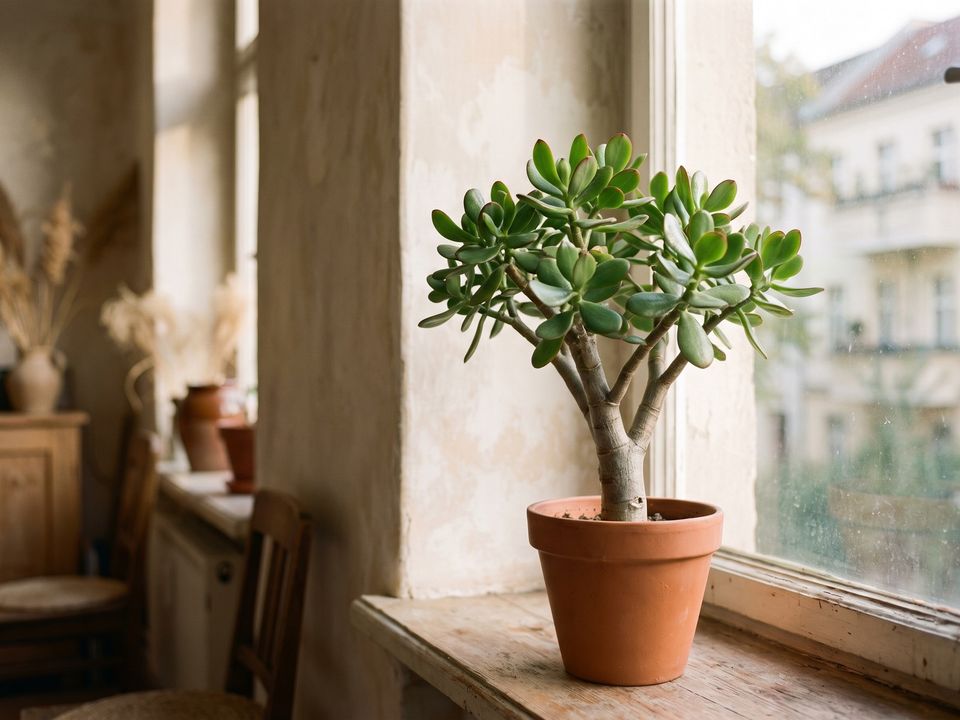
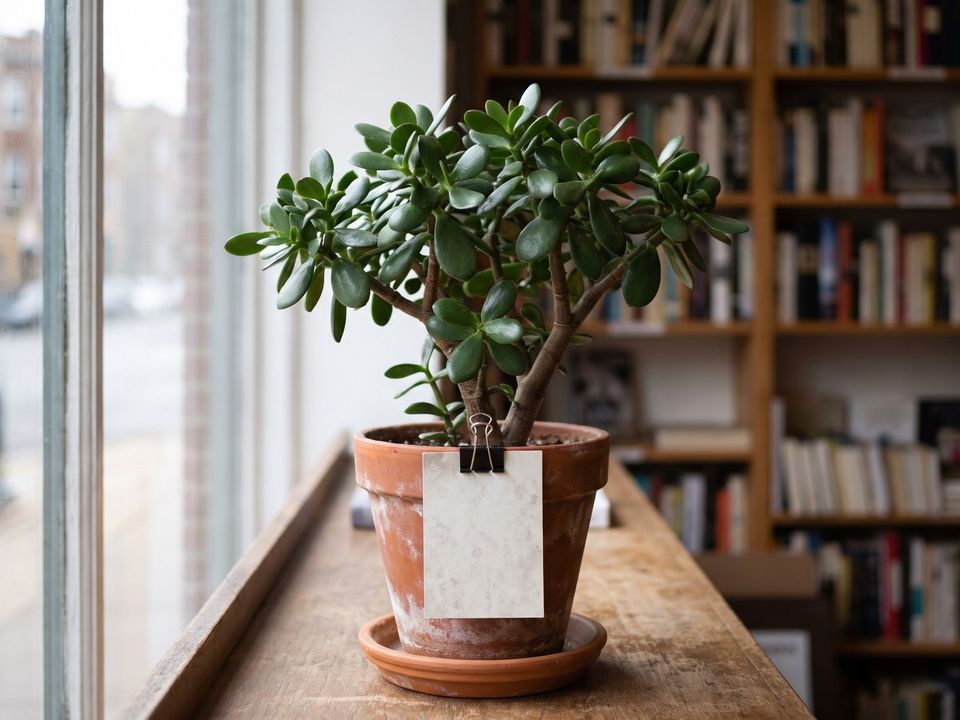
Plump, jewel-green leaves on a stout, gnarled little trunk. Give it sun and the odd drink, and it’s yours for years.
3.6/5
how easy it is to care for
2.5/5
how much it stands out visually
: Shade to full sun
Fun in the sun, or at least a bright windowsill
Sun is what it’s built for: four hours of direct sun at the least, all day if you have it, keeps it compact, with red-rimmed leaves. In bright shade it gets by, but stretches thin.
The sunniest window you have is the place to start, and in a Chicago winter it’ll take every hour of sun it gets. Come summer, a little afternoon shade, from a sheer curtain or a spot just off the glass, spares the leaves.
Summering it outdoors? Ease it into full sun over a week or two; leaves used to window light can scorch at first.
Of everything it needs, sun is the one it’s greedy about.
: Monthly
Fleshy leaves wrinkle when thirsty, then fill out again
Every couple of weeks in summer, and as little as monthly in winter. Its plump leaves hold weeks of water, so a missed drink barely registers; they wrinkle when it’s thirsty, then fill out again.
The leaves are your gauge. Plump and firm means all’s well; slightly wrinkled means it’s ready for a drink; soft or yellowing leaves mean it’s had too much (dropping leaves can mean either).
A terracotta pot and a gritty cactus mix let the soil dry out quickly between drinks, which is exactly how it likes it.
In fall, ease off. A drier, cooler stretch is also what nudges a mature jade to flower (University of Wisconsin Extension).
Gone for a while? A month is fine if it’s watered the day you leave; its leaves hold the water it needs.
: Medium
A pint-sized tree, 1.5-2.5 feet, taller with age
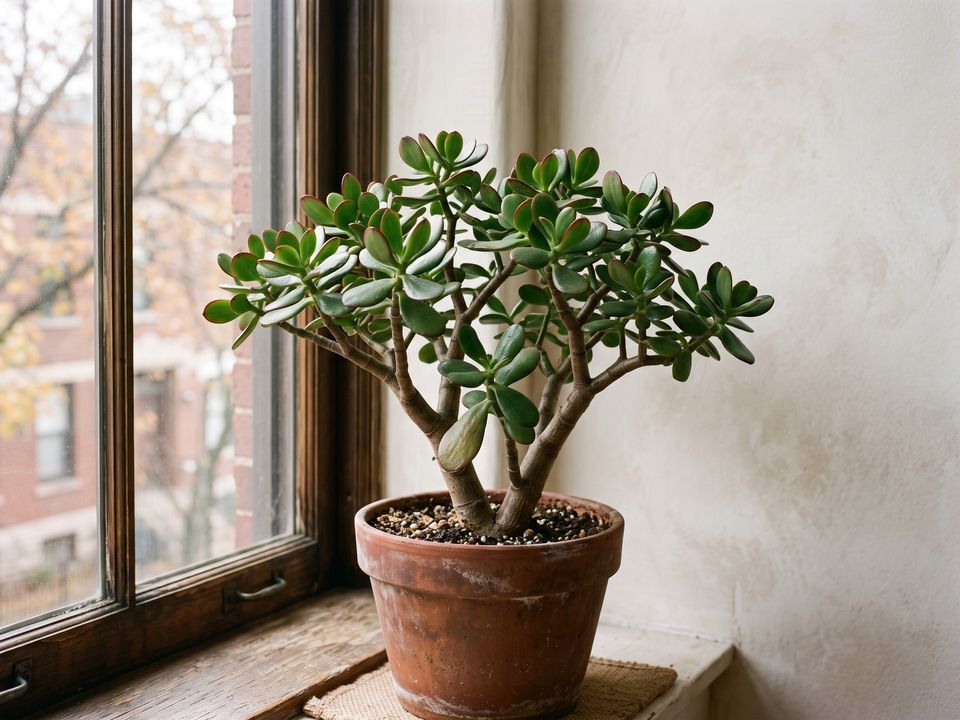
A pint-sized tree with a thick, branching trunk, reaching 1.5-2.5 feet over many years. Pretty on a sunny sill or a low stand, in a heavy pot that won’t tip as the trunk thickens.
Jade looks old long before it gets big. Its trunk thickens and gnarls early, so even a young plant can look decades old (University of Wisconsin Extension).
With age, the green stems turn brown and woody, marked with distinct rings called stipular scars (NC State).
Pinch off a stem tip and it tends to branch below the pinch, which is part of why it takes so well to bonsai.
: Mildly irritating
Chewing can upset dogs and cats; rated safe for kids
- DogsMildly irritating
- CatsMildly irritating
- KidsSafe
A dog or cat that chews it may vomit, but it usually passes on its own. For kids it’s nothing harmful: Poison Control lists it as non-poisonous, though the sap can irritate skin.
A few pets get sleepy or a little wobbly; it’s less common and usually passes.
What sets off the upset isn’t known; the cause is listed as unknown (ASPCA).
If symptoms don’t settle, or anything worries you, your vet or the ASPCA Animal Poison Control Center (a fee may apply) can help.
A sunny sill puts it right where cats like to lounge. If yours is a nibbler, choose a sill they can’t reach, or let it sun itself in a room they rarely visit.
- ASPCA: toxic for dogs.
- Pet Poison Helpline: mild for dogs.
- ASPCA: toxic for cats.
- Pet Poison Helpline: mild for cats.
- CHOP: safe for kids.
Cats and dogs: Most of the leading sources agree.
Kids: CHOP and Poison Control list it as non-poisonous. Its sap can irritate skin or eyes.
: Dry OK
55-75°F; dry air is fine
Anywhere from about 55-75°F suits it, and it shouldn’t sit below 45°F. Dry air is no trouble, down to about 10% humidity.
- Temperature
- 55-75°F
- Humidity
- 10-50%
: Mealybugs
Mealybugs most often; check the new growth
Mealybugs go for new growth and can deform it, so check the tips first. Scale on stems and leaves, spider mites under the leaves, and aphids on new shoots are occasional. A weekly look at the tips is plenty.
- Mealybugs
- Scale
- Spider mites
- Aphids
Few. Mealybugs are the one to watch for, spider mites turn up now and then, and rot sets in if the soil stays wet.
Mealybugs look like white, fluffy tufts where the leaves meet the stem. Wipe them off with a cotton swab dipped in rubbing alcohol, and check again every few days for a few weeks, since they hide. Go easy with sprays: insecticides can burn its fleshy leaves, so the swab is the safer fix.
Spider mites leave the leaves dull, dusty-looking, and speckled. Rinse the plant off in the shower, undersides of the leaves included, and let it drain well.
Rot shows as dropping leaves and a stem going soft and dark at the base while the soil is wet. Let it dry right out; if the stem has collapsed, cut a healthy piece from the top and root it (see Propagation).
: Little
Rotate 4× a year, feed 3× in summer, prune in spring
Turn the pot toward the window 4 times a year, and feed about every two months in spring and summer. Each spring, cut stems back to a side branch. Repot every 2-3 years, or sooner if it tips top-heavy.
- Feed3× a year
- Prune1× a year
- Rotate4× a year
A cactus and succulent mix, in a pot with a drainage hole. Terracotta is ideal: it dries faster than a glazed or plastic pot, and its weight keeps a top-heavy plant from tipping over.
It’s happy root-bound, so repot every two to three years, or sooner if it gets top-heavy, in spring as new growth starts. Hold off on feeding for four months after.
Food is optional: a balanced liquid houseplant fertilizer two or three times in spring and summer is plenty, and none in winter.
: Simple
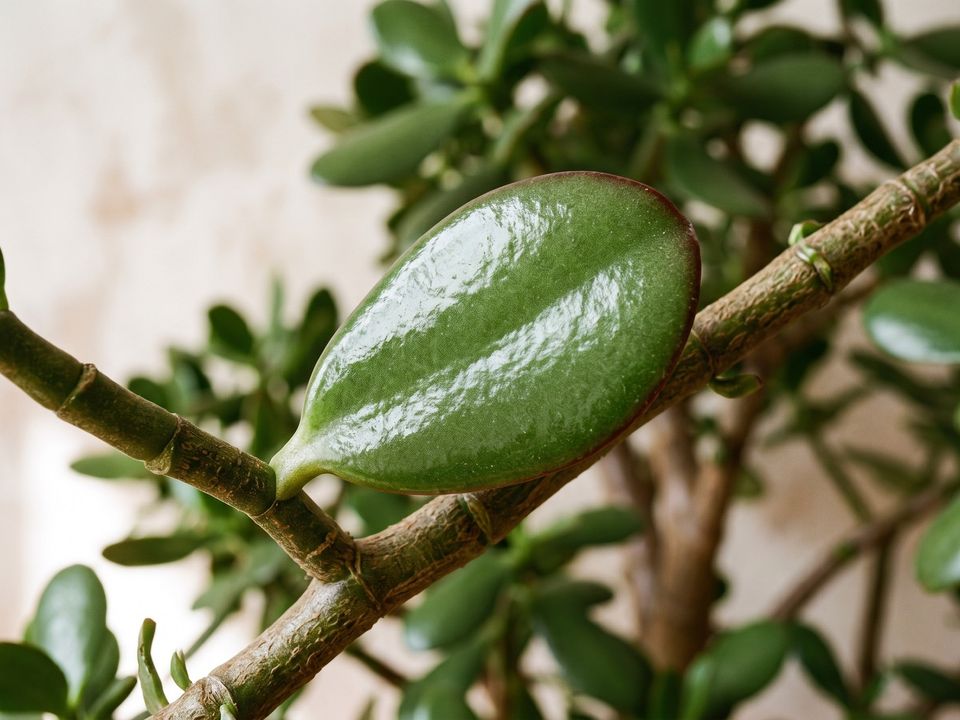
Plump, glossy green leaves on a gnarled trunk
Thick, oval leaves in one plain jewel green, with a waxy, polished gloss. They crowd along the branches so densely that the soil disappears beneath them.
Where to find me
Not yet pilferableFun fact
Its common name, lucky plant, comes with folklore: it’s said to bring financial luck, and by tradition it’s potted in square tubs on lion’s feet.
Designer tips
A living bonsai: a stout trunk and a crown of glossy leaves that suit a sunny, uncluttered sill.
Troubleshooting
It’s dropping leaves
Usually water, too much or too little. Soil that has stayed wet drops leaves and rots the stem, so let it dry right out and water less often; after weeks bone dry, a good soak and then one every couple of weeks in summer usually settles it.
The leaves look wrinkled
That’s thirst: plump, firm leaves mean all’s well, and slightly wrinkled ones mean it’s ready for a drink. A good soak usually fills them out again, while soft or yellowing leaves point the other way, to too much water.
Why is it tall and floppy, with gaps between the leaves?
Not enough sun: it stretches toward the light and goes leggy. Move it to your sunniest window, and cut the stretched stems back in spring if you like; they branch from the cut, and the pieces root.
See all 9
Why is the stem soft and dark at the base?
Rot, from wet soil. Once the base has collapsed it rarely recovers, so cut a firm piece from the top, leave it a few days for the cut to dry, and root it in dry cactus mix.
The leaf edges are turning red
A good sign: it’s getting plenty of sun. UW-Madison Extension says the leaves should be edged or tinged with red in good light, and pale, all-green leaves mean it wants more.
My cat took a bite
Your cat may vomit, and a few pets get sleepy or a little wobbly; Pet Poison Helpline rates it mild, and it usually passes on its own. If the signs keep up, call your vet or the ASPCA Animal Poison Control Center.
Is it the same as a money plant or a money tree?
Not necessarily: 'money plant' and 'money tree' are nicknames several plants share. This one is Crassula ovata; the Chinese money plant (Pilea) and the money tree (Pachira) are different plants with their own safety ratings, so check the botanical name on the tag.
How do I get it to flower?
Long nights and a cool fall. UW-Madison Extension’s method: in fall, water less, keep it around 55°F at night, and keep it in a room where no lamp goes on after dark. Indoors it often won’t flower even so, and it’s just as healthy either way.
Can it go outside for the summer?
Yes, and it loves a sunny porch or balcony. Ease it into full sun a little more each day so the leaves don’t scorch, and bring it back in before nights dip below 45°F.
Propagation
One of the easiest plants to multiply: a stem cutting, or even a single leaf, roots on its own.
- Cut a piece of stem, pull off the lowest leaves, and leave it out for a few days so the cut end dries and seals over; that keeps it from rotting.
- Then set it in a small pot of dry cactus mix and hold off on water until it starts to grow.
A fallen leaf, dried the same way and laid on the mix, can grow into a new plant too. Summer is the quickest time, but it roots any time of year.
The PILF Matrix
3.6/5
how easy it is to care for
2.5/5
how much it stands out visually
“The one with an old soul and the skin to match.”


Rated 1-5, with 5 being easiest
Built from light, water, air, pests, and upkeep.
Rated 1-5, with 5 being easiest
Rated 1-5, with 5 being highest presence
Built from its scale (size, shape, growth) and its look (color and flowers, shine, fullness).
Rated 1-5, with 5 being highest presence
Where it sits and what sun touches it.
- Dim shadeA dark corner or a windowless room; natural light casts no shadow
- Bright shadeBack from the window in a south-, east- or west-facing room, or right by a north-facing one, where only low early or late summer sun reaches it
- Filtered sunBehind a sheer curtain or tinted glass; the sun’s shadows are blurred
- Partial sunIn an east- or west-facing window: up to a few hours of direct sun
- Full sunThe sunniest spot you have, usually a south-facing window, with direct sun 6+ hours a day
How often, and what the soil does between.
- MonthlyEvery 2-3 weeks in summer and 3-5 in winter; the soil dries all the way between
- 2-3× a monthEvery 7-14 days in summer, longer in winter; the top of the soil dries between
- Weekly+About every 4-8 days in summer; the soil stays lightly damp
How much room it usually takes indoors.
Size
- TinyUnder 6 inches tall or wide; for a desk or a sill
- Small6 inches to 1.5 feet tall or wide; for a shelf or a sill
- Medium1.5 to 3 feet tall or wide; for a table or a stand
- Large3 to 6 feet tall or wide; for the floor
- GiantOver 6 feet tall or wide; a statement in the corner
Shape
- TreeA trunk that branches into a canopy
- CaneBare stalks topped with leaves
- UprightStiff stems or leaves rising straight from the soil
- FountainLeaves or fronds arching out from the center
- BushyA full, rounded mound of leaves
- RosetteLeaves radiating from one low point
- ViningTrails, climbs, or both
Growth
How fast it gets there.
- SlowUnder 6 inches of new growth a year
- Moderate6-12 inches a year, mostly in spring and summer
- FastOver 12 inches a year; it may want trimming or training
What risks exist for pets and kids.
- Pet & kid safeNothing to worry about
- Mildly irritatingMay irritate the mouth or stomach if chewed, or for some plants, the skin if handled
- Moderately toxicCan cause illness if eaten, though typically not serious or fatal
- DangerousCan cause serious illness if eaten, including some reports of death
- Not yet ratedNot clearly rated by our sources; please check with your vet or doctor
For its safety ratings, PILF relies on research and guidance from leading sources, including the ASPCA, Pet Poison Helpline, Merck Veterinary Manual, Poison Control, and Children’s Hospital of Philadelphia, and others.
The small jobs beyond watering, over a year.
- Little upkeepA few small jobs a year beyond watering, like a feed now and then
- Some upkeepA small job about once a month beyond watering, like feeding or turning it
- More upkeepA small job every couple of weeks beyond watering, like a wipe, a turn, or a feed
- Most upkeepA small job most weeks beyond watering, like raising the humidity or misting
- TreeA trunk that branches into a canopy
- CaneBare stalks topped with leaves
- UprightStiff stems or leaves rising straight from the soil
- FountainLeaves or fronds arching out from the center
- BushyA full, rounded mound of leaves
- RosetteLeaves radiating from one low point
- ViningTrails, climbs, or both
How fast it gets there.
- SlowUnder 6 inches of new growth a year
- Moderate6-12 inches a year, mostly in spring and summer
- FastOver 12 inches a year; it may want trimming or training
The temperature and humidity it’s comfortable in.
How dry a room it takes.
- Needs 50%+ humidity
- Fine at 35% humidity
- Fine at 15-20% humidity
The bugs that usually find it, by name.
How often pests find it.
- 5+ regular pests
- 3 regular pests
- Pests are rare
The year’s chores: feeding, pruning, repotting, and cleaning.
Chores beyond water (what needs work means).
- Most upkeep
- Some upkeep
- Little upkeep
Its finish, fullness, and texture.
Color, pattern, and flowers.
- SimpleOne green, one texture, nothing to read
- SuaveA sheen, a stripe, or a clean shape that catches the eye up close
- ShowyColor, pattern, or blooms you see from across the room
How the leaves catch light.
- Matte
- Satin
- Glossy or waxy
How much it fills its pot.
- Soil shows
- Soil partly hidden
- Leaves hide the soil