Ponytail Palm
Beaucarnea recurvata
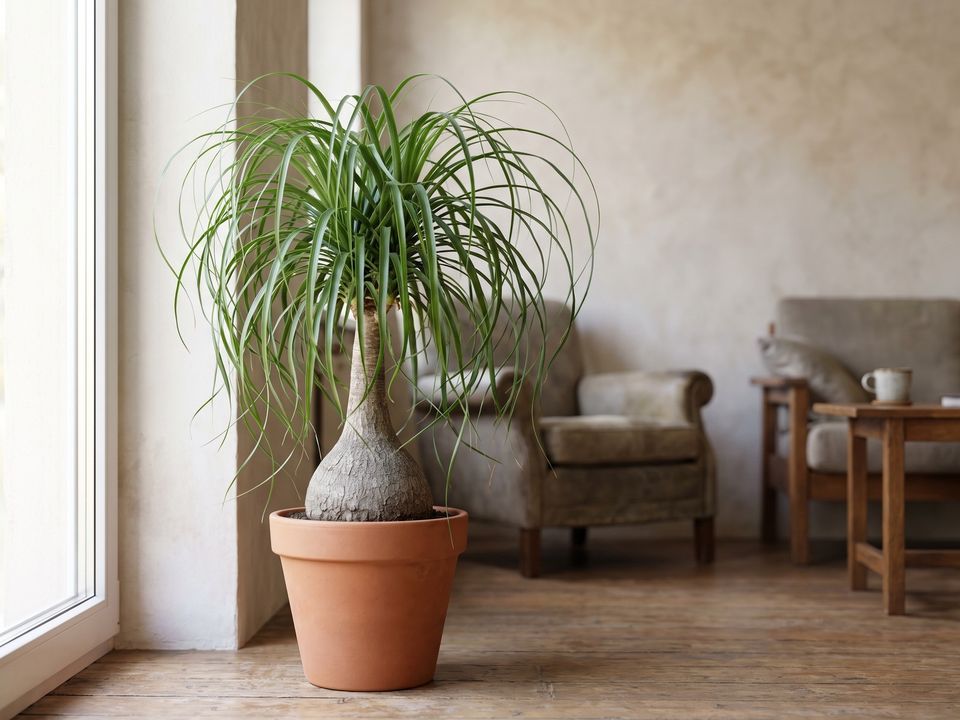
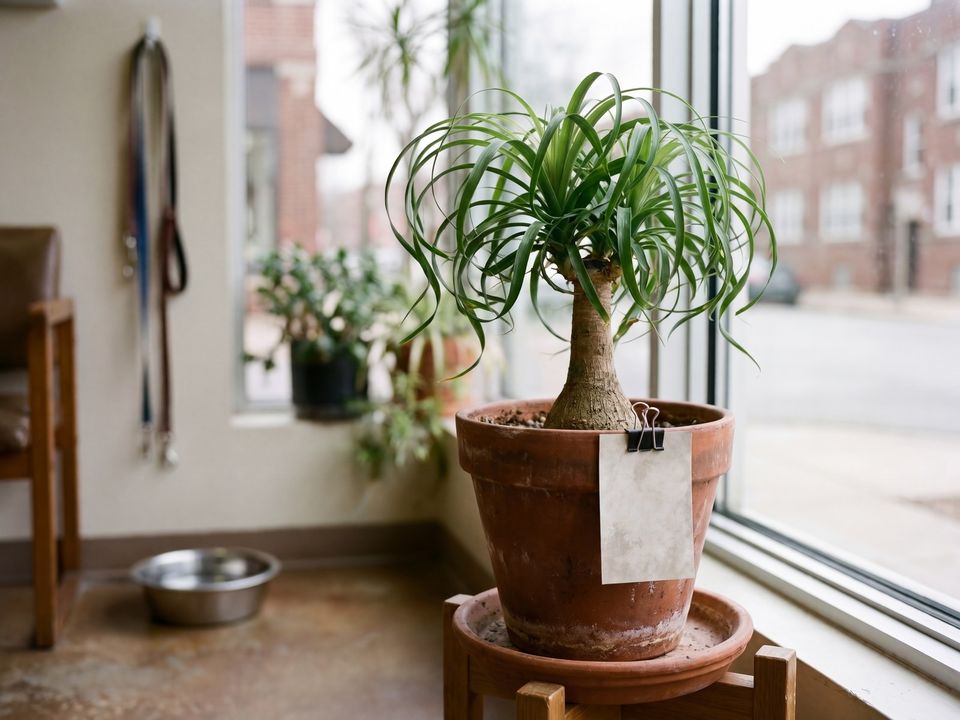
Curly, ribbon-thin leaves spill from a bulb of a trunk. Sun-loving and slow, it shrugs off forgotten waterings.
3.6/5
how easy it is to care for
2.5/5
how much it stands out visually
: Shade to full sun
Your sunniest window; bright light without sun will do
Six or more hours of direct sun a day keeps it happiest, and a south window usually gives the most. Bright light with no sun landing on it will do, though it grows slower there.
Its home ground is the dry shrubland and rocky low forest of eastern Mexico, from Tamaulipas south to Oaxaca (Kew; NC State). The Missouri Botanical Garden sums up its taste in three words: sunny, warm, and dry.
A summer outdoors can suit it, as long as you watch the thermometer. NC State puts its cold limit near 50°F, well above frost, so it goes out only once nights stay mild and comes back in at the first cool spell of fall. On the way out, ease it into full sun gradually rather than all at once (Missouri Botanical Garden).
Of everything on its short list, light is the one worth spoiling it with.
: Monthly
Deep drinks weeks apart; winter asks for even less
In summer, a deep soak roughly 2-3 weeks apart, with the pot drying out between; in winter, stretch it to 3-5. Skipped drinks barely register, but the swollen base can rot in soil kept soggy.
That bulging trunk is its water tank (NC State), so the roots need little soil around them. The Missouri Botanical Garden recommends a relatively small pot with excellent drainage, and NC State suggests the gritty mix sold for cacti and succulents.
A heated winter room is no hardship. NC State notes it prefers dry winters and handles heated indoor air that leaves many houseplants struggling, so it doesn’t need extra humidity.
Neglect has a price, just a small one: in Florida landscapes, plants given extra water through the dry season kept darker green leaves and dropped fewer (University of Florida). If a few tips brown and that bothers you, snip them off (Missouri Botanical Garden). Either way, it survives.
Gone for a while? A month is fine; its trunk holds water for exactly this.
: Large
A bulbous trunk and leafy plume; 6 feet takes many years
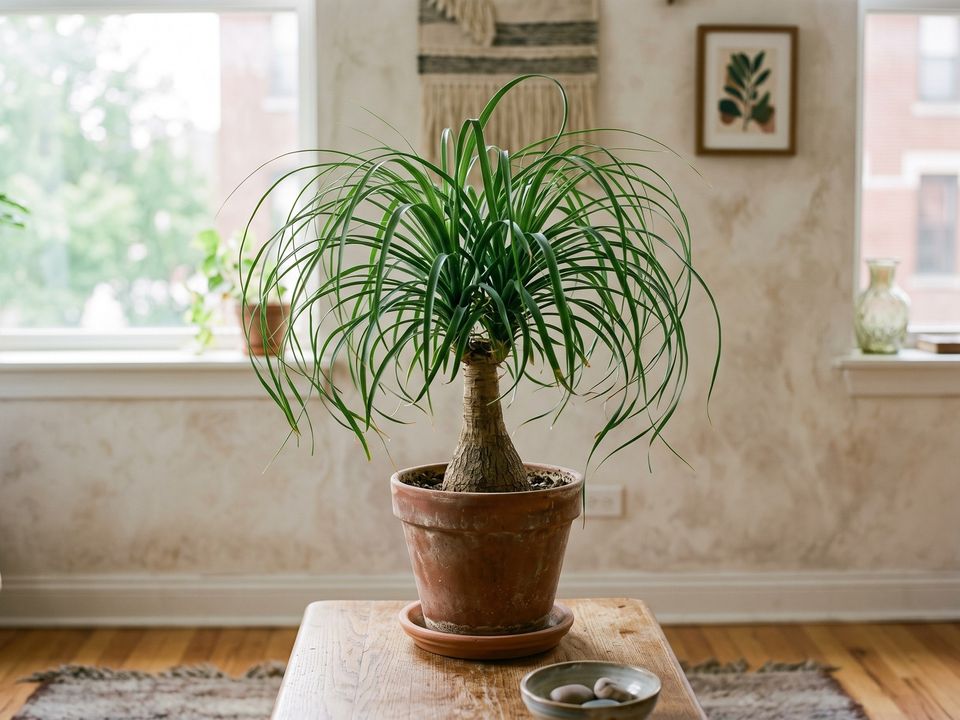
Starts as a bulb with a spray of leaves and climbs to 2-6 feet over many years. A young one can sit on a shelf or table where its leaves spill; an older one holds the floor.
Damage can reshape it. One California Master Gardener’s plant lost its top to a hard freeze and answered with two new branches lower on the trunk (UC Agriculture and Natural Resources).
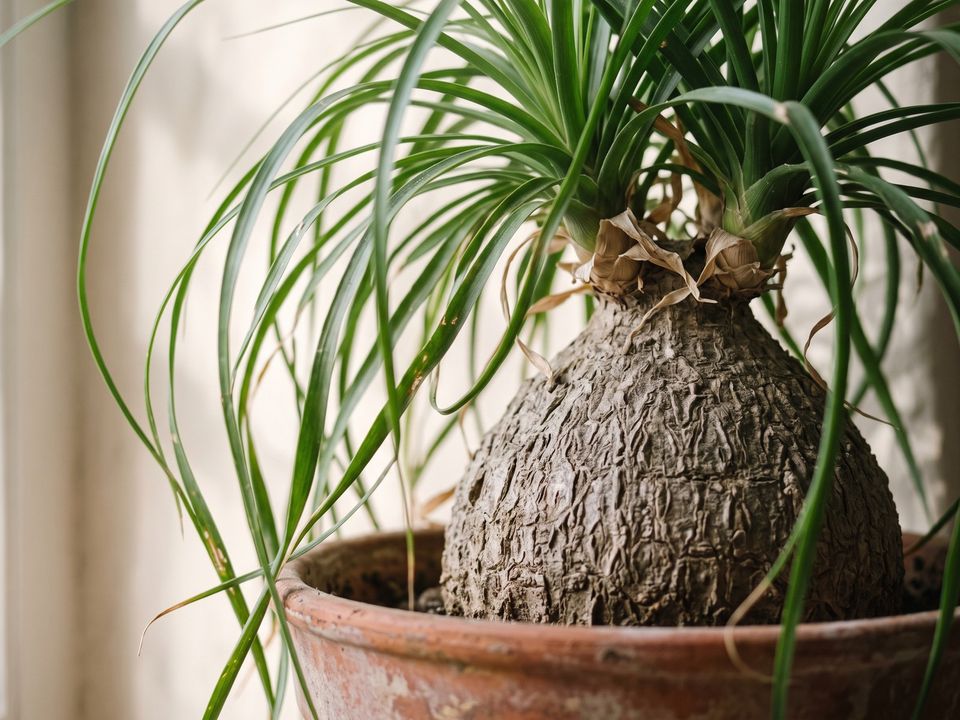
The trunk flares at the soil like a bottle, and its bark ages brown and smooth, marked with old leaf scars, until the swollen foot begins to crack (University of Florida).
The Royal Horticultural Society puts full size 20-50 years out, and that same Master Gardener notes that a ponytail palm outliving its owner isn’t unusual.
Given open space beside a sunny window, where the flared base and the falling leaves both have room, it reads like a small sculpture.
: Pet & kid safe
Nothing to worry about for dogs, cats, or kids
- DogsSafe
- CatsSafe
- KidsSafe
The ASPCA lists it as non-toxic to dogs and cats, and it’s safe for kids too. Just mind the leaf edges: their tiny teeth can be sharp enough to cut skin.
Every rating for this plant points the same way. The ASPCA files it under two names, Pony Tail and Bottle Palm, and clears it for every animal it rates, horses included; NC State tags it non-toxic for cats and dogs as well.
The one honest caveat is the ASPCA’s general one: eating any plant material can bring on vomiting or an upset stomach in a dog or cat.
Watch the name, though. Sago palm, a different plant sold under a similar label, is among the common toxic plants the ASPCA names first. If a plant is tagged only 'palm,' look for Beaucarnea recurvata before you bring it home.
For a home with crawlers, chewers or a cat who bats at anything that dangles, this one can sit on the floor with little worry.
Cats and dogs: The ASPCA lists it as non-toxic.
Kids: No poison-centre listing; rated from university extension sources.
: Dry OK
65-75°F; dry air is fine
Room temperatures of 65-75°F suit it best, and it shouldn’t sit below 50°F. Dry, heated winter air is no hardship, even down to 10% humidity.
- Temperature
- 65-75°F
- Humidity
- 5-24%
: Mealybugs
Mealybugs and scale; check the center of the rosette
Mealybugs and scale are the regulars. Look at the new growth in the center of the leaf rosette, under the leaves, and along the stems. Spider mites can settle on the undersides of young leaves.
- Mealybugs
- Scale
- Spider mites
Not many. A few sap-sucking bugs now and then, and rot if the soil stays wet.
Mealybugs look like tufts of white cotton where the leaves meet the trunk; scale looks like small brown bumps stuck to the leaves. Wipe them off with a cotton swab dipped in rubbing alcohol (a fingernail lifts scale), then check again next week.
Spider mites leave fine webbing and pale speckles on the leaves. Rinse the leaves in the shower, undersides included; if they come back, an insecticidal soap spray is the next step.
Rot is the real danger: a trunk that turns soft or mushy at the base, usually after months of wet soil. Let it dry out completely and water far less; a trunk that’s soft all the way through rarely recovers.
: Little
Turn 4× a year, feed twice, repot every several years
Turn it toward the window 4 times a year for even growth. Feed once or twice in the growing season, since extra browns the tips. Clip brown tips and peel yellow old leaves as needed. Every several years, repot in spring.
- Feed2× a year
- Prune1× a year
- Rotate4× a year
A cactus and succulent mix, or ordinary potting mix cut with sand or fine gravel, in a pot with a drainage hole. A small pot suits it: it stays compact, and there’s less soil to stay wet.
Repot only when the trunk nearly fills the pot; UW–Madison Extension notes it can go many years in the same pot. Move it up just one size, in spring or summer.
Food is optional: a cactus or houseplant fertilizer once or twice in spring and summer is plenty. Too much browns the leaf tips.
: Simple
Curly green ribbons spilling from a bulb of a trunk
Thin, ribbon-like leaves in one plain green curl and arch out from a swollen, bulb-shaped trunk. The leaves are matte and smooth, and the spray covers part of the soil.
Where to find me
Not yet pilferableFun fact
Bottle palm, elephant-foot tree: some of its names point to that swollen base, while ponytail points to the leaves. And recurvata means curved backwards, for leaves that curl down.
Designer tips
Sculptural and a little funny, with its fat trunk and wild hair: it suits a modern room, a desert-toned one, or anywhere that needs a conversation piece.
Troubleshooting
The leaf tips are turning brown
Usually water or salts: UW-Madison Extension names too much or too little water, too much fertilizer, and salts building up in the soil. Snip the brown bits if they bother you; once a season, a long, slow watering rinses salts from the pot.
The trunk is soft at the base
Likely rot, from soil that stayed wet too long. Let the pot dry out completely, then keep soaks at least 2-3 weeks apart, longer in winter. A little softness can firm up once it dries, though a trunk that’s mushy through rarely recovers.
The trunk looks shrunken and wrinkled
It’s been living on the water stored in its trunk. If the trunk is still firm, give it a deep soak now, then one every 2-3 weeks through summer.
See all 9
My cat keeps chewing the leaves
That’s hard on the leaves, not the cat: the ASPCA lists it as non-toxic to cats, dogs, and horses. A big chew can still upset a stomach, as any plant can, and ragged tips can be snipped if they bother you.
Why hasn’t it grown?
It’s slow by nature, and a small pot keeps it small (UW-Madison Extension). More sun speeds it a little; more water only risks rot.
Can it live away from a window?
It does best right by your sunniest window, and a spot with bright light but no sun works, just slower. In a dim room it slowly declines, however carefully you water it.
Is it really a palm?
No. It’s a succulent related to agaves, which is why UF/IFAS puts 'palm' in quotes. The swollen trunk is a water tank, and that’s why it forgives so much.
Can it go outside for the summer?
Yes, and it loves the sun out there; ease it in over a week or two, since UW-Madison warns it can sunburn otherwise. Bring it in before nights drop below 50°F.
Will it flower?
Almost certainly not indoors. The Missouri Botanical Garden says flowers rarely appear on houseplants; it takes a big, old plant.
Propagation
Not really at home. Growers raise ponytail palms from seed, which UF/IFAS notes usually comes from Mexico, and UW–Madison Extension says seed is the only way. Enjoy the one you have.
The PILF Matrix
3.6/5
how easy it is to care for
2.5/5
how much it stands out visually
“The one with a high pony and low expectations.”


- bottle palm
Rated 1-5, with 5 being easiest
Built from light, water, air, pests, and upkeep.
Rated 1-5, with 5 being easiest
Rated 1-5, with 5 being highest presence
Built from its scale (size, shape, growth) and its look (color and flowers, shine, fullness).
Rated 1-5, with 5 being highest presence
Where it sits and what sun touches it.
- Dim shadeA dark corner or a windowless room; natural light casts no shadow
- Bright shadeBack from the window in a south-, east- or west-facing room, or right by a north-facing one, where only low early or late summer sun reaches it
- Filtered sunBehind a sheer curtain or tinted glass; the sun’s shadows are blurred
- Partial sunIn an east- or west-facing window: up to a few hours of direct sun
- Full sunThe sunniest spot you have, usually a south-facing window, with direct sun 6+ hours a day
How often, and what the soil does between.
- MonthlyEvery 2-3 weeks in summer and 3-5 in winter; the soil dries all the way between
- 2-3× a monthEvery 7-14 days in summer, longer in winter; the top of the soil dries between
- Weekly+About every 4-8 days in summer; the soil stays lightly damp
How much room it usually takes indoors.
Size
- TinyUnder 6 inches tall or wide; for a desk or a sill
- Small6 inches to 1.5 feet tall or wide; for a shelf or a sill
- Medium1.5 to 3 feet tall or wide; for a table or a stand
- Large3 to 6 feet tall or wide; for the floor
- GiantOver 6 feet tall or wide; a statement in the corner
Shape
- TreeA trunk that branches into a canopy
- CaneBare stalks topped with leaves
- UprightStiff stems or leaves rising straight from the soil
- FountainLeaves or fronds arching out from the center
- BushyA full, rounded mound of leaves
- RosetteLeaves radiating from one low point
- ViningTrails, climbs, or both
Growth
How fast it gets there.
- SlowUnder 6 inches of new growth a year
- Moderate6-12 inches a year, mostly in spring and summer
- FastOver 12 inches a year; it may want trimming or training
What risks exist for pets and kids.
- Pet & kid safeNothing to worry about
- Mildly irritatingMay irritate the mouth or stomach if chewed, or for some plants, the skin if handled
- Moderately toxicCan cause illness if eaten, though typically not serious or fatal
- DangerousCan cause serious illness if eaten, including some reports of death
- Not yet ratedNot clearly rated by our sources; please check with your vet or doctor
For its safety ratings, PILF relies on research and guidance from leading sources, including the ASPCA, Pet Poison Helpline, Merck Veterinary Manual, Poison Control, and Children’s Hospital of Philadelphia, and others.
The small jobs beyond watering, over a year.
- Little upkeepA few small jobs a year beyond watering, like a feed now and then
- Some upkeepA small job about once a month beyond watering, like feeding or turning it
- More upkeepA small job every couple of weeks beyond watering, like a wipe, a turn, or a feed
- Most upkeepA small job most weeks beyond watering, like raising the humidity or misting
- TreeA trunk that branches into a canopy
- CaneBare stalks topped with leaves
- UprightStiff stems or leaves rising straight from the soil
- FountainLeaves or fronds arching out from the center
- BushyA full, rounded mound of leaves
- RosetteLeaves radiating from one low point
- ViningTrails, climbs, or both
How fast it gets there.
- SlowUnder 6 inches of new growth a year
- Moderate6-12 inches a year, mostly in spring and summer
- FastOver 12 inches a year; it may want trimming or training
The temperature and humidity it’s comfortable in.
How dry a room it takes.
- Needs 50%+ humidity
- Fine at 35% humidity
- Fine at 15-20% humidity
The bugs that usually find it, by name.
How often pests find it.
- 5+ regular pests
- 3 regular pests
- Pests are rare
The year’s chores: feeding, pruning, repotting, and cleaning.
Chores beyond water (what needs work means).
- Most upkeep
- Some upkeep
- Little upkeep
Its finish, fullness, and texture.
Color, pattern, and flowers.
- SimpleOne green, one texture, nothing to read
- SuaveA sheen, a stripe, or a clean shape that catches the eye up close
- ShowyColor, pattern, or blooms you see from across the room
How the leaves catch light.
- Matte
- Satin
- Glossy or waxy
How much it fills its pot.
- Soil shows
- Soil partly hidden
- Leaves hide the soil