Prayer Plant
Maranta leuconeura
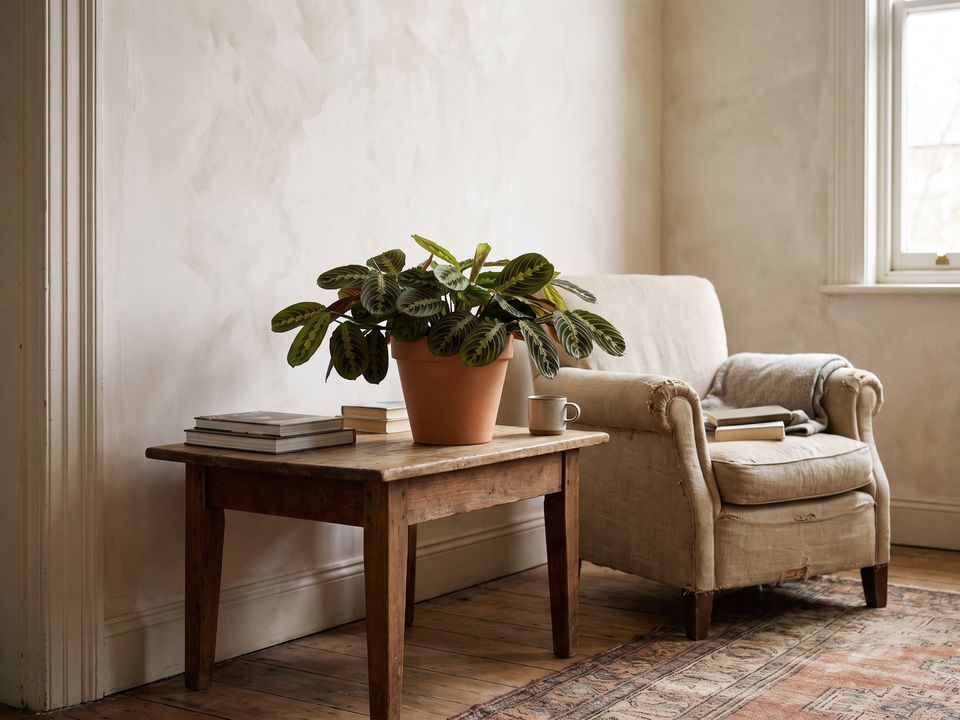
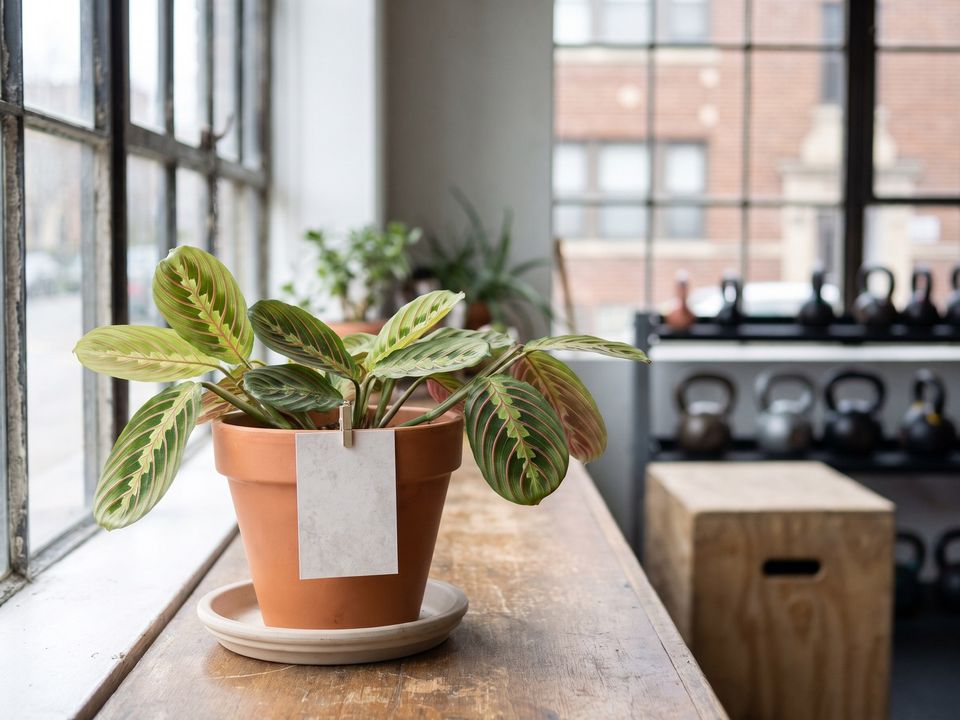
Red-ribbed leaves painted lime and deep green, on a low, spreading clump. Charming, and a little particular.
2.4/5
how easy it is to care for
3.4/5
how much it stands out visually
: Dim to bright
Lots of light but no sun keeps its reds and limes vivid
Its reds and limes hold their color best with plenty of light and no direct sun, which bleaches them. It gets by in medium or low light, just a little duller.
NC State files it under dappled light, the kind that reaches a forest floor through a canopy overhead. It’s native to the wet tropics of central and eastern Brazil (Kew), where Missouri Botanical Garden describes it as low and clump-forming.
A north-facing sill, or a table well back from an east window, is a close indoor match for that canopy shade. When light runs short, the purple-red undersides fade along with the markings on top (NC State notes both sides lose color).
The cold of a January pane is the other limit: it has no tolerance for chilly drafts, so keep it out of them in winter (NC State).
: Weekly+
Evenly damp spring to fall, a touch drier in winter
Every 5-7 days from spring to fall, stretching to 7-10 in winter. It prefers steady, even moisture, though poorly drained, soggy soil can lead to root rot.
In dry winter air, its leaf edges may curl or crisp. NC State says it needs high humidity, so a humidified room suits it; a pebble tray is an optional extra, never a must.
Penn State Extension’s guide to Maranta problems calls brown, dying leaf edges tip burn, and traces them to fluoride, phosphate fertilizer, or strong light. If the browning bugs you, switch to rainwater or distilled water, feed lightly, and choose a mix without perlite, which carries fluoride of its own. Skip all that and the plant carries on, just with crisper margins.
Gone for a while? A week is its limit; water it the day you leave and set it back from the window so the soil dries out more slowly.
: Small
A low clump 6-12 inches tall, slowly spreading to 2 feet
Only 6-12 inches tall but sprawling to 2 feet, so it wants width more than height: a low shelf or a wide sill. Its rhizomes spread sideways, so a crowded pot divides easily into two.
In warm climates it’s planted as a groundcover, shopping malls included, and it grows slowly (UF/IFAS). The red-veined form takes about 2-5 years to reach full size (RHS).
Each new leaf arrives rolled into a tight tube and opens flat (NC State), so on a growing plant you’ll often spot a scroll or two among the open leaves.
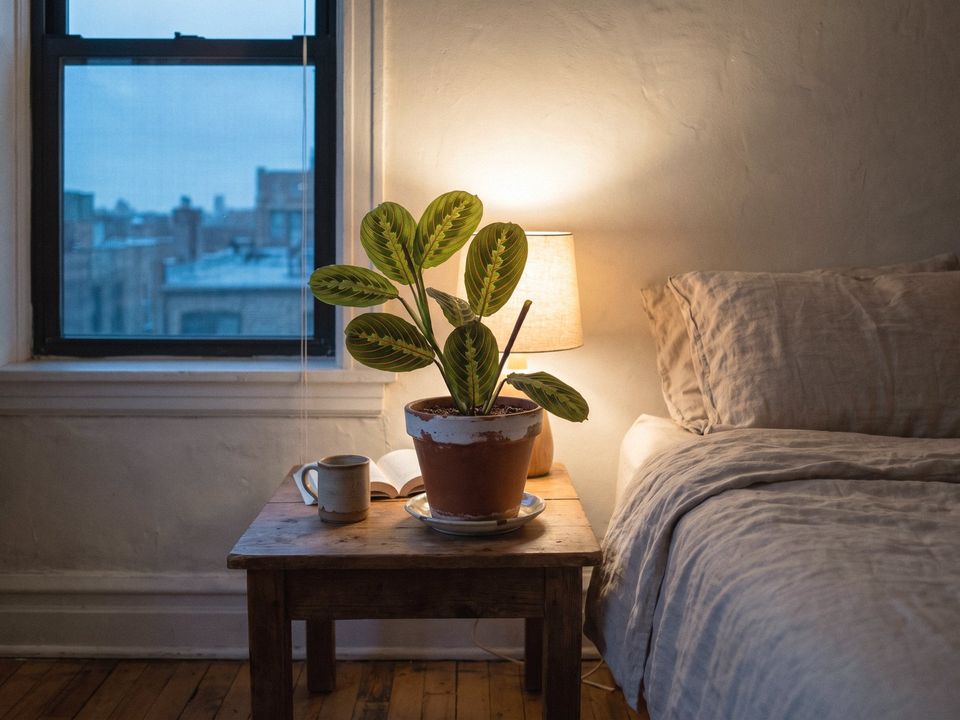
Because the pattern sits on top of each leaf, it reads best looked down on: a nightstand, a bathroom ledge, a low table beside a sofa.
: Pet & kid safe
Nothing to worry about for dogs, cats, or kids
- DogsSafe
- CatsSafe
- KidsSafe
The ASPCA lists the prayer plant as non-toxic to dogs and cats, and CHOP, a children’s poison center, lists it as non-poisonous for kids.
Good news all around: there’s nothing harmful in it for a toddler, a dog, or a cat. Look it up on the ASPCA’s list and you’ll find its entry filed under Calathea insignis, a cousin in the same family; the rating holds either way.
The bigger risk runs the other way. A writer at the Chicago Botanic Garden watched her cat chew her prayer plant until it died, and the Garden’s floriculturist notes that even a non-toxic plant may bring on a little tummy discomfort when eaten.
If a pet treats it as a snack, a hanging basket, a common use NC State notes, may keep it out of easy reach, though a determined cat can climb.
Cats and dogs: The ASPCA lists it as non-toxic.
Kids: CHOP lists it as non-poisonous.
: Average
60-90°F and humid air; keep it above 50°F
Happiest at 60-90°F, and it shouldn’t sit below 50°F. It wants at least 40% humidity.
- Temperature
- 60-90°F
: Spider mites
Spider mites most often; look under the leaves
Spider mites are the common guest, and they settle on leaf undersides. Mealybugs hide in leaf axils, stem joints, and leaf bases, and thrips tuck inside rolled new leaves. Flip a few leaves when you water.
- Spider mites
- Mealybugs
- Thrips
- Caterpillars
Not many. Spider mites are the one to watch for, especially in dry winter air, then mealybugs, and root rot if the soil stays soggy.
Spider mites leave fine webbing and a speckled, faded look on the leaves. Rinse the whole plant in the shower, undersides of the leaves included, and raise the humidity, since mites thrive in dry air. If they come back, an insecticidal soap is the next step.
Mealybugs look like tufts of white cotton where the leaves meet the stems. Wipe them off with a cotton swab dipped in rubbing alcohol, then check again next week.
Brown spots that spread across a leaf are leaf spot, a fungus that likes wet leaves. Cut off the spotted leaves and water the soil, not the plant.
: Most
Humidity weekly, feed monthly in summer, divide in spring
Keep humidity up year-round, and use low-fluoride water at every watering, since fluoride burns the leaves. Feed monthly in spring and summer, lightly, and much less from autumn on. Divide in spring when repotting.
- Feed6× a year
- Raise humidity52× a year
- Use low-fluoride water48× a year
- Divide1× a year
An ordinary peat-based potting mix that holds moisture but drains, in a pot with a drainage hole. A wide, shallow pot suits its spread.
Repot when it fills the pot, in spring, which is also the time to divide it (see Propagation).
Food is optional: a houseplant fertilizer at half strength a few times in spring and summer is plenty. Too much burns the leaf edges.
: Showy
Lime and deep green leaves, red ribs, in a low clump
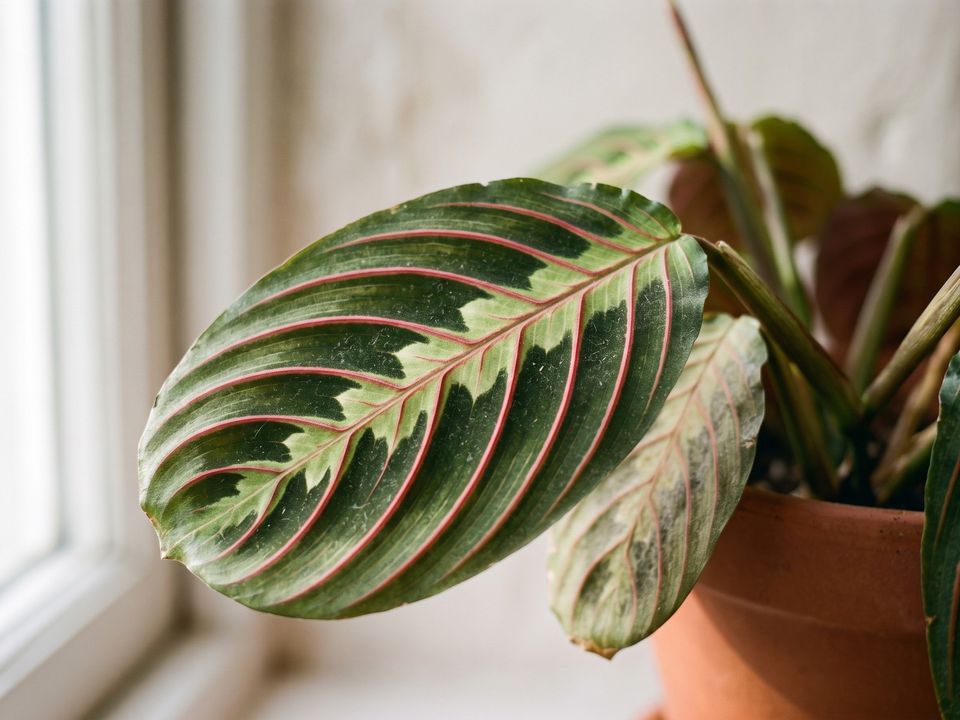
Each oval leaf is painted lime and deep green, with red ribs running through it. The surface has a gentle sheen, and the leaves overlap in a low, spreading clump that covers the soil.
Where to find me
Not yet pilferableFun fact
It also answers to rabbit tracks, for the dark blotches on either side of each leaf’s midrib, and herringbone plant, for the red veins that branch off like the bones of a fish.
Designer tips
A painterly, patterned plant for a side table or a bright bathroom, best seen up close.
Troubleshooting
Why do the leaves fold up at night?
That’s its namesake: by day it holds its leaves flat, and in the evening they rise and fold upright, like hands in prayer, then lie flat again by morning. Nothing to fix.
The leaf edges are brown and crispy
Usually dry air, fluoride in tap water or too much fertilizer. If it bothers you, a humidifier nearby, rain or distilled water and a lighter hand with food help; skip all that and it carries on, just with crisper edges.
Why are the leaf colors fading?
Sun on the leaves bleaches the pattern, so if it gets direct sun, move it back or behind a sheer. A dim spot dulls the colors too, top and underside, and a bit more light usually brings them back in new leaves.
See all 8
It looks worse every winter
Dry heat and cold glass, most likely. Moving it away from windows and vents helps, a humidifier makes the biggest difference, and a little less water until spring suits it.
Why are stems collapsing at the soil?
Likely root rot, from soil that stayed soggy. Cut off the collapsed stems, empty the saucer, and root a healthy stem tip or two in water as a backup.
The leaves look speckled, with fine webbing
Spider mites, its most common pest, and dry air is what they love. Raising the humidity helps as much as a rinse in the shower, undersides included; insecticidal soap is the next step if they come back.
Can it live without a window?
Not for long. It gets by across the room from a window, a little duller and slower, and does best a few feet from an east or north one.
My cat keeps chewing it
Nothing harmful for your cat: the ASPCA lists the prayer plant as non-toxic to cats and dogs. A big nibble of any plant can upset a stomach a little, and the plant is the one more likely to suffer; a hanging basket may keep it out of reach.
Propagation
Yes: divide it when you repot, or root a stem cutting.
- To divide, ease it out of its pot and pull the clump apart into pieces that each have a few stems and their own roots.
- Pot each one at the depth it grew before.
Or cut a stem just below a node (the joint where a leaf meets the stem), with a leaf or two on it, and set it in a glass of water or a small pot of damp mix somewhere warm. Pot it up once it has roots.
The PILF Matrix
2.4/5
how easy it is to care for
3.4/5
how much it stands out visually
“The one who lays you down to sleep and shouldn’t die before you wake.”


- herringbone plant
- rabbit tracks
Rated 1-5, with 5 being easiest
Built from light, water, air, pests, and upkeep.
Rated 1-5, with 5 being easiest
Rated 1-5, with 5 being highest presence
Built from its scale (size, shape, growth) and its look (color and flowers, shine, fullness).
Rated 1-5, with 5 being highest presence
Where it sits and what sun touches it.
- Dim shadeA dark corner or a windowless room; natural light casts no shadow
- Bright shadeBack from the window in a south-, east- or west-facing room, or right by a north-facing one, where only low early or late summer sun reaches it
- Filtered sunBehind a sheer curtain or tinted glass; the sun’s shadows are blurred
- Partial sunIn an east- or west-facing window: up to a few hours of direct sun
- Full sunThe sunniest spot you have, usually a south-facing window, with direct sun 6+ hours a day
How often, and what the soil does between.
- MonthlyEvery 2-3 weeks in summer and 3-5 in winter; the soil dries all the way between
- 2-3× a monthEvery 7-14 days in summer, longer in winter; the top of the soil dries between
- Weekly+About every 4-8 days in summer; the soil stays lightly damp
How much room it usually takes indoors.
Size
- TinyUnder 6 inches tall or wide; for a desk or a sill
- Small6 inches to 1.5 feet tall or wide; for a shelf or a sill
- Medium1.5 to 3 feet tall or wide; for a table or a stand
- Large3 to 6 feet tall or wide; for the floor
- GiantOver 6 feet tall or wide; a statement in the corner
Shape
- TreeA trunk that branches into a canopy
- CaneBare stalks topped with leaves
- UprightStiff stems or leaves rising straight from the soil
- FountainLeaves or fronds arching out from the center
- BushyA full, rounded mound of leaves
- RosetteLeaves radiating from one low point
- ViningTrails, climbs, or both
Growth
How fast it gets there.
- SlowUnder 6 inches of new growth a year
- Moderate6-12 inches a year, mostly in spring and summer
- FastOver 12 inches a year; it may want trimming or training
What risks exist for pets and kids.
- Pet & kid safeNothing to worry about
- Mildly irritatingMay irritate the mouth or stomach if chewed, or for some plants, the skin if handled
- Moderately toxicCan cause illness if eaten, though typically not serious or fatal
- DangerousCan cause serious illness if eaten, including some reports of death
- Not yet ratedNot clearly rated by our sources; please check with your vet or doctor
For its safety ratings, PILF relies on research and guidance from leading sources, including the ASPCA, Pet Poison Helpline, Merck Veterinary Manual, Poison Control, and Children’s Hospital of Philadelphia, and others.
The small jobs beyond watering, over a year.
- Little upkeepA few small jobs a year beyond watering, like a feed now and then
- Some upkeepA small job about once a month beyond watering, like feeding or turning it
- More upkeepA small job every couple of weeks beyond watering, like a wipe, a turn, or a feed
- Most upkeepA small job most weeks beyond watering, like raising the humidity or misting
- TreeA trunk that branches into a canopy
- CaneBare stalks topped with leaves
- UprightStiff stems or leaves rising straight from the soil
- FountainLeaves or fronds arching out from the center
- BushyA full, rounded mound of leaves
- RosetteLeaves radiating from one low point
- ViningTrails, climbs, or both
How fast it gets there.
- SlowUnder 6 inches of new growth a year
- Moderate6-12 inches a year, mostly in spring and summer
- FastOver 12 inches a year; it may want trimming or training
The temperature and humidity it’s comfortable in.
How dry a room it takes.
- Needs 50%+ humidity
- Fine at 35% humidity
- Fine at 15-20% humidity
The bugs that usually find it, by name.
How often pests find it.
- 5+ regular pests
- 3 regular pests
- Pests are rare
The year’s chores: feeding, pruning, repotting, and cleaning.
Chores beyond water (what needs work means).
- Most upkeep
- Some upkeep
- Little upkeep
Its finish, fullness, and texture.
Color, pattern, and flowers.
- SimpleOne green, one texture, nothing to read
- SuaveA sheen, a stripe, or a clean shape that catches the eye up close
- ShowyColor, pattern, or blooms you see from across the room
How the leaves catch light.
- Matte
- Satin
- Glossy or waxy
How much it fills its pot.
- Soil shows
- Soil partly hidden
- Leaves hide the soil