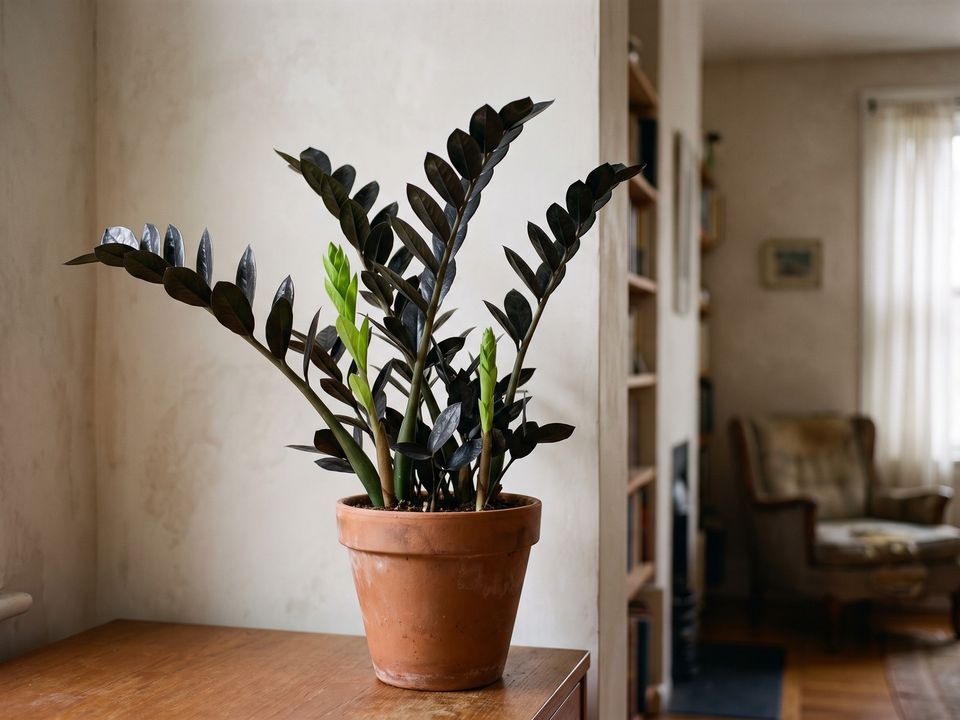

Raven ZZ Plant
Zamioculcas zamiifolia 'Dowon'
Leaflets so dark they pass for black, on stiff stalks that rise like feathers. Dim corners and missed waterings barely register.
4.8/5
how easy it is to care for
3.6/5
how much it stands out visually
: Dim to bright
A dim room or a bright one; direct sun can scald it
No window? A small grow light does the trick.
Its best growing comes with plenty of brightness and no direct sun, though it tolerates very low light. Direct rays can scald those near-black leaflets brown.
Indoors, try a spot several feet from an east or west window, beside a south window but out of its beam, or right on a north-facing sill. Where it’s planted outdoors in warm climates, NC State calls for partial to deep shade.
If scorched patches turn up on the leaflets nearest the glass, edge it farther into the room.
In a dim corner it carries on, which is why it turns up so often in commercial interiors (NC State). It’s built for the shady side of things, and it won’t ask you for more.
: Monthly
Twice a month in summer, monthly in winter; skips are fine
Water it, then forget it: a month or so in winter, closer to two weeks in summer. Wet feet are the one thing it won’t take; a skipped turn, it never notices.
Its reserves sit low. The thick, fleshy leaf stalks and the tuber-like rhizome under the soil both bank water, and the waxy leaflets give very little of it back to the air; University of Florida researchers found it can survive 3-4 months unwatered.
Pushed that far, it sheds leaflets and the upper part of each stalk, and the swollen base holds on until rain, or you, return (UF/IFAS). Not pretty, but survivable.
That same rhizome is why rot is the real risk (Clemson Extension): a water bank kept wet starts to break down. Clemson suggests a mix of half potting soil, a quarter perlite, and a quarter sand.
Gone for a while? Six weeks is fine; water it the day you leave and it won’t know you went.
: Medium
Stiff, upright stalks that take years to reach 3 feet
Dark stalks rise 2-3 feet and may spread nearly as wide. Set on a side table against a pale wall, the near-black leaves show best; it needs feeding only once or twice a year.
Its slow pace is inherited. The East African soils it evolved in are poor in nutrients, and it grows slowly to match, even when everything’s right (University of Illinois Extension; UF/IFAS).
Above the soil, there’s no stem at all: each upright 'branch' is one compound leaf rising straight from the rhizome (UF/IFAS). Growers sometimes treat it as a pseudo-bonsai.
A single leaflet can start a whole plant: over a few months it forms roots and then a tiny rhizome of its own (Illinois Extension). Splitting the root mass is quicker.
Because it rises rather than sprawls, it can fill a bookshelf gap or stand beside a doorway where a bushier plant would crowd the path.
: Mildly irritating
Chewing can sting the mouths of dogs, cats, or kids
- DogsMildly irritating
- CatsMildly irritating
- KidsMildly irritating
A chewed leaf can sting a pet’s or child’s mouth and bring on drooling; a bigger helping may mean vomiting or diarrhea that passes. The ASPCA names ZZ among calcium-oxalate plants of low severity.
No major pet poison database lists ZZ; it has the same mouth-stinging crystals as pothos. A Thai poison-centre review records one cat death, a single case.
The irritant is calcium oxalate, carried in the leaves (NC State). In a child, the burn can reach the lips and throat as well as the mouth. Rarely, a pet’s throat may swell, and that is worth a call.
The sap can irritate skin too (NC State’s Raven entry), so gloves are a good idea when you snip leaflets to root.
If symptoms don’t settle, or anything worries you, call Poison Control for a child. For a pet, call your vet or the ASPCA Animal Poison Control Center (a fee may apply).
Its stiff stalks don’t trail or dangle the way vining plants do, which leaves a cat less to bat at. Set it on a stand or dresser above toddler height. A passing nibble is then likely to mean a sore mouth and some drool, and little more.
- NC State Extension: mild for kids.
Cats and dogs: No vet database lists it; rated from university extension sources.
Kids: No poison-centre listing; rated from university extension sources.
: Dry OK
68-75°F; dry air is fine
Happiest at 68-75°F, and it shouldn’t sit below 60°F. Keep it away from cold glass in winter. Humidity can drop to 10% without trouble.
- Temperature
- 68-75°F
: Pest-resistant
Rarely bothered; check new shoots and leaflet undersides
Rarely bothered. Armored scale and whiteflies hide on the leaflet undersides, and mealybugs at the soil line and leaflet joints. Aphids favor soft lime-green shoots, and thrips the unfurling leaflets.
- Armored scale
- Mealybugs
- Aphids
- Thrips
- Whiteflies
Very few. Growers report hardly any pests or diseases on it; the one real danger is rot from wet soil.
Scale is the pest to watch for: small brown bumps stuck to the stems and leaves. Lift them off with a fingernail or a cotton swab dipped in rubbing alcohol, then check again next week.
Rot shows as a stem going yellow and soft at the base while the soil is still wet. Cut that stem off at the soil, let the pot dry right out, and water less often from then on.
: Some
Turn monthly; feed twice in summer; repot every few years
Turn the pot monthly so every side gets window light. Feed once or twice in spring and summer, and wipe the leaflets with a damp cloth twice a year. Repot in spring when rhizomes crowd, dividing if you like.
- Feed2× a year
- Rotate12× a year
- Clean leaves2× a year
A fast-draining mix in a pot with a drainage hole, snug rather than roomy: extra soil stays wet around the rhizomes. Ordinary potting mix cut half and half with perlite and sand works well.
Repot only when the rhizomes crowd the pot, into a pot one size up, in spring or summer while it’s growing.
Food is optional: a balanced houseplant fertilizer once or twice a year, in spring or summer, is all it uses.
: Suave
Near-black glossy leaflets on upright stalks
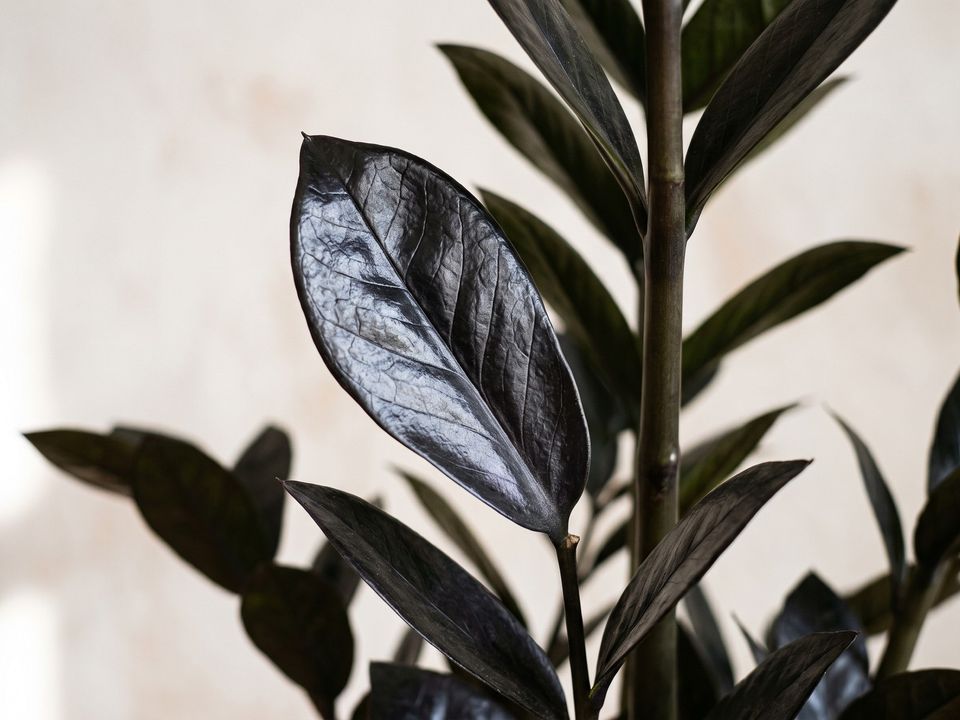
Leaflets so dark they pass for black line stiff stalks that rise like feathers. Each one is glossy and waxy, as if lacquered. The plant fills in enough to cover part of the soil.
Where to find me
Not yet pilferableFun fact
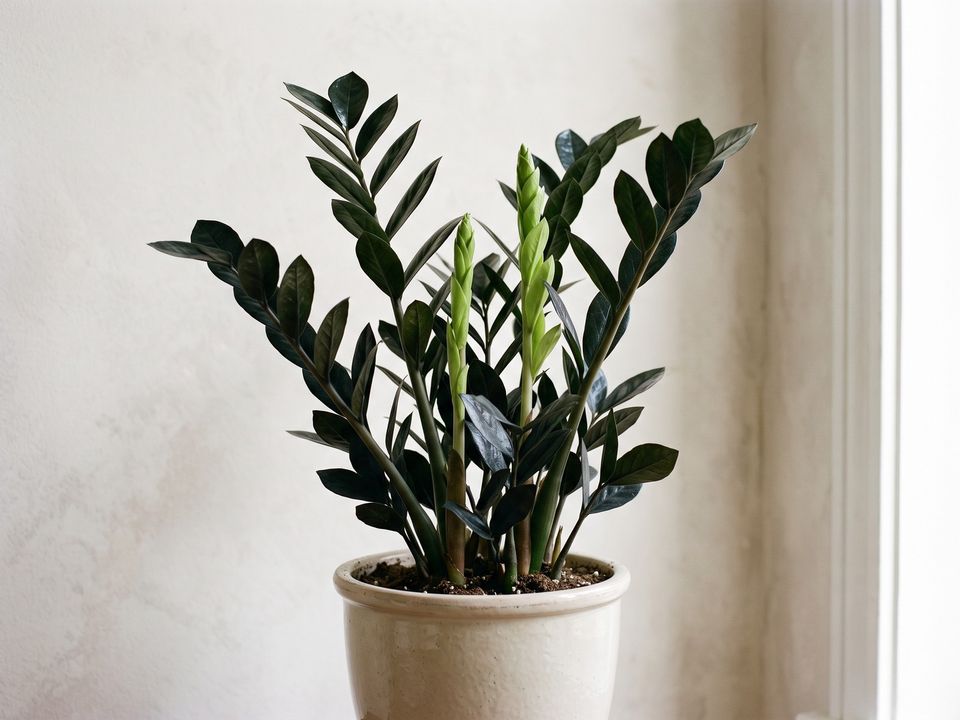
New leaves unfurl a bright lime green, then darken to the glossy near-black that gave Raven its name, so one plant often wears both colors at once.
Designer tips
Near-black and glossy, it reads modern and a little moody, and it looks best against something pale.
Troubleshooting
How often should I really water it?
About every two weeks in spring and summer and once a month in winter, with the soil drying all the way between. When in doubt, wait: UF/IFAS found ZZ can go 3-4 months without water, and it’s wet soil that does it in.
A stem is turning yellow and soft at the base
Likely too much water, with the rhizome under that stem starting to rot. Cut the stem off at the soil, let the pot dry out completely, and water less often; the rest of the plant usually carries on.
Why are the new leaves bright green?
That’s how it grows. New stems come up lime green, start darkening within a month or two, and turn fully black about a year after they appear (per its plant patent).
See all 9
Can it live in a room with no window?
Yes, if overhead lights or lamps are on for much of the day: UF/IFAS found ZZ still making new leaves after more than a year in very dim interior light. In total darkness, no plant lasts.
My cat chewed a leaf
It’s mildly irritating: calcium-oxalate crystals can leave a sore, drooly mouth, and a bigger helping may bring vomiting that passes; the ASPCA counts ZZ among low-severity oxalate plants. If vomiting keeps up, call your vet or the ASPCA Animal Poison Control Center.
Why hasn’t it grown in months?
That’s the deal with this one: UF/IFAS says ZZ grows slowly even in ideal conditions. A brighter spot out of the sun’s reach and a warm room speed it up a little; extra water and fertilizer don’t.
Some leaflets look brown or scorched
Sun landing on them through the glass. A spot farther from the window stops it; the marked leaflets stay marked, but new ones come in clean.
Are the dark spots on the stems a problem?
No: Clemson Extension says black spots on ZZ stems are normal. A stem that’s soft or mushy at the base is the one to look at, since that points to too much water.
I’m away for a month
Fine: it can go six weeks, so water it the day you leave and it likely won’t notice you went.
Propagation
Yes, slowly, and every new plant comes up just as black as its parent (its plant patent says it stays true from leaf cuttings).
Division is quickest: when you repot, pull the clump apart into pieces that each have a rhizome and a few stems, and pot them up at the same depth.
Or push a single leaflet halfway into damp mix. It grows a small rhizome of its own, then a first stem. Growers in warm greenhouses get a potted plant from a single leaflet in five to six months; at home, expect it to take longer.
The PILF Matrix
4.8/5
how easy it is to care for
3.6/5
how much it stands out visually
“The one that dresses for the funeral it never needs.”


- Raven ZZ
Rated 1-5, with 5 being easiest
Built from light, water, air, pests, and upkeep.
Rated 1-5, with 5 being easiest
Rated 1-5, with 5 being highest presence
Built from its scale (size, shape, growth) and its look (color and flowers, shine, fullness).
Rated 1-5, with 5 being highest presence
Where it sits and what sun touches it.
- Dim shadeA dark corner or a windowless room; natural light casts no shadow
- Bright shadeBack from the window in a south-, east- or west-facing room, or right by a north-facing one, where only low early or late summer sun reaches it
- Filtered sunBehind a sheer curtain or tinted glass; the sun’s shadows are blurred
- Partial sunIn an east- or west-facing window: up to a few hours of direct sun
- Full sunThe sunniest spot you have, usually a south-facing window, with direct sun 6+ hours a day
How often, and what the soil does between.
- MonthlyEvery 2-3 weeks in summer and 3-5 in winter; the soil dries all the way between
- 2-3× a monthEvery 7-14 days in summer, longer in winter; the top of the soil dries between
- Weekly+About every 4-8 days in summer; the soil stays lightly damp
How much room it usually takes indoors.
Size
- TinyUnder 6 inches tall or wide; for a desk or a sill
- Small6 inches to 1.5 feet tall or wide; for a shelf or a sill
- Medium1.5 to 3 feet tall or wide; for a table or a stand
- Large3 to 6 feet tall or wide; for the floor
- GiantOver 6 feet tall or wide; a statement in the corner
Shape
- TreeA trunk that branches into a canopy
- CaneBare stalks topped with leaves
- UprightStiff stems or leaves rising straight from the soil
- FountainLeaves or fronds arching out from the center
- BushyA full, rounded mound of leaves
- RosetteLeaves radiating from one low point
- ViningTrails, climbs, or both
Growth
How fast it gets there.
- SlowUnder 6 inches of new growth a year
- Moderate6-12 inches a year, mostly in spring and summer
- FastOver 12 inches a year; it may want trimming or training
What risks exist for pets and kids.
- Pet & kid safeNothing to worry about
- Mildly irritatingMay irritate the mouth or stomach if chewed, or for some plants, the skin if handled
- Moderately toxicCan cause illness if eaten, though typically not serious or fatal
- DangerousCan cause serious illness if eaten, including some reports of death
- Not yet ratedNot clearly rated by our sources; please check with your vet or doctor
For its safety ratings, PILF relies on research and guidance from leading sources, including the ASPCA, Pet Poison Helpline, Merck Veterinary Manual, Poison Control, and Children’s Hospital of Philadelphia, and others.
The small jobs beyond watering, over a year.
- Little upkeepA few small jobs a year beyond watering, like a feed now and then
- Some upkeepA small job about once a month beyond watering, like feeding or turning it
- More upkeepA small job every couple of weeks beyond watering, like a wipe, a turn, or a feed
- Most upkeepA small job most weeks beyond watering, like raising the humidity or misting
- TreeA trunk that branches into a canopy
- CaneBare stalks topped with leaves
- UprightStiff stems or leaves rising straight from the soil
- FountainLeaves or fronds arching out from the center
- BushyA full, rounded mound of leaves
- RosetteLeaves radiating from one low point
- ViningTrails, climbs, or both
How fast it gets there.
- SlowUnder 6 inches of new growth a year
- Moderate6-12 inches a year, mostly in spring and summer
- FastOver 12 inches a year; it may want trimming or training
The temperature and humidity it’s comfortable in.
How dry a room it takes.
- Needs 50%+ humidity
- Fine at 35% humidity
- Fine at 15-20% humidity
The bugs that usually find it, by name.
How often pests find it.
- 5+ regular pests
- 3 regular pests
- Pests are rare
The year’s chores: feeding, pruning, repotting, and cleaning.
Chores beyond water (what needs work means).
- Most upkeep
- Some upkeep
- Little upkeep
Its finish, fullness, and texture.
Color, pattern, and flowers.
- SimpleOne green, one texture, nothing to read
- SuaveA sheen, a stripe, or a clean shape that catches the eye up close
- ShowyColor, pattern, or blooms you see from across the room
How the leaves catch light.
- Matte
- Satin
- Glossy or waxy
How much it fills its pot.
- Soil shows
- Soil partly hidden
- Leaves hide the soil