Rex Begonia
Begonia
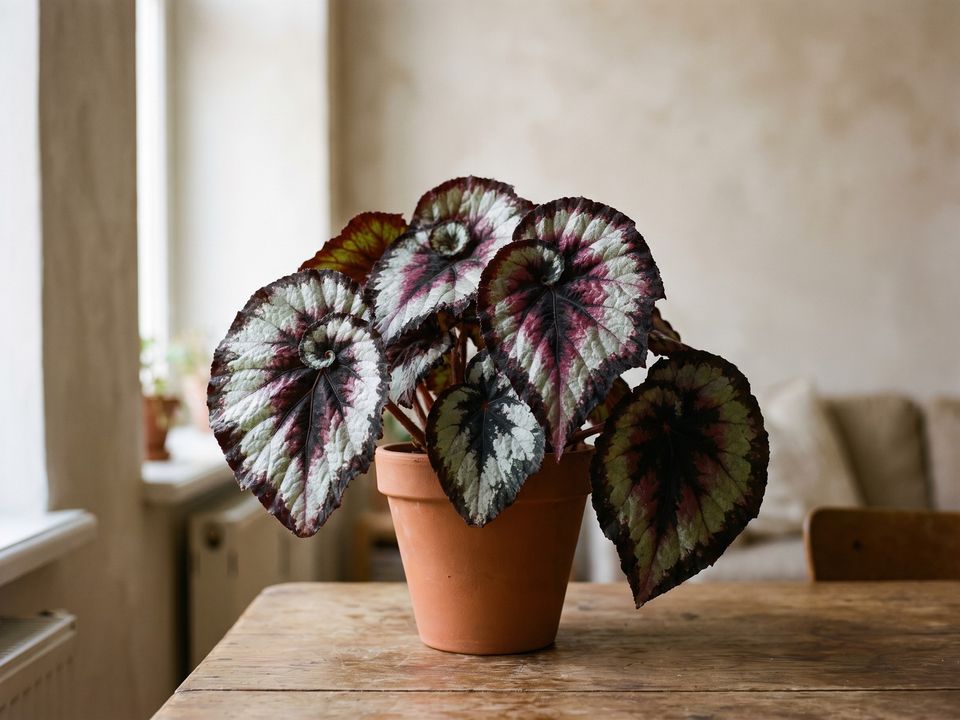
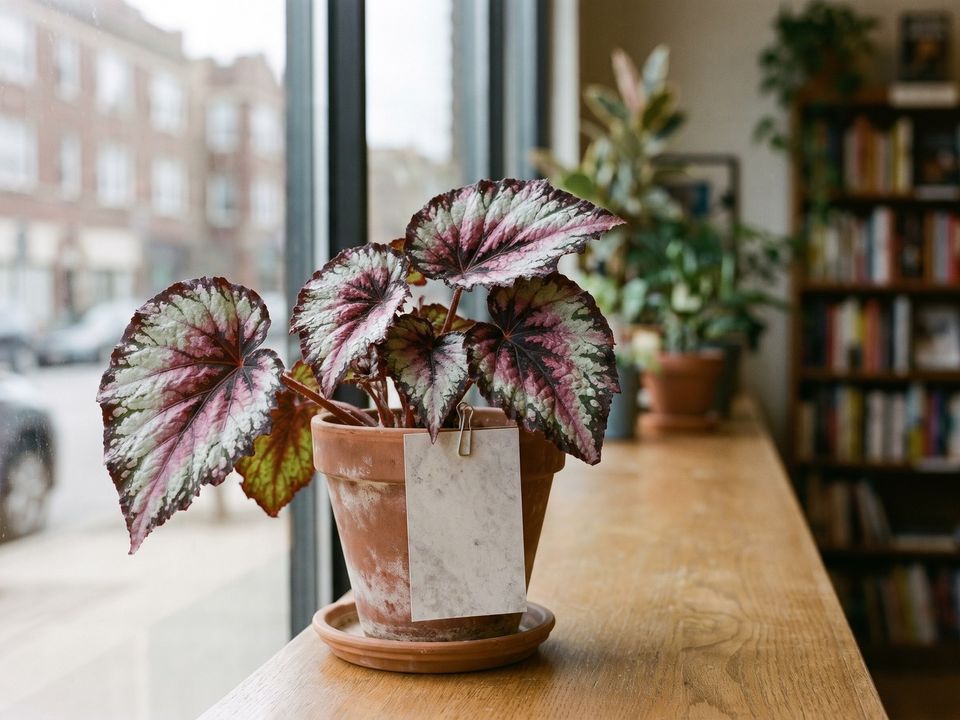
Leaves painted in silver, plum, and pink, as if no two shared a brush. Humid air keeps the edges soft; dry rooms crisp them.
2.1/5
how easy it is to care for
4.1/5
how much it stands out visually
: Shade to filtered
Bright but sunless; a step back from the glass works too
Plenty of light but no direct sun, which can scorch its thin, patterned leaves. Medium light farther into the room works too, though growth likely slows.
Wild Begonia rex grows in rocky, forested valleys and on slopes from the eastern Himalaya into Myanmar (Missouri Botanical Garden; Kew), under trees rather than out in the open. Outdoors, the Garden rates rex begonias for part shade to full shade.
Sun landing on the leaf is the threat to all that silver and plum, so choose the window to shield it. An east-facing sill behind a sheer curtain is likely a good fit, as is an unobstructed north-facing window. With south or west windows, keep it several feet from the glass, where light fills the space but the rays fall short.
Mind the cold too. NC State notes begonias don’t tolerate temperatures below 55°F, and a window in January can run colder than the air around it, so in deep winter give the pane a little room.
Bright and shaded, those leaves hold their depth of color.
: Weekly+
Wants lightly damp soil, not wet leaves; skip the mister
About every 5-7 days in summer and 7-10 in winter, keeping the soil lightly damp, not soggy; water the soil, not the leaves, and skip the mister. Its rhizome creeps along the soil’s face, so a wet pot can rot it.
Here’s its contradiction: it loves humid air and dislikes wet leaves. NC State puts its humidity needs above 75% and calls rex begonias excellent terrarium plants, while Missouri Botanical Garden sets the bar above 50%, with some varieties wanting more. NC State suggests bathrooms and kitchens as good spots.
So retire the spray bottle. NC State advises against misting to prevent disease, since botrytis and powdery mildew can take hold on the foliage; moving air helps keep both away.
Radiator season is when it shows the strain: leaf edges that brown and crisp, and patterns that lose their gloss. If that bothers you, give it a season in the bathroom or a terrarium; it can limp through a winter either way, though it looks its best in the steam.
Gone for a while? A week is about its limit, so water it the day you leave.
: Small
Swirled leaves that steadily mound 12-18 inches high
Broad leaves fan off a creeping rhizome in a mound 12-18 inches high, for a side table, shelf, or terrarium. Keep it at or below eye level; the leaves turn toward the light, so turn the pot to face the pattern your way.
That rhizome is a thickened stem (UConn Extension), so the clump widens more than it climbs; Missouri Botanical Garden recommends a shallow pot to match.
Leaves on the wild species can reach a foot long and 8 inches across (Missouri Botanical Garden), which is how a plant barely a foot tall can spread its leaves well past the rim of its pot.
Every named variety you buy is a clone. Rex begonias root from leaf cuttings (Penn State Extension), and those cuttings come true to the parent, so a patented cultivar is copied leaf by leaf, exactly as its breeder found it (US plant patents).
: Mildly irritating
Chewing can upset dogs and cats; rated safe for kids
- DogsMildly irritating
- CatsMildly irritating
- KidsSafe
A chewed leaf may make a dog or cat drool or vomit, and that usually passes; the ASPCA lists it as toxic to both. For kids, CHOP lists begonias as non-poisonous, though the sap can irritate skin.
Most of its irritant sits in the roots, so a pet digging in the pot is more of a worry than one nibbling a leaf.
Begonias carry soluble calcium oxalates (ASPCA), which explains the drool and the upset stomach. The ASPCA links them to kidney failure in grazing animals that eat a great deal. For a pet that only nibbles, the signs it lists stop at drooling and vomiting.
For kids, the news is good. CHOP and Poison Control list begonias as non-poisonous, so a curious bite is nothing harmful. The sap can irritate skin, and a quick hand wash after pruning or repotting takes care of it.
If a pet’s stomach doesn’t settle or anything worries you, call your vet or the ASPCA Animal Poison Control Center (a fee may apply). For a child, Poison Control can help.
A rex begonia stays low, so a high shelf or a plant stand lifts its leaves above nose height. A dog that digs, or a cat that treats potting soil like a litter box, gets past the leaves to the rhizome. A pot cover or a room they rarely visit keeps paws out of the soil.
- ASPCA: mild for dogs (rates the whole genus).
- ASPCA: mild for cats (rates the whole genus).
- CHOP: safe for kids.
Dogs: Only the ASPCA rates it for dogs, and the signs it lists are mild.
Cats: Only the ASPCA rates it for cats, and the signs it lists are mild.
Kids: CHOP and Poison Control list it as non-poisonous. Care note: oxalate in the plant may irritate skin (not confirmed by CHOP or Poison Control).
: Humid
63-80°F; likes humid air
Warm, humid rooms suit it: 63-80°F, not below 60°F, and away from cold winter glass. It likes 75-90% humidity, and dry air crisps the leaf edges.
- Temperature
- 63-80°F
- Humidity
- 75-90%
: Mealybugs
Mealybugs most often; check leaf joints and undersides
Mealybugs are the common guest: check the leaf axils, the base of the leaf stalks, and the undersides. Spider mites, whiteflies, and thrips are occasional; scale sits on stems and stalks. Mites favor hot, dry air.
- Mealybugs
- Spider mites
- Thrips
- Whiteflies
- Scales
Mildew and rot are the bigger worries; bugs turn up now and then.
Powdery mildew shows as white, dusty patches on the leaves. Pick off the worst leaves, give it more air around it, and keep water off the leaves; NC State Extension’s advice is good circulation and clearing away dead leaves.
Botrytis, a gray, fuzzy mold on leaves and stalks, and stem rot, soft dark stalks at the soil line, both come from damp, still conditions. Remove the affected parts, let the soil dry slightly before the next watering, and never let it sit in a wet saucer.
Mealybugs look like tufts of white cotton where the leaves meet the stalks: dab them with a cotton swab dipped in rubbing alcohol. Whiteflies and spider mites hide under the leaves; an insecticidal soap spray, aimed at the undersides, takes care of both.
: More
Pick off dead leaves, feed every 2-3 weeks, repot yearly
Remove dead or mildewed leaves all year, and feed at quarter strength every 2-3 weeks in spring and summer, stopping in October. Each spring, repot once the rhizomes reach the pot sides, dividing every few years.
- Feed10× a year
- Clean leaves12× a year
- Repot1× a year
- Divide1× a year
A rich potting mix that drains fast, in a pot with a drainage hole and not too big, since extra soil stays wet.
Repot in spring, once the roots circle the pot, one size up; Clemson Extension says that’s also the time to divide a crowded plant.
A balanced liquid fertilizer at half strength every other watering while it’s growing (Clemson’s rule), and none in winter.
: Showy
Silver, plum, and pink painted leaves, glossy, filling the pot
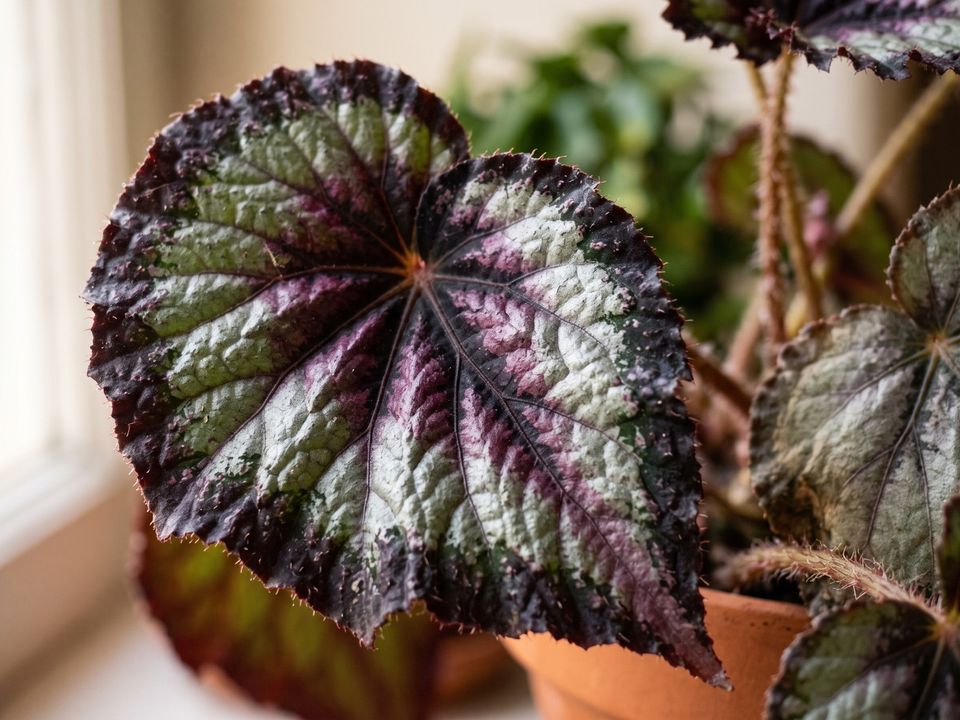
Each broad leaf is painted in its own swirl of silver, plum, and pink, so no two look alike. The surface is glossy and deeply textured, and the leaves overlap to cover the soil completely.
Where to find me
Not yet pilferableFun fact
Grown for leaves in silver, pink, lavender, maroon, and more, with a somewhat metallic sheen that often upstages the plant’s own small, pinkish-white flowers.
Designer tips
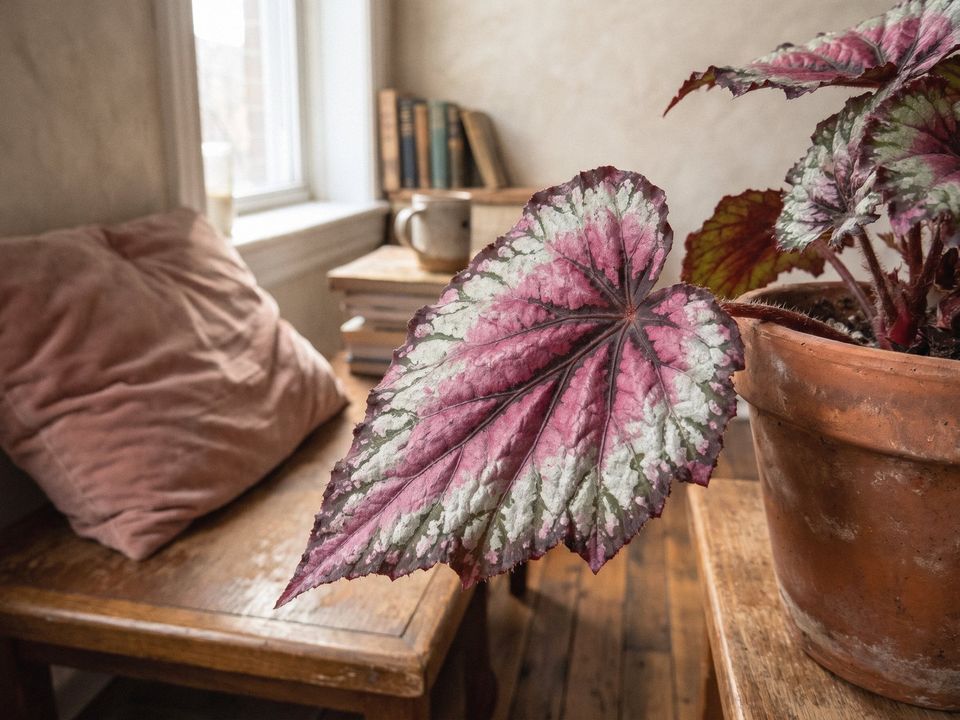
Pure color: silver, pink, burgundy, and near-black leaves that read like a small work of art on a table.
Troubleshooting
The leaf edges are brown and crispy
Dry air, most often: NC State Extension says rex begonias decline when the humidity is too low. A humidifier nearby or a season in a bright bathroom helps, especially in winter.
What’s the white powder on the leaves?
Powdery mildew, its most common problem. Pick off the worst leaves, give it more air around it, and water the soil rather than the leaves.
The stalks are going soft at the soil
Rot, from soil that stays too wet; NC State Extension notes begonias are highly susceptible to root rot. Cut away the soft parts, let the soil dry slightly, and water less. If the thick stem at the soil is still firm, it usually regrows, and if not, a healthy leaf can start a new plant.
See all 8
Should I mist it?
No need. It likes humid air, but Clemson and NC State Extension both advise against misting, since wet leaves invite mildew; a humidifier nearby or a spot in a bright bathroom does the job.
It looks worse every winter
Dry, heated air and short days, and in a dim winter it may even rest and drop leaves (UConn). Give it the most humid spot you have, water a little less than in summer, and trim the tired leaves; it usually picks up again in spring.
What are the little pink flowers?
Its flowers: small, pinkish-white clusters on upright stalks. The leaves are the show, so snip the stalks off if you prefer.
My dog dug it up and chewed the roots
Watch for drooling and vomiting, which usually pass: it’s mildly irritating, and most of the irritant sits in the roots, per the ASPCA. If your dog keeps vomiting or seems unwell, call your vet or the ASPCA Animal Poison Control Center.
Can I really grow a new plant from one leaf?
Yes, slowly. Push the stalk of a healthy leaf into a small pot of damp mix, or pin a leaf flat with a cut across a main vein, and keep it warm and humid under a clear bag; new plants form at the cuts.
Propagation
Yes, and it’s fun: a single leaf can grow a whole new plant.
- Cut a healthy leaf with an inch or so of stalk and push the stalk into a small pot of damp mix, or pin a leaf flat on the mix with a cut across a main vein.
- Keep it warm and humid under a clear bag or in a terrarium; new plants form at the cuts, slowly.
- Or divide a crowded plant when you repot in spring.
The PILF Matrix
2.1/5
how easy it is to care for
4.1/5
how much it stands out visually
“The one who isn’t high-maintenance, just has standards.”


- fancy‑leaf begonia
Rated 1-5, with 5 being easiest
Built from light, water, air, pests, and upkeep.
Rated 1-5, with 5 being easiest
Rated 1-5, with 5 being highest presence
Built from its scale (size, shape, growth) and its look (color and flowers, shine, fullness).
Rated 1-5, with 5 being highest presence
Where it sits and what sun touches it.
- Dim shadeA dark corner or a windowless room; natural light casts no shadow
- Bright shadeBack from the window in a south-, east- or west-facing room, or right by a north-facing one, where only low early or late summer sun reaches it
- Filtered sunBehind a sheer curtain or tinted glass; the sun’s shadows are blurred
- Partial sunIn an east- or west-facing window: up to a few hours of direct sun
- Full sunThe sunniest spot you have, usually a south-facing window, with direct sun 6+ hours a day
How often, and what the soil does between.
- MonthlyEvery 2-3 weeks in summer and 3-5 in winter; the soil dries all the way between
- 2-3× a monthEvery 7-14 days in summer, longer in winter; the top of the soil dries between
- Weekly+About every 4-8 days in summer; the soil stays lightly damp
How much room it usually takes indoors.
Size
- TinyUnder 6 inches tall or wide; for a desk or a sill
- Small6 inches to 1.5 feet tall or wide; for a shelf or a sill
- Medium1.5 to 3 feet tall or wide; for a table or a stand
- Large3 to 6 feet tall or wide; for the floor
- GiantOver 6 feet tall or wide; a statement in the corner
Shape
- TreeA trunk that branches into a canopy
- CaneBare stalks topped with leaves
- UprightStiff stems or leaves rising straight from the soil
- FountainLeaves or fronds arching out from the center
- BushyA full, rounded mound of leaves
- RosetteLeaves radiating from one low point
- ViningTrails, climbs, or both
Growth
How fast it gets there.
- SlowUnder 6 inches of new growth a year
- Moderate6-12 inches a year, mostly in spring and summer
- FastOver 12 inches a year; it may want trimming or training
What risks exist for pets and kids.
- Pet & kid safeNothing to worry about
- Mildly irritatingMay irritate the mouth or stomach if chewed, or for some plants, the skin if handled
- Moderately toxicCan cause illness if eaten, though typically not serious or fatal
- DangerousCan cause serious illness if eaten, including some reports of death
- Not yet ratedNot clearly rated by our sources; please check with your vet or doctor
For its safety ratings, PILF relies on research and guidance from leading sources, including the ASPCA, Pet Poison Helpline, Merck Veterinary Manual, Poison Control, and Children’s Hospital of Philadelphia, and others.
The small jobs beyond watering, over a year.
- Little upkeepA few small jobs a year beyond watering, like a feed now and then
- Some upkeepA small job about once a month beyond watering, like feeding or turning it
- More upkeepA small job every couple of weeks beyond watering, like a wipe, a turn, or a feed
- Most upkeepA small job most weeks beyond watering, like raising the humidity or misting
- TreeA trunk that branches into a canopy
- CaneBare stalks topped with leaves
- UprightStiff stems or leaves rising straight from the soil
- FountainLeaves or fronds arching out from the center
- BushyA full, rounded mound of leaves
- RosetteLeaves radiating from one low point
- ViningTrails, climbs, or both
How fast it gets there.
- SlowUnder 6 inches of new growth a year
- Moderate6-12 inches a year, mostly in spring and summer
- FastOver 12 inches a year; it may want trimming or training
The temperature and humidity it’s comfortable in.
How dry a room it takes.
- Needs 50%+ humidity
- Fine at 35% humidity
- Fine at 15-20% humidity
The bugs that usually find it, by name.
How often pests find it.
- 5+ regular pests
- 3 regular pests
- Pests are rare
The year’s chores: feeding, pruning, repotting, and cleaning.
Chores beyond water (what needs work means).
- Most upkeep
- Some upkeep
- Little upkeep
Its finish, fullness, and texture.
Color, pattern, and flowers.
- SimpleOne green, one texture, nothing to read
- SuaveA sheen, a stripe, or a clean shape that catches the eye up close
- ShowyColor, pattern, or blooms you see from across the room
How the leaves catch light.
- Matte
- Satin
- Glossy or waxy
How much it fills its pot.
- Soil shows
- Soil partly hidden
- Leaves hide the soil