Air Plant
Tillandsia spp. (most sold: T. ionantha)
Also called tillandsia
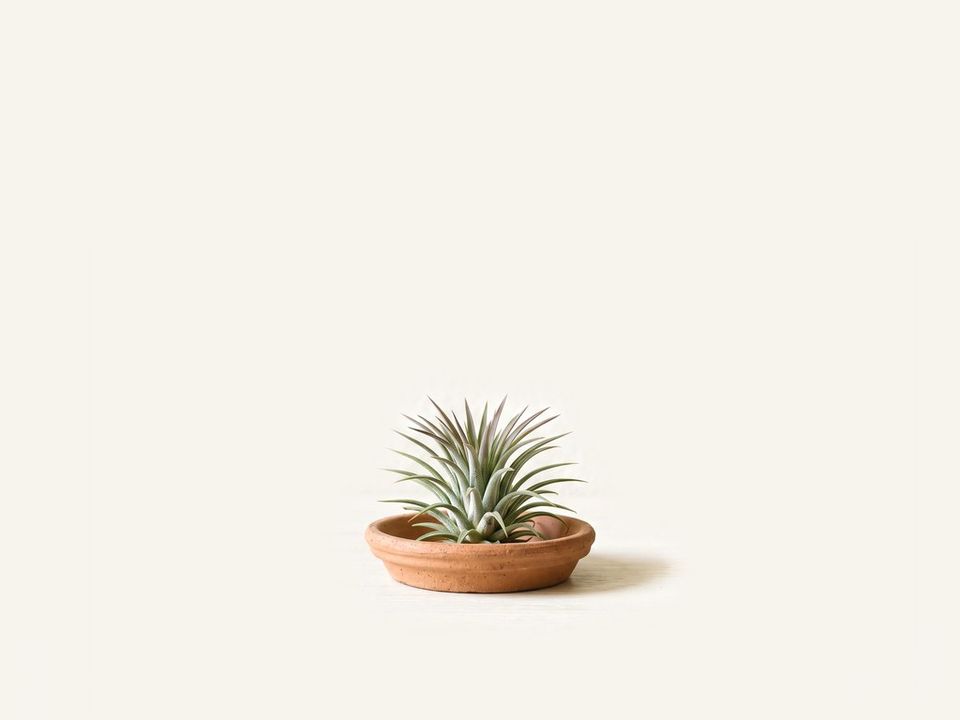
A small, spiky, silvery rosette that sits on a dish or driftwood, no soil at all. Known for living without soil, drinking through its leaves.
2.4/5
how easy it is to care for
1.7/5
how much it stands out visually
: Bright shade
By a bright window, with the sun kept off its leaves
Within a few feet of an east, south, or west window, out of the sun’s beam, though soft fall and winter sun is fine. Farther back it lives on, but it likely won’t flower.
An east or west window is the easy middle. NC State Extension says even the sunniest window isn’t too much for most air plants, while Clemson and UF/IFAS keep them where sun doesn’t land on the leaves; the difference is water, since more sun means more soaking.
Farther from the window it lives but won’t flower. In a dim room, an LED grow light can make up the difference.
: Weekly+
A soak every 5-7 days; more often in dry winter heat
A 20-30 minute soak in lukewarm water every 5-7 days in summer and every 3-6 in winter, when dry heat dries it faster. Shake it gently, then set it upside down so it dries within a few hours.
A soak of 20 to 30 minutes in lukewarm water (rainwater is ideal) does it. Then shake it gently and set it upside down on a towel: water left sitting in the center rots it. Give it a few hours to dry before it goes back into a glass globe.
In a sunny spot or dry winter heat it dries faster, so soak it longer or more often there; curled leaves are the sign (see Troubleshooting).
Gone for a while? Ten days is fine if you give it a good soak the day you leave.
: Small
A spiky rosette, 6-12 inches, that needs no pot or soil
A spiky, silvery rosette of 6-12 inches that needs no pot or soil, adding a leaf at a time from the center. Each rosette flowers once, then pups at its base carry it on as a clump.
Growth is slow: a new leaf now and then from the center. A mature rosette flowers once, then slowly fades while pups grow from its base, so the plant carries on as a clump.
: Pet & kid safe
Nothing harmful for dogs, cats, or kids
- DogsSafe
- CatsSafe
- KidsSafe
Nothing harmful for dogs, cats, or kids. UC ANR sources rate air plants safe for pets, and UConn’s poison control center lists their family, the bromeliads, as safe for kids.
No vet or poison-control source we found names it at all. The ASPCA notes that eating any plant can upset a pet’s stomach, and a plant this small is easy for a pet or a toddler to chew up, so keep it out of reach.
- UConn Health: safe for kids.
Cats and dogs: No vet database lists it; rated from university extension sources.
Kids: No poison-centre listing; rated from university extension sources.
: Average
55-90°F; moving air matters as much as warmth
Room temperatures of 55-90°F suit it, with 40% humidity or more. Moving air matters as much as warmth, since it’s how the plant dries after a soak, so keep it out of closed glass and away from heating vents.
- Temperature
- 55-90°F
- Humidity
- 40%+
: Mealybugs, scale
Mealybugs or scale, now and then, between the leaves
Few bugs find it, though mealybugs, like white cotton tufts, and scale, small brown bumps, turn up now and then between the leaves. Rot in the center, where water sits after a soak, is the likelier trouble.
- Mealybugs
- Scale
Few pests; rot is the real risk, and it starts in the center, where water sits after a soak.
Prevent it every time you water: shake the plant, let it dry upside down with air moving around it, and never tuck it back into glass, a shell or a dish while it’s still wet.
Mealybugs and scale turn up now and then: white cottony tufts or small brown bumps tucked between the leaves. Dab them off with a cotton swab dipped in rubbing alcohol, then check again next week.
: Some
A weak feed in its soak; trim dry leaves now and then
About once a month in the growing season, bromeliad or orchid fertilizer at quarter strength goes in its soak. Pull dry lower leaves or trim brown tips now and then, and twist off pups after it flowers if you like.
- Feed at 1/4 strength with soak, growing season6× a year
- Pull dried lower leaves / trim brown tips2× a year
- Separate pups after the mother bloomsevery 3 years
No soil and no pot: it takes up water through the silvery scales on its leaves, and its roots only hold on. Set it in a shallow dish, on driftwood, a shell, or a stand, or hang it in a glass globe, as long as nothing holds water against it.
Repotting is never needed. To fix one to a mount, use a dab of hot glue that has cooled slightly, or tie it on with thin wire.
Food is optional: once a month, add a bromeliad or orchid fertilizer at a quarter strength to its soaking water.
: Simple
Silvery-green spiky leaves with a satin finish
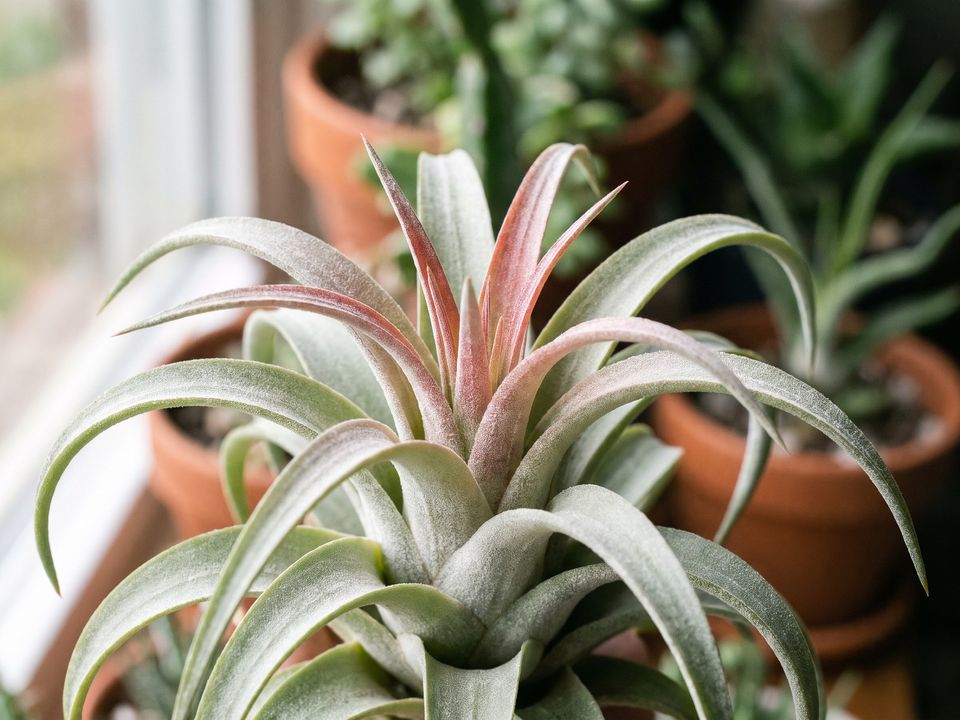
Spiky leaves about 3 inches long form a satin, silvery-green rosette; the silver is the scales it drinks through. Before it flowers, the inner leaves may blush red.
Where to find me
Not at PILF places
Fun fact
The genus honors Swedish botanist Elias Tillandz, reportedly for his fear of water. Odd for a plant that drinks through its leaves.
Designer tips
Sculptural and a little otherworldly: a plant that sits anywhere, on anything, with no pot.
Troubleshooting
The leaves are curling and rolling
It’s thirsty: curled or rolled leaves, a dull color, and brown tips usually mean it wants more water. A longer soak, or soaks closer together, usually sorts it, especially in a sunny spot or a heated room in winter.
How do I water a plant with no soil?
Dunk the whole plant in lukewarm water for 20-30 minutes every 5-7 days, then shake it gently and let it dry upside down. Misting works only if you mist until it drips, every other day in dry indoor air (Penn State Extension), so a soak is easier.
The center went brown and mushy
Water sat in the middle and rotted it, most likely. Next time, a gentle shake after each soak and a few hours upside down in moving air keep the center dry before it goes back on display.
See all 9
It flowered, and now it’s fading
That’s its life cycle: each rosette flowers once, then slowly fades while pups grow at its base to carry on. Once a pup is a third the size of its mother, you can twist it free, or leave the pups on and let it become a clump.
Why are the inner leaves turning red?
It’s getting ready to flower. The inner leaves of the most common air plant, Tillandsia ionantha, flush red before it blooms (NC State Extension), so there’s nothing to fix.
Can it live in a closed terrarium?
Not a closed one: it needs moving air to dry between soaks, or it can rot. An open globe or bowl works, as long as it goes back in dry.
Can it live without a window?
It does best close to a bright window. In a room without one, an LED grow light can stand in (NC State Extension).
My cat chewed a leaf
Nothing harmful: UC ANR sources rate air plants safe for cats and dogs. Eating any plant can upset a pet’s stomach, so a big chew might bring a little vomiting; a high spot mostly saves the plant, which is small enough to chew up.
Can it go outside for the summer?
Yes, somewhere bright and breezy and out of strong afternoon sun, like a porch or an open window (UMN Extension). Bring it back in while nights are still above 55°F.
Propagation
By pups: after it flowers, small new plants grow at its base.
- Once a pup is a third the size of its mother, gently twist or cut it free and care for it the same way.
- Or leave the pups on, and in a few years it becomes a clump.
The PILF Matrix
2.4/5
how easy it is to care for
1.7/5
how much it stands out visually
“The one that doesn’t need soil, just your undivided attention.”


Rated 1-5, with 5 being easiest
Built from light, water, air, pests, and upkeep.
Rated 1-5, with 5 being easiest
Rated 1-5, with 5 being highest presence
Built from its scale (size, shape, growth) and its look (color and flowers, shine, fullness).
Rated 1-5, with 5 being highest presence
Where it sits and what sun touches it.
- Dim shadeA dark corner or a windowless room; natural light casts no shadow
- Bright shadeBack from the window in a south-, east- or west-facing room, or right by a north-facing one, where only low early or late summer sun reaches it
- Filtered sunBehind a sheer curtain or tinted glass; the sun’s shadows are blurred
- Partial sunIn an east- or west-facing window: up to a few hours of direct sun
- Full sunThe sunniest spot you have, usually a south-facing window, with direct sun 6+ hours a day
How often, and what the soil does between.
- MonthlyEvery 2-3 weeks in summer and 3-5 in winter; the soil dries all the way between
- 2-3× a monthEvery 7-14 days in summer, longer in winter; the top of the soil dries between
- Weekly+About every 4-8 days in summer; the soil stays lightly damp
How much room it usually takes indoors.
Size
- TinyUnder 6 inches tall or wide; for a desk or a sill
- Small6 inches to 1.5 feet tall or wide; for a shelf or a sill
- Medium1.5 to 3 feet tall or wide; for a table or a stand
- Large3 to 6 feet tall or wide; for the floor
- GiantOver 6 feet tall or wide; a statement in the corner
Shape
- TreeA trunk that branches into a canopy
- CaneBare stalks topped with leaves
- UprightStiff stems or leaves rising straight from the soil
- FountainLeaves or fronds arching out from the center
- BushyA full, rounded mound of leaves
- RosetteLeaves radiating from one low point
- ViningTrails, climbs, or both
Growth
How fast it gets there.
- SlowUnder 6 inches of new growth a year
- Moderate6-12 inches a year, mostly in spring and summer
- FastOver 12 inches a year; it may want trimming or training
What risks exist for pets and kids.
- Pet & kid safeNothing to worry about
- Mildly irritatingMay irritate the mouth or stomach if chewed, or for some plants, the skin if handled
- Moderately toxicCan cause illness if eaten, though typically not serious or fatal
- DangerousCan cause serious illness if eaten, including some reports of death
- Not yet ratedNot clearly rated by our sources; please check with your vet or doctor
For its safety ratings, PILF relies on research and guidance from leading sources, including the ASPCA, Pet Poison Helpline, Merck Veterinary Manual, Poison Control, and Children’s Hospital of Philadelphia, and others.
The small jobs beyond watering, over a year.
- Little upkeepA few small jobs a year beyond watering, like a feed now and then
- Some upkeepA small job about once a month beyond watering, like feeding or turning it
- More upkeepA small job every couple of weeks beyond watering, like a wipe, a turn, or a feed
- Most upkeepA small job most weeks beyond watering, like raising the humidity or misting
- TreeA trunk that branches into a canopy
- CaneBare stalks topped with leaves
- UprightStiff stems or leaves rising straight from the soil
- FountainLeaves or fronds arching out from the center
- BushyA full, rounded mound of leaves
- RosetteLeaves radiating from one low point
- ViningTrails, climbs, or both
How fast it gets there.
- SlowUnder 6 inches of new growth a year
- Moderate6-12 inches a year, mostly in spring and summer
- FastOver 12 inches a year; it may want trimming or training
The temperature and humidity it’s comfortable in.
How dry a room it takes.
- Needs 50%+ humidity
- Fine at 35% humidity
- Fine at 15-20% humidity
The bugs that usually find it, by name.
How often pests find it.
- 5+ regular pests
- 3 regular pests
- Pests are rare
The year’s chores: feeding, pruning, repotting, and cleaning.
Chores beyond water (what needs work means).
- Most upkeep
- Some upkeep
- Little upkeep
Its finish, fullness, and texture.
Color, pattern, and flowers.
- SimpleOne green, one texture, nothing to read
- SuaveA sheen, a stripe, or a clean shape that catches the eye up close
- ShowyColor, pattern, or blooms you see from across the room
How the leaves catch light.
- Matte
- Satin
- Glossy or waxy
How much it fills its pot.
- Soil shows
- Soil partly hidden
- Leaves hide the soil