Bird of Paradise
Strelitzia reginae
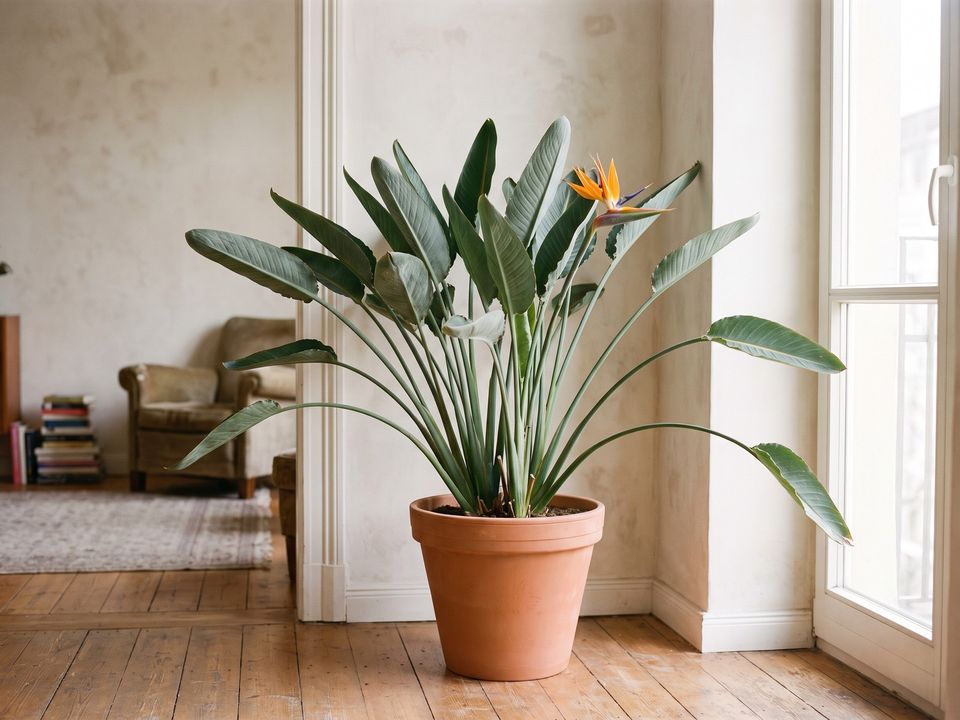
Orange-and-blue flowers shaped like a bird’s head over big paddle leaves. The more sun it gets, the better the odds of a bloom.
2.9/5
how easy it is to care for
3.7/5
how much it stands out visually
: Shade to full sun
Sun brings the flowers; bright shade, just the leaves
Give it the sunniest window you have and it may reward you with its orange-and-blue blooms. In bright shade you’ll have a handsome stand of paddle leaves; the birds need the sun.
Along riverbanks and in coastal scrub clearings of the Eastern Cape and KwaZulu-Natal, it stands in open light (Kew, NC State). Indoors, a south-facing window comes closest to that; a west window with long afternoon light is the runner-up.
Once temperatures rise above 70°F (NC State), it can move out to a patio or balcony in sun or light shade, with air moving around it. Bring it back in before nights fall near 54°F (RHS).
Flowering waits on age as well as light, so a young plant in a sunny window may simply be biding its time. Paddles alone will settle for less; the bird gets the best seat in the house.
: 2-3× a month
Drinks freely in summer; wants it drier in winter
Every 7-10 days from spring through summer, stretching to 10-14 in winter. A missed watering worries it far less than a soggy pot, which can rot the roots.
NC State pairs free watering with regular feeding in spring and summer, so the warm months are when it drinks and eats; winter is the drier season, and feeding is a spring-summer job in that guide.
Pot it in a fertile, loamy mix (NC State); its fleshy roots are the part that suffers when a pot stays wet.
The RHS notes it likes warmth and humidity. If dry radiator air browns the edges of those gray-green paddles and that bothers you, keeping it clear of heat vents may help; the plant survives regardless.
Gone for a while? Two weeks is fine if it’s watered well the day you leave.
: Large
Paddles on stiff stalks; slowly reaches 3-5 feet
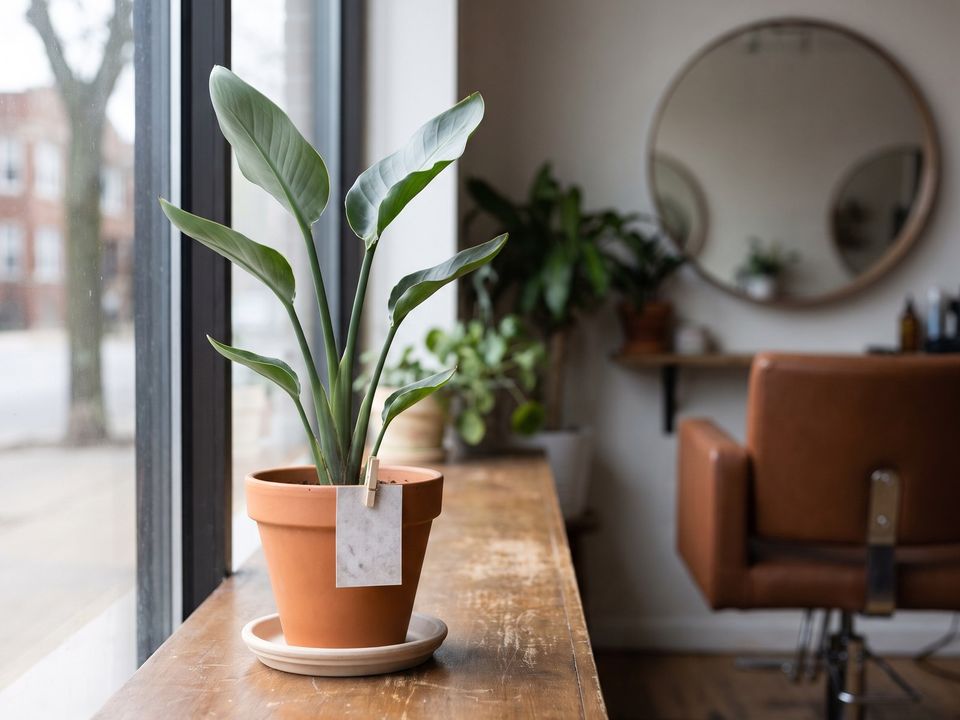
A slow-growing clump of banana-like paddles on long stalks, 3-5 feet tall and 2-4 feet wide. It wants floor space beside your sunniest window, with elbow room for the leaves to fan; cut spent flower stalks at the base.
New stalks rise from an underground rhizome (NC State), so the clump grows wider rather than taller. It takes its time about it, slow-growing by most accounts (UF, Wisconsin) and 10-20 years to full size (RHS), so the plant you bring home may stay close to its size for a good while. Offsets that form at the base are how it spreads, and how you divide it into two plants (Kew).
Kew notes that a slightly pot-bound bird of paradise is more likely to flower, and that its fleshy roots bruise when disturbed, so a snug pot serves the blooms and the roots alike.
That fan of upright paddles suits an open corner by a big south window, the far end of a long room, or a lobby where it can be seen from every side.
: Mildly irritating
Chewing can upset the stomachs of dogs, cats, or kids
- DogsMildly irritating
- CatsMildly irritating
- KidsMildly irritating
The ASPCA lists it as toxic to dogs and cats, though the usual signs are mild: nausea, vomiting, or drowsiness. For kids, Poison Control calls it minimally toxic, with an upset stomach at most.
Most of the effects come from the fruit and seeds.
What it carries works as a stomach irritant (ASPCA). Its fruit is a leathery capsule of seeds (NC State), and seed usually takes hand-pollination, which even then seldom works (Kew).
Check the label if you’re comparing notes. The name bird of paradise also goes to Caesalpinia gilliesii, a plant from the pea family that the ASPCA rates as more toxic; Strelitzia reginae is the gentler of the two namesakes.
For a child, a small bite may bring vomiting or diarrhea that passes, and a large piece can be a choking risk (Poison Control). If symptoms don’t settle or anything worries you, Poison Control can help with a child, and your vet or the ASPCA Animal Poison Control Center can help with a pet (a fee may apply).
If you have a nibbling pet or a curious toddler, cutting spent flower heads before pods form may reduce the chance of seeds. With that habit, trouble is less likely, though a chewed leaf can still upset a stomach.
- ASPCA: mild for dogs.
- Pet Poison Helpline: mild for dogs.
- ASPCA: mild for cats.
- Pet Poison Helpline: mild for cats (rates the whole genus).
- Poison Control: mild for kids.
Cats and dogs: Most of the leading sources agree.
Kids: Majority of top sources and extension.
: Dry OK
55-70°F; dry air is fine
Happiest at 55-70°F, and it shouldn’t sit below 50°F. It likes humidity around 60% and gets by at 20%.
- Temperature
- 55-70°F
- Humidity
- 60-60%
: Scale
Scale on stalks and midribs; mealybugs, aphids less often
Scale is the one to watch: check leaf stalks, midribs, and leaf undersides. Mealybugs sit where stalks sheathe the crown, mites and whiteflies under the leaves, and aphids on new leaves and flower spathes.
- Scale
- Mealybugs
- Spider mites
- Whiteflies
- Aphids
A few: mealybugs, scale, and spider mites (NC State, UW–Madison), and root rot from soggy soil.
Mealybugs look like tufts of white cotton where the leaf stalks meet; scale looks like small brown bumps on the stalks and the backs of the leaves. Wipe them off with a cotton swab dipped in rubbing alcohol (a fingernail lifts scale), then check again next week.
Spider mites leave fine webbing and pale speckles, worst in warm, dry winter air. Wipe the big leaves on both sides with a soft, damp cloth (UW–Madison warns against leaf-shine products), and if the mites come back, spray with insecticidal soap.
Root rot shows as yellowing leaves and a wilting plant in wet soil: let it dry more between soaks and make sure the pot drains.
: More
Feed every 2 weeks in summer; repot every 2nd year
Feed every 2 weeks in spring and summer, monthly or never in winter; overfeeding cuts flowers. Wipe leaves 6 times a year, snip spent blooms and shredded leaves, and repot every 2nd year after flowering.
- Feed12× a year
- Clean leaves6× a year
- Repot1× a year
- Deadhead2× a year
- Prune2× a year
A big, heavy pot with drainage holes and a potting mix that drains fast; a tall plant tips easily in a light pot.
Repot only when the roots bulge or crack the pot, in early spring, and don’t set it deeper than before (UW–Madison). It blooms better pot-bound, so in the years between, scrape off the top layer of soil and replace it with fresh mix.
It’s a heavy feeder: a water-soluble fertilizer every two weeks in spring and summer, and little or none in fall and winter (Clemson, UW–Madison). Too much cuts down on flowers (Clemson).
: Suave
Big green paddles with a bird-head bloom
Broad, banana-like paddle leaves in green, with a soft sheen and some texture, fan out on long stalks. The clump is full but leaves some soil showing. Orange-and-blue flowers look like a bird’s head.
Where to find me
Not yet pilferableFun fact
That blue arrow in the flower is a perch. When a bird lands to sip nectar, the petals open and dust its feet with pollen. Sunbirds visit too, though some sip without pollinating.
Designer tips
Big, sculptural, and unmistakably tropical: a statement plant for a sunny corner.
Troubleshooting
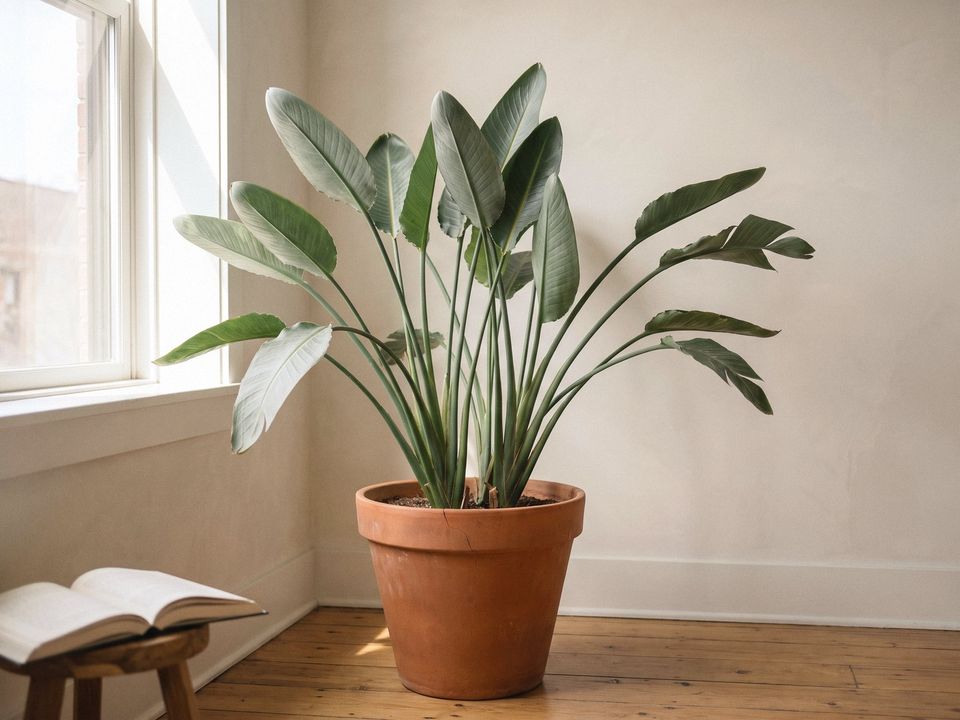
Why won’t it bloom?
Usually too little light, the most common reason (UW-Madison Extension), or a plant that’s still young: one from seed takes 4-7 years, a division 2-3 (Clemson). Your sunniest window gives it the best odds, and go easy on fertilizer, since too much cuts down on flowers.
The leaves are turning yellow
Often too much water: soggy soil rots its fleshy roots (NC State Extension). Give it longer between soaks and empty the saucer.
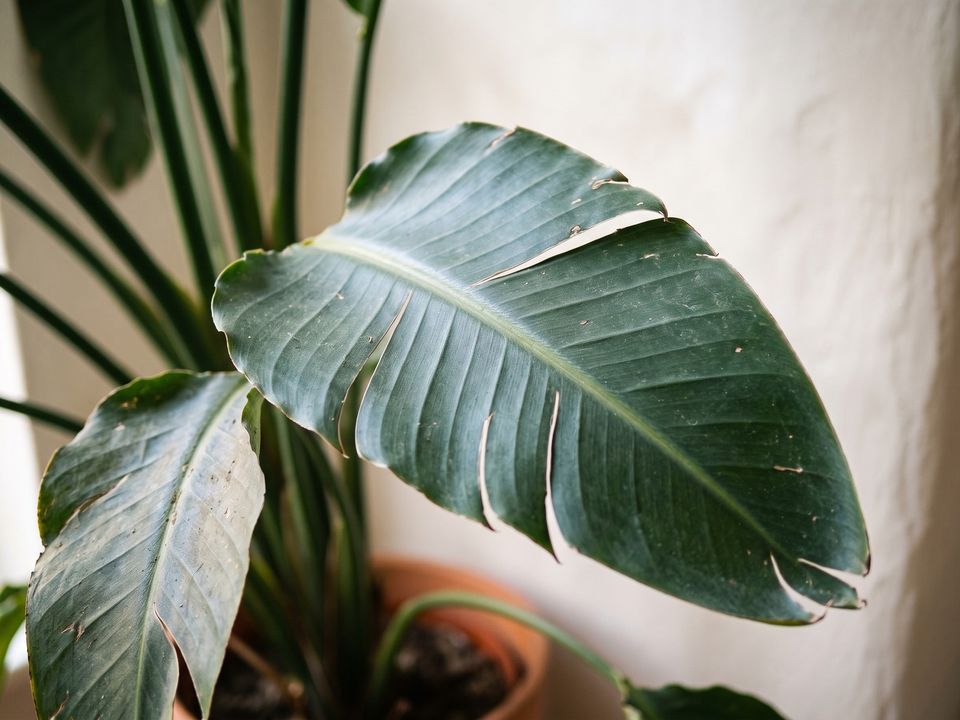
The big leaves are splitting
Splits along the paddles are part of its look, and the leaf carries on. If one gets badly shredded or browns and that bothers you, cut it off at the base; new leaves unfurl from the center of each fan.
See all 8
Can it live without sun on its leaves?
It gets by, as a handsome stand of paddles, but it rarely blooms there. Clemson Extension says it prefers full sun and tolerates the lower light of a south window; much dimmer than that, it just holds on.
Small brown bumps on the stalks
Likely scale, the most common pest on it, which settles on leaf stalks, midribs, and the backs of leaves. A fingernail or a cotton swab dipped in rubbing alcohol lifts them off; check again the next week.
Should I repot when roots crowd the pot?
Not right away: a crowded pot tends to bloom more (UW-Madison). Every second year is plenty, one size up in early spring, and in the years between, swap the top layer of soil for fresh mix.
My dog chewed a leaf
It’s mildly irritating: the ASPCA lists mild nausea, vomiting, or drowsiness, mostly from the fruit and seeds rather than the leaves. If your dog ate seeds or seems unwell, call your vet or the ASPCA Animal Poison Control Center.
Can it go outside for the summer?
Yes, once days run above 70°F (NC State). Ease it into full sun over a week or two so it doesn’t sunburn (UW-Madison), and bring it back in before nights fall near 54°F (RHS).
Propagation
By division, when you’re ready to wait for flowers again.
- In early spring, before new growth starts, lift it out of the pot and cut through the rhizome with a sharp knife so each piece has a fan of leaves and its own roots (Clemson).
- Pot each one and keep it warm, where sun doesn’t land on the leaves, for about eight weeks, then move it to its sunny window.
- Divisions flower in 2-3 years (Clemson), and dividing a plant that’s blooming well can stop it for a few years (UW–Madison).
The PILF Matrix
2.9/5
how easy it is to care for
3.7/5
how much it stands out visually
“The one that won’t strike a pose until the lighting’s right.”


- crane flower
Rated 1-5, with 5 being easiest
Built from light, water, air, pests, and upkeep.
Rated 1-5, with 5 being easiest
Rated 1-5, with 5 being highest presence
Built from its scale (size, shape, growth) and its look (color and flowers, shine, fullness).
Rated 1-5, with 5 being highest presence
Where it sits and what sun touches it.
- Dim shadeA dark corner or a windowless room; natural light casts no shadow
- Bright shadeBack from the window in a south-, east- or west-facing room, or right by a north-facing one, where only low early or late summer sun reaches it
- Filtered sunBehind a sheer curtain or tinted glass; the sun’s shadows are blurred
- Partial sunIn an east- or west-facing window: up to a few hours of direct sun
- Full sunThe sunniest spot you have, usually a south-facing window, with direct sun 6+ hours a day
How often, and what the soil does between.
- MonthlyEvery 2-3 weeks in summer and 3-5 in winter; the soil dries all the way between
- 2-3× a monthEvery 7-14 days in summer, longer in winter; the top of the soil dries between
- Weekly+About every 4-8 days in summer; the soil stays lightly damp
How much room it usually takes indoors.
Size
- TinyUnder 6 inches tall or wide; for a desk or a sill
- Small6 inches to 1.5 feet tall or wide; for a shelf or a sill
- Medium1.5 to 3 feet tall or wide; for a table or a stand
- Large3 to 6 feet tall or wide; for the floor
- GiantOver 6 feet tall or wide; a statement in the corner
Shape
- TreeA trunk that branches into a canopy
- CaneBare stalks topped with leaves
- UprightStiff stems or leaves rising straight from the soil
- FountainLeaves or fronds arching out from the center
- BushyA full, rounded mound of leaves
- RosetteLeaves radiating from one low point
- ViningTrails, climbs, or both
Growth
How fast it gets there.
- SlowUnder 6 inches of new growth a year
- Moderate6-12 inches a year, mostly in spring and summer
- FastOver 12 inches a year; it may want trimming or training
What risks exist for pets and kids.
- Pet & kid safeNothing to worry about
- Mildly irritatingMay irritate the mouth or stomach if chewed, or for some plants, the skin if handled
- Moderately toxicCan cause illness if eaten, though typically not serious or fatal
- DangerousCan cause serious illness if eaten, including some reports of death
- Not yet ratedNot clearly rated by our sources; please check with your vet or doctor
For its safety ratings, PILF relies on research and guidance from leading sources, including the ASPCA, Pet Poison Helpline, Merck Veterinary Manual, Poison Control, and Children’s Hospital of Philadelphia, and others.
The small jobs beyond watering, over a year.
- Little upkeepA few small jobs a year beyond watering, like a feed now and then
- Some upkeepA small job about once a month beyond watering, like feeding or turning it
- More upkeepA small job every couple of weeks beyond watering, like a wipe, a turn, or a feed
- Most upkeepA small job most weeks beyond watering, like raising the humidity or misting
- TreeA trunk that branches into a canopy
- CaneBare stalks topped with leaves
- UprightStiff stems or leaves rising straight from the soil
- FountainLeaves or fronds arching out from the center
- BushyA full, rounded mound of leaves
- RosetteLeaves radiating from one low point
- ViningTrails, climbs, or both
How fast it gets there.
- SlowUnder 6 inches of new growth a year
- Moderate6-12 inches a year, mostly in spring and summer
- FastOver 12 inches a year; it may want trimming or training
The temperature and humidity it’s comfortable in.
How dry a room it takes.
- Needs 50%+ humidity
- Fine at 35% humidity
- Fine at 15-20% humidity
The bugs that usually find it, by name.
How often pests find it.
- 5+ regular pests
- 3 regular pests
- Pests are rare
The year’s chores: feeding, pruning, repotting, and cleaning.
Chores beyond water (what needs work means).
- Most upkeep
- Some upkeep
- Little upkeep
Its finish, fullness, and texture.
Color, pattern, and flowers.
- SimpleOne green, one texture, nothing to read
- SuaveA sheen, a stripe, or a clean shape that catches the eye up close
- ShowyColor, pattern, or blooms you see from across the room
How the leaves catch light.
- Matte
- Satin
- Glossy or waxy
How much it fills its pot.
- Soil shows
- Soil partly hidden
- Leaves hide the soil