Burro’s Tail
Sedum morganianum
Frosted blue-green leaves stacked into long, braided tails. Light on water, and fragile: a brush can shake leaves loose.
2.3/5
how easy it is to care for
3.5/5
how much it stands out visually
: Shade to part sun
A sill with some sun; it gets by a step back from it
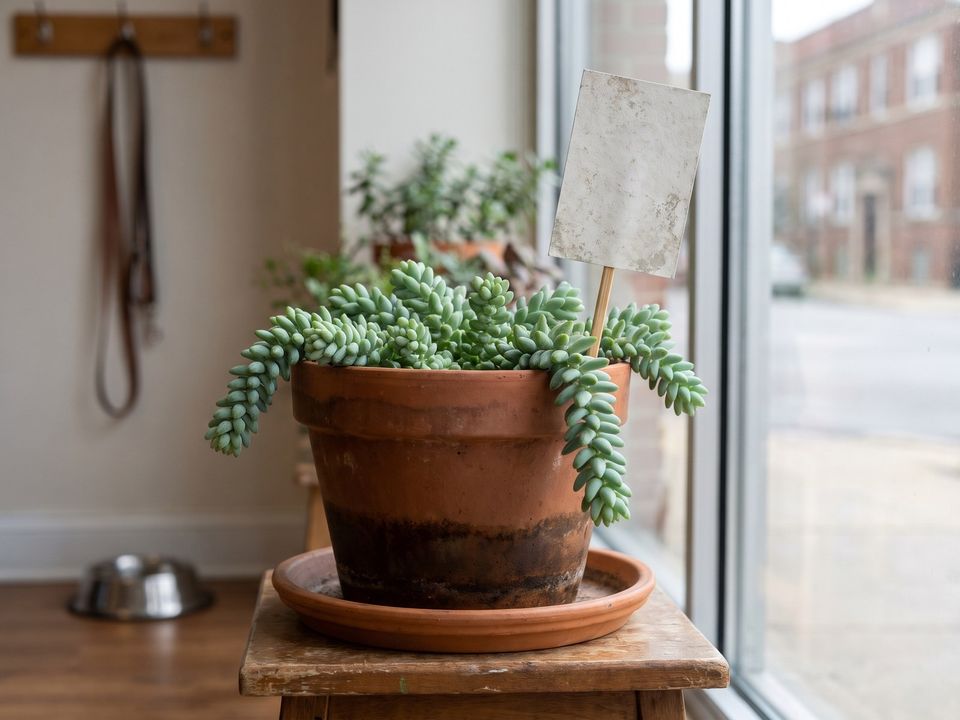
NC State’s pick is a windowsill with some sun on its leaves, where its braided tails grow best. A step back from the glass, out of the sun’s beam, it still grows in softer light, which UC lists too.
Picture an east- or west-facing sill, where direct sun crosses the glass for 2-6 hours a day, which NC State counts as part sun.
In winter, when days are short, Texas A&M’s interior-plant guide asks for bright light, so that’s the season to move it to your sunniest window.
Summers can be spent outside (University of Wisconsin Extension), and NC State says it likes fresh air. It takes temperatures down to 40°F (NC State), so plan to bring it in before October nights get that cold.
It comes from seasonally dry tropical country in Mexico (Kew), and on light it sides with the sill: some sun beats none.
: Monthly
9-14 days in summer, less in winter; nearly dry between
Every 9-14 days in summer, with the soil nearly drying between, and every 2-4 weeks in winter, just enough to keep it from going bone dry. Its beaded leaves store water; a wet pot is what brings it trouble.
NC State suggests tepid water, so take the chill off the can before you pour.
Water it where it hangs: a can with a long, narrow spout reaches under the tails to the soil, so the pot never travels to the sink.
A shallow pot suits it (NC State), and the food it needs is just as modest: once or twice in the growing season.
Gone for a while? Three weeks is fine if it’s watered the day you leave, and longer in winter.
: Small
Braided tails that hang up to about 2 feet
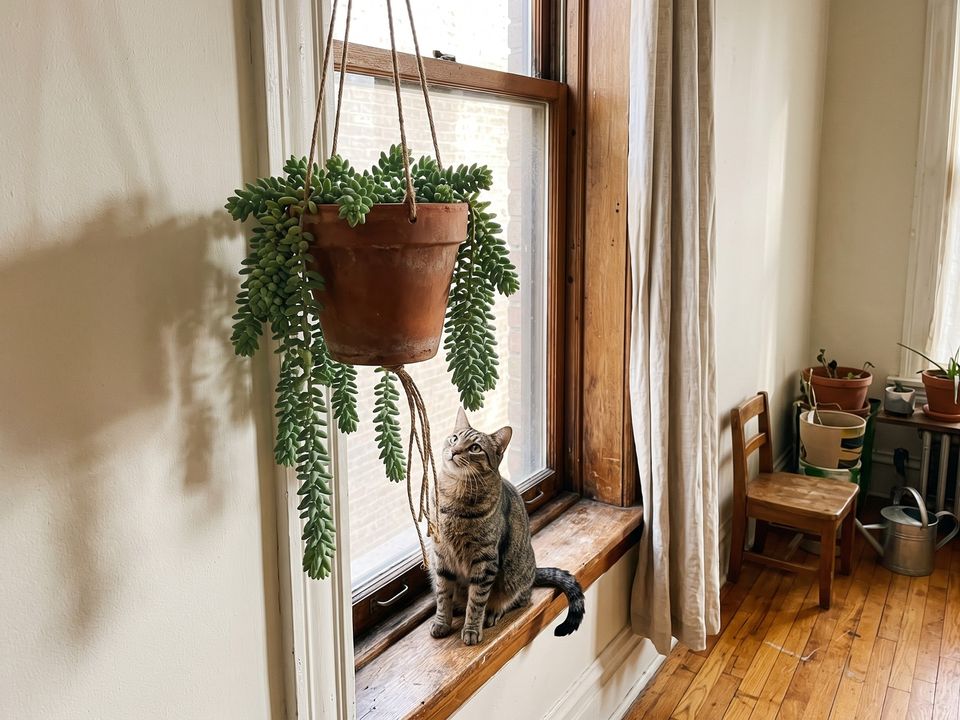
Stems rise at first, then tip over and trail 1-2 feet, braided with leaves. Hang it in a window corner away from foot traffic, where it can stay put.
Those tails are heavier than they look, since every leaf is packed with water (University of Wisconsin Extension), so give it a secure hook.
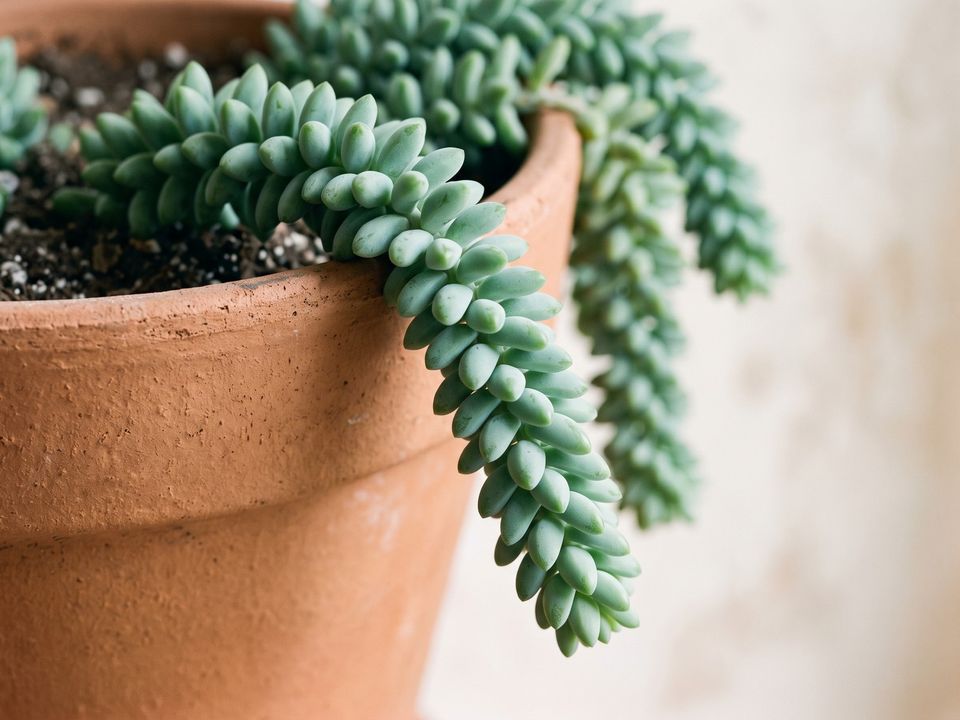
The frosty blue on its leaves is a powdery coating that rubs off wherever fingers land (NC State), leaving fingerprints behind.
Once its stems pass 10 inches, it’s old enough to bloom (University of Wisconsin Extension): small pink-red flowers at the tips in summer, though indoors that’s a rare treat.
Left alone, the tails drop in straight, braided ropes, more curtain than cascade, which suits a narrow window corner or the end of a high shelf.
: Pet & kid safe
Nothing to worry about for dogs, cats, or kids
- DogsSafe
- CatsSafe
- KidsSafe
The ASPCA lists it as non-toxic to dogs and cats, and UConn rates it safe for kids. A pet or child who eats a lot of the beads may still get a passing stomach upset.
Good news all around. Its stems and leaves are even listed as edible, and it’s tagged for children’s gardens and playgrounds (NC State).
A leaf a toddler picks up and tastes is nothing to worry about. For a pet owner, the only planning is for the plant’s sake: hang it above the reach of paws, since its leaves break off at a touch.
- ASPCA: safe for dogs.
- ASPCA: safe for cats.
- NC State Extension: safe for kids.
Cats and dogs: The ASPCA lists it as non-toxic.
Kids: No poison-centre listing; rated from university extension sources.
: Dry OK
55-85°F; dry air is fine
Happiest at 55-85°F, and it shouldn’t sit below 40°F. Dry indoor air suits it, down to about 10% humidity, so there’s no misting to do.
- Temperature
- 55-85°F
- Humidity
- 10-50%
: Pest-resistant
Rarely bothered; check stems for mealybugs
Rarely bothered. Mealybugs are the one to look for, and they tuck into the stems among the overlapping leaves. Check gently when you water, since a brush can knock leaves loose.
- Mealybugs
Very few: NC State Extension reports no serious pests or diseases. Mealybugs turn up now and then, and root rot if the soil stays wet.
Mealybugs look like tufts of white cotton tucked between the leaves. Dab them with a cotton swab dipped in rubbing alcohol, gently, since the leaves drop at a touch, then check again next week.
Root rot shows as soft, wilting leaves and tails going limp at the base while the soil is still wet. Let it dry right out and water less often; if a tail collapses, root its healthy tip.
: Little
Feed twice in summer; sweep fallen leaves; no pruning
Sweep up dropped leaves about 6 times a year; they root easily if you want more tails. Feed lightly once or twice in spring and summer. Repot in spring only when the pot is full, then wait a week to water.
- Feed2× a year
- Sweep up dropped leaves6× a year
A cactus mix that drains fast (or potting mix cut with plenty of perlite or pumice), in a hanging pot or on a pedestal with a drainage hole, so the tails can cascade.
Repot only when it has completely filled its pot, in spring: it likes being potbound. Plan the move, since every handling costs leaves, and wait a week before watering it afterward (per UW–Madison Extension).
Food is optional: a light feeding once or twice in spring and summer is all it uses.
: Simple
Frosted blue-green beads in long braided tails
Plump, waxy leaves overlap along each stem like braided beads, all one frosty blue-green. The surface is glossy and smooth, and the tails grow full enough to cover the soil.
Where to find me
Not yet pilferableFun fact
One of the most commonly grown succulents, yet for decades botanists couldn’t find it in the wild. In 2008 a small colony turned up, hanging from sheer canyon walls in Veracruz, Mexico.
Designer tips
A living sculpture for a sunny window: thick, blue-green braids hanging straight down.
Troubleshooting
Leaves fall off when I touch it
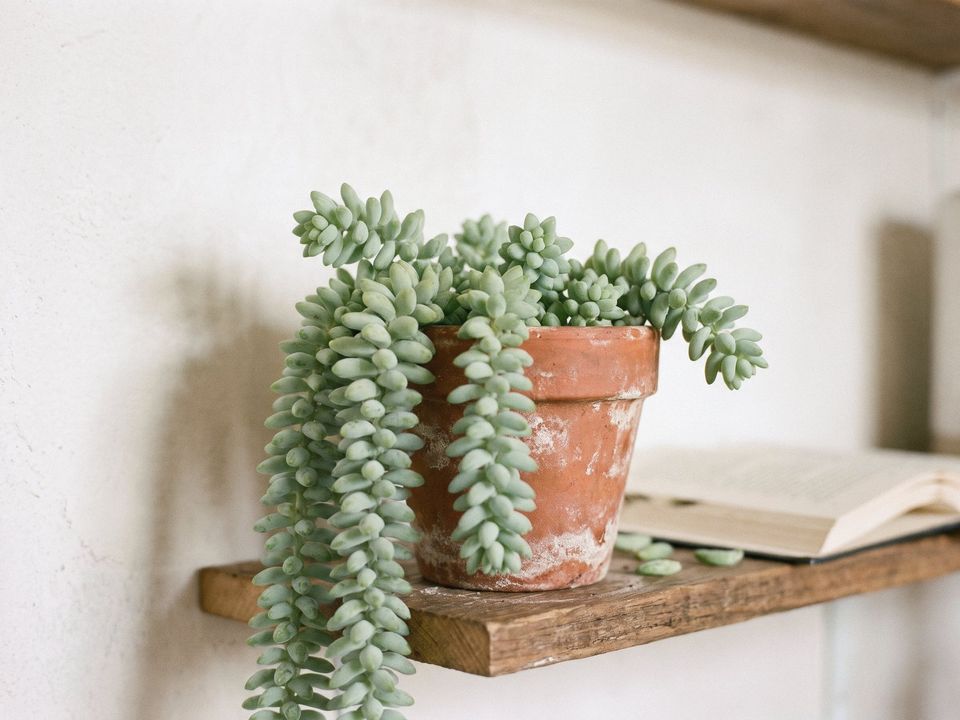
That’s its nature: NC State Extension notes the leaves are delicate and break off when handled. A spot where nobody brushes past keeps it fuller, and fallen leaves laid on barely damp cactus mix often grow new rosettes in several weeks.
Why are the leaves soft, mushy, or yellow?
Too much water, most likely; UW-Madison Extension calls root rot from overwatering its most common problem. Let the soil dry out completely and empty the saucer. If a tail has gone limp at the base, its healthy tip can be rooted as a new plant.
The leaves look wrinkled and shriveled
It’s thirsty: the leaves hold its water and wrinkle as it runs low. A good soak usually plumps them up again, and in spring and summer it drinks every 9-14 days.
See all 9
Why are the tails thin, with gaps between the leaves?
Not enough light. In your sunniest window the new growth usually comes in plump and tight, though the gappy part stays gappy; a stretched tip can be snipped and rooted to fill out the pot if you like.
The leaves have gone pale or yellowish
Usually harsh sun bleaching them, per UW-Madison Extension, and a little distance from the glass or a sheer through the hottest months helps. Pale and soft at once points to too much water instead.
Is it safe if my cat chews it?
Yes: the ASPCA lists it as non-toxic to cats and dogs. A big helping can upset a stomach, as with any plant, and a cat batting at the tails knocks leaves off, so a high hook protects the plant more than the cat.
Can it go outside for the summer?
Yes, somewhere sunny and sheltered from wind and heavy rain. Bring it in before fall nights dip toward 40°F, and expect each move to cost a few leaves.
Will it flower?
Rarely indoors. UW-Madison Extension says it blooms only on long, mature tails, and a cool room over winter helps; if it does, clusters of pink to red star-shaped flowers open at the tips in summer.
I’m away for three weeks
Usually fine: water it the day you leave and its beaded leaves carry it through, even longer in winter.
Propagation
Yes, easily, and every fallen leaf is a head start.
- For a stem cutting, snip the tip of a tail, strip the leaves off the bottom of it, and let it dry for a day or two.
- Push it into cactus mix and prop it up if it’s heavy.
- UW–Madison Extension says it can take several months to root well, so be patient.
Fallen leaves root too: lay them on barely damp cactus mix, and tiny new rosettes form at their base in several weeks.
The PILF Matrix
2.3/5
how easy it is to care for
3.5/5
how much it stands out visually
“The one with braids that never need redoing.”

EASE
2.4/5
how easy it is to care for
PRESENCE
3.4/5
how much it stands out visually
Dim to brightSoak weekly+Small sizePet & kid safe

EASE
2.5/5
how easy it is to care for
PRESENCE
4.1/5
how much it stands out visually
Shade to filteredSoak weekly+Small sizePet & kid safe

EASE
2.8/5
how easy it is to care for
PRESENCE
3.2/5
how much it stands out visually
Shade to filteredSoak 2-3× a monthSmall sizePet & kid safe
- lamb’s tail
Where it sits and what sun touches it.
- Dim shadeA dark corner or a windowless room; natural light casts no shadow
- Bright shadeBack from the window in a south-, east- or west-facing room, or right by a north-facing one, where only low early or late summer sun reaches it
- Filtered sunBehind a sheer curtain or tinted glass; the sun’s shadows are blurred
- Partial sunIn an east- or west-facing window: up to a few hours of direct sun
- Full sunThe sunniest spot you have, usually a south-facing window, with direct sun 6+ hours a day
How often, and what the soil does between.
- MonthlyEvery 2-3 weeks in summer and 3-5 in winter; the soil dries all the way between
- 2-3× a monthEvery 7-14 days in summer, longer in winter; the top of the soil dries between
- Weekly+About every 4-8 days in summer; the soil stays lightly damp
How much room it usually takes indoors.
Size
- TinyUnder 6 inches tall or wide; for a desk or a sill
- Small6 inches to 1.5 feet tall or wide; for a shelf or a sill
- Medium1.5 to 3 feet tall or wide; for a table or a stand
- Large3 to 6 feet tall or wide; for the floor
- GiantOver 6 feet tall or wide; a statement in the corner
Shape
- TreeA trunk that branches into a canopy
- CaneBare stalks topped with leaves
- UprightStiff stems or leaves rising straight from the soil
- FountainLeaves or fronds arching out from the center
- BushyA full, rounded mound of leaves
- RosetteLeaves radiating from one low point
- ViningTrails, climbs, or both
Growth
How fast it gets there.
- SlowUnder 6 inches of new growth a year
- Moderate6-12 inches a year, mostly in spring and summer
- FastOver 12 inches a year; it may want trimming or training
What risks exist for pets and kids.
- Pet & kid safeNothing to worry about
- Mildly irritatingMay irritate the mouth or stomach if chewed, or for some plants, the skin if handled
- Moderately toxicCan cause illness if eaten, though typically not serious or fatal
- DangerousCan cause serious illness if eaten, including some reports of death
- Not yet ratedNot clearly rated by our sources; please check with your vet or doctor
For its safety ratings, PILF relies on research and guidance from leading sources, including the ASPCA, Pet Poison Helpline, Merck Veterinary Manual, Poison Control, and Children’s Hospital of Philadelphia, and others.
The small jobs beyond watering, over a year.
- Little upkeepA few small jobs a year beyond watering, like a feed now and then
- Some upkeepA small job about once a month beyond watering, like feeding or turning it
- More upkeepA small job every couple of weeks beyond watering, like a wipe, a turn, or a feed
- Most upkeepA small job most weeks beyond watering, like raising the humidity or misting
- TreeA trunk that branches into a canopy
- CaneBare stalks topped with leaves
- UprightStiff stems or leaves rising straight from the soil
- FountainLeaves or fronds arching out from the center
- BushyA full, rounded mound of leaves
- RosetteLeaves radiating from one low point
- ViningTrails, climbs, or both
How fast it gets there.
- SlowUnder 6 inches of new growth a year
- Moderate6-12 inches a year, mostly in spring and summer
- FastOver 12 inches a year; it may want trimming or training
The temperature and humidity it’s comfortable in.
How dry a room it takes.
- Needs 50%+ humidity
- Fine at 35% humidity
- Fine at 15-20% humidity
The bugs that usually find it, by name.
How often pests find it.
- 5+ regular pests
- 3 regular pests
- Pests are rare
The year’s chores: feeding, pruning, repotting, and cleaning.
Chores beyond water.
- Most upkeep
- Some upkeep
- Little upkeep
Its finish, fullness, and texture.
Color, pattern, and flowers.
- SimpleOne green, one texture, nothing to read
- SuaveA sheen, a stripe, or a clean shape that catches the eye up close
- ShowyColor, pattern, or blooms you see from across the room
How the leaves catch light.
- Matte
- Satin
- Glossy or waxy
How much it fills its pot.
- Soil shows
- Soil partly hidden
- Leaves hide the soil