
String of Hearts
Ceropegia woodii
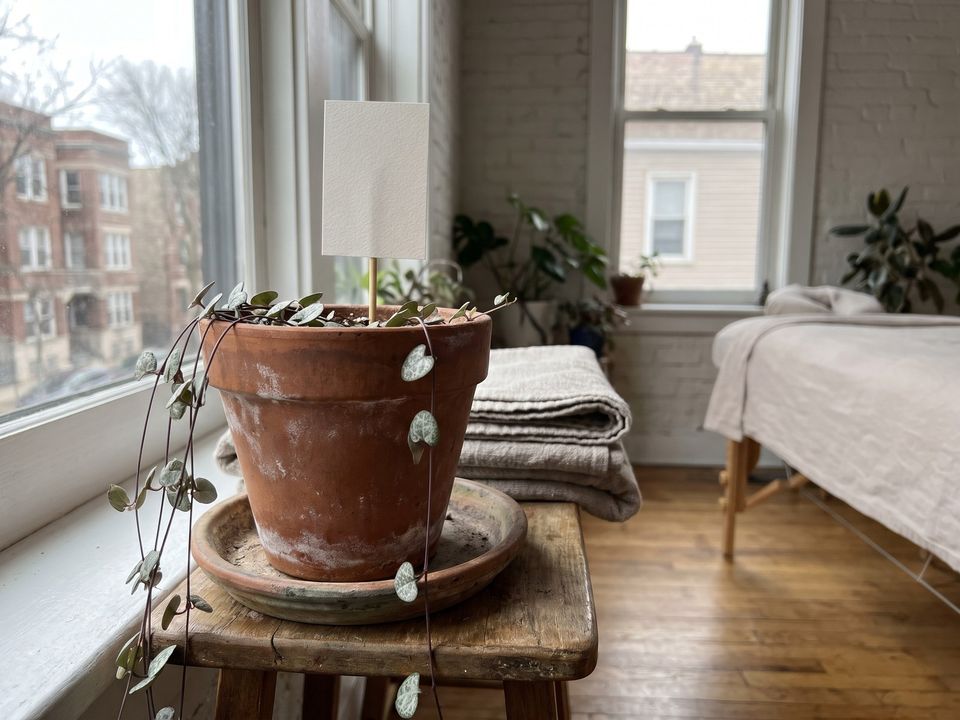
Tiny silver-marbled hearts on slender trailing threads, spilling from a small pot. Quick to grow and easy to keep.
3.3/5
how easy it is to care for
3.3/5
how much it stands out visually
: Shade to part sun
Close to a bright window; gentle sun is fine, harsh isn’t
Thrives near a bright window but shielded from direct sun, with some gentle morning or evening rays welcome. Good light keeps the hearts packed close and silvery; too little leaves bare stretches of string between them.
An east-facing window is close to ideal, since its morning sun is the gentle kind. Facing west or south, a sheer curtain softens the afternoon glare; Wisconsin Extension goes further and names a west or south window as a good home for it.
In strong light, new hearts come in dark green with crisp marbling; with too little, they turn a plain, pale green (SANBI). Too much sun shows up differently: leaves that scorch, curl, and brown (UC Master Gardeners).
So let the silver be your guide: while the marbling stays crisp and the hearts lie flat, the spot is working.
: 2-3× a month
Bone-dry between soaks; thirst shows as limp hearts
Every 10-14 days in spring and summer, the pot drying through between; every 2-3 weeks in its winter rest. Limp hearts mean it’s thirsty, but its tubers store water against a missed week, so soggy soil worries it more.
Its hearts double as tiny canteens: Wisconsin Extension notes the leaves thicken as they store water. Hearts that wilt are asking for a drink (NC State); yellowing points the other way.
Under the soil, a swollen, woody base and a cluster of tubers hold reserves of their own, and Wisconsin Extension notes it handles dry soil far better than soggy. Kept wet, those fleshy stores are prone to the root rot NC State ties to overwatering, so a cactus mix or potting soil cut with extra perlite suits them.
Those same stores carry it through its fall and winter rest, when it wants less water and warmth above 60°F; save the half-strength feed, once a month at most, for the growing months (Wisconsin Extension).
Gone for a while? Three weeks is fine if it’s watered the day you leave; its fleshy leaves carry it through.
: Medium
Quick strings of hearts that hang about 3 feet down
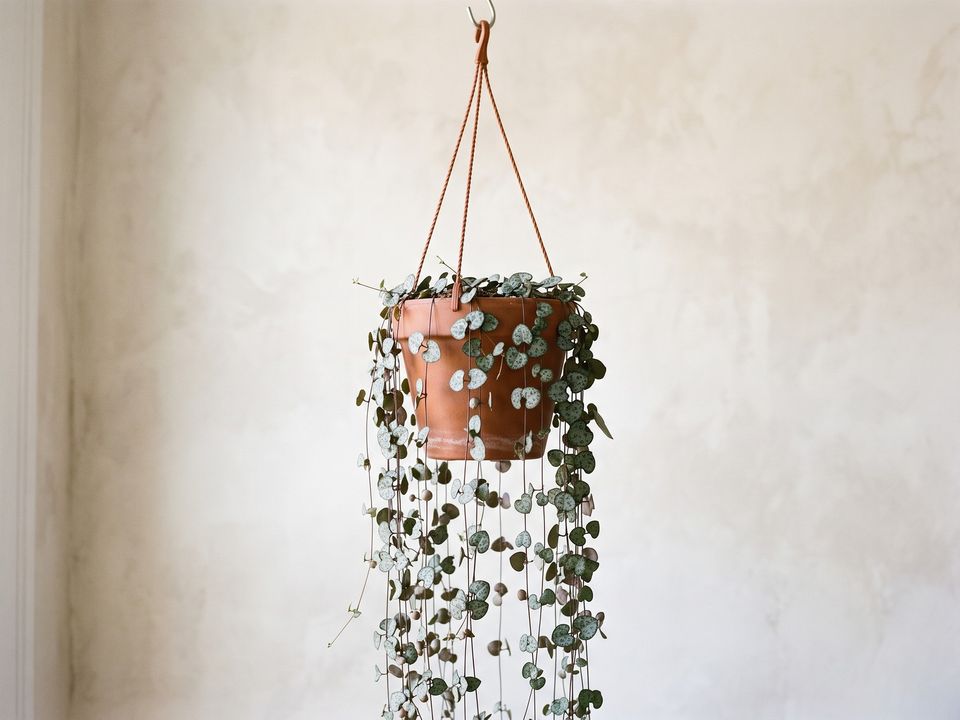
Its strings quickly fall about 3 feet from the pot, heart after heart like a beaded necklace. Hang it high so they drop free, wind them around a hoop to show off each pair, or trim them to any length.
The strands knot so easily that one old name for it is hearts entangled (Wisconsin Extension). Kept in a hanging pot, they reach about 3 feet (NC State), though the RHS gives stems of 1 m or more, so a plant left untrimmed for years can run a little past that.
Under all that lace, the base swells with age into a woody knob, a caudex, and its tubers can crowd the pot (Wisconsin Extension). It does best crowded, so wait to repot until the caudex is pressing at the rim, in spring before new growth starts.
With so little leaf on each string, it hangs in a near-straight line, which pairs well with a tall, narrow window or a wall bracket beside one, where a few strands can drop the full height of the frame.
: Not yet rated
No rating yet for dogs or cats; rated safe for kids
- DogsNot yet rated
- CatsNot yet rated
- KidsSafe
UC Agriculture and Natural Resources lists it, as rosary vine, among plants safe for kids. For dogs and cats there’s no rating: the ASPCA, Pet Poison Helpline, and NC State have no listing for it either way.
No pet poison database lists it yet, so it stays unrated for dogs and cats until one does.
For families, the news is good: a toddler who pulls off a heart or two is unlikely to come to any harm. If you ever want a second opinion on something a child has eaten, Poison Control answers.
With a dog or cat, it’s a judgment call, and your vet can help you make it. If your pet chews a mouthful and seems off, call your vet or the ASPCA Animal Poison Control Center (a fee may apply).
To keep one with pets in the house, give it a high hook or shelf. Those dangling strings sway like a cat toy, so trim any that dip within paw’s reach.
- Internet Archive: safe for kids.
Cats and dogs: None of the leading sources names it.
Kids: No poison-centre listing; rated from university extension sources.
: Dry OK
65-75°F; average humidity is fine
Happiest at 65-75°F, and it shouldn’t sit below 60°F. Keep it away from cold glass in winter. It likes 40-50% humidity and gets by at 25%.
- Temperature
- 65-75°F
- Humidity
- 40-50%
: Mealybugs
Mealybugs, plus aphids or scale; check the new growth
Mealybugs are the likeliest guests: check the new growth at the stem tips, and under the leaves. Aphids hide in new growth and young leaf undersides, and scale on leaves and stems. Look at the tips as you water.
- Mealybugs
- Aphids
- Scale
Few. Mealybugs are the pest to watch for, and rot if the soil stays wet.
Mealybugs look like tufts of white cotton where the leaves meet the vine. Wipe them off with a cotton swab dipped in rubbing alcohol (Arkansas Extension’s fix), then check again next week.
Aphids and scale turn up now and then: aphids as small soft bugs clustered on new tips, scale as small brown bumps stuck to the vines. Rinse aphids off under the tap and lift scale with a fingernail; insecticidal soap is the next step for either.
Rot starts where the vines meet the soil and shows as yellowing leaves and mushy stems. Let the pot dry right out; if the base is gone, root the healthy vines as new plants (see Propagation).
: Little
Feed up to 6× in summer, trim twice, repot every 2-3 years
Feed at half strength, at most monthly, through spring and summer, and skip winter. Trim and untangle the long strands twice a year. Repot in spring or summer every 2-3 years, only when needed; it likes a crowded pot.
- Feed6× a year
- Prune2× a year
Cactus and succulent mix, or potting mix with plenty of coarse sand or perlite, in a small pot with a drainage hole. It looks best hanging.
It does best crowded, so repot only when it’s truly crowded, in spring before new growth starts (UW–Madison).
Food is optional: half-strength houseplant fertilizer at most once a month while it’s growing, and none in winter.
: Suave
Silver-marbled green hearts on slender trailing threads
Small green hearts are marbled with silver and strung along thin threads that spill over the pot’s rim. The leaves have a slight sheen, and the strands cover the soil only in part.

Where to find me
Not yet pilferableFun fact
Its genus, Ceropegia, comes from the Greek words for wax and fountain, for its waxy, fountain-shaped flowers; the name woodii honors John Medley Wood.
Designer tips
Delicate and a little retro, it suits a bright, simple room where the vines can hang free.
Troubleshooting
Pale hearts with bare string between them
Too little light. Good light keeps the hearts silver-marbled and close together, so move it beside your brightest window, easing it into any sun on the leaves so they don’t scorch.
The hearts are turning yellow
Usually too much water: NC State lists yellowing as a sign of overwatering, the same thing that rots the roots. Let the pot dry all the way through, then stick to every 10-14 days in spring and summer.
The hearts look limp and shriveled
That’s thirst; NC State reads wilted leaves as underwatering. The hearts store water, so a good soak usually plumps them back up.
See all 8
What are the little balls along the strings?
Tubers, which UW-Madison likens to little potatoes; they form where the leaves join the vine. Press one into a pot of damp cactus mix, still attached, and it roots in anywhere from a few weeks to a few months.
It stopped growing this winter
That’s its rest, and UW-Madison says it does best with one: less water, no fertilizer, and a room above 60°F. It usually picks up again in spring.
What are the strange little flowers?
Its own: small tubes with a bulbous base, white to pale magenta, their petal tips fused into a tiny purple cage. UW-Madison says they come mostly in summer and fall; there’s nothing to do but enjoy them.
Is it safe for my cat?
It’s unrated for cats and dogs: the ASPCA, Pet Poison Helpline, and NC State don’t list it either way, so ask your vet if your cat’s a chewer. For kids, UC ANR lists it as safe, and a high hook keeps the swaying strings out of paw’s reach.
Can it go outside for the summer?
Yes, in a bright, sheltered spot, eased into the sun gradually so it doesn’t burn. Bring it back in well before frost, while nights stay above 60°F.
Propagation
One of the easiest: the little round tubers along the vines root on their own wherever they touch soil (NC State).
- Set a small pot of damp cactus mix beside it and press a tuber into the soil, still attached to its vine.
- Keep the mix barely moist; UW–Madison says it roots and grows in anywhere from a few weeks to a few months, and then you snip it free.
- Cuttings root too, best with a warm spot underneath.
The PILF Matrix
3.3/5
how easy it is to care for
3.3/5
how much it stands out visually
“The one who love-bombs, then actually sticks around.”


- chain of hearts
Rated 1-5, with 5 being easiest
Built from light, water, air, pests, and upkeep.
Rated 1-5, with 5 being easiest
Rated 1-5, with 5 being highest presence
Built from its scale (size, shape, growth) and its look (color and flowers, shine, fullness).
Rated 1-5, with 5 being highest presence
Where it sits and what sun touches it.
- Dim shadeA dark corner or a windowless room; natural light casts no shadow
- Bright shadeBack from the window in a south-, east- or west-facing room, or right by a north-facing one, where only low early or late summer sun reaches it
- Filtered sunBehind a sheer curtain or tinted glass; the sun’s shadows are blurred
- Partial sunIn an east- or west-facing window: up to a few hours of direct sun
- Full sunThe sunniest spot you have, usually a south-facing window, with direct sun 6+ hours a day
How often, and what the soil does between.
- MonthlyEvery 2-3 weeks in summer and 3-5 in winter; the soil dries all the way between
- 2-3× a monthEvery 7-14 days in summer, longer in winter; the top of the soil dries between
- Weekly+About every 4-8 days in summer; the soil stays lightly damp
How much room it usually takes indoors.
Size
- TinyUnder 6 inches tall or wide; for a desk or a sill
- Small6 inches to 1.5 feet tall or wide; for a shelf or a sill
- Medium1.5 to 3 feet tall or wide; for a table or a stand
- Large3 to 6 feet tall or wide; for the floor
- GiantOver 6 feet tall or wide; a statement in the corner
Shape
- TreeA trunk that branches into a canopy
- CaneBare stalks topped with leaves
- UprightStiff stems or leaves rising straight from the soil
- FountainLeaves or fronds arching out from the center
- BushyA full, rounded mound of leaves
- RosetteLeaves radiating from one low point
- ViningTrails, climbs, or both
Growth
How fast it gets there.
- SlowUnder 6 inches of new growth a year
- Moderate6-12 inches a year, mostly in spring and summer
- FastOver 12 inches a year; it may want trimming or training
What risks exist for pets and kids.
- Pet & kid safeNothing to worry about
- Mildly irritatingMay irritate the mouth or stomach if chewed, or for some plants, the skin if handled
- Moderately toxicCan cause illness if eaten, though typically not serious or fatal
- DangerousCan cause serious illness if eaten, including some reports of death
- Not yet ratedNot clearly rated by our sources; please check with your vet or doctor
For its safety ratings, PILF relies on research and guidance from leading sources, including the ASPCA, Pet Poison Helpline, Merck Veterinary Manual, Poison Control, and Children’s Hospital of Philadelphia, and others.
The small jobs beyond watering, over a year.
- Little upkeepA few small jobs a year beyond watering, like a feed now and then
- Some upkeepA small job about once a month beyond watering, like feeding or turning it
- More upkeepA small job every couple of weeks beyond watering, like a wipe, a turn, or a feed
- Most upkeepA small job most weeks beyond watering, like raising the humidity or misting
- TreeA trunk that branches into a canopy
- CaneBare stalks topped with leaves
- UprightStiff stems or leaves rising straight from the soil
- FountainLeaves or fronds arching out from the center
- BushyA full, rounded mound of leaves
- RosetteLeaves radiating from one low point
- ViningTrails, climbs, or both
How fast it gets there.
- SlowUnder 6 inches of new growth a year
- Moderate6-12 inches a year, mostly in spring and summer
- FastOver 12 inches a year; it may want trimming or training
The temperature and humidity it’s comfortable in.
How dry a room it takes.
- Needs 50%+ humidity
- Fine at 35% humidity
- Fine at 15-20% humidity
The bugs that usually find it, by name.
How often pests find it.
- 5+ regular pests
- 3 regular pests
- Pests are rare
The year’s chores: feeding, pruning, repotting, and cleaning.
Chores beyond water (what needs work means).
- Most upkeep
- Some upkeep
- Little upkeep
Its finish, fullness, and texture.
Color, pattern, and flowers.
- SimpleOne green, one texture, nothing to read
- SuaveA sheen, a stripe, or a clean shape that catches the eye up close
- ShowyColor, pattern, or blooms you see from across the room
How the leaves catch light.
- Matte
- Satin
- Glossy or waxy
How much it fills its pot.
- Soil shows
- Soil partly hidden
- Leaves hide the soil