Spider Plant
Chlorophytum comosum
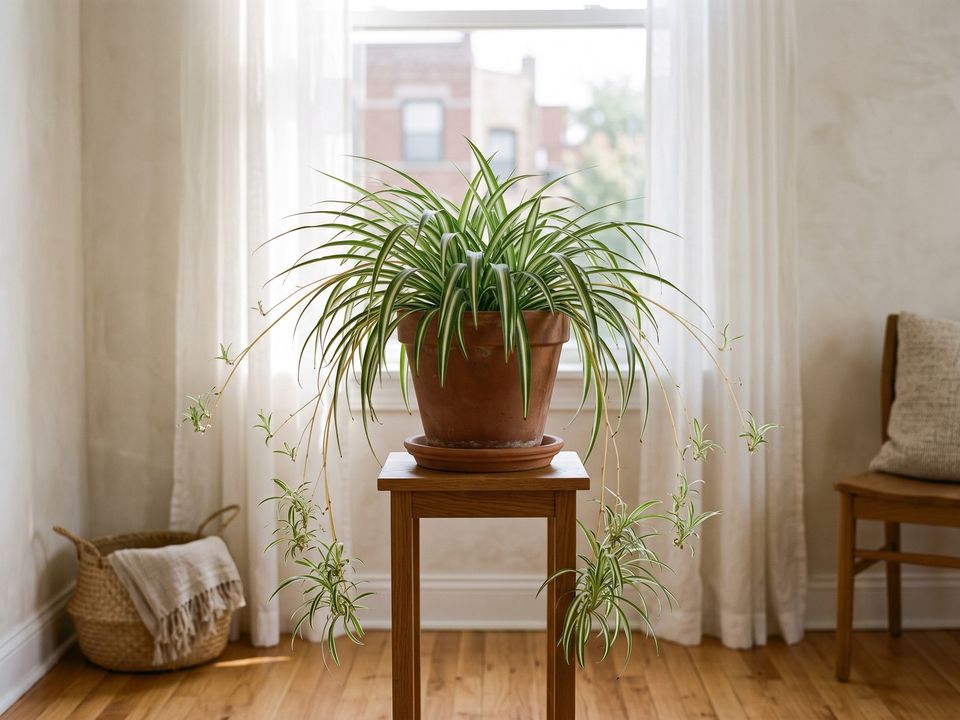
Like its namesake, long-legged sprouts arch out from a mounded center. Known for making babies and living forever.
Also called airplane plant and ribbon plant
3.4/5
how easy it is to care for
4.1/5
how much it stands out visually
: Dim to bright
Medium to bright light; keep it out of harsh sun
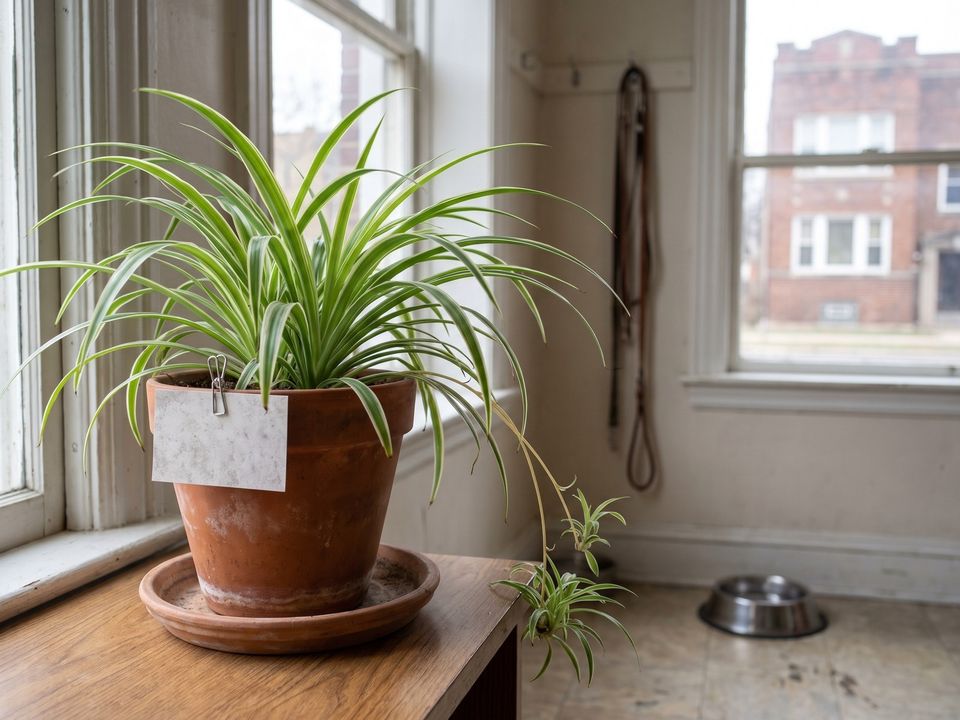
It does best in bright shade near a window, where it grows fullest and its stripes stay crisp. It handles less light, just slower and paler, and sun on its leaves may scorch the blades.
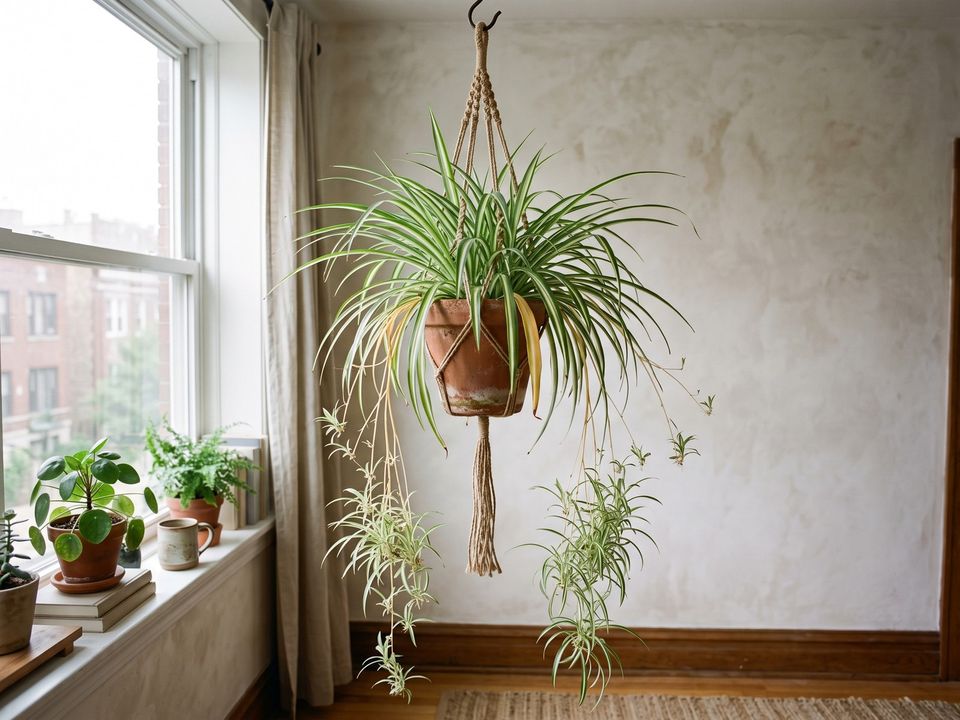
A north-facing room suits it, or anywhere well back from a sunny window. Hung high, it has room to let its babies swing out on their runners.
It tolerates deep shade for long stretches (NC State), though a thin, sparse plant usually wants a little more light. Give it what you have, and treat the next runner as its thank-you note.
: Weekly+
Let it dry slightly between deep drinks; never soggy
It drinks more steadily than most: a deep drink about weekly, the surface drying slightly between, never soggy. Let it go dry and the tips brown, though its fleshy roots store enough water to ride out a dry spell.
Let the surface dry slightly between thorough waterings, and give it a little less in winter (NC State). Soil that stays wet for long can rot those fleshy roots (University of Wisconsin Extension), so a regular pot you water by hand is likely a better fit than a self-watering one.
Its tips are the tell. If they begin to brown, and that bothers you, consider distilled or rainwater: University of Wisconsin Extension points to fluoride and salts in tap water as a common cause. It’ll survive either way, and you can snip the brown ends off with clean scissors.
Gone for a while? Two weeks is fine if it’s watered the day you leave. Any longer and it looks rough for a while, then recovers.
: Medium
A foot-tall mound whose runners steadily arch out 2 feet
A fountain of striped blades about a foot tall, with runners that arch out 2 feet and dangle babies. Made for a hanging pot or a high shelf, where the babies can spill; snip them to keep it tidy, or pot them up to share.
Its blades run 12-18 inches long, so even a modest pot spreads 1-2 feet wide (NC State).
A crowded pot isn’t all bad. A slightly potbound plant tends to make the most babies (University of Wisconsin Extension). When it finally needs more room, cut the root ball in two and make two plants.
Each baby on a runner arrives with roots already started: set it on moist soil, still attached if you like, and snip the runner once it takes hold.
: Pet & kid safe
Nothing to worry about for dogs, cats or kids
The ASPCA lists it as non-toxic to dogs and cats, and a children’s poison center (CHOP) lists it as non-poisonous for kids. Some cats love to chew the arching leaves, harmless to everyone but the plant.
Cats sometimes vomit after chewing the leaves; it passes on its own.
No harm, no foul, no problem. The spider plant is one of the easiest plants for parents and pet owners to have, with nothing harmful to a crawling baby or a curious cat.
Some cats find the arching blades irresistible, and a well-grazed plant mostly just looks ragged. If yours treats it like a salad bar, hang it high or let it trail from a shelf the cat can’t reach. It’ll keep making babies either way.
- ASPCA: safe for dogs.
- Merck Veterinary Manual: mild for dogs (rates the whole genus).
- Pet Poison Helpline: safe for dogs.
- ASPCA: safe for cats.
- Merck Veterinary Manual: mild for cats (rates the whole genus).
- Pet Poison Helpline: safe for cats.
- CHOP: safe for kids.
Cats and dogs: The ASPCA lists it as non-toxic.
Kids: CHOP lists it as non-poisonous.
: Dry OK
65-80°F; average humidity is fine
Happiest at 65-80°F, and it shouldn’t sit below 45°F. Humidity can drop to 25% without trouble.
- Temperature
- 65-80°F
: Pest-resistant
Rarely bothered; check leaf bases and undersides
Rarely bothered. If something turns up, look at the crown, leaf bases and runners for scale and mealybugs, under the leaves for mites and whiteflies, and in new growth for aphids and thrips.
- Scale insects
- Mealybugs
- Spider mites
- Whiteflies
- Aphids
- Thrips
Not many. A few sap-sucking bugs now and then, and root rot if the soil stays soggy.
Mealybugs look like tufts of white cotton where the leaves meet; scale looks like small brown bumps stuck to the leaves. Wipe them off with a cotton swab dipped in rubbing alcohol (a fingernail lifts scale), then check again next week.
Spider mites leave fine webbing and a dusty, speckled look, mostly in warm, dry air like a heated room in winter. Rinse the whole plant in the shower, undersides of the leaves included. Aphids and whiteflies turn up less often. If anything keeps coming back, an insecticidal soap spray is the next step.
Diseases are rare. Root rot is the one to watch: if it wilts while the soil is wet, let it dry out, empty the saucer and water less often.
: Little
Snip and pot up plantlets 2× a year; repot yearly
Snip brown tips and trim or pot up heavy plantlets twice a year, and feed 3 times from spring to autumn. Repot yearly while young, then every other year, dividing every 2-3 years before tubers crack the pot.
- Feed3× a year
- Prune2× a year
- Trim or pot up plantlets2× a year
- Repot1× a year
Any potting mix that drains fast, in a pot with a drainage hole and a little on the snug side.
Crowded roots make more babies, so there’s no rush. Repot every two years, one pot size up, or sooner if the thick roots start lifting the plant out of the soil.
Food is optional. A houseplant fertilizer at half strength a few times over spring and summer is plenty; too much means fewer babies.
: Showy
Arching striped blades, matte and smooth, mounded full
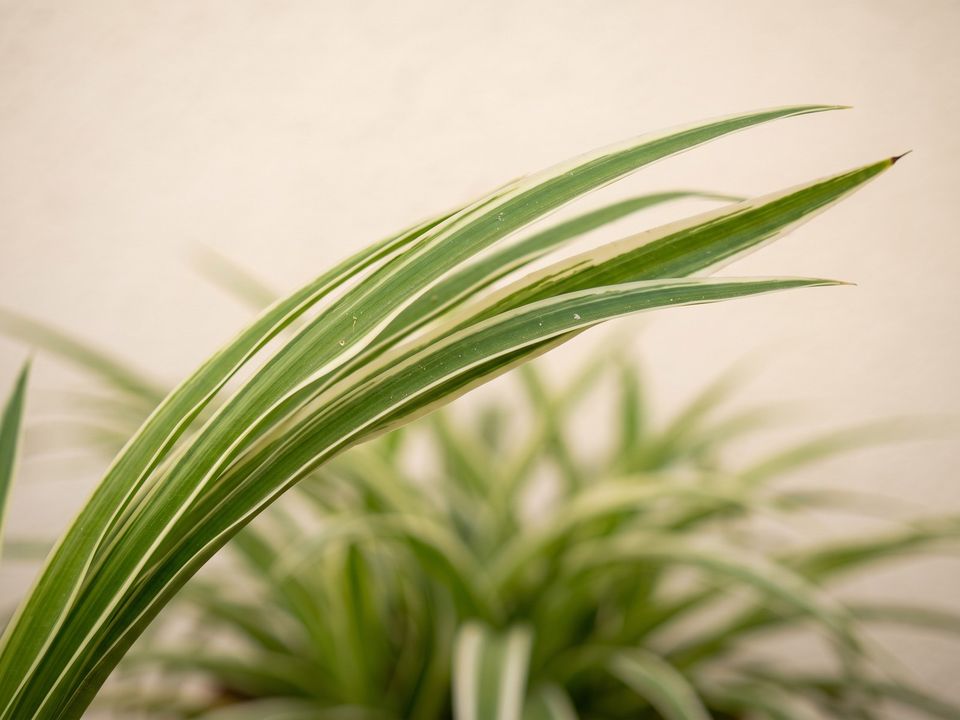
Long, narrow green blades with pale stripes arch out from the center like a fountain. The surface is matte and smooth, and the leaves mound up so thickly that the soil disappears.
Where to find me
Not yet pilferableFun fact
Those arching runners are really flower stalks: tiny white stars open along them first, and the babies form after the flowers. South Africans call it hen-and-chickens.
Designer tips
A retro classic that looks modern in a plain pot.
Troubleshooting
The tips are turning brown
Cosmetic, and very common: soil that dried out, dry air, salts from tap water and fertilizer, or tap water’s fluoride. Trim the brown bits at an angle if they bug you; if new tips keep browning, try rain or distilled water, since a pitcher filter doesn’t take out fluoride.
Why is it limp and droopy?
If it’s been a week or two since its last drink, it’s likely thirsty, and a good soak usually stands it back up. If the soil’s soggy, the roots may be starting to rot, so let it dry out and empty the saucer. Droopy for weeks with the watering fine usually means it wants more light.
Why isn’t it making babies?
It likes a bright spot, long nights and a snug pot. Spider plants usually start runners after a few weeks of short days and long, dark nights, which is why babies often show up in fall; a lamp left on late, a roomy pot or a lot of fertilizer can hold it back.
See all 9
My cat keeps chewing it
The cat’s fine: the ASPCA lists spider plants as non-toxic to cats and dogs, though a cat may vomit after a big chew, and that passes. The plant gets the worst of it, so hang it or move it up high if you want it to stay full.
The leaves look pale or scorched
Too much sun on the leaves. Move it a few feet back from the window or behind a sheer curtain; scorched leaves stay marked, but the new ones come in greener.
Why are thick white roots pushing out of the pot?
It’s outgrown its pot, and it doesn’t mind for a while; a snug pot even makes more babies. When the roots start bulging the pot or lifting the plant, move it one pot size up, or split it in two.
What are the little white flowers?
Its flowers: small white stars open on the runners, and babies form where they were. It’s a sign it’s doing well, with nothing for you to do.
I’m away for two weeks
Two weeks is fine if it’s watered the day you leave. Any longer and it may look rough for a while, then recover.
Can it go outside for the summer?
Yes, in the shade: a porch, a balcony or under a tree, out of the sun’s reach. Bring it back in before fall nights drop below 45°F, and check it for bugs before it comes inside.
Propagation
One of the easiest plants to multiply: the babies are ready-made plants.
- Snip off a baby with little root nubs underneath and set it in a glass of water or a small pot of damp mix.
- It roots in about a week.
- Or skip the snipping: set a baby on a small pot of mix beside the mother, still attached, and cut the runner once it has rooted.
A big, crowded plant can also be split in two when you repot.
The PILF Matrix
3.4/5
how easy it is to care for
4.1/5
how much it stands out visually
Forever
The ones you’ll grow old with.
“The one with a backup plan for its backup plan: a true baby mama.”


How easy it is to care for. Built from light, water, air, pests and upkeep.
Rated 1-5, with 5 being easiest.
How much it stands out visually. Built from its scale (size, shape, growth) and its look (color and flowers, shine, fullness).
Rated 1-5, with 5 being highest presence.
Where it sits and what sun touches it.
- Dim shadeA dark corner or a windowless room; natural light casts no shadow
- Bright shadeBack from the window in a south-, east- or west-facing room, or right by a north-facing one, where only low early or late summer sun reaches it
- Filtered sunBehind a sheer curtain or tinted glass; the sun’s shadows are blurred
- Partial sunIn an east- or west-facing window: up to a few hours of direct sun
- Full sunThe sunniest spot you have, usually a south-facing window, with direct sun 6+ hours a day
How often, and what the soil does between.
- MonthlyEvery 2-3 weeks in summer and 3-5 in winter; the soil dries all the way between
- 2-3× a monthEvery 7-14 days in summer, longer in winter; the top of the soil dries between
- Weekly+About every 4-8 days in summer; the soil stays lightly damp
How much room it usually takes indoors.
Size
- TinyUnder 6 inches tall or wide; for a desk or a sill
- Small6 inches to 1.5 feet tall or wide; for a shelf or a sill
- Medium1.5 to 3 feet tall or wide; for a table or a stand
- Large3 to 6 feet tall or wide; for the floor
- GiantOver 6 feet tall or wide; a statement in the corner
Shape
- TreeA trunk that branches into a canopy
- CaneBare stalks topped with leaves
- UprightStiff stems or leaves rising straight from the soil
- FountainLeaves or fronds arching out from the center
- BushyA full, rounded mound of leaves
- RosetteLeaves radiating from one low point
- ViningTrails, climbs, or both
Growth
How fast it gets there.
- SlowUnder 6 inches of new growth a year
- Moderate6-12 inches a year, mostly in spring and summer
- FastOver 12 inches a year; it may want trimming or training
What happens and how bad (the worst of dogs, cats and kids).
- Pet & kid safeNothing to worry about
- Mildly irritatingMay irritate the mouth or stomach if chewed, or for some plants, the skin if handled
- Moderately toxicCan cause illness if eaten, though typically not serious or fatal
- Highly toxicCan cause serious illness if eaten, including some reports of death
- Not yet ratedNot clearly rated by our sources; please check with your vet or doctor
For its safety ratings, PILF relies on research and guidance from leading sources, including the ASPCA, Pet Poison Helpline, Merck Veterinary Manual, Poison Control and Children’s Hospital of Philadelphia, and others.
The small jobs beyond watering, over a year.
- Little upkeepA few small jobs a year beyond watering, like a feed now and then
- Some upkeepA small job about once a month beyond watering, like feeding or turning it
- More upkeepA small job every couple of weeks beyond watering, like a wipe, a turn or a feed
- Most upkeepA small job most weeks beyond watering, like raising the humidity or misting
- TreeA trunk that branches into a canopy
- CaneBare stalks topped with leaves
- UprightStiff stems or leaves rising straight from the soil
- FountainLeaves or fronds arching out from the center
- BushyA full, rounded mound of leaves
- RosetteLeaves radiating from one low point
- ViningTrails, climbs, or both
How fast it gets there.
- SlowUnder 6 inches of new growth a year
- Moderate6-12 inches a year, mostly in spring and summer
- FastOver 12 inches a year; it may want trimming or training
The temperature and humidity it’s comfortable in.
How dry a room it takes.
- Needs 50%+ humidity
- Fine at 35%
- Fine at 15-20%
The bugs that usually find it, by name.
How often pests find it.
- 5+ regular pests
- 3 regular pests
- Pests are rare
The year’s chores: feeding, pruning, repotting and cleaning.
Chores beyond water (what needs work means).
- Most upkeep
- Some upkeep
- Little upkeep
Its finish, fullness and texture.
Color, pattern and flowers.
- SimpleOne green, one texture, nothing to read
- SuaveA sheen, a stripe or a clean shape that catches the eye up close
- ShowyColor, pattern or blooms you see from across the room
How the leaves catch light.
- Matte
- Satin
- Glossy or waxy
How much it fills its pot.
- Soil shows
- Soil partly hidden
- Leaves hide the soil