Yucca Cane
Yucca gigantea
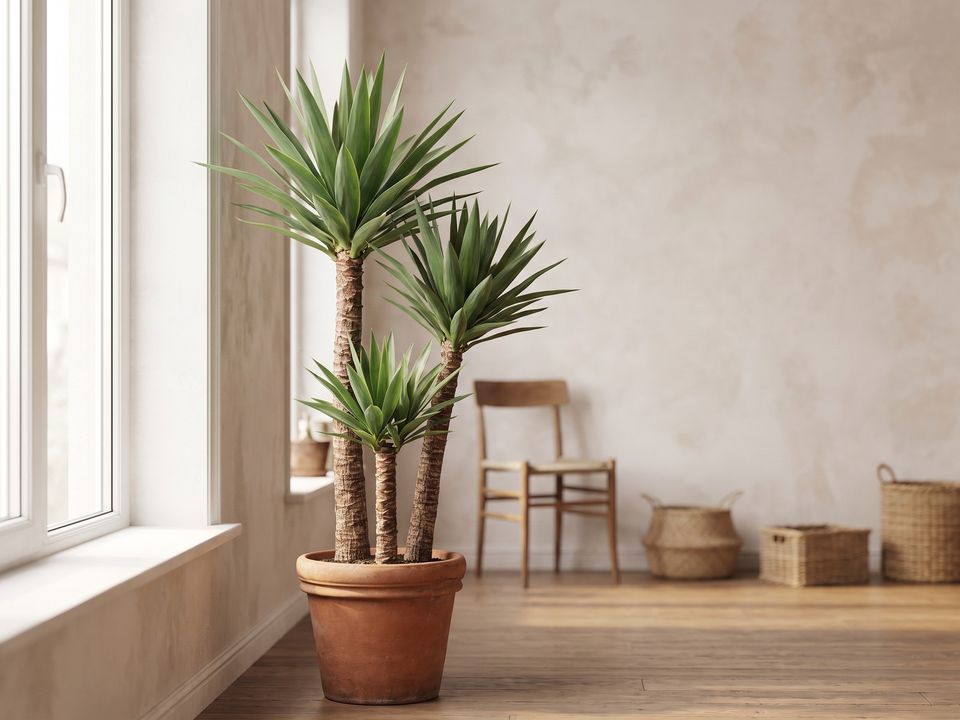
Sprays of sword-like leaves burst from thick, woody canes. A sunny spot and a little neglect keep it happy for years.
3.5/5
how easy it is to care for
2.2/5
how much it stands out visually
: Shade to full sun
Wants the sunniest window; settles for bright shade
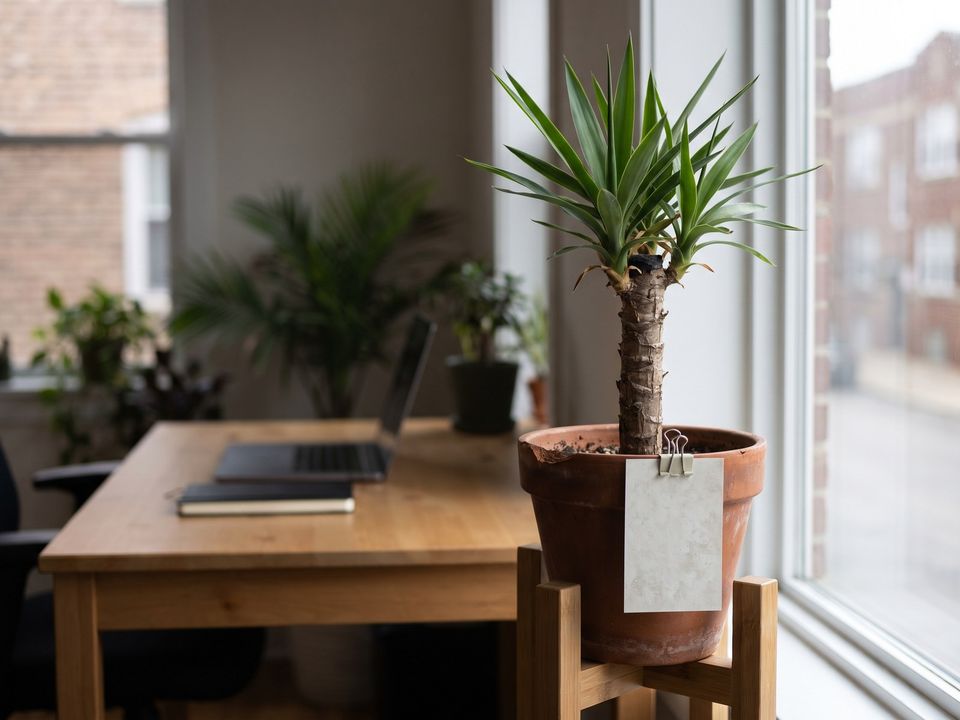
Built for full sun: a sunny south-facing window, with sun on its leaves most of the day, is where it grows best. Out of the sun it can get by in bright light, though the RHS notes its leaves may sag in low light.
Its home is the seasonally dry tropics from central Mexico to Central America (Kew). NC State also lists partial shade, 2-6 hours of direct sun, as workable, so an unshaded east or west window is a fair second choice.
In summer it can go outside; NC State advises bringing it in before nights drop below 50°F. Through winter, keep it clear of a door that opens onto January air, since NC State warns that cold drafts and sudden temperature swings can damage it.
Among the cane plants, this is the sun-seeker. Give it the window, and let the shade lovers have the corners.
: Monthly
Let the soil dry between drinks; soggy soil rots it
About every 3-4 weeks in winter, with the pot drying to the bottom between, and as often as every 10-14 days in summer. Drought barely troubles it; overwatering is the real danger, so lean dry.
NC State’s potting recipe for it is mostly grit: one part potting mix to three parts perlite or sand. A mix that coarse drains fast, keeping the roots out of the standing wet that NC State links to root rot.
Heated winter air won’t bother it either. NC State calls ordinary indoor humidity adequate for this yucca, so the mister and pebble tray can stay in the closet.
Gone for a while? Three weeks is fine if it’s watered the day you leave.
: Large
Slow-growing woody canes, 3-6 feet, crowned in leaves
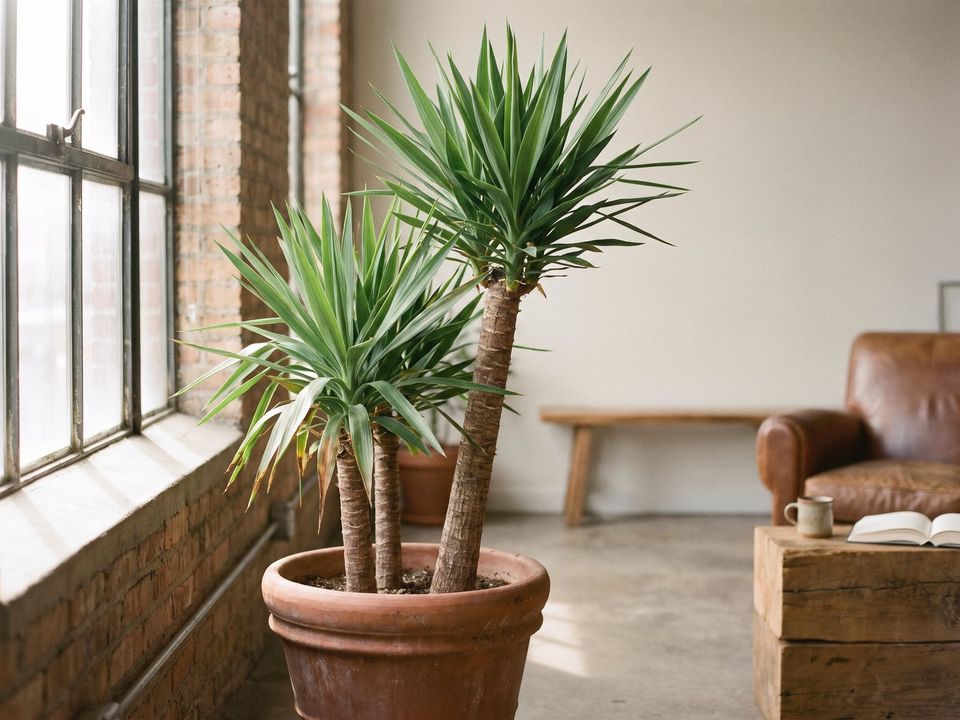
Slow-growing woody canes 3-6 feet tall, each topped by its own tuft of sword-shaped leaves. It belongs on the floor by a sunny window, in a heavy pot or one weighted with grit so the tall canes don’t tip.
Outdoors in its native range it becomes a tree of 15-30 feet, with a base so massive that NC State warns against planting it near a house’s foundation. As a houseplant it stays much more compact (NC State).
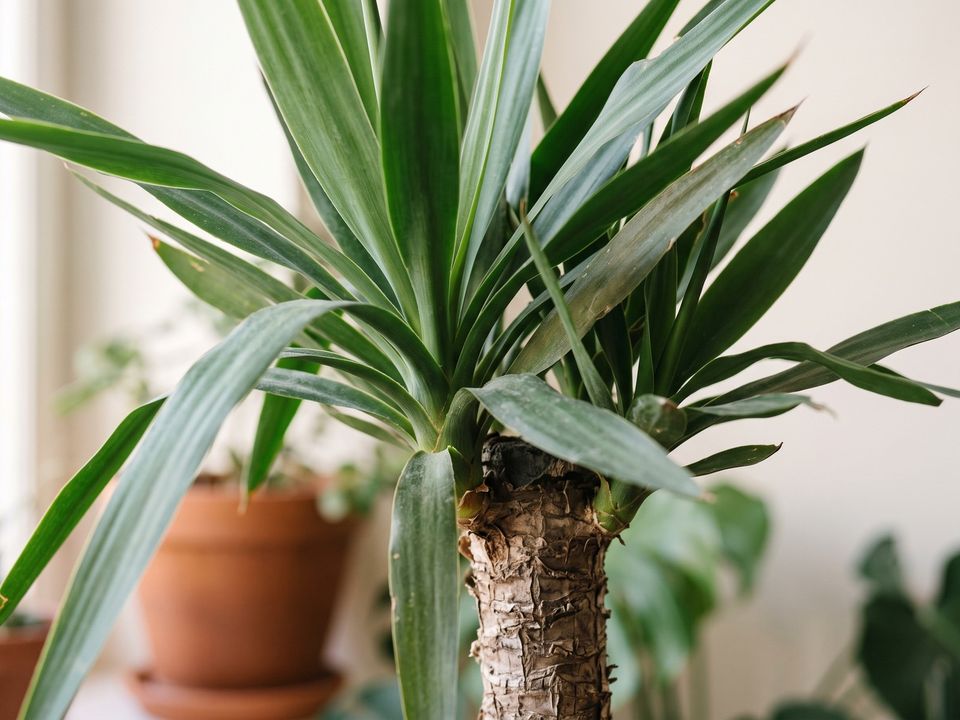
Its 12-18 inch leaves (NC State) spiral out only at the cane tops, so the green sits high and the floor stays clear; NC State calls that vertical build a natural accent. Picture it beside a sofa arm, between two windows, or at the end of a sunny hallway.
New shoots, which NC State calls suckers, rise from the base and grow into extra canes; separate one to pot on its own, or root a stem cutting.
: Mildly irritating
Chewing can upset the stomachs of dogs, cats, or kids
- DogsMildly irritating
- CatsMildly irritating
- KidsMildly irritating
A chewed leaf may bring on vomiting in a dog or cat, and nausea, vomiting, or diarrhea in a child, sometimes with a headache or dizziness. NC State rates it low severity, and the upset usually passes.
Grazing animals that eat it often can get liver disease; a dog or cat that chews it usually just vomits, and that passes.
Saponins are the compounds that let a cousin, soapweed yucca, be used to make soap (NC State), and in this plant they sit most heavily in the leaves and roots. In pets the usual result is mild vomiting and diarrhea, sometimes with dilated pupils (Pet Poison Helpline). The sap can leave a minor rash, so gloves help when you cut a cane back (NC State).
One worry this yucca spares you: its leaf tips are soft, with none of the sharp spines other yuccas carry (NC State).
Most upsets settle on their own. If symptoms don’t, or anything worries you, call your vet or the ASPCA Animal Poison Control Center (a fee may apply); for a child, call Poison Control.
Grown tall, its leaves sit up on the canes, above most dogs and toddlers, though fallen leaves land within reach, so pick them up as they drop. For a cat that climbs, a room it rarely visits works better.
- ASPCA: mild for dogs (rates the whole genus).
- Pet Poison Helpline: mild for dogs (rates the whole genus).
- ASPCA: mild for cats (rates the whole genus).
- Pet Poison Helpline: mild for cats (rates the whole genus).
- NC State Extension: mild for kids.
Cats and dogs: Most of the leading sources agree.
Kids: No poison-centre listing; rated from university extension sources.
: Dry OK
Room temperature; dry air is fine
Ordinary room temperature suits it, above 50°F, and humidity can drop to 10% without trouble.
: Pest-resistant
Rarely bothered; check the crown and stems
Rarely bothered. If something turns up, look for scale on the stems and leaves, mealybugs at the leaf bases and crown, and aphids on new growth. Black weevils and yucca moth borers tunnel into roots and stems.
- Scale
- Mealybugs
- Aphids
- Black weevil
- Yucca moth borer
Not many. NC State Extension calls it generally free of insects and diseases; mealybugs and scale turn up now and then, and root rot if the soil stays wet.
Mealybugs look like tufts of white cotton down in the leaf bases; scale looks like small brown bumps stuck to the leaves and canes. Wipe them off with a cotton swab dipped in rubbing alcohol (a fingernail lifts scale), then check again next week. If they keep coming, an insecticidal soap spray is the next step.
Yucca leaf spot, a fungus, starts as tiny pale spots on older leaves that turn yellow, then purple-brown. Cut off the worst leaves, clear away any that fall, and keep water off the leaves when you water.
Root rot shows as lower leaves that suddenly turn yellow and limp, per the RHS. Let the soil dry out well and water less often; if a cane has gone soft at the base, see Troubleshooting, below.
: More
Feed and turn every 2 weeks in summer; repot rarely
From April to September, feed it every 2 weeks and give it a turn so it doesn’t lean toward the light. Strip the brown lower leaves in spring and autumn. Repot in spring every few years, in a heavy pot.
- Feed12× a year
- Rotate12× a year
- Clean leaves2× a year
A gritty mix that drains fast: NC State Extension suggests one part potting mix to three parts perlite or sand. Use a heavy pot with a drainage hole, since tall canes tip a light one over.
Repot only when the roots fill the pot, one size up, in spring. Firm the mix around the canes so they stand straight.
A balanced houseplant fertilizer about once a month from spring to late summer is plenty, and none in winter.
: Simple
Plain green sword leaves, matte, on bare canes
Tufts of sword-shaped leaves in one plain green top thick, woody canes. The leaves are matte and smooth, and soil shows between the stems, so it looks more sculptural than bushy.
Where to find me
Not yet pilferableFun fact
Yucca isn’t yuca. The starchy root sold as yuca is cassava, a different plant entirely, a mix-up the Pet Poison Helpline takes care to clear up.
Designer tips
Architectural and a bit desert-modern: bare canes and spiky tufts make a strong, clean silhouette.
Troubleshooting
Why are the lower leaves turning yellow?
If it’s sudden and they go limp, likely too much water: the RHS names that as the classic sign, so let it dry out well and empty the saucer. An old lower leaf yellowing slowly now and then is normal; pull it off once it’s brown.
A cane has gone soft at the base
Likely rot, from soil that stayed wet too long, and a soft cane usually doesn’t firm up again. Cut off its healthy top, root it in gritty mix, and let the pot dry out well between soaks from then on.
It’s leaning toward the window
It’s reaching for light. A quarter turn each time you water keeps it upright, and if the lean is strong, a spot closer to the window or in more sun helps.
See all 8
Why are there brown spots on the leaves?
Most likely yucca leaf spot, a fungus that starts as tiny pale spots on older leaves and favors wet ones. Cut off the worst leaves if they bother you, clear away any that fall, and water the soil rather than the plant.
My dog chewed a leaf
Likely some vomiting, maybe diarrhea: it’s mildly irritating, from the saponins in its leaves, and NC State Extension rates the risk low. If your dog keeps vomiting or seems unwell, call your vet or the ASPCA Animal Poison Control Center.
Can it live in a dim corner?
Likely not for long: it’s built for your sunniest window, with some sun on the leaves. It gets by in bright shade near a window, but in a dim spot it slowly thins out and leans toward whatever light it gets.
It’s nearly touching the ceiling
In spring, cut the tallest cane back by as much as half; the RHS says healthy plants respond well. The top you cut off roots too: take 8-10 inches from the tip and set it in gritty mix.
Can it go outside for the summer?
Yes, in a sheltered spot where wind won’t tip it; the RHS suggests late May to August. Start it in shade for a week or two, since leaves can bleach moving from low light into strong sun (UF/IFAS), and bring it in before nights drop below 50°F.
Propagation
Yes, from the canes themselves, which is how growers make them: UF/IFAS says almost any size of cane makes a good plant.
- When you cut back a tall cane in spring, root the top.
- The RHS says to take a piece 8 to 10 inches long, measured from the tip, and set it in gritty, sandy mix somewhere warm and where sun doesn’t land on the leaves.
- Suckers that come up at the base root easily too (UF/IFAS): cut one off with some roots and pot it on its own.
The PILF Matrix
3.5/5
how easy it is to care for
2.2/5
how much it stands out visually
“The one with a fake ID: asparagus, but with palm energy.”


- giant yucca
- Formerly Yucca elephantipes
Rated 1-5, with 5 being easiest
Built from light, water, air, pests, and upkeep.
Rated 1-5, with 5 being easiest
Rated 1-5, with 5 being highest presence
Built from its scale (size, shape, growth) and its look (color and flowers, shine, fullness).
Rated 1-5, with 5 being highest presence
Where it sits and what sun touches it.
- Dim shadeA dark corner or a windowless room; natural light casts no shadow
- Bright shadeBack from the window in a south-, east- or west-facing room, or right by a north-facing one, where only low early or late summer sun reaches it
- Filtered sunBehind a sheer curtain or tinted glass; the sun’s shadows are blurred
- Partial sunIn an east- or west-facing window: up to a few hours of direct sun
- Full sunThe sunniest spot you have, usually a south-facing window, with direct sun 6+ hours a day
How often, and what the soil does between.
- MonthlyEvery 2-3 weeks in summer and 3-5 in winter; the soil dries all the way between
- 2-3× a monthEvery 7-14 days in summer, longer in winter; the top of the soil dries between
- Weekly+About every 4-8 days in summer; the soil stays lightly damp
How much room it usually takes indoors.
Size
- TinyUnder 6 inches tall or wide; for a desk or a sill
- Small6 inches to 1.5 feet tall or wide; for a shelf or a sill
- Medium1.5 to 3 feet tall or wide; for a table or a stand
- Large3 to 6 feet tall or wide; for the floor
- GiantOver 6 feet tall or wide; a statement in the corner
Shape
- TreeA trunk that branches into a canopy
- CaneBare stalks topped with leaves
- UprightStiff stems or leaves rising straight from the soil
- FountainLeaves or fronds arching out from the center
- BushyA full, rounded mound of leaves
- RosetteLeaves radiating from one low point
- ViningTrails, climbs, or both
Growth
How fast it gets there.
- SlowUnder 6 inches of new growth a year
- Moderate6-12 inches a year, mostly in spring and summer
- FastOver 12 inches a year; it may want trimming or training
What risks exist for pets and kids.
- Pet & kid safeNothing to worry about
- Mildly irritatingMay irritate the mouth or stomach if chewed, or for some plants, the skin if handled
- Moderately toxicCan cause illness if eaten, though typically not serious or fatal
- DangerousCan cause serious illness if eaten, including some reports of death
- Not yet ratedNot clearly rated by our sources; please check with your vet or doctor
For its safety ratings, PILF relies on research and guidance from leading sources, including the ASPCA, Pet Poison Helpline, Merck Veterinary Manual, Poison Control, and Children’s Hospital of Philadelphia, and others.
The small jobs beyond watering, over a year.
- Little upkeepA few small jobs a year beyond watering, like a feed now and then
- Some upkeepA small job about once a month beyond watering, like feeding or turning it
- More upkeepA small job every couple of weeks beyond watering, like a wipe, a turn, or a feed
- Most upkeepA small job most weeks beyond watering, like raising the humidity or misting
- TreeA trunk that branches into a canopy
- CaneBare stalks topped with leaves
- UprightStiff stems or leaves rising straight from the soil
- FountainLeaves or fronds arching out from the center
- BushyA full, rounded mound of leaves
- RosetteLeaves radiating from one low point
- ViningTrails, climbs, or both
How fast it gets there.
- SlowUnder 6 inches of new growth a year
- Moderate6-12 inches a year, mostly in spring and summer
- FastOver 12 inches a year; it may want trimming or training
The temperature and humidity it’s comfortable in.
How dry a room it takes.
- Needs 50%+ humidity
- Fine at 35% humidity
- Fine at 15-20% humidity
The bugs that usually find it, by name.
How often pests find it.
- 5+ regular pests
- 3 regular pests
- Pests are rare
The year’s chores: feeding, pruning, repotting, and cleaning.
Chores beyond water (what needs work means).
- Most upkeep
- Some upkeep
- Little upkeep
Its finish, fullness, and texture.
Color, pattern, and flowers.
- SimpleOne green, one texture, nothing to read
- SuaveA sheen, a stripe, or a clean shape that catches the eye up close
- ShowyColor, pattern, or blooms you see from across the room
How the leaves catch light.
- Matte
- Satin
- Glossy or waxy
How much it fills its pot.
- Soil shows
- Soil partly hidden
- Leaves hide the soil