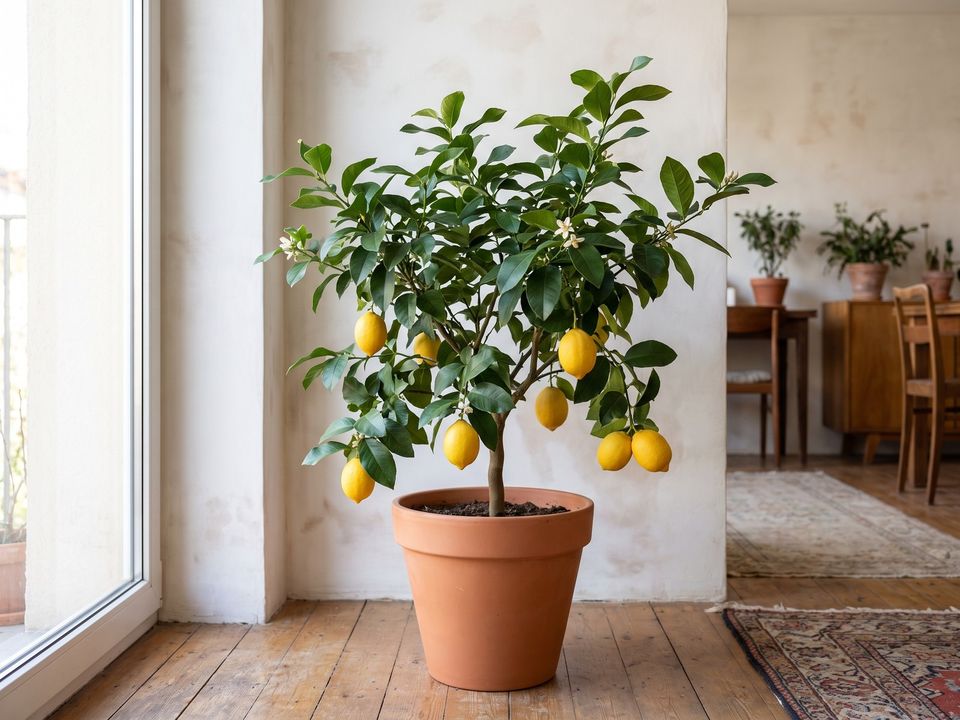
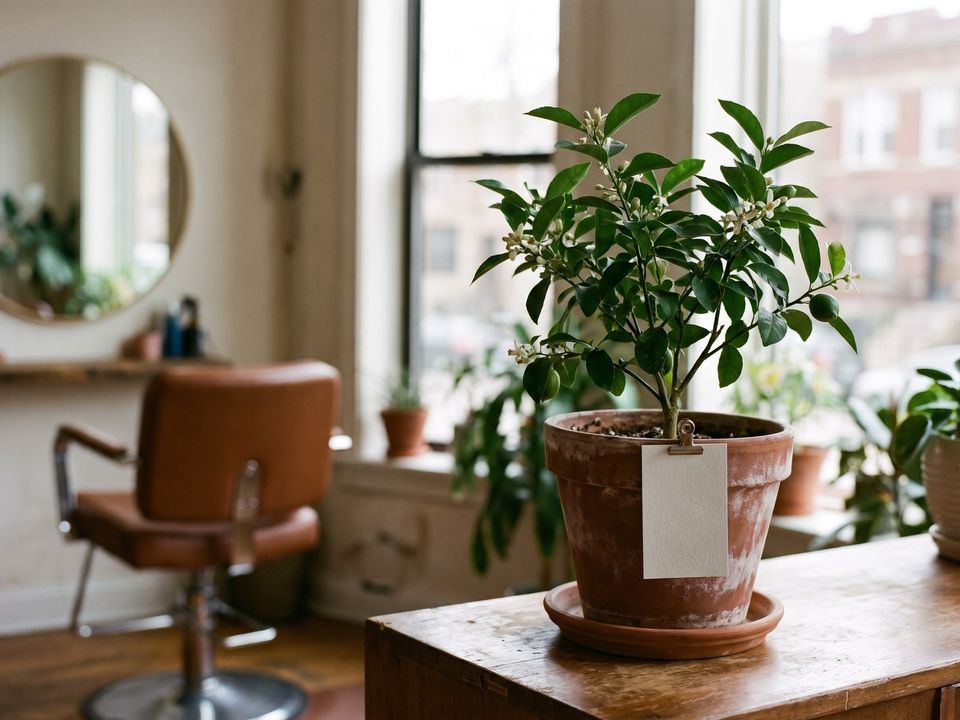
Meyer Lemon
Citrus × limon 'Meyer'
Also called Meyer lemon tree
Sweet-scented blooms and real lemons on a glossy little tree. Your sunniest window earns the fruit, with some patience.
1.0/5
how easy it is to care for
3.6/5
how much it stands out visually
: Shade to full sun
The sunniest sill you have; less sun, fewer lemons
Full sun in a south window is where it flowers and fruits best. With bright light and some shade it gets by as a leafy little tree, though it may set fewer lemons.
Six hours of sun is a tall order for a lemon kept indoors, so measure its pane by the clock as well as the compass: a building across the street or a deep overhang can steal half the day. When it grows outside, UC Master Gardeners ask for six or more hours of direct sun.
It can’t survive frost (NC State), which is why it lives in a pot: a balcony or patio for the summer, then back indoors before the first cold night. Out there, swallowtail caterpillars may chew its young leaves (NC State).
Winter brings the year’s leanest light, and that’s also when most of its lemons ripen (NC State). Hold the brightest pane in the house for it until spring.
: Weekly+
Every 5-7 days in summer, a little longer in winter
A good soak every 5-7 days in summer and 7-10 in winter, with the top of the soil drying between. Soggy soil can lead to root rot; a pot left dry too long may yellow its leaves.
On a lemon, yellowing leaves point to thirst or a missed feeding (UC Master Gardeners). If the watering seems steady, citrus fertilizer is the other lever: NC State feeds it only while it’s growing, spring to fall, and every three months indoors if you’re hoping for fruit. Skip it and you still have a handsome evergreen.
Citrus roots stay shallow, mostly within 1-2 feet of the surface even in open ground, and they fare poorly in heavy clay that holds water (UC Master Gardeners). A loose, gritty mix sold for citrus keeps those shallow roots in air as well as water.
Gone for a while? Ten days is fine if it’s soaked the day you leave; much longer, and it may drop leaves.
: Large
A spreading little tree, kept 3-6 feet in a pot
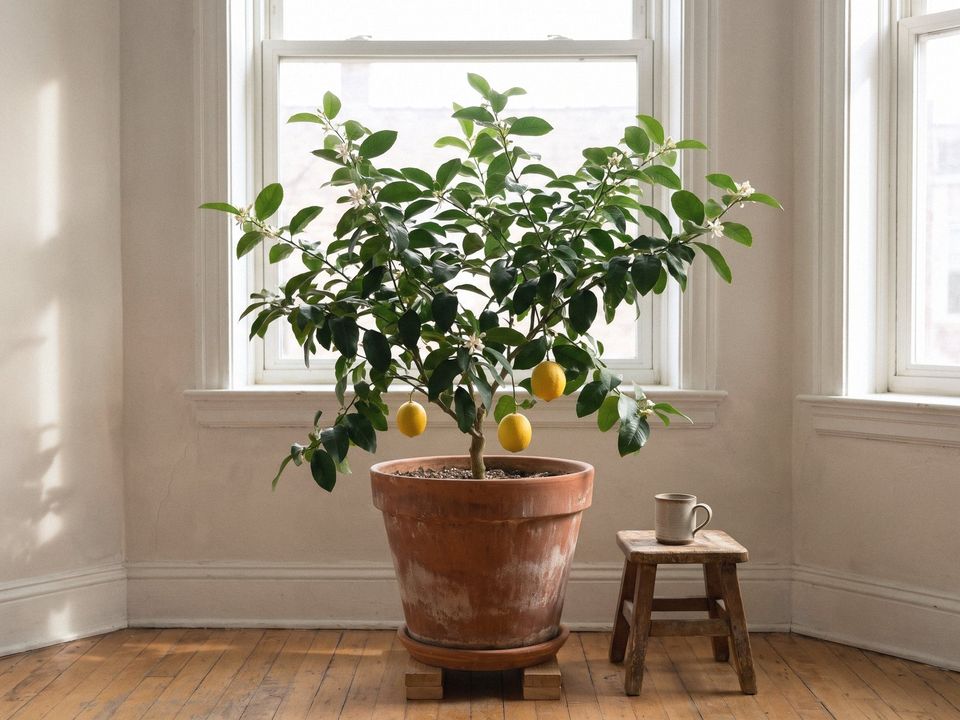
A spreading tree 3-6 feet tall in a pot, best on the floor by your brightest window. Prune to keep it compact and airy; a wide pot on casters makes its summer trips outside easier.
Planted in the ground where winters stay mild, it reaches 6-10 feet (Missouri Botanical Garden), so the pot is what keeps it to room size.
Expect a few thorns on both young and old growth (NC State), so a spot a step back from the sofa or a busy path saves sleeves and fingers. It also flowers on and off through the year (UC Master Gardeners, Sonoma County), so blossoms and fruit can share a branch.
When a cluster of little lemons sets, NC State suggests thinning it to one or two; the ones left grow larger and healthier.
: Mildly irritating
Chewing can upset the stomachs of dogs, cats, or kids
- DogsMildly irritating
- CatsMildly irritating
- KidsMildly irritating
The lemons are edible; the leaves, peel, and oils are the concern. The ASPCA lists lemon as toxic to dogs and cats, which may vomit, have diarrhea, or seem listless; kids may get an upset stomach or irritated skin.
The lemons are fine to eat; it’s the leaves and peel that can upset a stomach or irritate skin, more so in sun.
Behind the trouble are essential oils and psoralens (ASPCA); NC State adds citral, geraniol, and d-limonene to the list and rates the risk to people as low. Psoralens come with a twist: they need ultraviolet light to do their damage, so sap or zest left on skin can turn into a rash once the sun hits it (Poison Control). Wash up after pruning or zesting, before you head outside.
Cats get a little extra care with essential oils. Their livers lack an enzyme for breaking them down, citrus oil among them, and grooming adds whatever lands on their fur (Pet Poison Helpline). A nibble of leaf or peel usually means an upset stomach that passes at home. If symptoms don’t settle, or anything worries you, your vet or the ASPCA Animal Poison Control Center (a fee may apply) can help; for a child, Poison Control can help.
With pets or toddlers around, a lemon tree can still share the room. Pick the lemons as they ripen and sweep up fallen leaves, the easiest pieces for a curious mouth to find.
- ASPCA: mild for dogs.
- ASPCA: mild for cats.
- NC State Extension: mild for kids.
Cats and dogs: Most of the leading sources agree.
Kids: No poison-centre listing; rated from university extension sources.
: Average
55-85°F; average humidity is fine
Keep it at 55-85°F. Keep it away from cold glass in winter. It likes 40-60% humidity and gets by at 30%.
- Temperature
- 55-85°F
- Humidity
- 40-60%
: Brown soft scale
Scale and spider mites are common; check leaf undersides
Brown soft scale lives on stems, branches, and leaves, and spider mites sit under the leaves. Aphids favor new shoot tips, mealybugs hide in leaf axils and stem joints, and whiteflies hide under leaves.
- Brown soft scale
- Two-spotted spider mite
- Aphids
- Mealybugs
- Whiteflies
Pests are its weak spot. Spider mites, scale, whiteflies, and mealybugs all go for citrus indoors (Iowa State, NC State), so check under the leaves whenever you water.
Spider mites leave pale speckles and fine webbing, worst in dry winter air. Rinse the plant hard in the shower, undersides included, and repeat; Iowa State suggests washing the leaves now and then to keep pests off in the first place.
Scale looks like small brown bumps on the stems and leaves, often with sticky spots below; mealybugs look like tufts of white cotton. Scrape or swab them off with rubbing alcohol, then check again next week.
Whiteflies are tiny white moths that fly up when you brush the leaves. Wash the plant, then spray insecticidal soap on the undersides of the leaves (Clemson).
: Some
Feed Apr-Sep, wash leaves, prune; repot every 1-3 years
Feed half-dose citrus fertilizer every 4-6 weeks, April to September, and wash the leaves 4 times a year. Prune leggy branches twice, brush pollen between open flowers, and repot in spring every 1-3 years.
- Feed6× a year
- Prune2× a year
- Repot1× a year
- Clean leaves4× a year
- Hand-pollinate2× a year
A pot with drainage holes, about 15 inches wide and deep for a young tree (UF/IFAS), and a slightly acidic potting mix that drains fast.
Repot when the roots fill the pot, in spring, one pot size up.
Feed it a citrus fertilizer through the growing season: a slow-release kind applied in April or May carries it through the summer (Iowa State). Ease off in winter (NC State).
: Suave
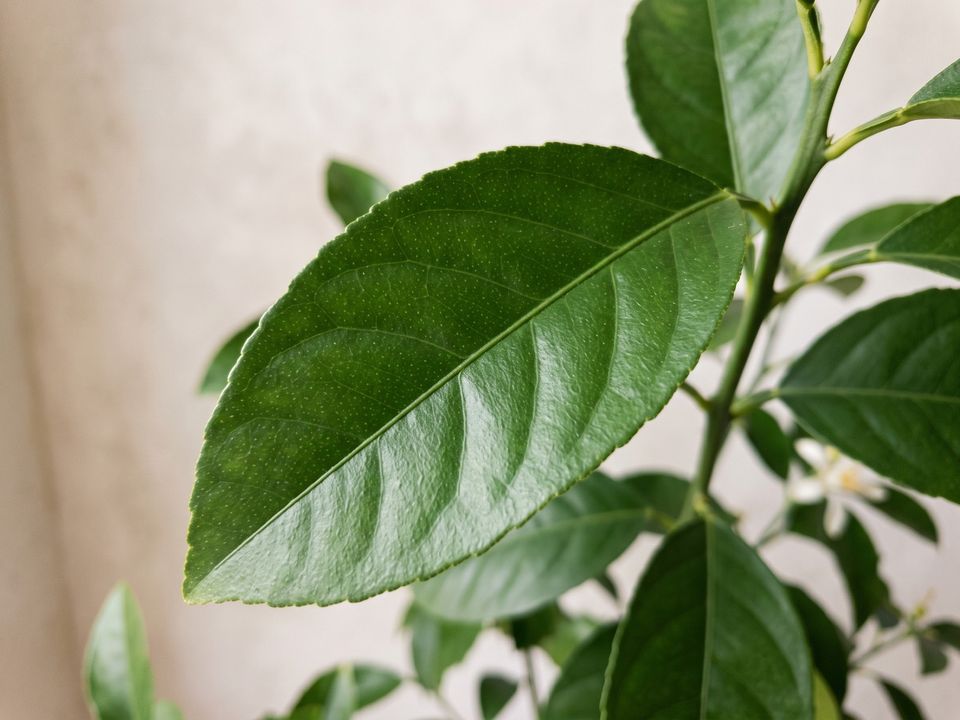
Glossy, waxy green leaves; soil partly hidden
Each leaf is a deep green oval with a waxy gloss, as if polished. Branches carry enough foliage to cover part of the soil, though the trunk and a bit of the pot still show.
Where to find me
Not yet pilferableFun fact
It was once citrus’s Typhoid Mary: the original carried the tristeza virus to other citrus. Most sold today are the Improved Meyer, a virus-free selection from the mid-1960s.
Designer tips
A kitchen-garden classic: glossy leaves, perfumed flowers and, with luck, a few lemons, in a big pot by a sunny window.
Troubleshooting
Why is it dropping leaves?
Usually cold or thirst: it sheds below 50°F or after a dry spell (Iowa State Extension), and a move indoors or out can do it too. Off cold glass and drafts, with a soak every 5-7 days in summer and 7-10 in winter, it usually regrows.
The leaves are turning yellow
On a lemon, that usually points to thirst or a missed feeding (UC Master Gardeners). Citrus fertilizer every 4-6 weeks from April to September is the lever if watering’s been steady; skip it and it’s still a handsome evergreen.
Why won’t it make lemons?
Usually not enough sun, or no pollinator. It needs 6+ hours of direct sun to flower, and indoors, with no bees, a small paintbrush dabbed from flower to flower moves the pollen. Even then, UF/IFAS says indoor fruit is unlikely, so a summer outside helps most.
See all 8
The leaves are sticky
Likely sap-sucking pests: brown soft scale, whiteflies, or mealybugs. Look under the leaves and along the stems; a swab dipped in rubbing alcohol lifts scale and mealybugs, and a wash, then insecticidal soap, helps with whiteflies.
Can it go outside for the summer?
Yes, and it’s the best thing for it. Move it out once nights stay above 55°F and ease it into full sun over a week or two; bring it back in before fall nights dip below 55°F.
It dropped its tiny lemons
Common on potted trees, which often shed extra fruit (UW-Madison Extension). Thinning a cluster to one or two, as NC State suggests, lets the rest grow larger.
How long do the lemons take to ripen?
Six to nine months (NC State, Iowa State). They turn from green to yellow-orange and are sweeter than common lemons once fully ripe.
My dog chewed a leaf
It’s mildly irritating: the ASPCA notes vomiting, diarrhea, or listlessness from the leaves and peel, though the fruit’s flesh is edible. If your dog chewed a lot or seems unwell, call your vet or the ASPCA Animal Poison Control Center.
Propagation
Not a practical home project.
NC State lists stem cuttings as the way it’s propagated; at home, buying a second tree is the simple route.
The PILF Matrix
1.0/5
how easy it is to care for
3.6/5
how much it stands out visually
“The one that hands you the lemons and the lemonade.”


Rated 1-5, with 5 being easiest
Built from light, water, air, pests, and upkeep.
Rated 1-5, with 5 being easiest
Rated 1-5, with 5 being highest presence
Built from its scale (size, shape, growth) and its look (color and flowers, shine, fullness).
Rated 1-5, with 5 being highest presence
Where it sits and what sun touches it.
- Dim shadeA dark corner or a windowless room; natural light casts no shadow
- Bright shadeBack from the window in a south-, east- or west-facing room, or right by a north-facing one, where only low early or late summer sun reaches it
- Filtered sunBehind a sheer curtain or tinted glass; the sun’s shadows are blurred
- Partial sunIn an east- or west-facing window: up to a few hours of direct sun
- Full sunThe sunniest spot you have, usually a south-facing window, with direct sun 6+ hours a day
How often, and what the soil does between.
- MonthlyEvery 2-3 weeks in summer and 3-5 in winter; the soil dries all the way between
- 2-3× a monthEvery 7-14 days in summer, longer in winter; the top of the soil dries between
- Weekly+About every 4-8 days in summer; the soil stays lightly damp
How much room it usually takes indoors.
Size
- TinyUnder 6 inches tall or wide; for a desk or a sill
- Small6 inches to 1.5 feet tall or wide; for a shelf or a sill
- Medium1.5 to 3 feet tall or wide; for a table or a stand
- Large3 to 6 feet tall or wide; for the floor
- GiantOver 6 feet tall or wide; a statement in the corner
Shape
- TreeA trunk that branches into a canopy
- CaneBare stalks topped with leaves
- UprightStiff stems or leaves rising straight from the soil
- FountainLeaves or fronds arching out from the center
- BushyA full, rounded mound of leaves
- RosetteLeaves radiating from one low point
- ViningTrails, climbs, or both
Growth
How fast it gets there.
- SlowUnder 6 inches of new growth a year
- Moderate6-12 inches a year, mostly in spring and summer
- FastOver 12 inches a year; it may want trimming or training
What risks exist for pets and kids.
- Pet & kid safeNothing to worry about
- Mildly irritatingMay irritate the mouth or stomach if chewed, or for some plants, the skin if handled
- Moderately toxicCan cause illness if eaten, though typically not serious or fatal
- DangerousCan cause serious illness if eaten, including some reports of death
- Not yet ratedNot clearly rated by our sources; please check with your vet or doctor
For its safety ratings, PILF relies on research and guidance from leading sources, including the ASPCA, Pet Poison Helpline, Merck Veterinary Manual, Poison Control, and Children’s Hospital of Philadelphia, and others.
The small jobs beyond watering, over a year.
- Little upkeepA few small jobs a year beyond watering, like a feed now and then
- Some upkeepA small job about once a month beyond watering, like feeding or turning it
- More upkeepA small job every couple of weeks beyond watering, like a wipe, a turn, or a feed
- Most upkeepA small job most weeks beyond watering, like raising the humidity or misting
- TreeA trunk that branches into a canopy
- CaneBare stalks topped with leaves
- UprightStiff stems or leaves rising straight from the soil
- FountainLeaves or fronds arching out from the center
- BushyA full, rounded mound of leaves
- RosetteLeaves radiating from one low point
- ViningTrails, climbs, or both
How fast it gets there.
- SlowUnder 6 inches of new growth a year
- Moderate6-12 inches a year, mostly in spring and summer
- FastOver 12 inches a year; it may want trimming or training
The temperature and humidity it’s comfortable in.
How dry a room it takes.
- Needs 50%+ humidity
- Fine at 35% humidity
- Fine at 15-20% humidity
The bugs that usually find it, by name.
How often pests find it.
- 5+ regular pests
- 3 regular pests
- Pests are rare
The year’s chores: feeding, pruning, repotting, and cleaning.
Chores beyond water (what needs work means).
- Most upkeep
- Some upkeep
- Little upkeep
Its finish, fullness, and texture.
Color, pattern, and flowers.
- SimpleOne green, one texture, nothing to read
- SuaveA sheen, a stripe, or a clean shape that catches the eye up close
- ShowyColor, pattern, or blooms you see from across the room
How the leaves catch light.
- Matte
- Satin
- Glossy or waxy
How much it fills its pot.
- Soil shows
- Soil partly hidden
- Leaves hide the soil