Marble Queen Pothos
Epipremnum aureum 'Marble Queen'
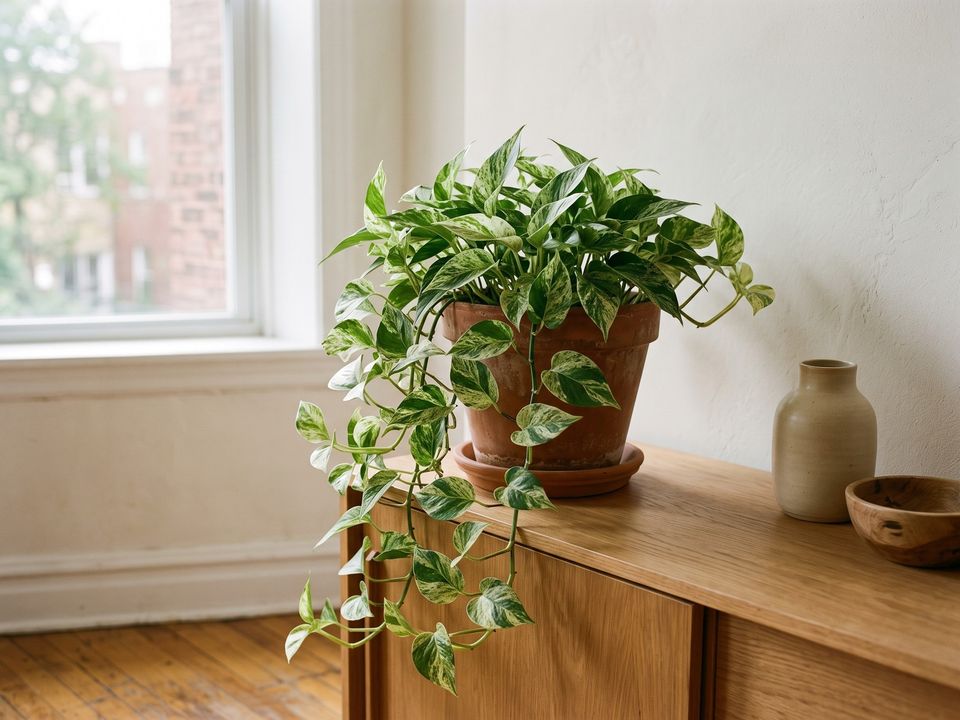
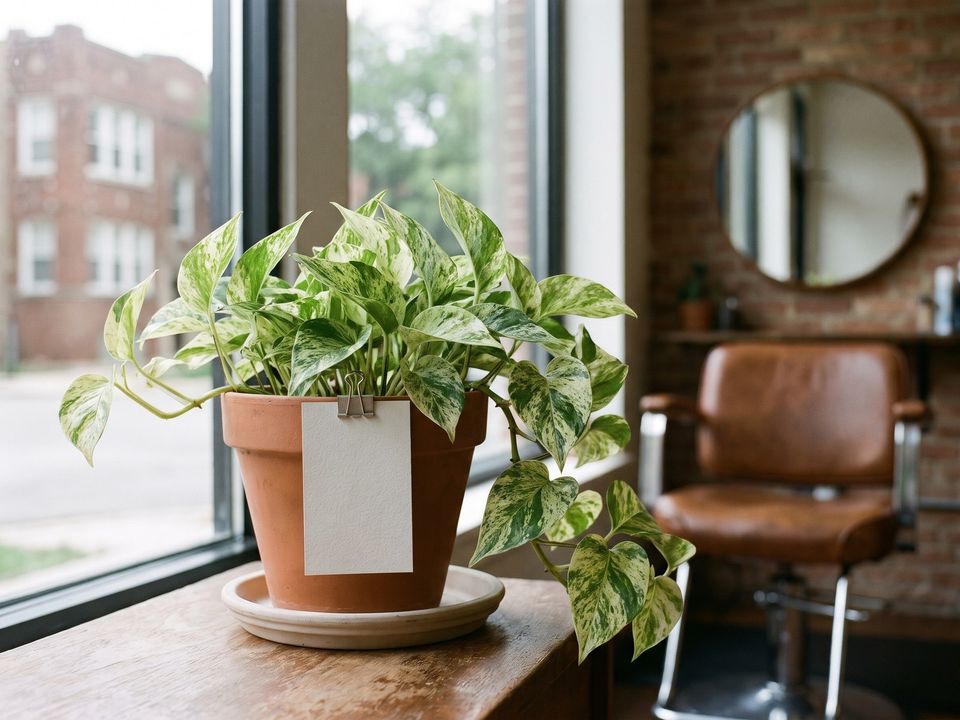
Leaves marbled white over green, trailing slowly over the pot’s edge. Easy to keep, and happiest when the light stays bright.
Also called variegated pothos
3.5/5
how easy it is to care for
4.3/5
how much it stands out visually
: Dim to bright
Bright keeps its marble; dim fades it toward green
Near a bright window but out of direct sun, it holds its white. Every bright week means more marbling; a dim year can turn its new leaves mostly green.
Of all the pothos, this one asks for the most light (Clemson Extension), and the reason sits in its leaves. The white patches make no chlorophyll, so the green parts feed the whole plant (UF/IFAS); with less green to work with, it leans harder on the window.
It does best right by a window but out of the sun, close enough to take in plenty of sky (Clemson Extension). Summer sun through a south or west window can scorch the foliage (RHS), so set it beside the sunbeam rather than in it.
Come winter, keep its leaves off cold glass. In University of Florida trials, Marble Queen proved more sensitive to a 50°F chill than its greener relatives.
Pothos need higher light to develop good leaf markings (Illinois Extension), so its brightest spot short of sun is the one it wants.
: 2-3× a month
A drink every 7-10 days; a little longer in winter
Kept wet, its leaf edges can blacken and its roots rot. Let the upper soil dry between drinks, every 7-10 days in summer and 10-14 in winter.
Dry indoor air is the one extra NC State suggests helping with: a humidifier or a pebble tray raises the moisture around its leaves. It’ll grow without either.
A slow grower uses less food than its faster cousins, so go light. NC State suggests feeding every other month through spring and summer and none in winter, when it rests.
Dust shows first on the pale patches. A soft, damp cloth now and then wipes it away (NC State).
Gone for a while? Two weeks is fine if it’s watered the day you leave. Pull it back from a bright window and it lasts a little longer.
: Medium
Slow vines that trail 4-6 feet, or trim to fit a shelf
Slower than most pothos, so its marbled vines stay tidy for years on their way to 4-6 feet. Trim the tips to keep it full, or let one vine wander along a bookcase.
Its leaves stay modest, about 4.5 by 3 inches (UF/IFAS), smaller than most varieties carry (University of Wisconsin Extension).
Pruning long stems back keeps it bushy instead of a few long strings with leaves at the tips (NC State).
Watch for a vine that comes in solid green. Green growth can outpace the marbled kind and slowly take over (UF/IFAS), so prune it out.
Its pale leaves read best against a dark wall or a deep wood shelf, where the marbling shows from across the room.
: Mildly irritating
Chewing can sting the mouths of dogs, cats or kids
A chewed leaf may cause mouth pain, drooling and vomiting in a dog, cat or child. The ASPCA lists Marble Queen as toxic to dogs and cats for its calcium oxalate crystals; severe cases are rare.
Under its old name, Scindapsus aureus, the ASPCA files it with Golden Pothos listed as another name for the same plant. Biting releases microscopic crystals that lodge in the lips, mouth and throat, and gagging can follow; in rare cases the throat swells enough to make breathing hard (Pet Poison Helpline). Every part carries the crystals, roots and stems included, and the sap can irritate skin (NC State).
Usually the soreness passes at home. For a child, rinse the mouth; if symptoms don’t settle, Poison Control is at 1‑800‑222‑1222. For a pet, if anything worries you, call your vet or the ASPCA Animal Poison Control Center at (888) 426‑4435 (a fee may apply).
A plant that’s irritating to chew is no reason to skip owning one (UF/IFAS). Hang the vines from a ceiling hook or a high shelf, clear of a teething puppy or a toddler’s reach. A hanging pot still drops the odd old leaf, so pick up fallen ones before a pet finds them, and wear gloves to trim it if your skin reacts.
- ASPCA: mild for dogs.
- Merck Veterinary Manual: mild for dogs (rates the whole genus).
- Pet Poison Helpline: mild for dogs.
- ASPCA: mild for cats.
- Merck Veterinary Manual: mild for cats (rates the whole genus).
- Pet Poison Helpline: mild for cats.
- Poison Control: mild for kids.
Cats and dogs: Most of the leading sources agree.
Kids: Poison Control lists it; the effect is mouth pain from oxalate crystals.
: Average
70-80°F; average humidity is fine
Happiest at 70-80°F, and it shouldn’t sit below 65°F. Keep it away from cold glass in winter. It likes 50-70% humidity and gets by at 30%.
- Temperature
- 70-80°F
- Humidity
- 50-70%
: Mealybugs
Mealybugs and scale are the ones to watch for
Mealybugs hide in leaf axils, under leaves and in the roots. Scale looks like bark-colored bumps on stems and leaves. Spider mites and thrips can visit too. Peek into the axils when you water.
- Mealybugs
- Scale
- Spider mites
- Banded greenhouse thrips
Few, indoors. Mealybugs and scale now and then, and root rot if the soil stays wet.
Mealybugs are fluffy white specks tucked where the leaves meet the vine; scale is small brown bumps stuck to the stems. Dab them off with a cotton swab dipped in rubbing alcohol (scale lifts off with a fingernail), and look again next week.
Spider mites leave fine webbing and pale speckles, mostly in warm, dry air, and thrips leave the leaves silvery and flecked. Rinse the plant in the shower, undersides of the leaves included; an insecticidal soap spray is the next step if they return.
Root rot, pothos’s most common disease according to UF/IFAS, turns leaves dark brown to black while the soil stays wet. Let it dry out, empty the saucer and water less often, and root a few healthy tips in water as a backup.
: Most
Turn weekly, feed 3× in summer, wipe leaves twice a year
Turn the pot weekly so the vines grow evenly. Feed every other month in spring and summer, none in winter. Wipe dust off twice a year; each spring, tip prune, and repot every year or two once roots show.
- Feed3× a year
- Prune1× a year
- Clean leaves2× a year
- Repot1× a year
- Rotate52× a year
Any potting mix that drains fast, in a pot with a drainage hole. It isn’t fussy about soil, only about roots sitting wet.
Repot every year or two, in spring, one pot size up, once roots poke out of the drainage hole or circle the pot.
Food is optional: a houseplant fertilizer every other month in spring and summer, and none in winter, is plenty. It won’t make up for too little light.
: Suave
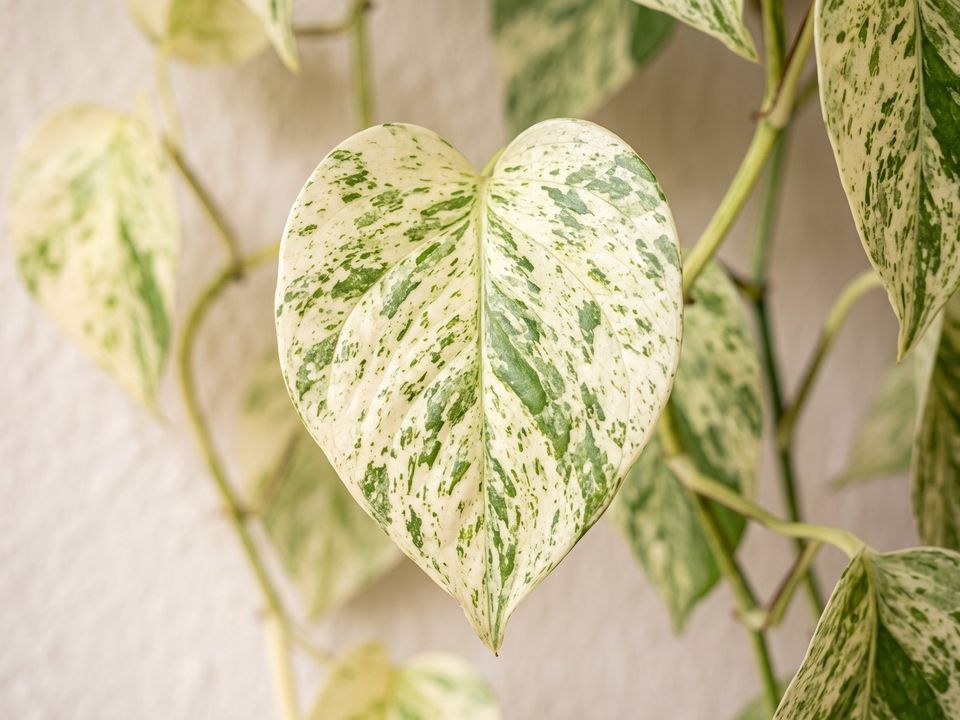
Green leaves marbled in white, with a gentle gloss
Each heart-shaped leaf is swirled white over green, so no two are marked alike. The surface is lightly glossy, and the trailing vines grow full enough to cover the soil.
Where to find me
Not yet pilferableFun fact
Cuttings from one batch look identical, but about two months in, some turn very white and some stay greener. Florida researchers advised growers to drop the too-white ones, since they grow more slowly.
Designer tips
The pothos for a pale, bright room: the cream marbling reads from across it.
Troubleshooting
The new leaves are coming in all green
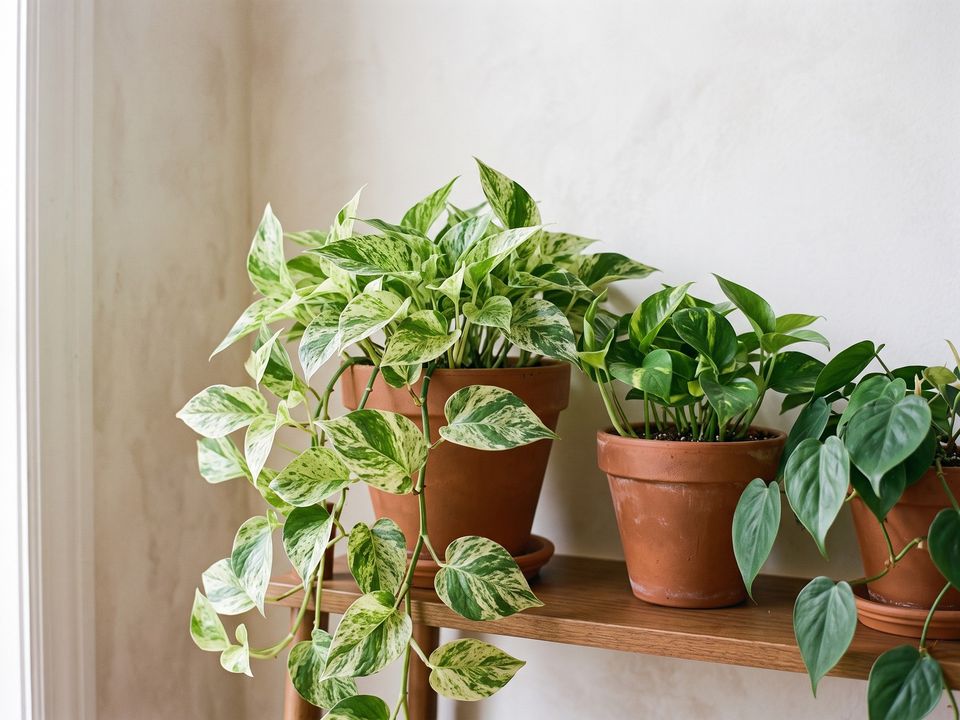
Likely too little light: the marbling needs more of it than a plain pothos. Within a few feet of a window, the next leaves usually come in whiter; a vine gone solid green can be cut off where it starts, since green growth can slowly take over.
Why are some leaves turning yellow?
One old leaf now and then is normal. Several at once usually means too much water, so give it longer between drinks and empty the saucer; if the soil’s been fine and it keeps happening, it may be hungry.
The vines are drooping
Probably thirst, and a good soak usually perks it back up soon after. If the soil is wet and it still droops, the roots may be rotting: let it dry out, empty the saucer, and root a few healthy tips in water as a backup.
See all 8
Why is it slower than my golden pothos?
The white parts of its leaves make no food, so it has less to grow on; UF/IFAS found the whiter the plant, the slower it grows. More light helps, while extra water and fertilizer don’t.
Brown, crispy patches on the whitest leaves
Sun through glass, or a chill like a frosty window or a winter car ride home; the whitest leaves take cold hardest (UF/IFAS). Move it out of the sun’s reach and off cold glass, and trim the worst leaves if you like; new ones come in clean.
Can it live in a room with no window?
Not happily. Under overhead lights alone it stalls, and new leaves come in small and green; it leans on a window more than a golden pothos does.
My cat chewed a leaf
The crystals in its leaves sting, so expect drooling and a sore mouth, maybe some vomiting: it’s mildly irritating (ASPCA), and severe cases are rare. If vomiting keeps up, or swallowing or breathing looks hard, call your vet or the ASPCA Animal Poison Control Center at (888) 426-4435.
Can it go outside for the summer?
Yes, in shade where sun can’t reach the leaves, like a porch or balcony. Bring it in before nights dip below 65°F, and check it for bugs on the way.
Propagation
Easy: a piece of vine roots in a glass of water.
- Cut just below a node (the bump where a leaf meets the vine), strip the bottom leaf and stand the cutting in water with the node under.
- Roots show in 3-4 weeks; pot several cuttings together for a fuller plant.
- Pick vines with a fair share of green in their leaves, since the whitest ones grow slowest.
The PILF Matrix
3.5/5
how easy it is to care for
4.3/5
how much it stands out visually
Forever
The ones you’ll grow old with.
“The one who walks every shelf like it’s the runway.”


How easy it is to care for. Built from light, water, air, pests and upkeep.
Rated 1-5, with 5 being easiest.
How much it stands out visually. Built from its scale (size, shape, growth) and its look (color and flowers, shine, fullness).
Rated 1-5, with 5 being highest presence.
Where it sits and what sun touches it.
- Dim shadeA dark corner or a windowless room; natural light casts no shadow
- Bright shadeBack from the window in a south-, east- or west-facing room, or right by a north-facing one, where only low early or late summer sun reaches it
- Filtered sunBehind a sheer curtain or tinted glass; the sun’s shadows are blurred
- Partial sunIn an east- or west-facing window: up to a few hours of direct sun
- Full sunThe sunniest spot you have, usually a south-facing window, with direct sun 6+ hours a day
How often, and what the soil does between.
- MonthlyEvery 2-3 weeks in summer and 3-5 in winter; the soil dries all the way between
- 2-3× a monthEvery 7-14 days in summer, longer in winter; the top of the soil dries between
- Weekly+About every 4-8 days in summer; the soil stays lightly damp
How much room it usually takes indoors.
Size
- TinyUnder 6 inches tall or wide; for a desk or a sill
- Small6 inches to 1.5 feet tall or wide; for a shelf or a sill
- Medium1.5 to 3 feet tall or wide; for a table or a stand
- Large3 to 6 feet tall or wide; for the floor
- GiantOver 6 feet tall or wide; a statement in the corner
Shape
- TreeA trunk that branches into a canopy
- CaneBare stalks topped with leaves
- UprightStiff stems or leaves rising straight from the soil
- FountainLeaves or fronds arching out from the center
- BushyA full, rounded mound of leaves
- RosetteLeaves radiating from one low point
- ViningTrails, climbs, or both
Growth
How fast it gets there.
- SlowUnder 6 inches of new growth a year
- Moderate6-12 inches a year, mostly in spring and summer
- FastOver 12 inches a year; it may want trimming or training
What happens and how bad (the worst of dogs, cats and kids).
- Pet & kid safeNothing to worry about
- Mildly irritatingMay irritate the mouth or stomach if chewed, or for some plants, the skin if handled
- Moderately toxicCan cause illness if eaten, though typically not serious or fatal
- Highly toxicCan cause serious illness if eaten, including some reports of death
- Not yet ratedNot clearly rated by our sources; please check with your vet or doctor
For its safety ratings, PILF relies on research and guidance from leading sources, including the ASPCA, Pet Poison Helpline, Merck Veterinary Manual, Poison Control and Children’s Hospital of Philadelphia, and others.
The small jobs beyond watering, over a year.
- Little upkeepA few small jobs a year beyond watering, like a feed now and then
- Some upkeepA small job about once a month beyond watering, like feeding or turning it
- More upkeepA small job every couple of weeks beyond watering, like a wipe, a turn or a feed
- Most upkeepA small job most weeks beyond watering, like raising the humidity or misting
- TreeA trunk that branches into a canopy
- CaneBare stalks topped with leaves
- UprightStiff stems or leaves rising straight from the soil
- FountainLeaves or fronds arching out from the center
- BushyA full, rounded mound of leaves
- RosetteLeaves radiating from one low point
- ViningTrails, climbs, or both
How fast it gets there.
- SlowUnder 6 inches of new growth a year
- Moderate6-12 inches a year, mostly in spring and summer
- FastOver 12 inches a year; it may want trimming or training
The temperature and humidity it’s comfortable in.
How dry a room it takes.
- Needs 50%+ humidity
- Fine at 35%
- Fine at 15-20%
The bugs that usually find it, by name.
How often pests find it.
- 5+ regular pests
- 3 regular pests
- Pests are rare
The year’s chores: feeding, pruning, repotting and cleaning.
Chores beyond water (what needs work means).
- Most upkeep
- Some upkeep
- Little upkeep
Its finish, fullness and texture.
Color, pattern and flowers.
- SimpleOne green, one texture, nothing to read
- SuaveA sheen, a stripe or a clean shape that catches the eye up close
- ShowyColor, pattern or blooms you see from across the room
How the leaves catch light.
- Matte
- Satin
- Glossy or waxy
How much it fills its pot.
- Soil shows
- Soil partly hidden
- Leaves hide the soil